1 3 5 Triazine Market Size, Share Demand Report By Type (Cyanuric Chloride, Melamine-Based Triazines, Others), By Application (Agrochemicals, Water Treatment Chemicals, Resins & Coatings, Others), By End-Use Industry (Agriculture, Construction, Chemical Manufacturing, Others), By Form (Liquid, Solid) By Region & Segment Forecasts, 2026–2034
USD 3950
Market Overview
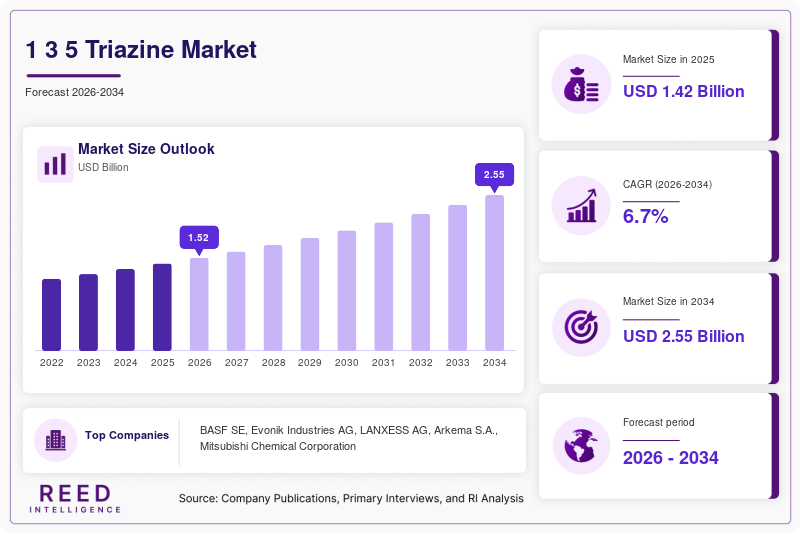
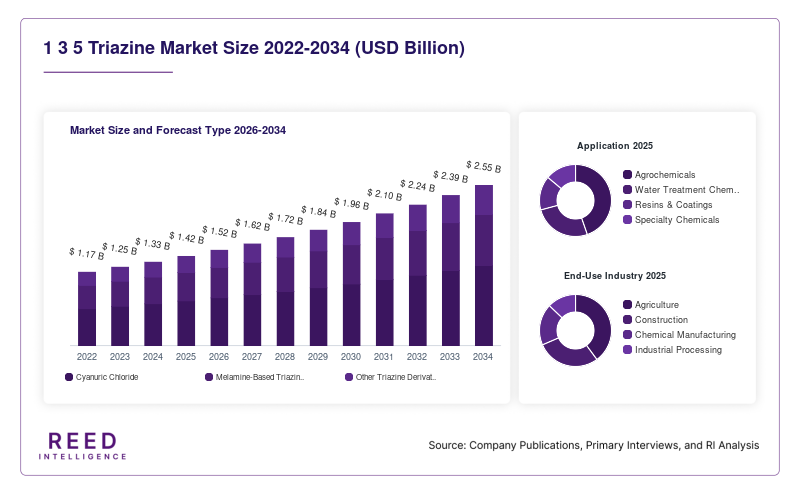
The global 1 3 5 Triazine Market was valued at approximately USD 1.42 billion in 2026 and is projected to reach USD 2.38 billion by 2034, expanding at a CAGR of 6.7% from 2026 to 2034. The market growth is supported by increasing utilization of triazine derivatives across agrochemicals, water treatment chemicals, resins, and coatings due to their chemical stability and reactivity.
A key global factor driving the expansion of the 1 3 5 Triazine Market is the rising demand for high-performance agrochemicals to enhance agricultural productivity. Triazine-based compounds are widely used as herbicides and intermediates, contributing to efficient crop yield management amid increasing global food demand.
Key Highlights:
- Asia Pacific dominated the market with a 41.2% share, while it is expected to register the fastest CAGR of 7.4% during the forecast period.
- By type, cyanuric chloride was the leading subsegment with a 38.5% share, while melamine-based triazines are projected to grow at a CAGR of 7.6%.
- By application, agrochemicals dominated with a 45.8% share, whereas water treatment chemicals are anticipated to grow at a CAGR of 7.8%.
- China remained the dominant country, with market values of USD 312 million in 2024 and USD 335 million in 2025.
Market Trends
Increasing Adoption in Water Treatment Applications
The growing emphasis on water quality and sanitation has significantly influenced the 1 3 5 Triazine Market trends. Triazine derivatives, particularly those used in biocides and disinfectants, are gaining traction in municipal and industrial water treatment systems. Their effectiveness in controlling microbial growth and enhancing water purity makes them suitable for large-scale operations. This trend is further supported by stringent environmental regulations and increased investment in water infrastructure projects globally.
Expansion of Specialty Chemical Applications
Another notable trend shaping the market is the increasing integration of triazine compounds in specialty chemicals, including advanced coatings, adhesives, and polymer additives. These compounds provide enhanced thermal stability, UV resistance, and chemical durability. Manufacturers are focusing on developing high-purity and customized triazine derivatives to meet the specific needs of industries such as automotive, construction, and electronics. This shift toward high-value applications is contributing to the steady evolution of the 1 3 5 Triazine Market outlook.
Market Drivers
Rising Demand for Agrochemicals
The growing global population and shrinking arable land have intensified the need for efficient crop protection solutions. Triazine-based herbicides and intermediates play a crucial role in improving agricultural productivity. Their ability to control weeds effectively and enhance crop yield has made them indispensable in modern farming practices. This sustained demand from the agriculture sector continues to drive the growth of the 1 3 5 Triazine Market.
Growth in Polymer and Resin Industries
The increasing demand for high-performance polymers and resins across industries such as construction, automotive, and packaging has positively impacted the market. Triazine compounds are widely used as crosslinking agents and stabilizers, enhancing the durability and performance of materials. The rapid industrialization and infrastructure development in emerging economies further support this demand, contributing to market expansion.
Market Restraint
Environmental and Regulatory Concerns
Despite its widespread applications, the 1 3 5 Triazine Market faces challenges due to environmental and regulatory concerns. Certain triazine derivatives, particularly in agrochemical applications, have been associated with environmental persistence and potential ecological impact. Regulatory authorities in various regions have imposed restrictions on the use of specific compounds, leading to increased compliance costs for manufacturers.
Additionally, the need for environmentally friendly alternatives and sustainable chemical formulations is gaining prominence. Companies are required to invest in research and development to develop safer and biodegradable substitutes, which can impact profit margins. These regulatory pressures may limit the growth potential of certain segments within the market.
Market Opportunities
Development of Eco-Friendly Triazine Derivatives
The increasing focus on sustainability presents a significant opportunity for market players to innovate and develop eco-friendly triazine derivatives. Biodegradable and low-toxicity formulations are gaining attention, particularly in agriculture and water treatment applications. Companies investing in green chemistry solutions are likely to gain a competitive edge and expand their market presence.
Emerging Markets and Industrial Expansion
Rapid industrialization in emerging economies offers substantial growth opportunities for the 1 3 5 Triazine Market. Countries in Asia Pacific, Latin America, and the Middle East are witnessing increased demand for chemicals used in construction, agriculture, and manufacturing. The expansion of chemical production facilities and supportive government policies further enhance market prospects in these regions.
Segmental Analysis
By Type
Cyanuric chloride emerged as the dominant subsegment, accounting for 38.5% of the market share in 2025. Its widespread use as an intermediate in the production of agrochemicals, dyes, and resins contributed to its leading position. The compound’s high reactivity and versatility made it a preferred choice across multiple industrial applications.
Melamine-based triazines are expected to be the fastest-growing subsegment, with a projected CAGR of 7.6%. The increasing demand for flame retardants and laminates in construction and automotive industries will drive growth. These compounds offer enhanced durability and thermal stability, making them suitable for high-performance applications.
By Application
Agrochemicals dominated the application segment, holding 45.8% of the market share in 2025. The extensive use of triazine derivatives in herbicides and crop protection products supported this dominance. Their effectiveness in improving crop yield and controlling weeds made them essential in agricultural practices.
Water treatment chemicals are anticipated to grow at the fastest CAGR of 7.8%. Increasing concerns regarding water quality and the need for efficient disinfection solutions will drive demand. Triazine-based biocides are expected to play a crucial role in this segment.
By End-Use Industry
The agriculture sector held the largest share of 42.3% in 2025, driven by the high demand for crop protection chemicals. The use of triazine derivatives in herbicides and pesticides contributed significantly to this segment.
The construction industry is expected to register the fastest CAGR of 7.2%. The increasing use of triazine-based resins and coatings in building materials will support growth. These compounds enhance durability and resistance to environmental factors.
By Form
Liquid triazine formulations dominated the segment with a 54.6% share in 2025, owing to their ease of application and compatibility with various industrial processes. They are widely used in water treatment and agrochemical formulations.
Solid triazine compounds are projected to grow at a CAGR of 6.9%, driven by their stability and suitability for storage and transportation. Their increasing use in specialty chemical applications will support growth.
Regional Analysis
North America
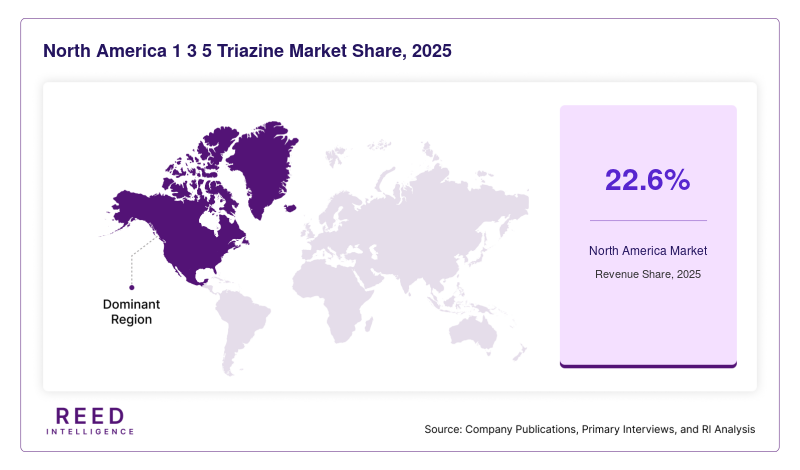
North America accounted for approximately 22.6% of the global market share in 2025 and is expected to grow at a CAGR of 5.8% during the forecast period. The region's mature chemical industry and strong regulatory framework influenced steady demand for triazine derivatives. The United States dominated the regional market due to its advanced agrochemical sector and widespread use of specialty chemicals.
The United States remained the leading country, driven by technological advancements in chemical manufacturing. The presence of well-established companies and continuous investment in research and development contributed to market stability. Additionally, increasing demand for water treatment solutions supported market growth.
Europe
Europe held a 19.4% share in 2025 and is projected to grow at a CAGR of 5.6%. The region's focus on sustainable chemical production and strict environmental regulations influenced market dynamics. Countries such as Germany and France played a significant role in the adoption of triazine derivatives in industrial applications.
Germany emerged as the dominant country due to its strong industrial base and emphasis on high-quality chemical production. The country's focus on innovation and sustainability supported the development of advanced triazine-based products, particularly in coatings and polymers.
Asia Pacific
Asia Pacific led the global market with a 41.2% share in 2025 and is anticipated to grow at a CAGR of 7.4%. Rapid industrialization, expanding agricultural activities, and increasing chemical production contributed to the region's dominance.
China dominated the region due to its large-scale chemical manufacturing capabilities and strong demand from agriculture and industrial sectors. The country's focus on increasing agricultural productivity and expanding export-oriented chemical production supported market growth.
Middle East & Africa
The Middle East & Africa accounted for 9.1% of the market share in 2025 and is expected to grow at a CAGR of 6.2%. The region's growing investment in water treatment infrastructure and industrial development influenced demand.
Saudi Arabia emerged as a key country due to its expanding petrochemical sector and increasing focus on industrial diversification. The development of chemical manufacturing facilities supported the demand for triazine derivatives.
Latin America
Latin America held a 7.7% share in 2025 and is projected to grow at a CAGR of 6.4%. The region's agricultural sector played a significant role in driving demand for triazine-based agrochemicals.
Brazil dominated the regional market due to its extensive agricultural activities and increasing adoption of advanced crop protection solutions. Government initiatives to enhance agricultural productivity further supported market growth.
Competitive Landscape
The 1 3 5 Triazine Market is characterized by the presence of several global and regional players focusing on product innovation and capacity expansion. Companies are investing in research and development to develop sustainable and high-performance triazine derivatives.
A leading player in the market is BASF SE, which has maintained a strong position through its diversified product portfolio and global presence. The company recently expanded its production capacity for specialty chemicals, including triazine derivatives, to meet growing demand.
Other key players are focusing on strategic partnerships, mergers, and acquisitions to strengthen their market position. The competitive landscape remains moderately consolidated, with companies emphasizing technological advancements and sustainability initiatives.
Key Players List
- BASF SE
- Evonik Industries AG
- LANXESS AG
- Arkema S.A.
- Mitsubishi Chemical Corporation
- Sumitomo Chemical Co., Ltd.
- Huntsman Corporation
- Eastman Chemical Company
- SABIC
- Clariant AG
- Lonza Group AG
- Nippon Shokubai Co., Ltd.
- Shandong Sinobioway Biomedicine Co., Ltd.
- Hebei Chengxin Co., Ltd.
- Zhejiang Jihua Group Co., Ltd.
Recent Developments
- In 2025, major manufacturers increased investments in sustainable triazine production technologies to comply with environmental regulations.
- A leading chemical company announced the expansion of its triazine derivatives production facility in Asia Pacific to meet rising regional demand.
- Strategic collaborations between agrochemical firms and specialty chemical producers were observed to develop advanced formulations.
- Several companies introduced eco-friendly triazine-based products aimed at reducing environmental impact.
- Ongoing research initiatives focused on enhancing the efficiency and safety profile of triazine compounds across applications.
1 3 5 Triazine Market Segments
Type
- Cyanuric Chloride
- Melamine-Based Triazines
- Other Triazine Derivatives
Application
- Agrochemicals
- Water Treatment Chemicals
- Resins & Coatings
- Specialty Chemicals
End-Use Industry
- Agriculture
- Construction
- Chemical Manufacturing
- Industrial Processing
Form
- Liquid
- Solid
Distribution Channel
- Direct Sales (B2B Contracts)
- Chemical Distributors
- Online Chemical Marketplaces
- Specialty Chemical Suppliers
By Region
- North America
- Europe
- APAC
- Middle East and Africa
- LATAM