1-Octanol Market Size, Share & Demand Report By Type (Synthetic 1-Octanol, Bio-Based 1-Octanol), By Application (Plasticizers, Surfactants, Lubricants, Personal Care Ingredients, Pharmaceuticals, Coatings and Adhesives, Others), By End-Use Industry (Chemicals and Manufacturing, Automotive, Personal Care and Cosmetics, Pharmaceuticals, Construction, Agriculture, Others) By Region & Segment Forecasts, 2026–2034
USD 3950
Market Overview
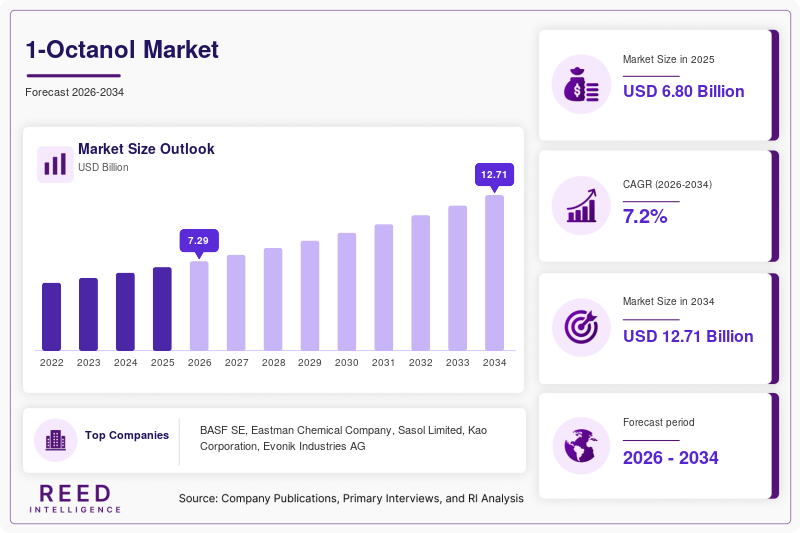
The global 1-Octanol Market size was valued at USD 6.8 billion in 2026 and is projected to reach USD 11.9 billion by 2034, expanding at a CAGR of 7.2% during the forecast period from 2026 to 2034. The market continues to gain momentum due to rising demand for specialty chemicals, plasticizers, surfactants, and personal care ingredients across developed and emerging economies. 1-octanol is widely utilized as an intermediate in the production of esters, lubricants, pharmaceuticals, agrochemicals, and coatings, making it an important chemical compound across multiple industrial value chains. Growing industrialization and increased investment in chemical manufacturing facilities have further strengthened market expansion across Asia Pacific, North America, and Europe.
One of the major global factors supporting market growth is the increasing consumption of specialty chemicals in automotive, construction, and cosmetics industries. Manufacturers are expanding production capacities to meet the rising demand for high-performance solvents and intermediates used in coatings, adhesives, and surfactants. In addition, the shift toward bio-based chemicals and sustainable production processes is encouraging companies to adopt advanced technologies for 1-octanol manufacturing. Several chemical producers are also focusing on long-term supply contracts and integration strategies to stabilize raw material availability and improve profitability.
Key Highlights
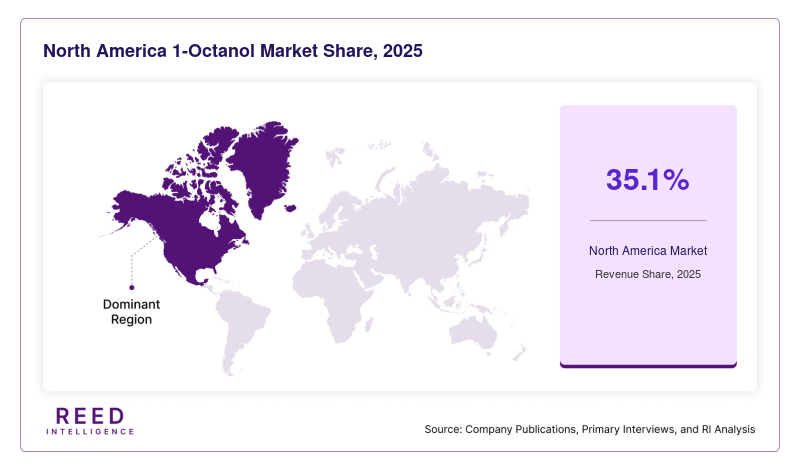
- North America dominated the market with a 35.1% share in 2025, while Asia Pacific is expected to grow at the fastest CAGR of 8.9% during 2026–2034.
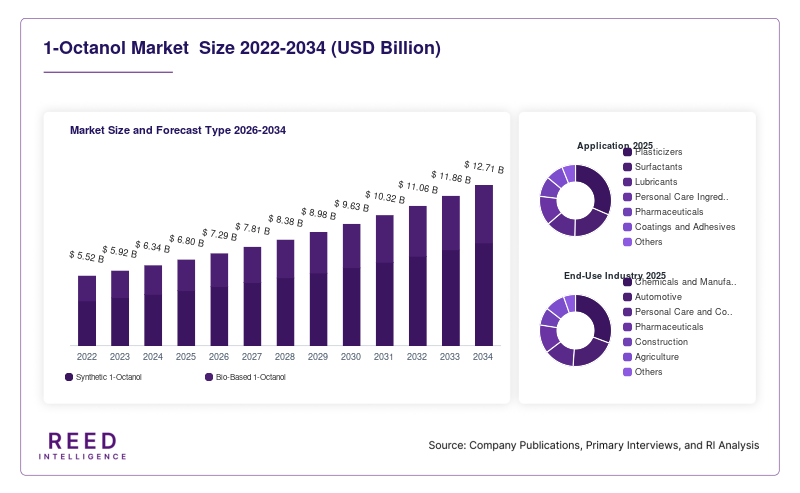
- By type, synthetic 1-octanol accounted for the largest share of 72.8%, while bio-based 1-octanol is projected to grow at a CAGR of 9.6%.
- By application, plasticizers led with a 39.4% share, whereas personal care ingredients are expected to expand at a CAGR of 9.1%.
- By end-use industry, chemicals and manufacturing dominated with a 43.7% share, while pharmaceuticals are projected to grow at a CAGR of 8.8%.
- The United States remained the dominant country, with market values of USD 1.42 billion in 2024 and USD 1.53 billion in 2025.
Market Trends
Growing Transition Toward Bio-Based Chemical Production
The increasing focus on sustainable chemical manufacturing has emerged as a major trend in the 1-Octanol Market. Chemical companies are gradually shifting from petroleum-derived feedstocks toward renewable raw materials to reduce environmental impact and improve compliance with evolving sustainability standards. Bio-based 1-octanol production is gaining attention due to rising consumer demand for environmentally responsible products in cosmetics, detergents, and specialty chemicals. Manufacturers are investing in fermentation technologies and renewable alcohol processing methods to lower carbon emissions and improve production efficiency. Governments across Europe and Asia Pacific are also supporting green chemical initiatives through incentives and industrial policies. This trend is expected to reshape supply chains and encourage long-term investments in renewable chemical infrastructure over the forecast period.
The adoption of circular economy principles is also influencing product innovation in the market. Companies are increasingly integrating waste reduction strategies and energy-efficient production systems into manufacturing facilities. Several producers are partnering with biotechnology firms to develop advanced bio-based intermediates that can compete with conventional petroleum-derived alternatives. In addition, growing awareness among industrial buyers regarding sustainable sourcing is increasing the preference for eco-friendly solvents and intermediates. These developments are expected to strengthen the commercial viability of bio-based 1-octanol across multiple industries.
Rising Demand from Personal Care and Specialty Surfactant Applications
Another major trend shaping the 1-Octanol Market is the growing use of the compound in personal care formulations and specialty surfactant manufacturing. The expansion of skincare, cosmetics, fragrances, and premium hygiene products has increased demand for high-purity chemical intermediates. 1-octanol is increasingly utilized in emulsifiers, fragrance compounds, and conditioning agents due to its favorable chemical properties and formulation compatibility. Rapid urbanization, changing lifestyles, and growing spending on beauty and wellness products are supporting this trend across developed and emerging economies.
The market is also witnessing rising demand for specialty surfactants used in industrial cleaning products, textile processing, and agrochemical formulations. Manufacturers are focusing on developing customized formulations with improved stability and lower toxicity levels to address evolving industrial requirements. Asia Pacific remains a key production and consumption hub due to the presence of large-scale chemical manufacturing facilities and growing domestic consumption. Furthermore, increased investment in research and development activities is supporting the introduction of advanced surfactant technologies that enhance product performance across industrial and consumer applications.
Market Drivers
Expansion of Global Specialty Chemical Manufacturing
The rapid expansion of the global specialty chemical sector is a key driver supporting the growth of the 1-Octanol Market. Demand for specialty chemicals has increased significantly in automotive, electronics, packaging, coatings, and industrial processing industries. 1-octanol serves as an important intermediate in the production of esters, lubricants, plasticizers, and surfactants, making it essential for various downstream manufacturing activities. Industrial manufacturers are expanding production capacities and improving operational efficiency to meet rising global demand for high-performance chemical products.
The increasing establishment of chemical production facilities in Asia Pacific and the Middle East is also accelerating market growth. Countries such as China, India, and Saudi Arabia are investing heavily in petrochemical infrastructure and industrial diversification programs. These investments are creating favorable conditions for raw material availability and integrated chemical manufacturing. In addition, long-term supply agreements between chemical producers and downstream industries are helping stabilize pricing and reduce procurement risks. The growing emphasis on industrial automation and advanced chemical processing technologies is expected to further strengthen production capabilities during the forecast period.
Increasing Demand from Plasticizer and Lubricant Industries
The expanding use of 1-octanol in plasticizer and lubricant production is another important factor driving market growth. Plasticizers are widely used in flexible PVC products, construction materials, automotive components, and electrical applications. As infrastructure development and vehicle production continue to rise globally, demand for durable and flexible materials is increasing steadily. This trend has created strong demand for chemical intermediates such as 1-octanol, which are used in the manufacturing of high-performance plasticizers.
Lubricant manufacturers are also increasing the use of specialty alcohols to improve thermal stability, oxidation resistance, and performance efficiency in industrial machinery and automotive systems. Rapid industrialization in emerging economies is driving machinery installation and maintenance activities, further increasing lubricant consumption. Additionally, the aviation and marine sectors are adopting advanced lubricant formulations that require high-purity intermediates for enhanced operational reliability. These developments are expected to contribute significantly to the expansion of the global 1-octanol industry throughout the forecast period.
Market Restraint
Volatility in Raw Material Prices and Environmental Compliance Costs
Fluctuations in raw material prices remain one of the primary challenges affecting the growth of the 1-Octanol Market. The production of conventional 1-octanol is highly dependent on petrochemical feedstocks, which are vulnerable to changes in crude oil prices, geopolitical instability, and supply chain disruptions. Sudden increases in feedstock costs can significantly impact manufacturing expenses and profit margins for producers. Small and medium-sized manufacturers often face difficulties in maintaining pricing stability, especially during periods of economic uncertainty and volatile energy markets.
Environmental regulations associated with chemical manufacturing also create operational challenges for industry participants. Governments in North America and Europe are implementing stricter emission standards, waste management requirements, and sustainability guidelines for chemical production facilities. Compliance with these regulations requires substantial investment in pollution control technologies, wastewater treatment systems, and energy-efficient manufacturing processes. For example, several chemical plants in Europe have experienced increased operational costs due to carbon emission reduction mandates and environmental auditing procedures. These additional expenditures may limit expansion plans for smaller companies and create pricing pressures across the market.
Market Opportunities
Rising Adoption of Bio-Based Industrial Chemicals
The growing adoption of bio-based industrial chemicals presents significant opportunities for the 1-Octanol Market. Industrial buyers and consumer goods manufacturers are increasingly seeking renewable alternatives to traditional petroleum-derived chemicals due to sustainability goals and environmental regulations. Bio-based 1-octanol derived from renewable feedstocks is gaining traction in applications such as personal care products, detergents, lubricants, and specialty coatings. The rising popularity of environmentally responsible products among consumers is encouraging chemical companies to invest in green manufacturing technologies.
Several biotechnology and chemical firms are forming strategic partnerships to develop scalable production methods for renewable alcohols and specialty intermediates. Advances in fermentation technologies and biomass conversion processes are improving production efficiency and lowering manufacturing costs. In addition, government initiatives promoting sustainable industrial development are supporting research and investment in renewable chemical infrastructure. As demand for low-carbon products continues to rise, manufacturers that successfully commercialize bio-based 1-octanol are expected to gain long-term competitive advantages in the global market.
Increasing Growth Potential in Emerging Economies
Emerging economies across Asia Pacific, Latin America, and the Middle East offer substantial growth opportunities for the 1-Octanol Market. Rapid industrialization, infrastructure expansion, and increasing manufacturing activities are driving demand for specialty chemicals and industrial intermediates. Countries such as India, Indonesia, Brazil, and the United Arab Emirates are witnessing rising investment in automotive, construction, pharmaceutical, and consumer goods industries, all of which utilize products derived from 1-octanol.
The expansion of domestic chemical production facilities in emerging markets is also improving regional supply chain capabilities and reducing import dependence. Governments are introducing favorable industrial policies, tax incentives, and infrastructure development programs to attract foreign direct investment in chemical manufacturing. Additionally, increasing urban populations and improving consumer purchasing power are driving higher demand for personal care products, detergents, and household chemicals. These economic and industrial developments are expected to create attractive business opportunities for global and regional market participants over the next decade.
Segmental Analysis
By Type
Synthetic 1-octanol accounted for the largest share of the global market in 2024, representing 72.8% of total revenue. The dominance of this segment is primarily attributed to the widespread availability of petrochemical feedstocks and established large-scale manufacturing infrastructure. Synthetic variants are extensively used across industrial applications including plasticizers, surfactants, coatings, lubricants, and chemical intermediates. Manufacturers prefer synthetic 1-octanol due to its consistent purity levels, stable supply chain availability, and relatively lower production costs compared to renewable alternatives. The segment also benefits from long-standing industrial adoption across automotive, construction, and chemical manufacturing sectors.
Large chemical producers continue to improve synthetic production efficiency through advanced catalytic processes and integrated petrochemical operations. Increasing demand from developing economies has further strengthened the segment’s position in the market. In addition, the expansion of industrial manufacturing activities and infrastructure projects worldwide continues to support the use of synthetic specialty alcohols in downstream production processes. Despite growing environmental concerns, the availability of mature production technologies and established supplier networks continues to maintain strong demand for synthetic 1-octanol across global markets.
By Application
Plasticizers emerged as the dominant application segment in the global 1-Octanol Market, accounting for 39.4% of total revenue in 2024. The segment’s strong position is supported by rising demand for flexible and durable materials used in construction, automotive, electrical, and packaging industries. 1-octanol plays an important role in the production of specialty plasticizers that improve material flexibility, thermal stability, and chemical resistance. Increasing infrastructure development and urbanization across emerging economies continue to drive demand for PVC products and related construction materials.
The automotive industry also contributes significantly to segment growth through increasing demand for lightweight interior components and durable polymer materials. Manufacturers are focusing on producing high-performance plasticizers that comply with evolving environmental and safety standards. In addition, rising investments in industrial manufacturing and infrastructure modernization projects are strengthening consumption of specialty chemicals used in flexible polymer applications. The continued expansion of construction activities across Asia Pacific and the Middle East is expected to maintain strong demand for plasticizer applications throughout the forecast period.
By End-Use Industry
The chemicals and manufacturing segment dominated the global 1-Octanol Market in 2024 with a revenue share of 43.7%. The segment’s leadership position is driven by extensive use of 1-octanol in chemical synthesis, surfactant production, industrial solvents, and specialty formulations. Industrial manufacturers rely heavily on specialty alcohols to improve product performance and processing efficiency across multiple applications. The expansion of industrial manufacturing facilities and chemical processing infrastructure in emerging economies has further strengthened demand for specialty intermediates.
The increasing production of coatings, adhesives, lubricants, and agrochemicals also contributes to segment growth. Large-scale industrial projects in Asia Pacific and the Middle East are increasing demand for specialty chemicals used in manufacturing operations. In addition, technological advancements in industrial automation and process optimization are supporting efficient chemical production and product customization. Strong integration between petrochemical producers and downstream manufacturing industries continues to enhance supply chain stability and support market growth globally.
Regional Analysis
North America
North America accounted for 35.1% of the global 1-Octanol Market in 2025 and maintained its position as the leading regional market due to advanced chemical manufacturing infrastructure and strong industrial demand. The region is projected to expand at a CAGR of 6.8% during the forecast period as demand for specialty chemicals, lubricants, and personal care ingredients continues to rise. High investment in research and development activities, combined with the presence of integrated petrochemical companies, supports production efficiency and product innovation across the region.
The United States remained the dominant country within North America due to its extensive chemical production base and strong downstream industrial ecosystem. Growing demand from automotive coatings, surfactants, and pharmaceutical applications continues to strengthen market growth. One unique factor supporting the U.S. market is the increasing adoption of sustainable chemical processing technologies. Manufacturers are investing in low-emission production systems and renewable feedstock integration to improve environmental performance and maintain compliance with evolving regulatory standards.
Europe
Europe represented a significant share of the global 1-Octanol Market in 2025, supported by stringent quality standards and strong demand from personal care and industrial manufacturing sectors. The regional market is expected to grow at a CAGR of 6.5% from 2026 to 2034 as manufacturers increase investment in specialty chemicals and sustainable production technologies. The presence of established chemical companies and advanced logistics infrastructure continues to support regional supply chain efficiency and export activities.
Germany emerged as the leading country in the European market due to its strong industrial manufacturing capabilities and technological expertise in chemical processing. The country benefits from extensive demand for specialty lubricants, coatings, and pharmaceutical intermediates. A unique growth factor supporting the German market is the rapid adoption of green chemistry initiatives and energy-efficient industrial systems. Companies are focusing on reducing carbon emissions and improving recycling efficiency, which is accelerating investment in sustainable specialty chemical production.
Asia Pacific
Asia Pacific is expected to register the fastest growth in the global 1-Octanol Market, with a projected CAGR of 8.9% during the forecast period. The region accounted for a substantial market share in 2025 due to expanding manufacturing industries, rising industrial output, and growing consumption of consumer goods. Increasing investments in petrochemical infrastructure, especially in China and India, are supporting production capacity expansion and improving regional supply chain integration.
China dominated the Asia Pacific market owing to its extensive industrial base and large-scale chemical production facilities. The country continues to experience strong demand from plasticizer, detergent, and coatings manufacturers. A key factor driving growth in China is the rapid expansion of domestic specialty chemical production supported by government industrial modernization programs. Increasing exports of chemical intermediates and growing investments in advanced manufacturing technologies are also contributing to regional market expansion.
Middle East & Africa
The Middle East & Africa region is witnessing gradual growth in the 1-Octanol Market due to increasing industrial diversification and rising petrochemical investments. The market is projected to grow at a CAGR of 6.1% during the forecast period as governments focus on strengthening non-oil industrial sectors. Expanding infrastructure development, coupled with rising demand for industrial chemicals in construction and manufacturing applications, is supporting regional market growth.
Saudi Arabia remained the dominant country in the region due to its strong petrochemical industry and abundant feedstock availability. The country has been increasing investments in downstream chemical manufacturing as part of long-term economic diversification initiatives. One unique growth factor driving the Saudi Arabian market is the development of integrated industrial zones that combine refining, petrochemical processing, and specialty chemical manufacturing. These projects are improving supply chain efficiency and creating new opportunities for specialty alcohol producers.
Latin America
Latin America accounted for a moderate share of the global 1-Octanol Market in 2025 and is expected to grow steadily during the forecast period at a CAGR of 6.3%. Rising industrialization, infrastructure projects, and increasing consumption of household and personal care products are supporting demand for specialty chemicals across the region. Countries in Latin America are also witnessing increased foreign investment in manufacturing and chemical processing industries.
Brazil dominated the Latin American market due to its strong industrial base and expanding consumer goods sector. Demand for coatings, lubricants, and detergents continues to rise across automotive and construction industries. A unique factor contributing to market growth in Brazil is the increasing utilization of renewable raw materials and bio-based chemical production technologies. Government support for sustainable industrial development and biofuel integration is encouraging investment in environmentally responsible chemical manufacturing processes.
Competitive Landscape
The global 1-Octanol Market is moderately consolidated, with several multinational chemical manufacturers competing through product innovation, production capacity expansion, and strategic partnerships. Companies are increasingly focusing on sustainable manufacturing technologies and supply chain integration to improve operational efficiency and strengthen market presence. The competitive environment is influenced by fluctuations in raw material prices, environmental regulations, and evolving customer demand across industrial and consumer applications.
Leading companies are investing in advanced processing technologies to improve product purity, reduce emissions, and optimize production costs. Strategic collaborations with downstream manufacturers are also becoming common as producers seek long-term supply stability and market expansion opportunities. Several market participants are expanding production facilities in Asia Pacific and the Middle East to capitalize on growing regional demand and lower manufacturing costs.
Key Players
- BASF SE
- Eastman Chemical Company
- Sasol Limited
- Kao Corporation
- Evonik Industries AG
- Arkema S.A.
- ExxonMobil Chemical
- Mitsubishi Chemical Group
- KH Neochem Co., Ltd.
- Oxiteno S.A.
- Solvay S.A.
- SABIC
- Dow Inc.
- Shell Chemicals
- LG Chem Ltd.
Recent Developments
- In 2025, BASF SE expanded its specialty alcohol production facility in Asia Pacific to address increasing demand from personal care and industrial chemical applications.
- In 2024, Sasol Limited announced a strategic investment in renewable feedstock integration to improve sustainable specialty alcohol production capabilities.
- In 2025, Eastman Chemical Company introduced advanced processing technologies aimed at improving purity levels and operational efficiency for specialty chemical intermediates.
- In 2024, Evonik Industries AG partnered with a biotechnology company to accelerate research into bio-based specialty alcohol production technologies.
- In 2025, Kao Corporation increased investment in sustainable surfactant development to strengthen its specialty chemicals portfolio for consumer and industrial markets.
1-Octanol Market Segments
Type
- Synthetic 1-Octanol
- Bio-Based 1-Octanol
Application
- Plasticizers
- Surfactants
- Lubricants
- Personal Care Ingredients
- Pharmaceuticals
- Coatings and Adhesives
- Others
End-Use Industry
- Chemicals and Manufacturing
- Automotive
- Personal Care and Cosmetics
- Pharmaceuticals
- Construction
- Agriculture
- Others
By Region
- North America
- Europe
- APAC
- Middle East and Africa
- LATAM