100 Ton Mobile Cranes Market Size, Share & Demand Report By Crane Type (All-Terrain Cranes, Truck-Mounted Cranes, Rough Terrain Cranes), By Application (Construction & Infrastructure Projects, Industrial Plant Installation), By End User (Construction Companies, Energy & Utility Operators, Industrial Manufacturing Facilities, Mining Companies), By Ownership Model (Direct Equipment Ownership, Rental Services), By Region & Segment Forecasts, 2026–2034
USD 3950
Market Overview
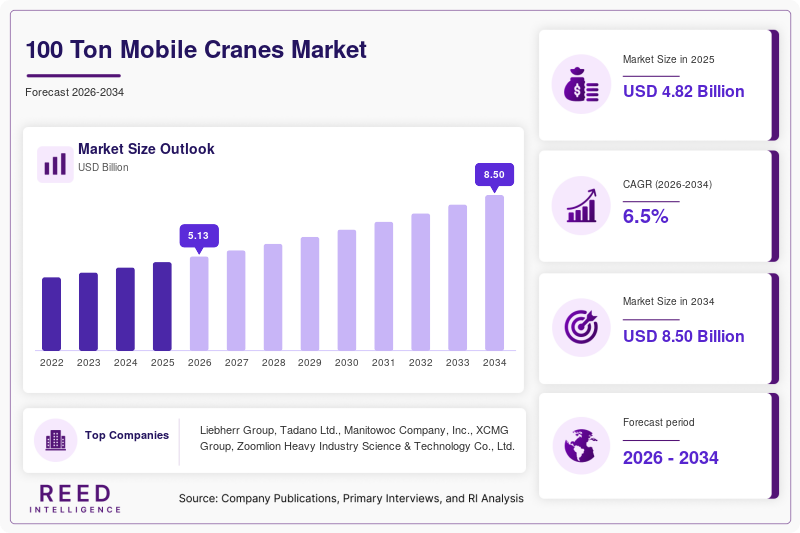
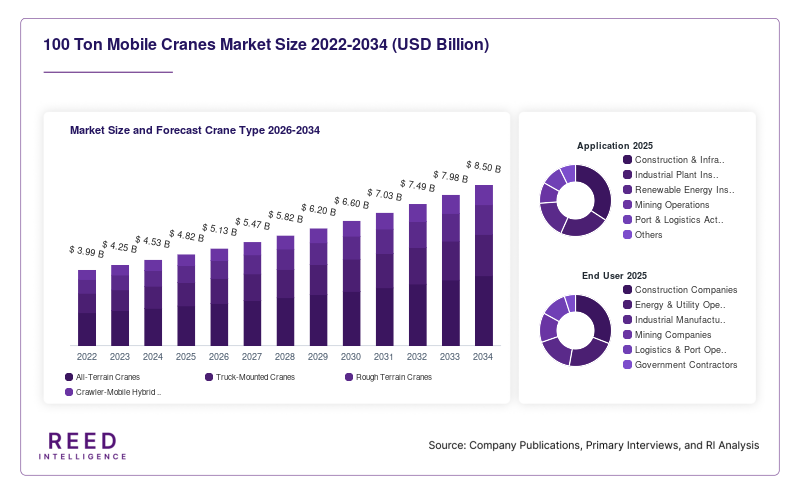
The 100 Ton Mobile Cranes Market Size was valued at USD 4.82 billion in 2026 and is projected to reach USD 7.96 billion by 2034, expanding at a CAGR of 6.5% during the forecast period (2026–2034). The market is experiencing stable growth due to increasing investments in infrastructure development, renewable energy projects, industrial facility expansion, and transportation network modernization across developed and emerging economies. Mobile cranes with a lifting capacity of 100 tons are widely utilized for medium-to-heavy lifting operations requiring operational flexibility, mobility, and rapid deployment across diverse construction and industrial environments.
A major global factor supporting the growth of the 100 Ton Mobile Cranes Market is the accelerated development of large-scale infrastructure projects worldwide. Governments and private investors are allocating significant capital toward highways, railways, bridges, airports, industrial complexes, ports, and renewable energy installations. These projects require lifting equipment capable of handling substantial loads while maintaining mobility across construction sites. As a result, demand for 100-ton mobile cranes continues to increase across multiple end-use sectors.
Key Highlights
- Asia Pacific accounted for the largest market share of 38.4% in 2025, while the Middle East & Africa is anticipated to register the fastest CAGR of 7.8% during 2026–2034.
- By Crane Type, All-Terrain Cranes held the dominant market share of 46.7% in 2025, while Rough Terrain Cranes are projected to grow at a CAGR of 7.3%.
- By Application, Construction & Infrastructure Projects represented 41.5% share in 2025, whereas Renewable Energy Installation applications are forecast to expand at 8.2% CAGR.
- By End User, Construction Companies accounted for 43.8% market share in 2025, while Energy & Utility Operators are expected to register a CAGR of 7.9%.
- By Ownership Model, Rental Services captured 55.4% share in 2025, while Equipment Leasing Solutions are projected to grow at 7.5% CAGR.
- China, the leading country market, recorded values of USD 642 million in 2024 and USD 689 million in 2025.
Market Trends
Integration of Telematics and Fleet Management Technologies
The adoption of telematics systems in mobile cranes is becoming increasingly common across the industry. Modern 100-ton cranes are equipped with GPS tracking, fuel consumption monitoring, maintenance alerts, operator performance analytics, and remote diagnostics capabilities. These technologies enable fleet owners to improve asset utilization, reduce downtime, and optimize operating costs. As digital construction practices become more prevalent, telematics integration is expected to remain a significant trend in the 100 Ton Mobile Cranes Market.
Increasing Demand for Environmentally Efficient Crane Equipment
Construction firms and industrial operators are placing greater emphasis on reducing carbon emissions and improving fuel efficiency. Manufacturers are responding by introducing cleaner engine technologies, hybrid power systems, and energy-efficient hydraulic solutions. Environmental compliance requirements and sustainability initiatives are encouraging the replacement of aging crane fleets with more efficient equipment, supporting market growth.
Market Drivers
Expansion of Transportation and Urban Infrastructure Projects
Governments worldwide continue investing heavily in transportation infrastructure, including roads, railways, airports, bridges, and urban development projects. These projects require lifting equipment capable of handling structural components, construction materials, and heavy machinery. The increasing volume of infrastructure development projects is creating sustained demand for 100-ton mobile cranes across both public and private sectors.
Rising Investments in Renewable Energy Facilities
The global transition toward renewable energy is driving the installation of wind turbines, solar farms, substations, and transmission infrastructure. These projects require specialized lifting equipment for assembling heavy components at remote locations. The growing number of renewable energy developments is contributing significantly to the expansion of the 100 Ton Mobile Cranes Market.
Market Restraint
High Acquisition and Maintenance Costs
The substantial capital investment required to purchase and maintain 100-ton mobile cranes remains a significant market restraint. Equipment acquisition costs, operator training expenses, fuel consumption, spare parts requirements, and periodic maintenance can create financial challenges for smaller contractors, limiting direct ownership adoption in certain regions.
Market Opportunities
Growth of Crane Rental and Shared Equipment Services
The increasing preference for equipment rental rather than ownership presents substantial opportunities for manufacturers and rental service providers. Contractors are seeking flexible access to specialized lifting equipment without incurring long-term capital expenditures. Expanding rental fleets are expected to generate additional demand for new crane purchases.
Development of Smart Construction Projects
The growing implementation of digital construction methodologies, including Building Information Modeling (BIM), automated site monitoring, and connected equipment ecosystems, creates opportunities for technologically advanced mobile cranes. Equipment integrated with smart construction platforms will benefit from increasing adoption across major infrastructure developments.
Segmental Analysis
By Crane Type
The 100 Ton Mobile Cranes Market is segmented into:
- All-Terrain Cranes
- Truck-Mounted Cranes
- Rough Terrain Cranes
- Crawler-Mobile Hybrid Cranes
All-Terrain Cranes accounted for the largest market share of 46.7% in 2025. Their ability to operate efficiently on both paved roads and challenging off-road environments made them suitable for diverse construction and industrial applications.
Rough Terrain Cranes are expected to register the fastest CAGR of 7.3% during the forecast period. Increasing deployment across remote construction sites and renewable energy projects will support future segment growth due to enhanced maneuverability and lifting performance on uneven terrain.
By Application
The market is categorized into:
- Construction & Infrastructure Projects
- Industrial Plant Installation
- Renewable Energy Installation
- Mining Operations
- Port & Logistics Activities
- Others
Construction & Infrastructure Projects represented 41.5% of market revenue in 2025. Extensive use in bridge construction, highway development, urban infrastructure projects, and commercial building construction supported segment dominance.
Renewable Energy Installation is projected to expand at a CAGR of 8.2% throughout the forecast period. Increasing deployment of wind turbines and large-scale energy infrastructure projects will create strong demand for specialized lifting equipment.
By End User
The market includes:
- Construction Companies
- Energy & Utility Operators
- Industrial Manufacturing Facilities
- Mining Companies
- Logistics & Port Operators
- Government Contractors
Construction Companies held 43.8% market share in 2025 due to extensive utilization of mobile cranes across residential, commercial, and infrastructure projects.
Energy & Utility Operators are anticipated to witness the fastest growth at a CAGR of 7.9% through 2034. Investments in transmission infrastructure, renewable energy facilities, and utility modernization projects will drive equipment demand.
By Ownership Model
The market is segmented into:
- Direct Equipment Ownership
- Rental Services
- Equipment Leasing Solutions
Rental Services accounted for 55.4% share in 2025. Contractors increasingly preferred rental arrangements due to operational flexibility and reduced capital investment requirements.
Equipment Leasing Solutions are expected to grow at a CAGR of 7.5% during the forecast period. Flexible financing structures and growing demand from mid-sized contractors will contribute to segment expansion.
Regional Analysis
North America
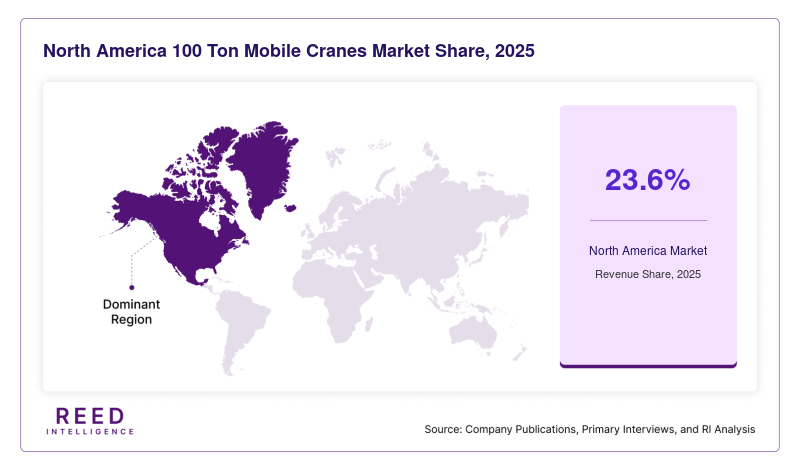
North America accounted for 23.6% of the 100 Ton Mobile Cranes Market share in 2025 and is expected to grow at a CAGR of 5.9% during 2026–2034. Demand in the region is supported by transportation modernization initiatives, industrial construction projects, and utility infrastructure upgrades.
The United States dominated the regional market due to ongoing investments in bridge rehabilitation, airport expansion programs, and utility transmission infrastructure. Growing activity in logistics and industrial construction projects further supported equipment demand.
Europe
Europe held 26.1% market share in 2025 and is projected to expand at a CAGR of 6.1% through 2034. The region benefits from sustained investment in renewable energy infrastructure, industrial modernization, and transportation projects requiring heavy lifting equipment.
Germany remained the dominant national market due to its strong construction sector and ongoing deployment of renewable energy installations. Demand for technologically advanced cranes supported equipment replacement activities across multiple industries.
Asia Pacific
Asia Pacific represented 38.4% of the global market in 2025 and is forecast to maintain strong growth at a CAGR of 7.2% during 2026–2034. Rapid urbanization, industrial expansion, and large-scale public infrastructure projects continue to support market demand.
China led the regional market owing to extensive investments in transportation networks, industrial facilities, and urban development initiatives. The country's ongoing infrastructure expansion generated substantial demand for mobile lifting equipment.
Middle East & Africa
The Middle East & Africa accounted for 6.2% market share in 2025 and is expected to register the fastest CAGR of 7.8% during the forecast period. Infrastructure diversification strategies and industrial development programs are supporting equipment adoption across the region.
Saudi Arabia emerged as the dominant market due to major construction initiatives, industrial development zones, and large-scale tourism infrastructure projects. The increasing scale of development activities is creating sustained demand for heavy lifting equipment.
Latin America
Latin America captured 5.7% market share in 2025 and is anticipated to expand at a CAGR of 6.4% through 2034. Market growth is supported by investments in transportation infrastructure, mining projects, and industrial facility construction.
Brazil remained the leading country in the region due to infrastructure rehabilitation programs and continued expansion of logistics and energy-related developments. Increasing construction activity is supporting equipment deployment across multiple sectors.
Competitive Landscape
The 100 Ton Mobile Cranes Market remains moderately consolidated, with major manufacturers competing through technological innovation, fleet expansion strategies, product reliability, and global service networks. Companies are focusing on digital fleet management capabilities, fuel efficiency improvements, and enhanced safety systems to strengthen market positioning.
Liebherr Group remains a leading participant in the market due to its extensive portfolio of mobile lifting equipment and strong international presence. The company recently introduced upgraded all-terrain crane models featuring advanced telematics integration, enhanced fuel efficiency, and intelligent load management technologies designed to improve operational productivity and safety.
Tadano Ltd. continues expanding its crane portfolio through technology-driven product enhancements. Manitowoc Company, Inc. focuses on strengthening rental fleet partnerships and expanding aftermarket service capabilities. XCMG Group leverages large-scale manufacturing capacity and competitive pricing strategies to strengthen global market presence. Zoomlion Heavy Industry Science & Technology Co., Ltd. continues investing in digital crane technologies and international market expansion initiatives.
Key Players List
- Liebherr Group
- Tadano Ltd.
- Manitowoc Company, Inc.
- XCMG Group
- Zoomlion Heavy Industry Science & Technology Co., Ltd.
- SANY Heavy Industry Co., Ltd.
- Terex Corporation
- Kobelco Construction Machinery Co., Ltd.
- KATO Works Co., Ltd.
- Elliott Equipment Company
- Palfinger AG
- Sennebogen Maschinenfabrik GmbH
- Action Construction Equipment Ltd.
- Hyundai Construction Equipment Co., Ltd.
- Hitachi Construction Machinery Co., Ltd.
Recent Developments
- In 2025, multiple crane manufacturers introduced advanced telematics platforms for real-time fleet monitoring and predictive maintenance management.
- Several equipment suppliers expanded rental partnerships to improve crane availability across infrastructure and renewable energy projects.
- New all-terrain crane models featuring fuel-efficient engines and enhanced load control systems were launched across major markets.
- Manufacturers invested in operator-assistance technologies designed to improve lifting precision and workplace safety.
- International crane producers expanded production capacity in Asia and the Middle East to support growing regional demand for heavy lifting equipment.
100 Ton Mobile Cranes Market Segments
Crane Type
- All-Terrain Cranes
- Truck-Mounted Cranes
- Rough Terrain Cranes
- Crawler-Mobile Hybrid Cranes
Application
- Construction & Infrastructure Projects
- Industrial Plant Installation
- Renewable Energy Installation
- Mining Operations
- Port & Logistics Activities
- Others
End User
- Construction Companies
- Energy & Utility Operators
- Industrial Manufacturing Facilities
- Mining Companies
- Logistics & Port Operators
- Government Contractors
Ownership Model
- Direct Equipment Ownership
- Rental Services
- Equipment Leasing Solutions
By Region
- North America
- Europe
- APAC
- Middle East and Africa
- LATAM