2 Hexyldecanol Market Size, Share & Demand Report By Product Grade (Industrial Grade, Cosmetic Grade), By Application (Cosmetics & Personal Care, Synthetic Lubricants, Plasticizers & Polymer Additives, Coatings & Adhesives, Chemical Intermediates), By End-Use Industry (Chemical Manufacturing, Automotive, Personal Care & Cosmetics, Industrial Processing, Others), By Region & Segment Forecasts, 2025–2034
Report Code: RI5469PUB
Last Updated : September 08, 2026
Format:
Starting From
USD 3950
Buy Now
USD 3950
Market Overview
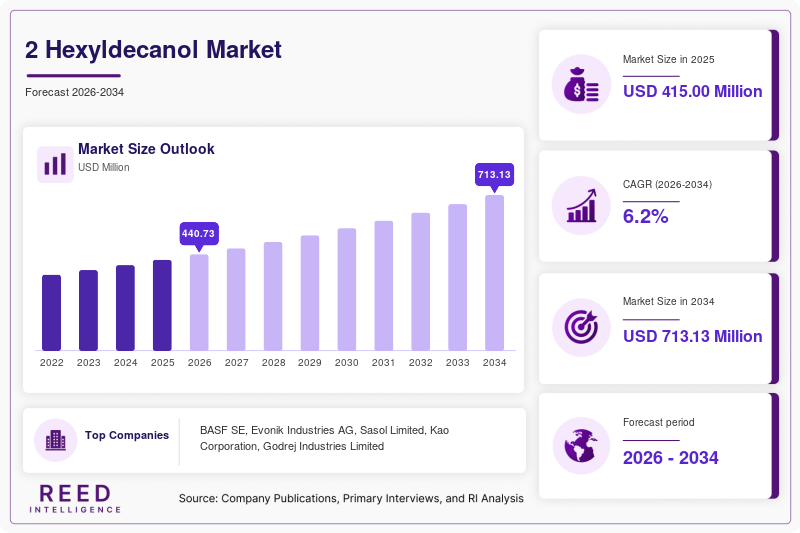
The global 2 Hexyldecanol Market was valued at approximately USD 415 million in 2025 and is projected to reach USD 708 million by 2033, expanding at a compound annual growth rate (CAGR) of 6.2% during the forecast period (2025–2034). The market growth is primarily attributed to the increasing utilization of specialty fatty alcohols in high-performance chemical formulations across cosmetics, lubricants, coatings, and industrial intermediates.
2 Hexyldecanol is widely used as an emollient, plasticizer intermediate, and solvent in several chemical formulations. Its branched molecular structure enhances viscosity control, oxidative stability, and hydrophobic performance in multiple industrial applications. As a result, the compound is gaining traction among specialty chemical manufacturers looking to improve formulation performance and durability.
Key Highlights
- Asia Pacific accounted for the dominant regional share of 38.4% in 2025, while the region is projected to expand at the fastest CAGR of 7.1% through 2034.
- Cosmetics & personal care emerged as the leading application segment with 34.6% market share in 2025, while synthetic lubricants are projected to grow at the fastest CAGR of 7.4%.
- Industrial grade 2 Hexyldecanol represented the largest product segment with 61.3% share in 2025, while cosmetic grade variants are forecast to grow at 7.0% CAGR.
- China, the dominant country market, generated approximately USD 82 million in 2025 and is estimated to reach USD 87 million in 2026.
Market Trends
Rising Adoption in Advanced Cosmetic Formulations
One of the key trends shaping the 2 Hexyldecanol Market is its increasing use in advanced cosmetic and personal care formulations. Cosmetic manufacturers are integrating specialty fatty alcohols such as 2 Hexyldecanol to improve product texture, skin compatibility, and moisture retention properties.
The compound functions as an emollient and stabilizing agent in creams, lotions, and skincare formulations. As consumer demand for high-performance skincare products continues to expand globally, cosmetic manufacturers are increasingly incorporating multifunctional ingredients that enhance product feel and stability. This shift toward ingredient innovation is encouraging the integration of specialty alcohols like 2 Hexyldecanol in premium formulations.
Expansion of Specialty Lubricant Applications
Another notable trend influencing the 2 Hexyldecanol Market growth is the expansion of specialty lubricants used in automotive and industrial equipment. 2 Hexyldecanol acts as a key intermediate in the synthesis of lubricant esters that offer improved thermal stability and viscosity characteristics.
Industrial equipment operating under high stress requires lubricants that maintain performance under varying temperatures and pressure conditions. As machinery and automotive systems become more advanced, lubricant formulators are focusing on improving oxidation resistance and lubrication efficiency. This has encouraged the increased incorporation of branched fatty alcohol derivatives, supporting the long-term outlook of the 2 Hexyldecanol Market.
Market Drivers
Increasing Demand for Specialty Chemical Intermediates
The growing requirement for specialty chemical intermediates across multiple industrial sectors represents a significant driver for the 2 Hexyldecanol Market. Industries including coatings, adhesives, polymer processing, and personal care rely heavily on functional intermediates that enhance formulation properties.
2 Hexyldecanol provides superior stability, viscosity control, and compatibility with a variety of chemical compounds. These characteristics make it suitable for advanced formulations requiring improved durability and chemical performance. As specialty chemical manufacturing continues to expand globally, the demand for multifunctional intermediates such as 2 Hexyldecanol is expected to grow steadily.
Expanding Industrial Manufacturing Activities
Another factor driving the 2 Hexyldecanol Market size is the continued expansion of industrial manufacturing activities worldwide. Growth in sectors such as automotive production, chemical processing, and industrial coatings has increased the demand for high-performance raw materials used in manufacturing formulations.
The compound’s compatibility with synthetic esters and specialty additives makes it valuable in lubricant and industrial chemical production. As manufacturing sectors scale operations and invest in advanced chemical formulations, demand for high-purity fatty alcohol intermediates is expected to increase.
Market Restraint
Fluctuating Raw Material Availability
One of the primary challenges impacting the 2 Hexyldecanol Market is the volatility associated with raw material availability. The production of 2 Hexyldecanol depends on petrochemical intermediates and oleochemical feedstocks that are subject to price fluctuations and supply chain variability.
Changes in feedstock pricing can significantly influence production costs for manufacturers. In addition, supply chain disruptions in the chemical industry can lead to temporary shortages of raw materials required for fatty alcohol synthesis. Such fluctuations may affect profit margins for producers and create uncertainty in the overall supply environment of the 2 Hexyldecanol Market.
Market Opportunities
Growth of High-Performance Industrial Fluids
The expanding demand for high-performance industrial fluids presents a promising opportunity for the 2 Hexyldecanol Market. Industrial fluids such as metalworking lubricants, hydraulic oils, and compressor lubricants require additives that improve thermal stability and lubrication performance.
2 Hexyldecanol-derived esters provide enhanced viscosity characteristics and oxidation resistance, making them suitable for advanced industrial fluid formulations. As industries increasingly adopt specialized lubricants to enhance machinery efficiency and lifespan, the demand for intermediate chemicals like 2 Hexyldecanol is expected to grow.
Emerging Applications in Specialty Polymer Additives
Another emerging opportunity within the 2 Hexyldecanol Market involves its increasing use in specialty polymer additives. Chemical manufacturers are exploring the compound as a precursor for plasticizers and stabilizers used in polymer production.
These additives improve flexibility, durability, and processing stability in various plastic materials. With growing demand for advanced polymer products in packaging, electronics, and construction industries, the development of new polymer additive formulations incorporating 2 Hexyldecanol could open additional market avenues.
Segmental Analysis
By Product Grade
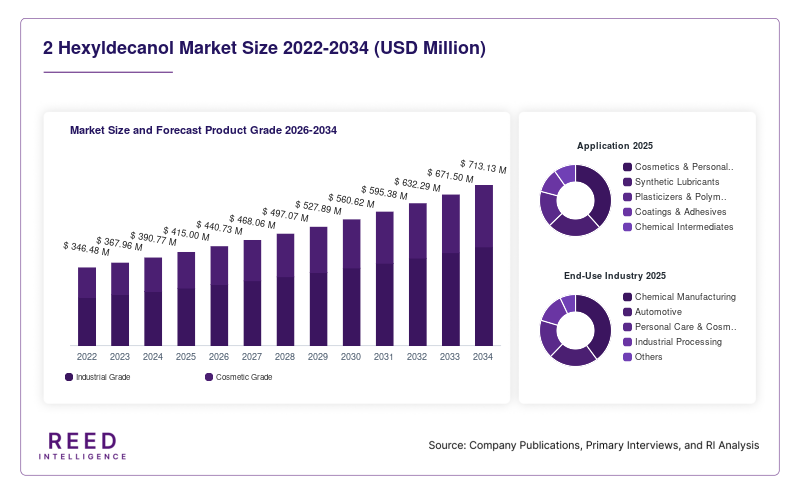
Industrial grade 2 Hexyldecanol accounted for the dominant share of approximately 61.3% in 2025. The segment’s growth has been supported by its widespread use in industrial lubricants, coatings, and chemical intermediates. Industrial grade variants offer suitable purity levels and chemical properties required for large-scale manufacturing processes, making them widely adopted across chemical production facilities.
The cosmetic grade segment is projected to grow at the fastest CAGR of 7.0% during the forecast period. This growth will be driven by increasing demand for premium skincare and personal care formulations that require specialized emollients and stabilizing agents. Cosmetic manufacturers are expected to expand the use of high-purity fatty alcohol derivatives to improve product texture and formulation stability.
By Application
The cosmetics and personal care segment represented the largest share of the 2 Hexyldecanol Market at 34.6% in 2025. The compound has been widely used as an emollient and stabilizing ingredient in creams, lotions, and skincare products. Its ability to improve formulation consistency and enhance skin feel has made it a valuable component in cosmetic manufacturing.
The synthetic lubricants segment is projected to grow at the fastest CAGR of 7.4% during the forecast period. Increasing demand for high-performance lubricants used in advanced machinery and automotive systems is expected to drive growth in this segment. Lubricant manufacturers will increasingly incorporate specialty alcohol derivatives to improve thermal stability and oxidation resistance.
By End-Use Industry
The chemical manufacturing industry accounted for the largest share of approximately 41.2% in 2025. The segment has been driven by the extensive use of 2 Hexyldecanol as an intermediate in the synthesis of various specialty chemicals and additives used in industrial formulations.
The automotive industry segment is projected to grow at a CAGR of 6.9% through 2034. Growth will be supported by the increasing demand for advanced lubricants and specialty fluids used in modern automotive systems. Automotive manufacturers are expected to adopt high-performance lubricant formulations that incorporate specialty intermediates such as 2 Hexyldecanol.
Regional Analysis
North America
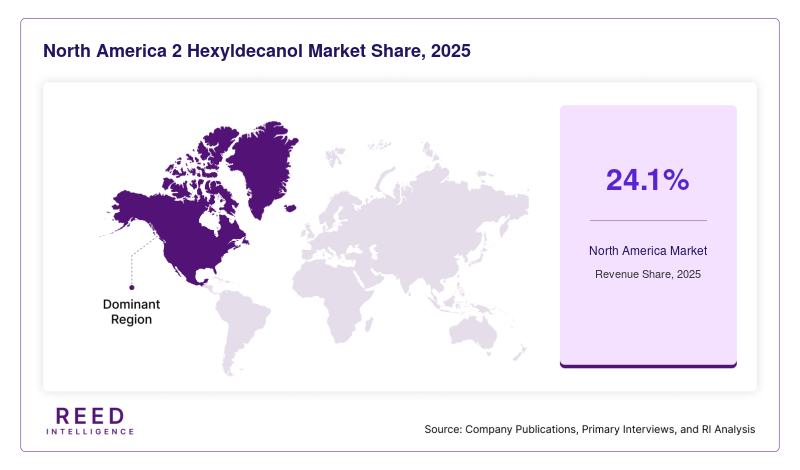
North America accounted for approximately 24.1% of the global 2 Hexyldecanol Market share in 2025. The region is expected to expand at a CAGR of 5.6% between 2025 and 2034. Market demand in North America has been influenced by the presence of advanced chemical manufacturing facilities and established specialty ingredient supply chains.
The United States represented the dominant country market within the region. Growth in the country has been supported by the increasing use of specialty alcohol derivatives in industrial coatings and chemical processing applications. Manufacturers in the U.S. have been investing in advanced chemical production technologies to improve product efficiency and expand specialty intermediate output. These investments are expected to sustain steady demand for 2 Hexyldecanol across industrial sectors.
Europe
Europe held nearly 22.8% share of the global 2 Hexyldecanol Market in 2025. The region is projected to register a CAGR of 5.4% during the forecast period. Market growth has been supported by a well-established specialty chemicals sector and the presence of several large chemical manufacturers operating across the region.
Germany dominated the European market due to its strong chemical manufacturing infrastructure and research capabilities. The country hosts numerous chemical processing facilities producing high-value intermediates used in coatings, lubricants, and specialty formulations. Continuous investments in chemical innovation and industrial efficiency improvements are expected to sustain the demand for specialty alcohols, including 2 Hexyldecanol, across Europe.
Asia Pacific
Asia Pacific accounted for the largest share of the global 2 Hexyldecanol Market at 38.4% in 2025. The region is projected to grow at the fastest CAGR of 7.1% from 2025 to 2034. Rapid industrialization and expanding chemical production capacities have contributed significantly to market growth.
China emerged as the dominant country within the region. The country’s extensive chemical manufacturing ecosystem and large-scale industrial production facilities have created strong demand for specialty intermediates. Domestic manufacturers are expanding production capacities to meet growing requirements across coatings, lubricants, and personal care ingredient markets. These developments are expected to support the long-term expansion of the 2 Hexyldecanol Market in Asia Pacific.
Middle East & Africa
The Middle East & Africa region represented approximately 7.3% of the global 2 Hexyldecanol Market share in 2025 and is anticipated to grow at a CAGR of 5.8% through 2034. The region’s chemical sector has been gradually expanding due to investments in petrochemical processing and downstream chemical manufacturing.
Saudi Arabia led the regional market. The country’s focus on expanding petrochemical production and diversifying chemical manufacturing has supported the development of intermediate chemical supply chains. Investments in specialty chemical production facilities and industrial diversification initiatives are expected to strengthen regional demand for 2 Hexyldecanol over the forecast period.
Latin America
Latin America accounted for around 7.4% of the global 2 Hexyldecanol Market in 2025 and is expected to grow at a CAGR of 5.7% during the forecast period. Market development in the region has been influenced by increasing industrial chemical consumption across manufacturing sectors.
Brazil represented the largest country market in Latin America. Growth in the Brazilian chemical industry has supported demand for specialty intermediates used in industrial formulations. The expansion of domestic manufacturing activities and investments in chemical production infrastructure are expected to contribute to the gradual expansion of the 2 Hexyldecanol Market in the region.
Competitive Landscape
The global 2 Hexyldecanol Market features a moderately consolidated competitive landscape characterized by the presence of specialty chemical manufacturers and oleochemical producers. Market participants focus on production capacity expansion, product purity improvements, and strategic collaborations with downstream manufacturers to strengthen their market presence.
Among key companies, BASF SE is recognized as a leading market participant due to its extensive specialty chemical portfolio and strong global distribution network. The company has been focusing on improving production efficiency and expanding its specialty alcohol product lines to address the evolving requirements of industrial and personal care manufacturers.
Other major players are investing in research and development activities to enhance synthesis technologies and improve product performance characteristics. These initiatives are expected to strengthen the competitive dynamics of the 2 Hexyldecanol Market over the coming years.
Key Players
- BASF SE
- Evonik Industries AG
- Sasol Limited
- Kao Corporation
- Godrej Industries Limited
- Croda International Plc
- Emery Oleochemicals
- KLK OLEO
- Musim Mas Holdings
- Arkema Group
- Solvay SA
- Oxiteno S.A.
- VVF LLC
- Wilmar International Limited
- Ecogreen Oleochemicals
- New Japan Chemical Co., Ltd.
Recent Developments
- In 2024, several specialty chemical manufacturers expanded fatty alcohol production capacity to support rising demand for lubricant intermediates.
- In 2023, chemical companies increased investments in high-purity alcohol synthesis technologies to improve product quality for cosmetic applications.
- In 2024, specialty ingredient suppliers introduced new formulations incorporating branched fatty alcohol derivatives for industrial fluid applications.
2 Hexyldecanol Market Segments
Product Grade
- Industrial Grade
- Cosmetic Grade
Application
- Cosmetics & Personal Care
- Synthetic Lubricants
- Plasticizers & Polymer Additives
- Coatings & Adhesives
- Chemical Intermediates
End-Use Industry
- Chemical Manufacturing
- Automotive
- Personal Care & Cosmetics
- Industrial Processing
- Others
By Region
- North America
- Europe
- APAC
- Middle East and Africa
- LATAM
Frequently Asked Questions
How big is the 2 Hexyldecanol market?
According to Reed Intelligence, the global 2 Hexyldecanol market size was valued at USD 415 million in 2025 and is projected to reach USD 708 million by 2033, expanding at a CAGR of 6.2% during 2025–2034.
What are the key opportunities in the market?
Growth of high-performance industrial fluids and emerging applications in specialty polymer additives are the key opportunities in the market.
Who are the leading players in the market?
BASF SE, Evonik Industries AG, Sasol Limited, Kao Corporation, Godrej Industries Limited, Croda International Plc, Emery Oleochemicals, KLK OLEO, Arkema Group, and Wilmar International Limited are the leading players in the market.
What are the factors driving the growth of the market?
Increasing demand for specialty chemical intermediates and expanding industrial manufacturing activities are the major factors driving the growth of the market.
Which are the various segmentations that the market report covers?
The market report is segmented as follows: By Product Grade, By Application, By End-Use Industry, and By Region.