3-Hydroxypropionic Acid Market Size, Share & Trends Analysis Report By Source (Petroleum-Based, Bio-Based), By Form (Liquid, Powder), By Application (Acrylic Acid Production, 1,3-Propanediol, Biodegradable Plastics, Other Chemical Derivatives), By End Use (Chemicals & Petrochemicals, Plastics & Polymers, Personal Care & Cosmetics, Coatings & Adhesives, Other End Uses) and By Region (North America, Europe, APAC, Middle East and Africa, LATAM) Forecasts, 2026–2034
USD 3950
3-Hydroxypropionic Acid Market Size
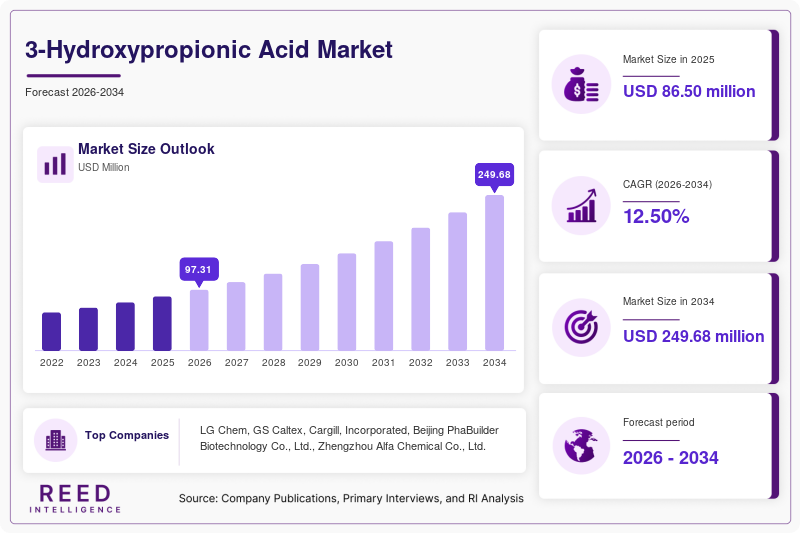
The global 3-hydroxypropionic acid market size was valued at USD 86.50 million in 2025 and is projected to grow from USD 97.31 million in 2026 to USD 249.68 million by 2034, registering a CAGR of 12.50% during the forecast period from 2026 to 2034.
3-Hydroxypropionic acid (3-HP) is gaining commercial importance as a platform chemical because it can be converted into acrylic acid, 1,3-propanediol, acrylamide, biodegradable polymers and other chemical intermediates. Research from the U.S. Department of Energy-linked Pacific Northwest National Laboratory describes 3-HP as a precursor for polymer materials used in applications ranging from automotive and electronics to clothing and diapers.
The main change in the market is the transition from laboratory-scale biological production toward processes designed for industrial economics. Traditional chemical production has relied heavily on fossil-derived feedstocks, while current research is focusing on fermentation using glucose, glycerol, acetic acid and waste-derived substrates. A 2025 ACS study demonstrated a route using acetic acid obtainable from biomass, organic waste and C1-gas sources, while 2026 research investigated glycerol-molasses fermentation as a lower-carbon production pathway.
Commercial activity is also becoming more visible. LG Chem has developed microbial-fermentation technology for 3-HP and used it to produce 100% bio-based acrylic acid. In February 2025, the company announced prototype production of bio-acrylic acid at an initial capacity of 100 metric tons per year, with potential capacity expansion depending on customer demand.
The market's central constraint remains scale economics. 3-HP-producing microorganisms can experience product toxicity, substrate inhibition and metabolic inefficiencies, while downstream recovery can materially affect production costs. Recent research is therefore focused on strain engineering, low-pH fermentation, feedstock flexibility and improved recovery.
3-Hydroxypropionic Acid Market Drivers
Bio-based acrylic acid is creating a downstream demand pathway
Acrylic acid is one of the most commercially important downstream products from 3-HP. It is used in superabsorbent polymers, coatings, adhesives and other materials, creating a much larger potential demand base than direct consumption of 3-HP itself. LG Chem's February 2025 announcement provides a direct commercial example: its 100% plant-based acrylic acid is produced from 3-HP generated through microbial fermentation and is targeted at cosmetics, diaper materials, adhesives, coatings and paints. This creates a clear market mechanism: improvements in 3-HP production can feed into established acrylic-acid value chains without requiring customers to redesign downstream applications. The opportunity is particularly relevant for manufacturers seeking lower-fossil-content materials while maintaining conventional acrylic-acid functionality.
Fermentation technology is improving production economics
Biological production is moving beyond simple sugar fermentation toward engineered microorganisms and alternative feedstocks. A 2026 Nature Communications study demonstrated an acid-tolerant Issatchenkia orientalis platform for low-pH 3-HP biosynthesis, while 2026 research on recombinant E. coli investigated dual-substrate fermentation. These advances matter commercially because fermentation yield, product tolerance, oxygen requirements and downstream recovery directly determine the cost of producing 3-HP. Research using glycerol, molasses and acetic acid also creates opportunities to use lower-cost or waste-derived feedstocks instead of relying exclusively on refined sugars.
Demand for biodegradable and renewable polymer intermediates is broadening applications
3-HP can be incorporated into biodegradable plastics and other bio-based materials. LG Chem identifies 3-HP as a core raw material for its PLH compostable-material platform and describes applications including films, disposable cups and protective packaging materials. PNNL similarly identifies 3-HP as a precursor for biodegradable polymers and polymer intermediates. This broadens the market beyond acrylic acid: polymer producers can use 3-HP as a building block for materials where biodegradability, renewable feedstock content or carbon reduction is commercially relevant. The counterbalance is that bio-based alternatives must still compete with established petrochemical materials on price, performance and supply reliability.
3-Hydroxypropionic Acid Market Restraints
High Production and Recovery Costs
The principal constraint is achieving commercially competitive production at high yield, concentration and productivity. Research has identified product toxicity, low microbial tolerance, cofactor requirements, pathway losses and substrate inhibition as barriers to biological 3-HP production. Downstream purification is another cost driver because fermentation broth contains water, cells, residual substrate and other metabolites that must be separated from 3-HP. Recent techno-economic work identifies fermentation yield and recovery as major variables affecting both minimum selling price and environmental performance. Until these parameters become sufficiently stable at industrial scale, bio-based 3-HP can face a cost disadvantage against mature fossil-derived chemical routes.
Limited Commercial-Scale Production Infrastructure
3-HP has historically remained closer to the development and demonstration stage than mature commodity chemicals. LG Chem itself previously described mass production as a key commercialization challenge and worked with GS Caltex to combine fermentation technology with separation and purification scale-up. Although LG Chem subsequently advanced to bio-acrylic-acid prototype production, the relatively limited number of large-scale commercial producers means customers can face qualification, supply-security and price risks. This is particularly important for downstream chemical manufacturers that require consistent feedstock specifications and large-volume supply.
3-Hydroxypropionic Acid Market Opportunities
Bio-Based Acrylic Acid and Superabsorbent Polymers
The strongest downstream opportunity is the conversion of bio-based 3-HP into acrylic acid. Acrylic acid feeds superabsorbent polymers used in diapers and hygiene products, as well as coatings, adhesives and other applications. LG Chem's 2025 prototype production shows that 3-HP can already serve as a direct bridge between microbial fermentation and conventional acrylic-acid applications. The commercial opportunity therefore comes from supplying renewable feedstock into an existing downstream ecosystem rather than building an entirely new market for 3-HP.
Waste-Derived Feedstocks
Waste glycerol, molasses, acetic acid and other low-value feedstocks could improve the economics of biological 3-HP. The 2026 glycerol-molasses study specifically evaluated the simultaneous economic and environmental implications of converting two low-value waste streams into 3-HP. Similarly, research using acetic acid points toward feedstocks derived from biomass, organic waste and C1 gases. This creates an opportunity for integrated biorefineries to reduce feedstock costs while producing higher-value chemicals.
Segmental Analysis
Source
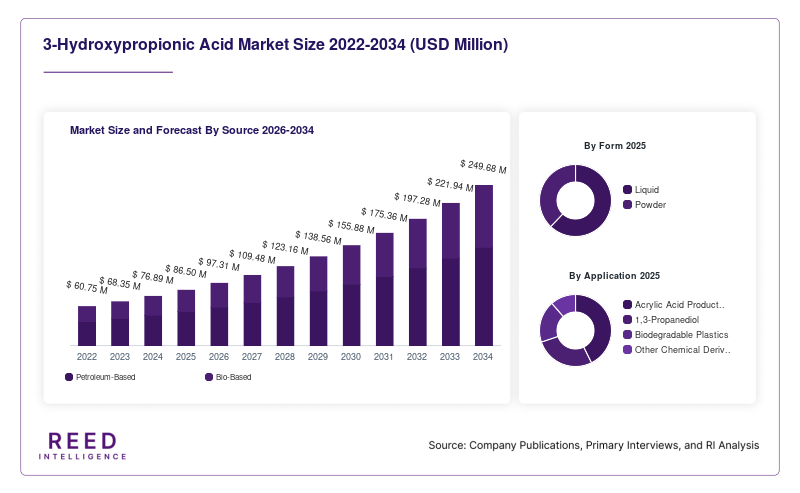
Petroleum-Based 3-HP represents approximately 62% of the global market in 2025, reflecting the established chemical-production infrastructure and existing downstream relationships. However, the strategic direction of the industry is increasingly toward biological production. Research and corporate development are focusing on fermentation routes based on glucose, glycerol, acetic acid and other renewable substrates.
Bio-Based 3-HP is the fastest-growing source segment, with a CAGR of approximately 16.8%, supported by investments in microbial strain engineering, renewable feedstocks and bio-acrylic-acid development. LG Chem's 100% bio-based acrylic-acid program is an important commercial example of this transition.
Form
Liquid 3-HP accounts for approximately 73% of the global market, supported by its suitability for chemical processing, fermentation-derived production and downstream conversion. 3-HP is commonly handled as an aqueous solution during biological production, making liquid form important in industrial processing.
Powder 3-HP represents approximately 27% of the market, serving applications where concentrated or dry material handling provides logistical advantages.
Powder is the faster-growing form, with a CAGR of approximately 13.7%, supported by easier storage, transportation and handling in specialized chemical applications.
Application
Acrylic Acid Production represents approximately 46% of the global market in 2025, making it the largest application. The importance of this segment comes from acrylic acid's established downstream uses in superabsorbent polymers, coatings, adhesives and other chemical products.
1,3-Propanediol accounts for approximately 21%, while Biodegradable Plastics represent 19% and Other Chemical Derivatives account for 14%.
Biodegradable Plastics are the fastest-growing application, with a CAGR of approximately 15.2%, supported by the use of 3-HP as a building block for compostable polymers and materials. LG Chem's PLH platform demonstrates the application of 3-HP in biodegradable material development.
End Use
Chemicals & Petrochemicals represent approximately 39% of the global market, reflecting the use of 3-HP as an intermediate and platform chemical. Acrylic acid production places the largest demand on this downstream group.
Plastics & Polymers account for approximately 28%, followed by Coatings & Adhesives at 15%, Personal Care & Cosmetics at 10%, and Other End Uses at 8%.
Plastics & Polymers are the fastest-growing end-use segment, with a CAGR of approximately 15.0%, supported by demand for biodegradable and renewable-content materials. LG Chem has also identified 3-HP-derived materials for films, disposable products and packaging-related applications.
Regional Analysis
North America 3-Hydroxypropionic Acid Market
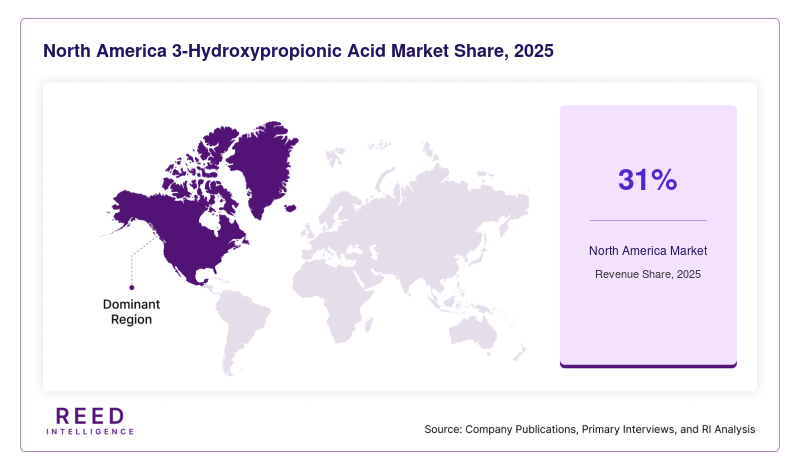
North America represents approximately 31% of the global market in 2025, supported by biotechnology research, chemical manufacturing infrastructure and demand for renewable chemical intermediates. The United States has a strong research base in metabolic engineering and bioprocess development, including work from national laboratories and universities on biological 3-HP production. PNNL has developed an engineered Aspergillus niger platform intended to improve 3-HP production toward commodity-chemical economics. The region also provides an important downstream market for bio-based acrylic acid, coatings, adhesives and personal-care ingredients. LG Chem specifically identified North America as one of its target markets for bio-acrylic acid. North America is projected to grow at approximately 11.2% CAGR.
Europe 3-Hydroxypropionic Acid Market
Europe accounts for approximately 26% of the market in 2025, supported by chemical manufacturing, sustainability-oriented materials development and demand for renewable feedstocks. European chemical companies operate across acrylics, coatings, polymers and specialty materials, creating downstream markets for bio-derived intermediates. The region's emphasis on circular materials and lower fossil dependence also supports investment in bio-based chemical routes. However, European production economics remain sensitive to energy, feedstock and regulatory-compliance costs. Europe is projected to grow at approximately 11.7% CAGR, supported by increased use of renewable chemical inputs and biodegradable polymer technologies.
APAC 3-Hydroxypropionic Acid Market
APAC represents approximately 30% of the market and is the fastest-growing region, with a CAGR of approximately 15.0%. The region combines major chemical manufacturing bases with substantial biotechnology research and fermentation expertise. South Korea is particularly important because LG Chem has developed proprietary 3-HP fermentation technology and collaborated with GS Caltex on commercialization and scale-up. China and India also have active research programs covering microbial engineering, glycerol conversion and renewable chemical production. Recent research from Asian institutions has continued to improve microbial pathways and feedstock flexibility. The combination of chemical manufacturing capacity and lower-cost fermentation infrastructure creates a strong commercialization pathway.
Middle East and Africa 3-Hydroxypropionic Acid Market
Middle East and Africa represents approximately 6% of the global market and is projected to grow at approximately 10.8% CAGR. The region's existing petrochemical infrastructure provides an established downstream customer base for acrylic acid, polymers and chemical intermediates. The transition toward bio-based 3-HP is comparatively earlier than in APAC, North America and Europe, but integrated chemical producers could use renewable feedstocks and biorefinery concepts to diversify raw-material sources. The principal constraint is the relatively limited local biological-production ecosystem and the need to develop reliable supply chains for biomass-derived feedstocks.
Latin America 3-Hydroxypropionic Acid Market
LATAM accounts for approximately 7% of the global market and is projected to grow at approximately 12.8% CAGR. The region has access to agricultural feedstocks and established biofuel industries, creating potential advantages for fermentation-based chemical production. Glycerol generated by biodiesel production is particularly relevant because it can serve as a substrate for 3-HP fermentation. Research has long identified biodiesel-derived glycerol as a potential feedstock for biological 3-HP production. The main opportunity is therefore integration with existing biofuel and agricultural-processing infrastructure, although large-scale purification and downstream chemical capacity remain important requirements.
Competitive Landscape
The 3-HP competitive landscape is developing around biotechnology capability, fermentation yield, feedstock flexibility, downstream purification and access to established chemical markets. Unlike mature commodity acids, competition is not yet based only on production volume. Companies and research organizations are attempting to solve the technical barriers that determine whether bio-based 3-HP can compete economically with fossil-derived intermediates.
LG Chem has one of the clearest commercial pathways. The company developed its own 3-HP fermentation strain and subsequently used the material to produce 100% bio-based acrylic acid. Its 2025 prototype program began with 100 metric tons per year and is intended to scale according to customer demand. The company's earlier collaboration with GS Caltex combined fermentation and purification capabilities, demonstrating the importance of integrating upstream biotechnology with downstream chemical processing.
Key Market Players
- LG Chem
- GS Caltex
- Cargill, Incorporated
- Beijing PhaBuilder Biotechnology Co., Ltd.
- Zhengzhou Alfa Chemical Co., Ltd.
- Fluoropharm Co., Ltd.
- Tokyo Chemical Industry Co., Ltd.
- Thermo Fisher Scientific
- PNNL / Agile BioFoundry
- Qingdao Institute of Bioenergy and Bioprocess Technology
Recent Market Developments
- February 2025 – LG Chem announced prototype production of 100% bio-based acrylic acid derived from 3-HP, with an initial capacity of 100 metric tons per year. The product received USDA Certified Biobased Product certification and was targeted at cosmetics, diapers, adhesives and coatings.
- July 2025 – ACS research demonstrated microbial production of 3-HP from acetic acid, creating a route using feedstocks potentially obtainable from biomass, organic waste, and C1-gas sources.
3-Hydroxypropionic Acid Market Segments
By Source
- Petroleum-Based
- Bio-Based
By Form
- Liquid
- Powder
By Application
- Acrylic Acid Production
- 1,3-Propanediol
- Biodegradable Plastics
- Other Chemical Derivatives
By End Use
- Chemicals & Petrochemicals
- Plastics & Polymers
- Personal Care & Cosmetics
- Coatings & Adhesives
- Other End Uses
By Region
- North America
- Europe
- APAC
- Middle East and Africa
- LATAM