3C Coating Market Size, Share & Demand Report By Coating Type (UV-Curable Coatings, Nano Coatings), By Substrate Material (Plastic, Glass, Metal, Composite Materials), By Application (Smartphones and Mobile Devices), By Technology (Solvent-Based Coatings, Water-Based Coatings, Powder Coatings, Hybrid Technologies), By End User (Consumer Electronics Manufacturers, Original Design Manufacturers (ODMs), Contract Electronics Manufacturers), By Region & Segment Forecasts, 2026–2034
USD 3950
Market Overview
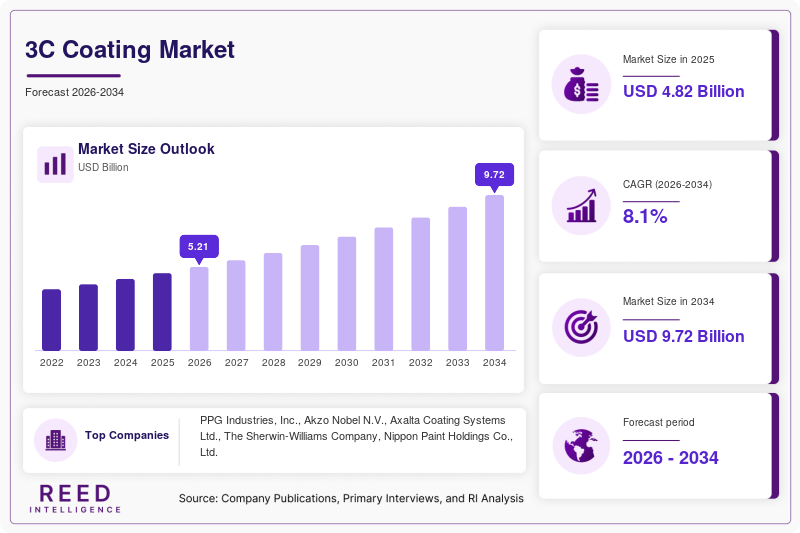
The 3C Coating Market size was valued at USD 4.82 billion in 2026 and is projected to reach USD 8.97 billion by 2034, expanding at a CAGR of 8.1% during the forecast period (2026–2034). The market is experiencing steady expansion due to increasing production of consumer electronics, communication devices, and computing equipment worldwide. Growing demand for durable, scratch-resistant, anti-fingerprint, and high-performance surface coatings across smartphones, laptops, tablets, wearable devices, and smart home products has accelerated market adoption.
One of the primary global factors supporting market growth has been the continued digitalization of economies and rapid penetration of connected electronic devices. The expansion of 5G infrastructure, rising adoption of Internet of Things (IoT) products, and increasing replacement cycles for premium electronic devices have encouraged manufacturers to invest in advanced coating technologies that enhance product aesthetics, durability, and functionality.
Key Highlights
- North America accounted for the largest market share of 34.2% in 2025, while Asia Pacific is expected to register the fastest CAGR of 9.4% during 2026–2034.
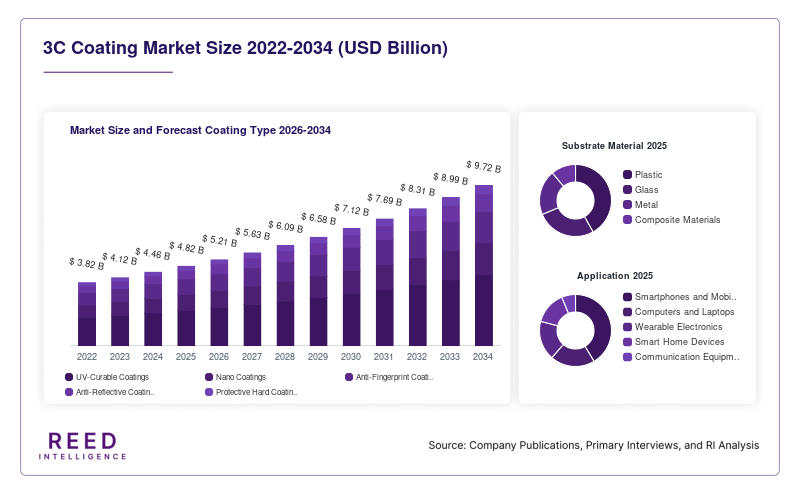
- By Coating Type, UV-Curable Coatings dominated with 38.6% market share in 2025, while Nano Coatings are projected to expand at a CAGR of 10.2%.
- By Substrate Material, Plastic Substrates held 44.1% share in 2025, whereas Composite Materials are forecast to grow at 9.8% CAGR.
- By Application, Smartphones and Mobile Devices represented 36.8% share in 2025, while Wearable Electronics are anticipated to grow at 10.7% CAGR.
- By Technology, Solvent-Based Coatings captured 41.3% share in 2025, while Water-Based Coatings are expected to witness 9.6% CAGR.
- The United States remained the dominant country market, valued at USD 1.21 billion in 2024 and USD 1.30 billion in 2025.
Market Trends
Integration of Nano-Engineered Surface Protection Technologies
The increasing incorporation of nano-engineered coating formulations is emerging as a significant trend in the 3C Coating Market. Manufacturers are deploying nanotechnology to improve scratch resistance, hydrophobic properties, anti-smudge performance, and optical clarity. Nano-coatings provide ultra-thin protection layers without compromising device appearance, making them particularly suitable for premium consumer electronics and advanced display applications. As device manufacturers focus on durability and user experience, nano-enhanced coatings are becoming an integral component of next-generation electronic products.
Shift Toward Sustainable and Low-Emission Coating Solutions
Environmental sustainability is reshaping product development strategies across the industry. Electronics manufacturers are increasingly adopting water-based and low-VOC coating formulations to comply with environmental regulations and corporate sustainability objectives. Coating suppliers are investing in green chemistry innovations that reduce emissions while maintaining high performance standards. This transition is expected to strengthen demand for environmentally responsible coating technologies across global manufacturing facilities.
Market Drivers
Expansion of Consumer Electronics Manufacturing
The rapid increase in production volumes of smartphones, tablets, laptops, smart appliances, and wearable devices is driving demand for specialized protective coatings. As electronic devices become thinner and more sophisticated, manufacturers require coatings that provide protection against abrasion, fingerprints, moisture, and daily wear. Rising consumer expectations regarding device durability and appearance continue to support market expansion.
Growing Demand for High-Performance Functional Coatings
The increasing need for anti-reflective, anti-microbial, anti-static, and oleophobic surface properties is accelerating adoption of advanced coating technologies. Electronics manufacturers are integrating multiple functional characteristics into a single coating layer to improve product performance and user convenience. The ability of modern coatings to enhance both aesthetics and functionality is creating sustained demand across multiple device categories.
Market Restraint
Volatility in Specialty Raw Material Costs
Fluctuating prices of specialty resins, additives, solvents, and advanced chemical intermediates present a significant challenge for coating manufacturers. Variations in raw material availability and pricing can affect production costs and profit margins, making long-term pricing strategies more difficult across the supply chain.
Market Opportunities
Increasing Adoption of Flexible and Foldable Electronics
The growing commercialization of foldable smartphones, flexible displays, and advanced wearable technologies is creating demand for highly adaptable coating solutions. Coatings capable of maintaining performance under repeated bending and deformation are expected to experience increasing adoption throughout the forecast period.
Expansion of Smart Home and Connected Device Ecosystems
The proliferation of smart home products, connected appliances, and IoT-enabled devices offers substantial growth opportunities for coating manufacturers. These products require durable surface protection and aesthetic enhancements, creating new application areas for advanced coating technologies.
Segmental Analysis
By Coating Type
The market is segmented into UV-Curable Coatings, Nano Coatings, Anti-Fingerprint Coatings, Anti-Reflective Coatings, and Protective Hard Coatings.
UV-Curable Coatings dominated the segment with 38.6% market share in 2025. Their rapid curing speed, excellent surface properties, and compatibility with high-volume production processes made them widely adopted across electronics manufacturing facilities.
Nano Coatings are expected to witness the fastest growth at a CAGR of 10.2% during 2026–2034. Increasing demand for ultra-thin protective layers capable of delivering superior hydrophobic and scratch-resistant performance will drive segment expansion.
By Substrate Material
The market includes Plastic, Glass, Metal, and Composite Materials.
Plastic Substrates accounted for the largest share of 44.1% in 2025 due to widespread utilization in smartphones, tablets, wearable devices, and consumer electronic housings. Their lightweight characteristics and design flexibility supported extensive adoption.
Composite Materials are projected to grow at a CAGR of 9.8% during the forecast period. Increasing use of advanced composite structures in premium electronics and lightweight device manufacturing will support future demand.
By Application
The segment comprises Smartphones and Mobile Devices, Computers and Laptops, Wearable Electronics, Smart Home Devices, and Communication Equipment.
Smartphones and Mobile Devices held the dominant position with 36.8% share in 2025. Continuous product launches, high replacement rates, and growing demand for premium surface finishes contributed to segment leadership.
Wearable Electronics are expected to expand at a CAGR of 10.7% through 2034. Rising consumer interest in smartwatches, fitness trackers, and health-monitoring devices will generate substantial demand for specialized protective coatings.
By Technology
The market is segmented into Solvent-Based Coatings, Water-Based Coatings, Powder Coatings, and Hybrid Technologies.
Solvent-Based Coatings captured 41.3% of market revenue in 2025 due to their strong adhesion properties and broad compatibility with various substrate materials.
Water-Based Coatings are forecast to grow at a CAGR of 9.6%. Increasing environmental compliance requirements and corporate sustainability initiatives will accelerate adoption of low-emission coating technologies.
By End User
The market includes Consumer Electronics Manufacturers, Original Design Manufacturers (ODMs), Contract Electronics Manufacturers, and Industrial Electronics Producers.
Consumer Electronics Manufacturers represented 47.5% market share in 2025. Large-scale production volumes and increasing emphasis on product differentiation supported demand for advanced coating solutions.
Contract Electronics Manufacturers are anticipated to register a CAGR of 9.1% during the forecast period. Growing outsourcing of electronics production activities will create opportunities for specialized coating applications across manufacturing networks.
Regional Analysis
North America
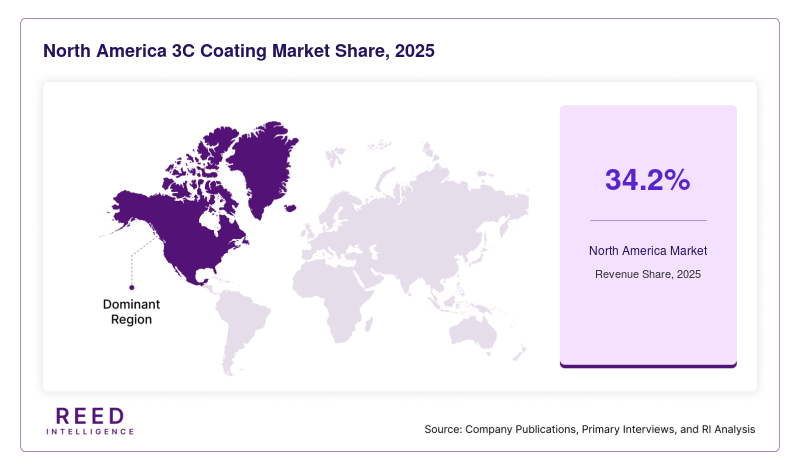
North America held 34.2% of the global 3C Coating Market share in 2025. The region is expected to expand at a CAGR of 7.4% from 2026 to 2034. Strong demand for premium consumer electronics, advanced manufacturing capabilities, and substantial investment in technology innovation supported regional growth.
The United States dominated the regional market due to extensive research and development activities focused on advanced surface engineering technologies. The country's emphasis on high-value electronic product manufacturing and premium device innovation contributed significantly to coating adoption.
Europe
Europe accounted for 24.6% market share in 2025 and is projected to grow at a CAGR of 7.8% during the forecast period. The region benefited from strong environmental compliance frameworks and increasing adoption of sustainable manufacturing practices.
Germany remained the leading country market owing to its sophisticated industrial base and strong presence of precision engineering companies. The country's focus on high-quality manufacturing standards encouraged demand for technologically advanced coating solutions.
Asia Pacific
Asia Pacific represented 28.8% of the global market in 2025 and is anticipated to register the fastest CAGR of 9.4% through 2034. The region's position as a global electronics manufacturing hub continued to support market expansion.
China dominated the regional landscape due to large-scale production of smartphones, computers, and consumer electronic devices. Extensive manufacturing infrastructure and continuous investments in electronics production capacity supported demand for coating materials and technologies.
Middle East & Africa
The Middle East & Africa accounted for 6.1% market share in 2025 and is forecast to expand at a CAGR of 7.2% between 2026 and 2034. Increasing digital transformation initiatives and rising electronics consumption contributed to market development.
The United Arab Emirates emerged as the dominant country market due to growing investments in technology infrastructure and increasing adoption of advanced consumer electronic products across commercial and residential sectors.
Latin America
Latin America captured 6.3% of the global market share in 2025 and is expected to grow at a CAGR of 7.6% during the forecast period. Rising urbanization and growing demand for connected electronic devices supported regional expansion.
Brazil led the regional market owing to its expanding consumer electronics sector and increasing domestic demand for smartphones, laptops, and smart household devices. Continued growth in technology adoption supported coating consumption across multiple applications.
Competitive Landscape
The 3C Coating Market remains moderately consolidated with participants focusing on technology innovation, strategic collaborations, product portfolio expansion, and sustainable formulation development.
PPG Industries maintained a leading market position through its broad coating portfolio and continued investment in advanced electronics protection technologies. The company recently expanded its specialty coatings portfolio to address growing demand for environmentally compliant electronics coating applications.
Akzo Nobel N.V. continues to strengthen its market presence through sustainable coating innovations and regional manufacturing expansion.
Axalta Coating Systems focuses on advanced functional coatings designed for high-performance electronic applications and precision manufacturing environments.
The Sherwin-Williams Company emphasizes research-driven product development and enhanced coating durability solutions for consumer electronics manufacturers.
Nippon Paint Holdings Co., Ltd. continues to expand its specialty electronics coatings business through technology investments and strategic partnerships across Asia-Pacific markets.
Key Players List
- PPG Industries, Inc.
- Akzo Nobel N.V.
- Axalta Coating Systems Ltd.
- The Sherwin-Williams Company
- Nippon Paint Holdings Co., Ltd.
- Kansai Paint Co., Ltd.
- Jotun A/S
- BASF SE
- Covestro AG
- Henkel AG & Co. KGaA
- 3M Company
- Dow Inc.
- Wacker Chemie AG
- H.B. Fuller Company
- RPM International Inc.
Recent Developments
- In 2025, several coating manufacturers introduced advanced nano-coating formulations designed to improve scratch resistance and fingerprint protection for premium consumer electronics.
- Electronics coating suppliers expanded production capacities across Asia Pacific to support increasing demand from smartphone and wearable device manufacturers.
- Multiple industry participants launched low-VOC and water-based coating systems aligned with evolving environmental compliance requirements.
- Strategic partnerships between coating developers and electronics manufacturers increased to accelerate commercialization of specialized protective surface technologies.
- Research investments in flexible coating materials intensified to address growing demand from foldable smartphone and flexible display applications.
3C Coating Market Segments
Coating Type
- UV-Curable Coatings
- Nano Coatings
- Anti-Fingerprint Coatings
- Anti-Reflective Coatings
- Protective Hard Coatings
Substrate Material
- Plastic
- Glass
- Metal
- Composite Materials
Application
- Smartphones and Mobile Devices
- Computers and Laptops
- Wearable Electronics
- Smart Home Devices
- Communication Equipment
Technology
- Solvent-Based Coatings
- Water-Based Coatings
- Powder Coatings
- Hybrid Technologies
End User
- Consumer Electronics Manufacturers
- Original Design Manufacturers (ODMs)
- Contract Electronics Manufacturers
- Industrial Electronics Producers
By Region
- North America
- Europe
- APAC
- Middle East and Africa
- LATAM