3D Bioprinting Intellectual Property Landscape Market Size, Share Demand Report By IP Type (Patents, Licensing Agreements, Trademarks), By Technology Area (Bioink Formulations, Printer Hardware), By End User (Biotechnology Companies, Pharmaceutical Companies, Academic Institutes, Hospitals), By Application (Tissue Engineering, Drug Discovery Model), By Region & Segment Forecasts, 2026–2034
USD 3950
Market Overview
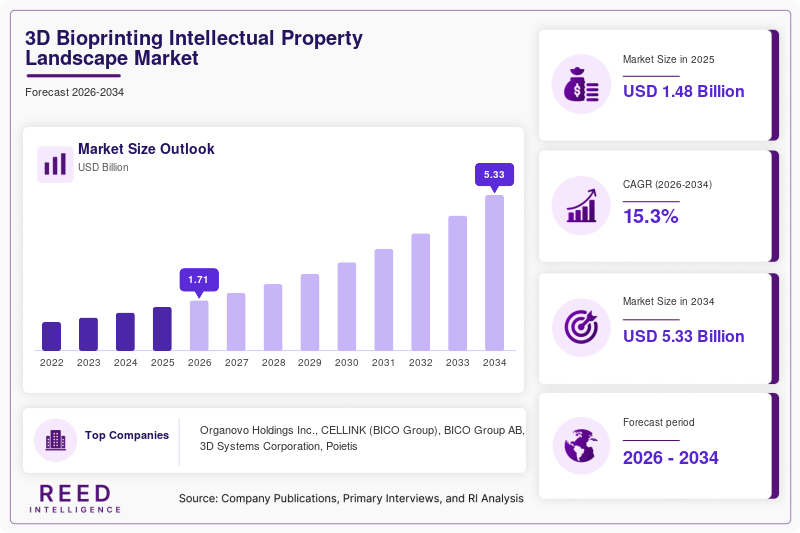
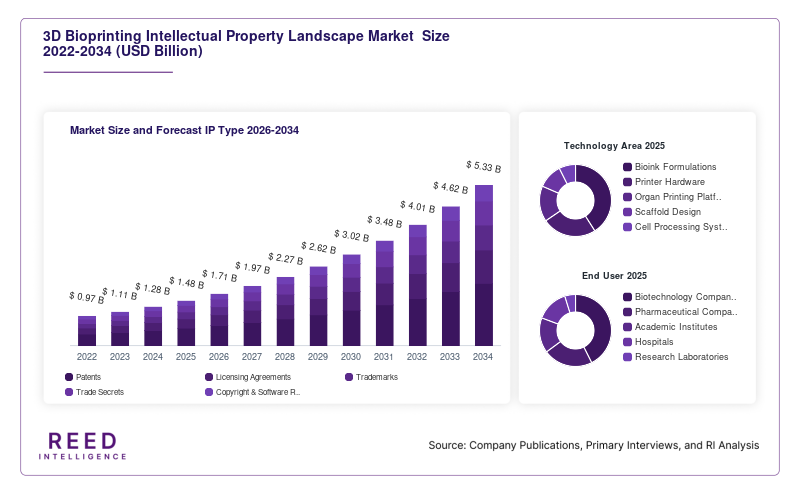
The 3D Bioprinting Intellectual Property Landscape Market size was valued at USD 1.48 billion in 2026 and is projected to reach USD 4.62 billion by 2034, expanding at a CAGR of 15.3% during 2026–2034. The market reflects the rising commercial value of patents, licensing portfolios, technology transfers, trademark assets, and proprietary know-how linked to bioprinting hardware, bioinks, tissue engineering methods, scaffold design, and regenerative medicine workflows.
A major global factor supporting the growth of the 3D Bioprinting Intellectual Property Landscape Market has been the expansion of precision healthcare and regenerative medicine funding. Governments, universities, and private investors have increased spending on organ repair research, cell therapy manufacturing, and advanced biomaterials, resulting in a larger volume of patent filings and strategic licensing activity.
Key Highlights
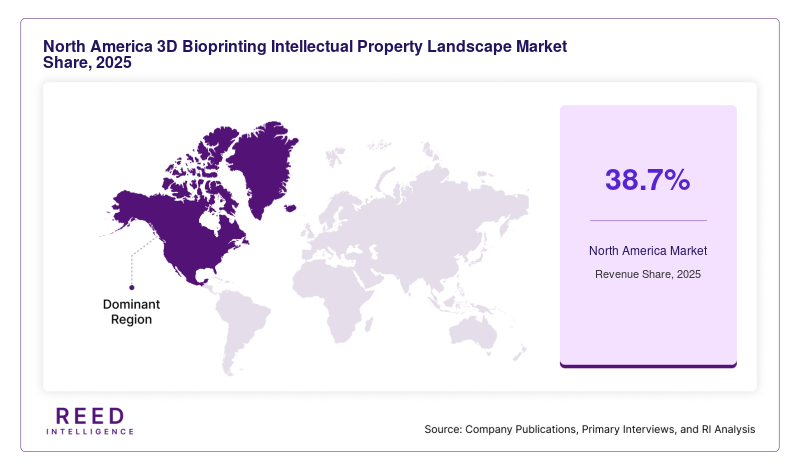
- North America held the dominant regional share of 38.7% in 2025.
- Asia Pacific is expected to be the fastest-growing region with a 17.8% CAGR through 2034.
- By IP Type, Patents led with 54.2% share in 2025.
- By IP Type, Licensing Agreements will be the fastest-growing subsegment at 16.9% CAGR.
- By Technology Area, Bioink Formulations led with 31.4% share.
- By Technology Area, Organ Printing Platforms will grow fastest at 18.4% CAGR.
- By End User, Biotechnology Companies dominated with 36.1% share.
- By End User, Pharmaceutical Companies will grow fastest at 17.2% CAGR.
- The United States, the dominant country, was valued at USD 451 million in 2024 and USD 512 million in 2025.
Market Trends
AI-Driven Patent Intelligence Platforms
Companies are increasingly using AI tools to map patent clusters, detect infringement risks, and identify white-space innovation zones. This trend is improving portfolio valuation and accelerating transaction decisions in the 3D Bioprinting Intellectual Property Landscape Market.
Rise of Cross-Licensing and Collaborative Ownership
As bioprinting systems combine hardware, software, cells, and materials, ownership structures are becoming more complex. Cross-licensing models between printer developers, bioink specialists, and tissue engineering firms are becoming more common.
Market Drivers
Growth in Regenerative Medicine Commercialization
As tissue repair and personalized implants move closer to commercial use, companies are securing patents and trademarks to protect future revenue streams. This has increased IP filing activity across multiple jurisdictions.
Increasing University Technology Transfer Activity
Academic institutions are producing a large share of bioprinting innovation. Stronger university commercialization programs are leading to spinouts, licensing deals, and IP asset sales, supporting market expansion.
Market Restraint
Complex Global Patent Enforcement
Differences in patent law, biological material claims, and process patentability across countries create enforcement challenges. This raises legal costs and delays monetization strategies for market participants.
Market Opportunities
Expansion of Emerging Market Patent Filings
Countries in Asia and Latin America are strengthening biotech innovation systems. This creates opportunities for early-stage patent filings and local licensing partnerships.
IP Packaging for Contract Research Partnerships
Bioprinting developers are increasingly bundling patents, software rights, and process know-how into structured partnerships with CROs and pharma firms, opening new recurring revenue models.
Segmental Analysis
By IP Type
Patents: Patents accounted for the dominant 54.2% share in 2025. Strong demand for exclusive protection of printer mechanisms, cell deposition systems, and biomaterial processes drove segment leadership.
Licensing Agreements: Licensing Agreements will grow at the fastest 16.9% CAGR through 2034. Many firms will prefer licensing over full acquisition to access technologies with lower upfront capital requirements.
By Technology Area
Bioink Formulations: Bioink Formulations held 31.4% share in 2025 due to extensive research in hydrogels, stem-cell carriers, and tissue-compatible polymers.
Organ Printing Platforms: Organ Printing Platforms will expand at 18.4% CAGR. Growth will be supported by increasing efforts to print liver, skin, cartilage, and vascular tissues for clinical and testing use.
By End User
Biotechnology Companies: Biotechnology Companies captured 36.1% share in 2025. These firms actively accumulated IP assets to strengthen valuations and partnership potential.
Pharmaceutical Companies: Pharmaceutical Companies will witness 17.2% CAGR through 2034. They will increase investment in bioprinted tissues for drug screening and toxicity testing.
By Transaction Type
Direct Licensing: Direct Licensing represented 43.8% share in 2025, reflecting straightforward bilateral commercialization structures.
Joint Ventures: Joint Ventures will grow at 16.1% CAGR as companies seek shared ownership models for expensive R&D programs.
By Application
Tissue Engineering: Tissue Engineering led with 39.6% share in 2025 due to high patent activity in scaffold structures and cell patterning methods.
Drug Discovery Models: Drug Discovery Models will grow at 17.5% CAGR, supported by demand for realistic human tissue testing alternatives.
Regional Analysis
North America
North America accounted for 38.7% of the 2025 market share and will grow at a 14.6% CAGR through 2034. The United States remained the leading country due to its strong venture funding ecosystem and advanced university patent commercialization networks. Major patent activity in tissue scaffolds and medical device bioprinting supported regional demand.
Europe
Europe held 27.1% of the 2025 market share and will expand at a 14.9% CAGR during the forecast period. Germany led regional growth due to strong biomedical engineering capabilities and structured public-private innovation grants supporting translational research ownership.
Asia Pacific
Asia Pacific represented 22.4% of the 2025 market share and will register the fastest 17.8% CAGR through 2034. China was the leading country, supported by large-scale investments in domestic patent generation and local manufacturing of advanced bioprinting systems.
Middle East & Africa
Middle East & Africa captured 6.1% of the 2025 market share and will grow at a 13.1% CAGR. The United Arab Emirates led regional development through health innovation zones and biotechnology incubation programs attracting foreign partnerships.
Latin America
Latin America held 5.7% of the 2025 market share and is projected to grow at a 13.8% CAGR. Brazil remained the dominant country due to expanding life sciences research clusters and greater adoption of biomedical commercialization frameworks.
Competitive Landscape
The 3D Bioprinting Intellectual Property Landscape Market remains moderately concentrated with a mix of printer developers, biomaterial innovators, and research-driven biotech firms. Leading participants focus on patent expansion, licensing revenue, and collaboration with pharmaceutical companies.
Organovo Holdings Inc. remained a market leader due to its early patent portfolio in human tissue bioprinting and commercialization strategy. The company recently expanded its licensing discussions around disease-model platforms.
CELLINK (BICO Group) maintains a broad portfolio in bioprinters, consumables, and software integration.
3D Systems Corporation continues to strengthen healthcare-related additive manufacturing patents.
Poietis focuses on laser-assisted bioprinting technologies for regenerative medicine.
Allevi Inc. has built recognition in research-grade desktop bioprinting systems and academic partnerships.
Competition is increasingly based on portfolio breadth, enforceability, cross-border filings, and access to application-specific know-how.
Key Players List
- Organovo Holdings Inc.
- CELLINK
- BICO Group AB
- 3D Systems Corporation
- Poietis
- Allevi Inc.
- Aspect Biosystems
- regenHU
- Cyfuse Biomedical K.K.
- EnvisionTEC GmbH
- Inventia Life Science
- Advanced Solutions Life Sciences
- Rokit Healthcare
- T&R Biofab
- CollPlant Biotechnologies
Recent Developments
- In 2025, several bioprinting firms expanded patent filings for vascular tissue generation methods.
- Printer manufacturers introduced bundled licensing models combining hardware and bioink rights.
- Universities increased spinout creation around cell-printing software algorithms.
- Pharmaceutical companies signed multi-year evaluation agreements for bioprinted tissue platforms.
- Cross-border collaborations increased between North American and Asian developers for co-owned IP portfolios.
3D Bioprinting Intellectual Property Landscape Market Segments
IP Type
- Patents
- Licensing Agreements
- Trademarks
- Trade Secrets
- Copyright & Software Rights
Technology Area
- Bioink Formulations
- Printer Hardware
- Organ Printing Platforms
- Scaffold Design
- Cell Processing Systems
End User
- Biotechnology Companies
- Pharmaceutical Companies
- Academic Institutes
- Hospitals
- Research Laboratories
Application
- Tissue Engineering
- Drug Discovery Models
- Implants
- Cosmetic Testing
- Personalized Medicine
By Region
- North America
- Europe
- APAC
- Middle East and Africa
- LATAM