3D Cardiac Mapping System Market Size, Share & Demand Report By Type (Contact Mapping Systems, Non-Contact Mapping Systems), By Application (Atrial Fibrillation, Ventricular Tachycardia, Other Arrhythmias), By Component (Hardware, Software), By End-Use (Hospitals, Ambulatory Surgical Centers, Specialty Clinics), By Region & Segment Forecasts, 2025–2034
USD 3950
Market Overview
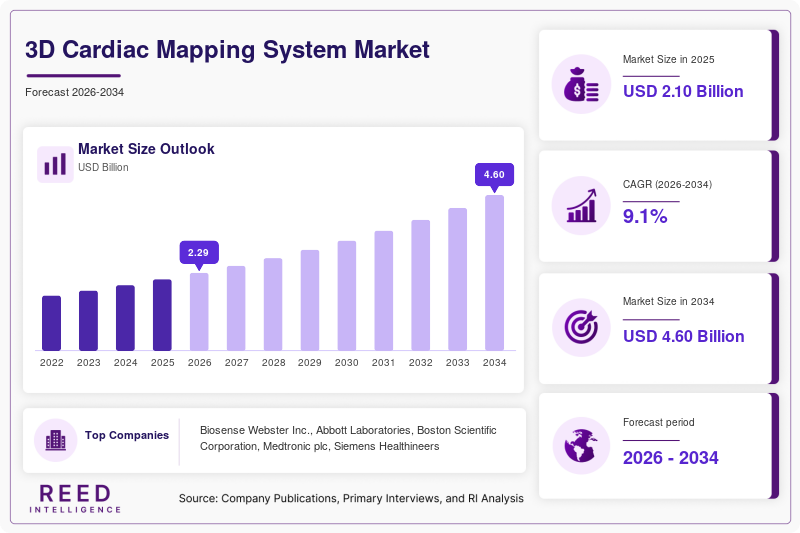
The 3D Cardiac Mapping System Market size was valued at approximately USD 2.1 billion in 2025 and is projected to reach USD 4.6 billion by 2034, expanding at a CAGR of 9.1% during 2025–2034. The market growth reflects increasing adoption of advanced electrophysiology procedures for diagnosing and treating complex cardiac arrhythmias. The integration of high-resolution imaging and real-time mapping capabilities has enhanced procedural accuracy, thereby strengthening market demand across developed and emerging healthcare systems.
A major global factor supporting the expansion of the 3D Cardiac Mapping System Market is the rising prevalence of cardiovascular diseases, particularly atrial fibrillation and ventricular tachycardia. Healthcare systems worldwide are prioritizing early diagnosis and minimally invasive treatments, which has accelerated the deployment of mapping systems in electrophysiology labs. In addition, continuous technological advancements in catheter-based mapping and software-driven visualization tools are contributing to improved clinical outcomes and workflow efficiency.
Key Highlights
- North America dominated the market with 38.5% share in 2025, while Asia Pacific is projected to register the fastest CAGR of 11.2% during the forecast period.
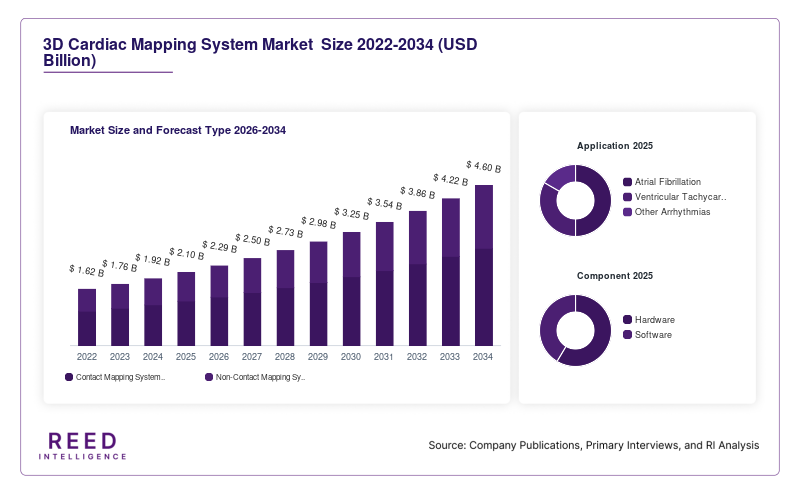
- By type, contact mapping systems led with 61% share in 2025, while non-contact mapping systems are expected to grow at a CAGR of 10.4%.
- By application, atrial fibrillation remained the leading segment with 47% share, whereas ventricular tachycardia mapping is projected to grow at 9.8% CAGR.
- The U.S. accounted for USD 720 million in 2025 and is expected to reach USD 770 million in 2026, maintaining its dominance in the global landscape.
Market Trends
Integration of Artificial Intelligence in Mapping Systems
The 3D Cardiac Mapping System Market is witnessing a notable trend toward the integration of artificial intelligence (AI) and machine learning algorithms. These technologies enable automated signal interpretation, enhanced mapping precision, and predictive analysis during electrophysiology procedures. AI-driven platforms reduce procedure time and operator dependency while improving diagnostic accuracy. As healthcare providers focus on efficiency and clinical outcomes, the demand for intelligent mapping solutions is steadily increasing.
Shift Toward Minimally Invasive Electrophysiology Procedures
Another significant trend shaping the 3D Cardiac Mapping System Market is the growing preference for minimally invasive cardiac procedures. Patients and clinicians are opting for catheter-based interventions that reduce recovery time and complications. This shift has driven the adoption of advanced 3D mapping systems capable of providing detailed anatomical visualization without the need for open surgery. The trend is further supported by increasing investments in ambulatory surgical centers and specialized cardiac clinics.
Market Drivers
Rising Incidence of Cardiac Arrhythmias
The increasing prevalence of cardiac arrhythmias, including atrial fibrillation and ventricular tachycardia, is a primary driver of the 3D Cardiac Mapping System Market. Aging populations and lifestyle-related risk factors such as obesity and hypertension have led to a higher burden of cardiovascular disorders. As a result, healthcare providers are adopting advanced mapping systems to improve diagnostic precision and treatment outcomes. The growing patient pool is directly contributing to the expansion of electrophysiology procedures globally.
Technological Advancements in Electrophysiology Equipment
Continuous innovation in mapping technologies is accelerating market growth. Modern 3D cardiac mapping systems offer high-resolution imaging, real-time data visualization, and improved catheter navigation. These advancements enhance procedural efficiency and reduce complications. Additionally, the development of hybrid systems combining imaging modalities and mapping capabilities is creating new opportunities for clinical applications, thereby driving the overall growth of the market.
Market Restraint
High Cost of 3D Cardiac Mapping Systems and Procedures
One of the key challenges limiting the growth of the 3D Cardiac Mapping System Market is the high cost associated with these systems and related procedures. The installation of advanced mapping equipment requires significant capital investment, which can be a barrier for small and mid-sized healthcare facilities. Additionally, the cost of consumables and maintenance further increases the overall expenditure.
Patients undergoing electrophysiology procedures also face high treatment costs, particularly in regions with limited insurance coverage. This factor restricts market penetration in developing economies where healthcare budgets are constrained. Furthermore, the requirement for skilled professionals to operate these systems adds to operational costs, creating an additional barrier to widespread adoption.
As a result, despite technological advancements and growing demand, cost-related challenges continue to hinder the full-scale expansion of the 3D Cardiac Mapping System Market.
Market Opportunities
Expansion in Emerging Healthcare Markets
Emerging economies present significant growth opportunities for the 3D Cardiac Mapping System Market. Rapid urbanization, improving healthcare infrastructure, and increasing healthcare expenditure are driving demand for advanced medical technologies. Governments in these regions are investing in cardiac care facilities and promoting early diagnosis of cardiovascular diseases. This environment is expected to create favorable conditions for market expansion over the forecast period.
Development of Portable and Compact Mapping Systems
The development of portable and compact 3D cardiac mapping systems is another promising opportunity. These systems enable greater accessibility in smaller hospitals and outpatient settings, expanding the reach of advanced electrophysiology procedures. Manufacturers are focusing on reducing system size while maintaining performance, which will support adoption in resource-limited environments. This innovation is likely to open new avenues for growth in both developed and developing markets.
Segmental Analysis
By Type
Contact mapping systems dominated the 3D Cardiac Mapping System Market with a 61% share in 2025. These systems were widely used due to their high accuracy and ability to provide detailed electrical activity mapping. Their reliability in complex procedures made them a preferred choice among healthcare professionals.
Non-contact mapping systems are expected to grow at a CAGR of 10.4% during the forecast period. These systems will gain traction due to their ability to map cardiac activity without direct tissue contact, reducing procedural risks and improving efficiency.
By Application
Atrial fibrillation accounted for the largest share of 47% in 2025. The high prevalence of this condition and the need for precise diagnosis and treatment contributed to its dominance in the market.
Ventricular tachycardia mapping is projected to grow at a CAGR of 9.8%. The increasing complexity of ventricular arrhythmias and the need for advanced mapping solutions will drive growth in this segment.
By End-Use
Hospitals held the dominant share of 65% in 2025 due to the availability of advanced infrastructure and skilled professionals. Large patient volumes and access to comprehensive treatment facilities contributed to their leading position.
Ambulatory surgical centers are expected to grow at a CAGR of 10.1%. The shift toward outpatient procedures and cost-effective treatment options will support growth in this segment.
By Component
Hardware systems accounted for the largest share of 58% in 2025. These systems form the core of mapping technology and are essential for performing electrophysiology procedures.
Software solutions are expected to grow at a CAGR of 10.6%. The increasing demand for advanced data visualization and analytics will drive growth in this segment.
Regional Analysis
North America
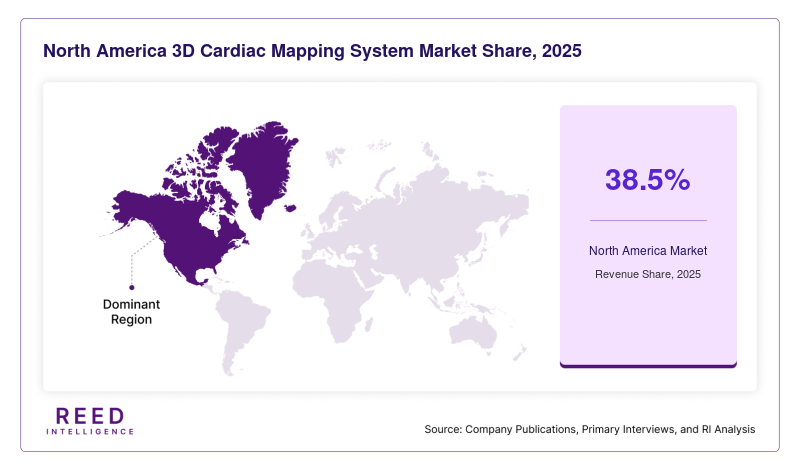
North America accounted for 38.5% of the 3D Cardiac Mapping System Market share in 2025 and is expected to grow at a CAGR of 8.7% during the forecast period. The region’s strong market position was supported by advanced healthcare infrastructure and high adoption of innovative medical technologies. The presence of well-established electrophysiology centers contributed to widespread use of mapping systems.
The United States dominated the regional market due to a high prevalence of cardiac arrhythmias and strong reimbursement frameworks. The country’s focus on technological innovation and early adoption of advanced treatment methods has significantly supported market growth.
Europe
Europe held approximately 27.2% share in 2025 and is projected to grow at a CAGR of 8.5%. The region’s growth was driven by increasing healthcare spending and a rising number of electrophysiology procedures. Government initiatives aimed at improving cardiac care also contributed to market expansion.
Germany emerged as the dominant country due to its well-developed healthcare system and emphasis on advanced diagnostic technologies. The country’s investment in research and clinical studies has further supported the adoption of 3D mapping systems.
Asia Pacific
Asia Pacific captured 21.8% share in 2025 and is expected to register the fastest CAGR of 11.2%. Rapid economic development and improving healthcare infrastructure have accelerated market growth in the region. Increasing awareness about cardiovascular diseases has also driven demand for advanced diagnostic tools.
China led the regional market due to its large patient population and expanding healthcare facilities. The government’s focus on strengthening cardiac care services has created a strong growth environment for the market.
Middle East & Africa
The Middle East & Africa region held 6.1% share in 2025 and is projected to grow at a CAGR of 9.0%. The market growth was supported by improving healthcare infrastructure and rising investments in medical technology. The increasing burden of cardiovascular diseases has also contributed to demand.
Saudi Arabia dominated the region due to its focus on healthcare modernization and investment in specialized cardiac centers. The country’s initiatives to enhance medical services have supported the adoption of advanced mapping systems.
Latin America
Latin America accounted for 6.4% share in 2025 and is expected to grow at a CAGR of 8.9%. The region’s growth was driven by increasing healthcare awareness and gradual improvement in medical infrastructure. Rising demand for minimally invasive procedures has further supported market expansion.
Brazil emerged as the leading country due to its growing healthcare sector and increasing number of cardiac procedures. The country’s focus on improving access to advanced treatments has contributed to market growth.
Competitive Landscape
The 3D Cardiac Mapping System Market is characterized by the presence of several global and regional players focusing on technological innovation and strategic collaborations. Companies are investing in research and development to enhance system capabilities and improve clinical outcomes.
A leading player in the market is Biosense Webster, which has maintained a strong position through continuous innovation and product development. The company recently introduced an advanced mapping platform with enhanced visualization features, strengthening its market presence.
Other key players are focusing on expanding their product portfolios and entering emerging markets to increase their global footprint. Strategic partnerships and acquisitions are also common strategies adopted to gain competitive advantage.
Key Players List
- Biosense Webster Inc.
- Abbott Laboratories
- Boston Scientific Corporation
- Siemens Healthineers
- GE Healthcare
- Philips Healthcare
- Medtronic plc
- Acutus Medical Inc.
- MicroPort Scientific Corporation
- Stereotaxis Inc.
- Biotronik SE & Co. KG
- Lepu Medical Technology
- Johnson & Johnson
- Nihon Kohden Corporation
- CardioFocus Inc.
Recent Developments
- In 2024, a major market player launched a next-generation mapping system with improved real-time imaging capabilities.
- In 2023, a leading company expanded its presence in Asia Pacific through strategic partnerships with regional healthcare providers.
- In 2024, advancements in AI-enabled mapping software enhanced procedural efficiency and reduced operation time.
- In 2025, several companies focused on developing compact systems to increase accessibility in smaller healthcare facilities.
- Ongoing investments in research and innovation continue to shape the future of the 3D Cardiac Mapping System Market.
3D Cardiac Mapping System Market Segments
Type
- Contact Mapping Systems
- Non-Contact Mapping Systems
Application
- Atrial Fibrillation
- Ventricular Tachycardia
- Other Arrhythmias
Component
- Hardware
- Software
End-Use
- Hospitals
- Ambulatory Surgical Centers
- Specialty Clinics
By Region
- North America
- Europe
- APAC
- Middle East and Africa
- LATAM