3D Orthopedic Scanning System Market Size, Share Demand Report By Technology (Optical Scanning, Laser Scanning, Structured Light Scanning), By Application (Preoperative Planning, Prosthetics Design, Orthopedic Diagnosis, Rehabilitation Monitoring), By End-Use (Hospitals, Orthopedic Clinics, Rehabilitation Centers) By Region & Segment Forecasts, 2026–2034
USD 3950
Market Overview
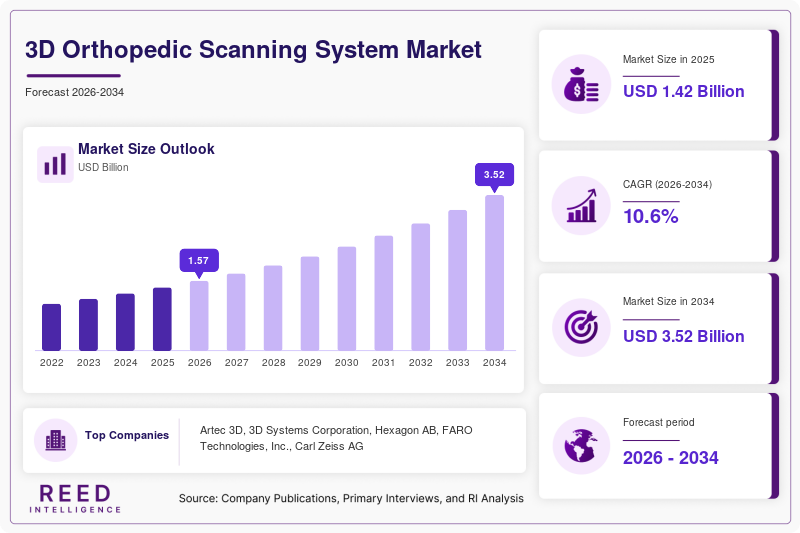
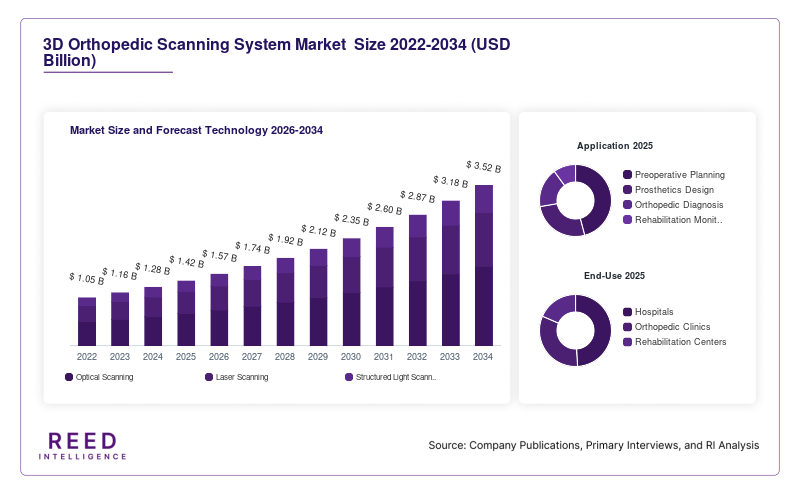
The 3D Orthopedic Scanning System Market size was valued at approximately USD 1.42 billion in 2026 and is projected to reach USD 3.18 billion by 2034, expanding at a CAGR of 10.6% during the forecast period (2026–2034). The market growth is primarily supported by the rising global prevalence of musculoskeletal disorders and the increasing demand for precision-driven orthopedic diagnostics. The adoption of 3D scanning systems in orthopedic applications has improved clinical accuracy, enabled faster treatment planning, and enhanced patient outcomes, making them an essential component in modern healthcare facilities.
One global factor significantly contributing to the expansion of the market is the rapid integration of digital healthcare technologies. Hospitals and orthopedic centers are transitioning toward advanced imaging and modeling solutions to reduce manual errors and optimize surgical planning. The growing use of 3D scanning in preoperative planning, prosthetics design, and rehabilitation monitoring is accelerating adoption across developed and emerging economies. Additionally, the increasing aging population worldwide has amplified the need for orthopedic interventions, further driving demand for accurate and efficient scanning systems.
Key Highlights
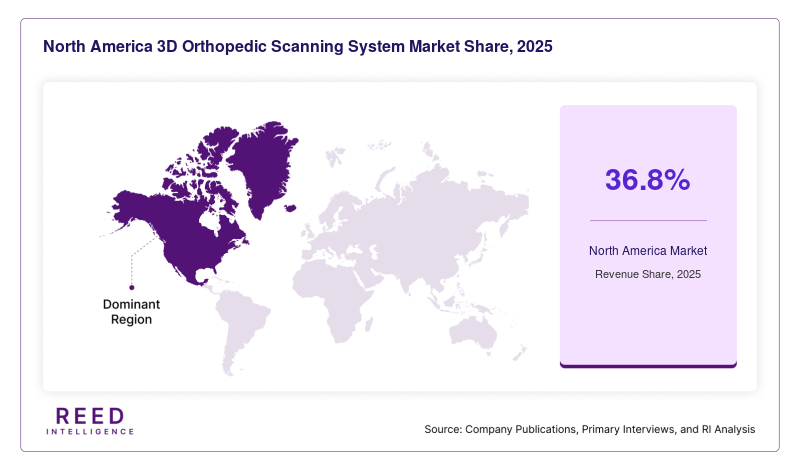
- North America dominated the market with a 36.8% share in 2025.
- Asia Pacific is expected to grow at the fastest CAGR of 11.9% during 2026–2034.
- By technology, optical scanning accounted for the largest share of 42.3%, while structured light scanning is projected to grow at a CAGR of 12.6%.
- By application, preoperative planning led with a 44.1% share, whereas prosthetics design is expected to expand at a CAGR of 11.7%.
- The United States remained the dominant country, with market values of USD 480 million in 2024 and USD 525 million in 2025.
Market Trends
Integration of AI and Machine Learning in 3D Orthopedic Imaging
Artificial intelligence and machine learning are increasingly being embedded into 3D orthopedic scanning systems to improve diagnostic precision and workflow efficiency. These technologies enable automated image segmentation, real-time analysis, and predictive modeling, which significantly reduce the burden on clinicians. AI-powered solutions can identify anomalies in bone structures, detect fractures, and assist in designing patient-specific implants. This integration is particularly beneficial in complex orthopedic surgeries, where precision is critical. Moreover, healthcare providers are adopting AI-enabled scanning platforms to enhance decision-making and reduce treatment timelines, which is further strengthening the market outlook.
Growing Adoption of Portable and Handheld Scanning Devices
The market is witnessing a shift toward portable and handheld 3D orthopedic scanning devices, driven by the need for flexibility and point-of-care diagnostics. These devices offer ease of use, reduced setup time, and improved accessibility in remote or resource-constrained settings. Handheld scanners are increasingly being used in outpatient clinics, rehabilitation centers, and sports medicine applications. Their ability to deliver accurate 3D imaging without the need for bulky equipment is attracting significant attention. Additionally, advancements in battery technology and wireless connectivity are improving device performance, making portable solutions a key trend shaping the market landscape.
Market Drivers
Increasing Prevalence of Orthopedic Disorders and Aging Population
The rising incidence of orthopedic conditions such as osteoporosis, arthritis, and spinal disorders is a major factor driving the growth of the 3D orthopedic scanning system market. As the global population ages, the demand for orthopedic diagnostics and treatments continues to increase. Elderly individuals are more prone to fractures and joint-related issues, which require precise imaging for effective treatment planning. 3D scanning systems provide detailed anatomical visualization, enabling clinicians to develop customized treatment strategies. This growing patient pool is encouraging healthcare providers to invest in advanced imaging technologies, thereby fueling market expansion.
Advancements in 3D Imaging Technologies and Digital Healthcare Infrastructure
Technological advancements in 3D imaging, including improved resolution, faster processing speeds, and enhanced software capabilities, are significantly contributing to market growth. Modern 3D scanning systems offer high accuracy and reproducibility, making them suitable for complex orthopedic applications. Additionally, the expansion of digital healthcare infrastructure, including electronic health records and telemedicine platforms, is supporting the integration of 3D scanning systems into clinical workflows. These advancements enable seamless data sharing and collaboration among healthcare professionals, improving patient care and driving adoption across hospitals and clinics.
Market Restraints
High Cost of Equipment and Limited Accessibility in Emerging Regions
One of the primary challenges hindering the growth of the 3D orthopedic scanning system market is the high cost associated with advanced scanning equipment. These systems require significant initial investment, along with ongoing maintenance and software upgrade costs. This financial burden limits adoption, particularly among small healthcare facilities and clinics in developing regions. Additionally, the lack of skilled professionals to operate these systems further restricts market penetration. In emerging economies, healthcare budgets are often constrained, leading to slower adoption of advanced technologies. This restraint not only impacts market growth but also creates disparities in access to high-quality orthopedic care, highlighting the need for cost-effective solutions and training initiatives.
Market Opportunities
Expansion of Customized Orthopedic Implants and Prosthetics
The growing demand for personalized healthcare solutions presents a significant opportunity for the 3D orthopedic scanning system market. 3D scanning technology enables the creation of patient-specific implants and prosthetics, which improve comfort, functionality, and overall treatment outcomes. This trend is gaining traction in both developed and developing regions, as patients and healthcare providers seek tailored solutions. The integration of 3D scanning with additive manufacturing technologies further enhances the ability to produce customized orthopedic devices. As awareness and adoption of personalized medicine increase, the demand for advanced scanning systems is expected to rise, creating new growth avenues for market players.
Rising Adoption in Sports Medicine and Rehabilitation
The increasing focus on sports medicine and rehabilitation is another key opportunity for market growth. Athletes and active individuals require precise assessment of injuries and recovery progress, which can be effectively achieved using 3D orthopedic scanning systems. These systems provide detailed insights into musculoskeletal structures, enabling accurate diagnosis and monitoring. Rehabilitation centers are also adopting 3D scanning technologies to track patient progress and optimize therapy plans. The growing popularity of fitness and sports activities worldwide is driving demand for advanced diagnostic tools, positioning 3D orthopedic scanning systems as a valuable asset in this segment.
Segmental Analysis
By Technology
Optical scanning technology dominated the market in 2024, accounting for a share of 42.3%. This dominance is attributed to its high accuracy, non-invasive nature, and ability to capture detailed 3D images of anatomical structures. Optical scanners are widely used in orthopedic applications such as preoperative planning and prosthetics design due to their precision and reliability. Healthcare providers prefer this technology as it reduces patient discomfort and eliminates exposure to radiation. Additionally, advancements in optical imaging techniques have improved resolution and scanning speed, further enhancing their adoption across hospitals and clinics.
Structured light scanning is expected to be the fastest-growing subsegment, with a CAGR of 12.6% during the forecast period. This growth is driven by its ability to provide high-resolution 3D images with minimal distortion. Structured light scanners are increasingly being used in complex orthopedic procedures where precision is critical. The technology’s compatibility with digital workflows and its integration with advanced software solutions are further supporting its growth. As healthcare providers continue to adopt digital imaging technologies, the demand for structured light scanning systems is expected to increase significantly.
By Application
Preoperative planning emerged as the dominant application segment, holding a 44.1% share in 2024. The use of 3D orthopedic scanning systems in preoperative planning allows surgeons to visualize patient anatomy in detail, enabling accurate surgical planning and reducing the risk of complications. This application is particularly important in complex orthopedic procedures, where precision is essential. The increasing adoption of minimally invasive surgeries is further driving demand for 3D scanning systems in preoperative planning.
Prosthetics design is anticipated to be the fastest-growing application segment, with a CAGR of 11.7% during the forecast period. The growing demand for customized prosthetics is a key factor driving this growth. 3D scanning systems enable the creation of patient-specific prosthetic devices, improving comfort and functionality. Advances in additive manufacturing technologies are also supporting the development of customized prosthetics, further boosting demand for 3D scanning systems in this segment.
By End-Use
Hospitals accounted for the largest share of 48.6% in 2024, driven by the high volume of orthopedic procedures performed in these settings. Hospitals are equipped with advanced medical technologies and have the resources to invest in 3D orthopedic scanning systems. The integration of these systems into hospital workflows improves diagnostic accuracy and enhances patient care. Additionally, the increasing number of orthopedic surgeries and the growing focus on precision medicine are driving adoption in hospitals.
Rehabilitation centers are expected to be the fastest-growing end-use segment, with a CAGR of 11.3% during the forecast period. The increasing emphasis on post-surgical recovery and physical therapy is driving demand for advanced diagnostic tools in rehabilitation centers. 3D orthopedic scanning systems enable accurate monitoring of patient progress and help in designing effective rehabilitation programs. The growing awareness about the importance of rehabilitation in improving patient outcomes is further supporting the growth of this segment.
Regional Analysis
North America
North America accounted for a significant share of the 3D orthopedic scanning system market, contributing 36.8% in 2025, and is expected to maintain steady growth at a CAGR of 9.8% during the forecast period. The region benefits from a well-established healthcare infrastructure, high adoption of advanced technologies, and strong presence of key market players. Increasing investments in healthcare innovation and the widespread use of digital imaging systems are supporting market growth. Additionally, favorable reimbursement policies and government initiatives aimed at improving healthcare quality are encouraging the adoption of 3D orthopedic scanning systems across hospitals and clinics.
The United States dominates the regional market due to its advanced healthcare system and high prevalence of orthopedic conditions. A key growth factor is the increasing adoption of minimally invasive surgical procedures, which require precise preoperative planning. 3D scanning systems play a critical role in enabling accurate visualization and planning, thereby improving surgical outcomes. The presence of leading technology providers and continuous innovation further strengthens the market position of the country.
Europe
Europe held a substantial market share of 28.4% in 2025 and is projected to grow at a CAGR of 10.1% during the forecast period. The region’s growth is driven by the increasing adoption of advanced medical technologies and the rising prevalence of orthopedic disorders. Countries such as Germany, France, and the United Kingdom are investing heavily in healthcare modernization, which is supporting the integration of 3D scanning systems. Additionally, the growing focus on patient-centric care and personalized treatment is driving demand for accurate diagnostic tools.
Germany emerges as the dominant country in the European market, supported by its strong healthcare infrastructure and emphasis on technological innovation. A unique growth factor is the country’s focus on research and development in medical imaging technologies. Collaborative efforts between academic institutions and industry players are leading to the development of advanced scanning solutions, further boosting market growth.
Asia Pacific
Asia Pacific is expected to witness the fastest growth, with a CAGR of 11.9% during the forecast period, and accounted for 21.7% of the market share in 2025. The region’s rapid growth is attributed to increasing healthcare investments, rising awareness about advanced diagnostic technologies, and a growing patient population. Emerging economies such as China and India are focusing on improving healthcare infrastructure, which is creating opportunities for market expansion. Additionally, the increasing prevalence of orthopedic conditions due to lifestyle changes is driving demand for advanced imaging systems.
China dominates the Asia Pacific market, driven by its large population and expanding healthcare sector. A key growth factor is the government’s initiatives to promote digital healthcare and medical technology adoption. Investments in hospital infrastructure and the rising number of orthopedic procedures are further supporting the demand for 3D orthopedic scanning systems in the country.
Middle East & Africa
The Middle East & Africa region accounted for 7.6% of the market share in 2025 and is expected to grow at a CAGR of 9.3% during the forecast period. The market growth is supported by increasing healthcare investments and the gradual adoption of advanced medical technologies. Countries in the Gulf Cooperation Council (GCC) are focusing on modernizing healthcare facilities and improving diagnostic capabilities. However, limited access to advanced technologies in certain parts of Africa remains a challenge.
Saudi Arabia leads the regional market due to its strong focus on healthcare development and modernization. A unique growth factor is the government’s investment in healthcare infrastructure under national development programs. The establishment of advanced medical centers and the adoption of digital healthcare solutions are driving the demand for 3D orthopedic scanning systems in the country.
Latin America
Latin America held a market share of 5.5% in 2025 and is projected to grow at a CAGR of 9.7% during the forecast period. The region is experiencing steady growth due to increasing healthcare awareness and the adoption of advanced diagnostic technologies. Brazil and Mexico are the key contributors to market growth, driven by improvements in healthcare infrastructure and rising demand for orthopedic treatments.
Brazil dominates the Latin American market, supported by its large population and growing healthcare sector. A key growth factor is the increasing number of orthopedic procedures and the rising demand for accurate diagnostic tools. Government initiatives to improve healthcare access and the growing presence of private healthcare providers are further contributing to market expansion.
Competitive Landscape
The 3D orthopedic scanning system market is characterized by the presence of several established players focusing on technological innovation and strategic collaborations. Companies are investing in research and development to enhance product capabilities and expand their market presence. The competitive landscape is moderately consolidated, with leading players holding a significant share of the market.
A leading company in the market is Artec 3D, known for its advanced 3D scanning solutions and strong global presence. The company has recently introduced a new generation of high-precision scanners designed specifically for medical applications, including orthopedics. Other key players are focusing on expanding their product portfolios and entering emerging markets to capitalize on growth opportunities. Strategic partnerships with healthcare providers and research institutions are also common, enabling companies to develop innovative solutions and strengthen their market position.
Key Players
- Artec 3D
- 3D Systems Corporation
- Hexagon AB
- FARO Technologies, Inc.
- Carl Zeiss AG
- Creaform Inc.
- Shining 3D Tech Co., Ltd.
- Materialise NV
- Renishaw plc
- Trimble Inc.
- Align Technology, Inc.
- Medit Corp.
- Planmeca Oy
- EOS GmbH
- Stryker Corporation
Recent Developments
- Artec 3D launched an advanced handheld 3D scanner designed for medical applications, improving portability and accuracy.
- 3D Systems Corporation introduced a new software platform integrating AI-based analysis for orthopedic imaging.
- Hexagon AB expanded its healthcare portfolio through the acquisition of a medical imaging technology firm, strengthening its presence in the orthopedic segment.
3D Orthopedic Scanning System Market Segments
Technology
- Optical Scanning
- Laser Scanning
- Structured Light Scanning
Application
- Preoperative Planning
- Prosthetics Design
- Orthopedic Diagnosis
- Rehabilitation Monitoring
End-Use
- Hospitals
- Orthopedic Clinics
- Rehabilitation Centers
By Region
- North America
- Europe
- APAC
- Middle East and Africa
- LATAM