3D Printed Bones Market Size, Share, Demand Report by Material Type (Bio-ceramic Composites, Polymer-based Scaffolds, Metal Alloys), By Application (Orthopedic Reconstruction, Dental Bone Regeneration, Craniofacial Reconstruction), By End-Use (Hospitals & Surgical Centers, Research Institutes, Specialty Clinics) – Global Industry Forecast 2026–2034
USD 3950
Market Overview
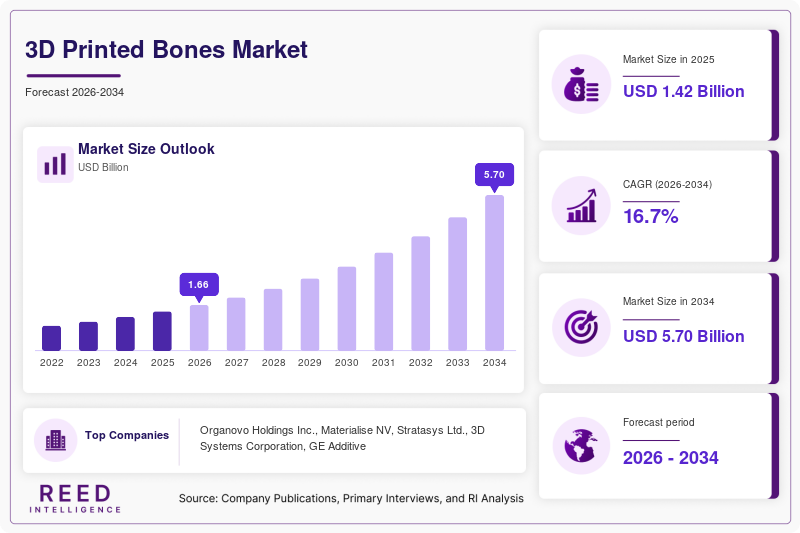
The 3D Printed Bones Market size is projected to experience steady expansion, with the global market valued at approximately USD 1.42 billion in 2026 and anticipated to reach nearly USD 4.86 billion by 2034, growing at a CAGR of 16.7% (2026–2034). The market growth is primarily driven by the increasing demand for patient-specific bone grafts, advancements in bioprinting technologies, and rising incidences of orthopedic trauma and degenerative bone disorders. The integration of 3D printing in regenerative medicine has significantly improved surgical precision, reduced donor dependency, and enhanced post-operative recovery outcomes, supporting widespread clinical adoption across hospitals and research institutions.
A key global factor contributing to market expansion is the rapid advancement in biocompatible materials and scaffold engineering, enabling the creation of structurally stable and biologically active printed bone substitutes. Governments and private healthcare organizations are increasingly investing in regenerative healthcare infrastructure, further accelerating commercialization.
Key Highlights
- North America dominated the market with a 34.2% share in 2025.
- Asia Pacific is expected to grow at the fastest CAGR of 11.2% during 2026–2034.
- By material type, bio-ceramic composites accounted for the largest share of 38.5%.
- while polymer-based bone scaffolds are projected to grow at a CAGR of 12.4%.
- By application, orthopedic reconstruction led with a 41.7% share, whereas dental bone regeneration is expected to expand at a CAGR of 11.8%.
- The United States remained the dominant country, with market values of USD 510 million in 2024 and USD 560 million in 2025.
Market Trends
Integration of Bioprinting with Stem Cell Technology
One of the most significant trends in the 3D Printed Bones Market is the increasing integration of bioprinting techniques with stem cell-based regenerative therapies. This convergence allows researchers to create living bone structures that mimic natural bone tissue more closely. Stem cells embedded within bio-inks are enabling improved vascularization and faster tissue regeneration. Hospitals and research institutes are increasingly adopting hybrid printing systems that combine scaffold fabrication with biological cell deposition. This trend is also supported by advancements in automated bioreactors, which enhance cell viability and structural integrity during printing. As a result, clinical trials for complex bone reconstruction procedures are expanding globally, particularly in orthopedic trauma and craniofacial reconstruction.
Rise of Patient-Specific 3D Printed Bone Implants
Another key trend shaping the market is the growing adoption of patient-specific bone implants designed using advanced imaging techniques such as CT and MRI scanning. These imaging tools enable precise modeling of bone defects, allowing manufacturers to create customized implants that match anatomical requirements. This personalization reduces surgical complications and improves recovery outcomes. Medical device companies are investing heavily in AI-driven design software to enhance accuracy and reduce production time. Additionally, regulatory approvals for customized implants are becoming more streamlined in several regions, encouraging hospitals to adopt 3D printed solutions for complex orthopedic surgeries.
Market Drivers
Rising Prevalence of Orthopedic Disorders and Trauma Cases
The increasing incidence of osteoporosis, bone fractures, and degenerative skeletal conditions is a major driver of the 3D Printed Bones Market. Aging populations worldwide are more susceptible to bone-related diseases, leading to higher demand for advanced reconstructive solutions. Road accidents and sports injuries further contribute to the need for bone grafting procedures. Traditional bone grafting techniques often face limitations such as donor scarcity and immune rejection risks, creating strong demand for 3D printed alternatives. Healthcare systems are increasingly investing in regenerative medicine technologies to improve patient outcomes and reduce long-term treatment costs.
Technological Advancements in 3D Bioprinting Systems
Continuous improvements in 3D bioprinting technologies, including multi-material printing and nano-scale resolution, are significantly driving market growth. Modern printers can now fabricate complex bone microstructures with enhanced mechanical strength and biological compatibility. The integration of AI and machine learning in design optimization is further improving production efficiency. Additionally, advancements in biomaterials such as hydroxyapatite composites and collagen-based scaffolds are enabling better tissue integration. Research institutions and biotech companies are collaborating to develop scalable printing systems suitable for clinical applications, accelerating commercialization in the healthcare sector.
Market Restraint
Despite strong growth prospects, the 3D Printed Bones Market faces notable restraints, primarily related to high production costs and regulatory complexities. The development of biocompatible materials and advanced bioprinting systems requires significant capital investment, limiting accessibility for smaller healthcare providers. Additionally, stringent regulatory approval processes for medical implants delay product commercialization, particularly in emerging economies. Concerns regarding long-term implant durability and biological compatibility also restrict widespread adoption. Many healthcare institutions remain cautious due to limited long-term clinical data. Furthermore, the need for skilled professionals to operate advanced bioprinting systems adds operational challenges. These factors collectively slow down mass adoption despite strong technological potential and growing clinical demand for personalized bone reconstruction solutions.
Market Opportunities
Expansion of Regenerative Medicine in Emerging Economies
Emerging economies present significant growth opportunities for the 3D Printed Bones Market, driven by improving healthcare infrastructure and rising investment in advanced medical technologies. Countries in Asia Pacific and Latin America are witnessing increased adoption of regenerative medicine for orthopedic applications. Government initiatives supporting domestic manufacturing of medical devices are encouraging local production of 3D printed implants. Additionally, partnerships between global biotech firms and regional hospitals are expanding access to advanced bone reconstruction solutions. Growing medical tourism in countries like India and Thailand further enhances demand for cost-effective, high-quality bone implant technologies.
Development of Biodegradable and Smart Bone Scaffolds
The development of biodegradable and smart scaffolds represents another major opportunity in the market. Researchers are focusing on materials that gradually dissolve while promoting natural bone regeneration. These smart scaffolds are embedded with sensors that monitor healing progress and deliver localized drug therapy. Such innovations are expected to revolutionize post-surgical recovery and reduce complication rates. Pharmaceutical and medical device companies are investing in R&D collaborations to develop next-generation implants. This trend is expected to significantly enhance clinical outcomes and open new revenue streams in personalized orthopedic treatment.
Segmental Analysis
By Material Type
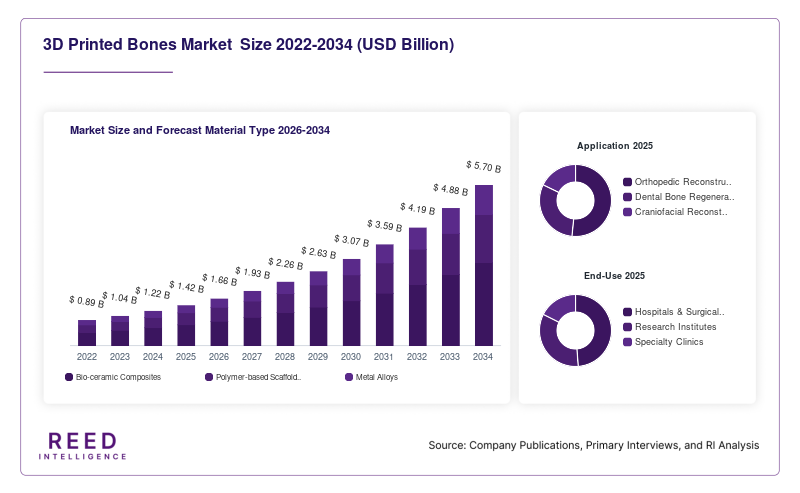
Bio-ceramic composites accounted for approximately 38.5% share in 2024, driven by their superior mechanical strength and biocompatibility. These materials closely mimic natural bone composition, making them highly suitable for orthopedic applications. Hospitals prefer bio-ceramics for their durability and ability to support long-term bone regeneration in complex surgical procedures. Increasing research into hydroxyapatite-based formulations has further strengthened this segment’s dominance in clinical applications.
Polymer-based scaffolds are expected to grow at a CAGR of 12.4%, driven by their flexibility and cost-effectiveness. These materials are widely used in dental and reconstructive surgeries due to their ease of customization and faster manufacturing time. Advancements in biodegradable polymers are further enhancing their adoption, particularly in temporary bone support applications where gradual absorption is required.
By Application
Orthopedic reconstruction led the market with a 41.7% share in 2024, supported by rising fracture cases and joint replacement surgeries. This segment benefits from increasing demand for personalized implants that improve surgical precision and recovery outcomes. Hospitals are increasingly adopting 3D printed solutions for complex bone injuries that cannot be treated using traditional grafting methods.
Dental bone regeneration is projected to grow at a CAGR of 11.8%, driven by increasing demand for dental implants and cosmetic dentistry procedures. The rise in periodontal diseases and tooth loss cases has significantly contributed to this segment’s expansion. Technological advancements in miniaturized printing systems are further improving dental applications.
By End-Use
Hospitals and surgical centers dominated with a 44.3% share in 2024, driven by high patient inflow and advanced surgical infrastructure. These facilities are primary adopters of 3D printed bone technologies due to access to skilled surgeons and advanced imaging systems.
Research institutes are expected to grow at a CAGR of 13.1%, supported by increasing government funding and academic collaborations. Continuous innovation in biomaterials and bioprinting techniques is expanding experimental applications in regenerative medicine.
Regional Analysis
North America
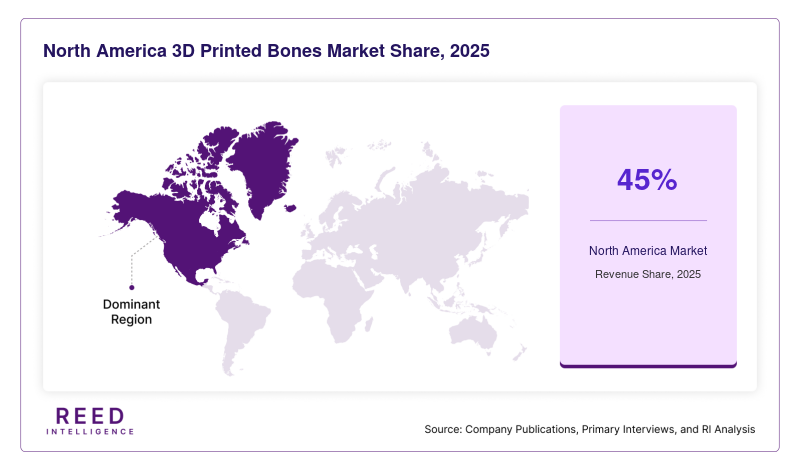
North America held the largest share of the global 3D Printed Bones Market, accounting for approximately 42–45% of total revenue in 2025, and is expected to grow at a CAGR of around 15.5%–16.5% during 2026–2034. This dominance is attributed to advanced healthcare systems, early adoption of additive manufacturing, and strong regulatory support for medical innovation. High healthcare spending and widespread use of personalized implants further strengthen regional leadership.
The United States remains the dominant country in this region due to its robust research ecosystem and large number of clinical trials in regenerative medicine. A key growth factor is the presence of advanced reimbursement frameworks and strong government funding for biomedical innovation, which accelerates the commercialization of 3D printed bone implants across hospitals and surgical centers.
Europe
Europe accounted for nearly 28–30% market share in 2025, with an expected CAGR of approximately 14.8%–15.5% over the forecast period. The region benefits from a strong regulatory framework, well-established medical device industry, and increasing focus on precision medicine. Countries across Western Europe are investing heavily in 3D printing technologies for orthopedic and dental applications.
Germany leads the European market due to its advanced manufacturing capabilities and strong medical research infrastructure. A unique growth factor is the region’s emphasis on quality compliance and CE-certified medical products, which enhances the reliability and adoption of 3D printed bone implants in clinical environments.
Asia Pacific
Asia Pacific captured approximately 22–25% market share in 2025 and is projected to expand at the fastest CAGR of 17.5%–18.5% during the forecast period. Rapid healthcare infrastructure development, increasing awareness of advanced surgical solutions, and rising patient population are key drivers of regional growth.
China dominates the Asia Pacific market, supported by large-scale investments in biotechnology and healthcare modernization. A major growth factor is the increasing affordability of 3D printing technologies combined with rising medical tourism, enabling broader access to personalized orthopedic and dental procedures across developing economies.
Middle East & Africa
The Middle East & Africa region accounted for approximately 8–11% market share in 2025, with a projected CAGR of around 14%–15% through 2034. Growth in this region is supported by expanding healthcare infrastructure, rising adoption of advanced surgical technologies, and increasing government initiatives aimed at modernizing healthcare systems.
United Arab Emirates and Saudi Arabia are the dominant countries in this region. A key growth factor is the rapid development of smart hospitals and specialized medical centers that are integrating 3D printing technologies for orthopedic and reconstructive procedures, enhancing treatment quality and patient outcomes.
Latin America
Latin America held approximately 7–9% market share in 2025, with an anticipated CAGR of 14.5%–15.2% during the forecast period. The region is gradually expanding due to improvements in healthcare accessibility and increasing demand for cost-effective medical solutions. Countries are investing in localized production of medical devices to reduce dependency on imports.
Brazil is the leading country in this region, driven by expanding private healthcare infrastructure and growing awareness of advanced orthopedic treatments. A unique growth factor is the rise of public-private partnerships aimed at integrating innovative technologies such as 3D printing into national healthcare systems, supporting long-term market expansion.
Competitive Landscape
The 3D Printed Bones Market is moderately consolidated, with key players focusing on innovation, strategic collaborations, and clinical trials. Companies such as Organovo Holdings Inc., Materialise NV, and Stratasys Ltd. are leading in bioprinting technology development. GE Additive and 3D Systems Corporation are expanding their medical applications portfolio through advanced material research. Organovo recently introduced enhanced bio-ink formulations aimed at improving bone tissue viability, strengthening its position in regenerative medicine solutions.
Key Players List
- Organovo Holdings Inc.
- Materialise NV
- Stratasys Ltd.
- 3D Systems Corporation
- GE Additive
- CELLINK
- EnvisionTEC
- Medtronic plc
- Stryker Corporation
- Zimmer Biomet Holdings Inc.
- EOS GmbH
- Renishaw plc
- CollPlant Biotechnologies
- Aspect Biosystems
- Oxford Performance Materials
Recent Developments
- In 2025, a leading biotech firm introduced a next-generation bioprinter capable of producing vascularized bone tissues with improved cellular integration.
- In early 2026, a collaboration between a U.S. university and a medical device company resulted in successful clinical trials for patient-specific jawbone implants.
- A European manufacturer launched biodegradable scaffold systems embedded with growth factor delivery technology to accelerate bone healing in orthopedic patients.
3D Printed Bones Market Segments
Material Type
- Bio-ceramic Composites
- Polymer-based Scaffolds
- Metal Alloys
Application
- Orthopedic Reconstruction
- Dental Bone Regeneration
- Craniofacial Reconstruction
End-Use
- Hospitals & Surgical Centers
- Research Institutes
- Specialty Clinics
By Region
- North America
- Europe
- APAC
- Middle East and Africa
- LATAM