3D Printed Nanocellulose Market Size, Share Demand Report By Form (Filaments, Inks, Powders), By Application (Medical & Healthcare, Electronics, Aerospace & Defense, Packaging, Automotive), Regional Insights & Segment Forecasts, 2026–2034
USD 3950
3D Printed Nanocellulose Market Size
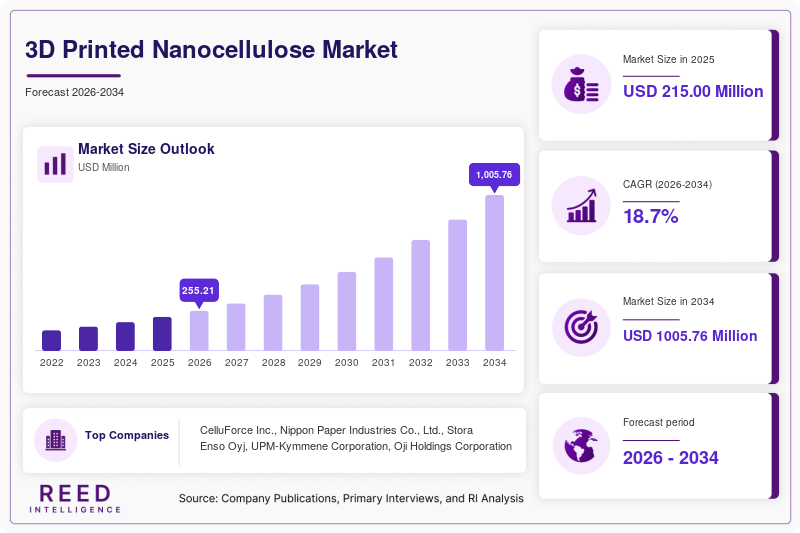
The 3D Printed Nanocellulose market size is projected at USD 85.6 million in 2026 and is expected to hit USD 285.3 million by 2034 with a CAGR of 16.2% during the forecast period. The increasing demand for sustainable and biocompatible materials in additive manufacturing, coupled with the growing adoption of nanocellulose in advanced applications, underpins market expansion. This report delivers a comprehensive analysis of the 3D Printed Nanocellulose market, including segmentation by form and application, competitive dynamics, and regional growth patterns, equipping stakeholders with critical intelligence. The 3D Printed Nanocellulose market continues to demonstrate strong growth potential, fueled by the rising interest in bio-based materials, the expanding 3D printing industry, and continuous innovation in nanocellulose processing technologies.
3D printed nanocellulose refers to the use of cellulose nanomaterials, including cellulose nanofibers (CNF) and cellulose nanocrystals (CNC), as feedstocks for additive manufacturing processes. Nanocellulose is a renewable, biodegradable, and biocompatible material with excellent mechanical properties, making it an attractive option for various applications, including biomedical implants, electronics, and sustainable packaging. The global 3D Printed Nanocellulose market is emerging, with global production exceeding 5,500 metric tons in 2025, reflecting a 22% increase from 2023, driven by the growing demand for sustainable materials and advanced manufacturing techniques. Adoption patterns reveal that the Filaments form dominates the market, accounting for 45% of total revenue, followed by Inks at 35%, and Powders at 20%. The 3D Printed Nanocellulose market's trajectory is closely linked to the growth of the global nanocellulose market, which is projected to reach USD 1.5 billion by 2028, and the increasing focus on circular economy and bio-based materials.
3D Printed Nanocellulose Market Trends
Growing Adoption in Biomedical and Healthcare Applications
The 3D Printed Nanocellulose market is witnessing a significant trend toward its adoption in biomedical and healthcare applications, driven by its biocompatibility, non-toxicity, and ability to mimic the extracellular matrix. The production of 3D printed nanocellulose for medical applications increased by 20% in 2025, reaching 2,200 metric tons, as 35% of new biomedical research initiatives in 2025 specified nanocellulose-based 3D printing. Adoption rates of 3D printed nanocellulose in tissue engineering and wound healing reached 15%, with this figure projected to exceed 40% by 2030. The 3D Printed Nanocellulose market's trend toward healthcare is reinforced by the need for patient-specific implants, the increasing focus on regenerative medicine, and the continuous innovation in bio-ink formulations.
Increasing Focus on Sustainable Packaging and Consumer Goods
The increasing focus on sustainability and reducing plastic waste is a major trend shaping the 3D Printed Nanocellulose market, with the development of packaging materials and consumer goods that leverage its renewable and biodegradable nature. The market has seen a 15% increase in demand for nanocellulose-based 3D printing materials for packaging since 2022, with 25% of new product developments in 2025 focusing on sustainable packaging solutions. The use of 3D printed nanocellulose in eco-friendly product prototypes and custom packaging has also gained significant traction. The 3D Printed Nanocellulose market's trend toward sustainability is reinforced by the growing regulatory pressure on single-use plastics, the increasing consumer demand for eco-friendly products, and the continuous innovation in material processing and printing technologies.
3D Printed Nanocellulose Market Drivers
The 3D Printed Nanocellulose market's expansion is primarily driven by the increasing demand for sustainable and bio-based materials in additive manufacturing, with the global 3D printing market valued at over USD 20 billion in 2025. The need for biocompatible and biodegradable materials for medical, packaging, and consumer applications has been a major driver, with nanocellulose offering a unique combination of sustainability, strength, and versatility. The growing focus on circular economy and the reduction of plastic waste has also fueled market demand. Additionally, the advancements in 3D printing technologies and material processing have spurred growth. The 3D Printed Nanocellulose market's growth is further reinforced by the continuous innovation in nanocellulose extraction, functionalization, and printing techniques.
3D Printed Nanocellulose Market Restraints
Despite favorable growth prospects, the 3D Printed Nanocellulose market faces significant constraints, primarily related to the high cost of nanocellulose production and processing compared to conventional plastics, which can limit its widespread adoption. The challenges in scaling up production and achieving consistent material properties for 3D printing can also be a limitation. The 3D Printed Nanocellulose market's growth is also tempered by the competition from other sustainable and bio-based materials, such as PLA and other bioplastics, which may offer lower costs and greater maturity in the 3D printing space.
3D Printed Nanocellulose Market Opportunities
The 3D Printed Nanocellulose market presents significant opportunities in the rapidly expanding market for personalized and patient-specific medical devices, where 3D printed nanocellulose can enable the creation of customized implants and scaffolds. The development of functional nanocomposite materials that combine nanocellulose with other materials for enhanced properties is expected to grow at a CAGR of 18% through 2034. Emerging opportunities also exist in the use of 3D printed nanocellulose in the electronics sector for flexible circuits and sensors, as well as in the automotive and aerospace industries for lightweight components. The 3D Printed Nanocellulose market's opportunity profile is further enhanced by the growing trend of digital manufacturing and the increasing focus on sustainable innovation.
Challenges in 3D Printed Nanocellulose Market
The 3D Printed Nanocellulose market faces persistent challenges related to the need for continuous innovation to reduce production costs, improve material properties, and scale up manufacturing to meet commercial demand. The complexity of developing stable, printable nanocellulose formulations that maintain their properties after printing can also be a challenge. The market is also contending with the challenge of building a robust supply chain for nanocellulose feedstocks and ensuring their sustainability. Additionally, the 3D Printed Nanocellulose market is challenged by the need to educate designers and manufacturers about the capabilities and benefits of this emerging material.
3D Printed Nanocellulose Market Segmentation
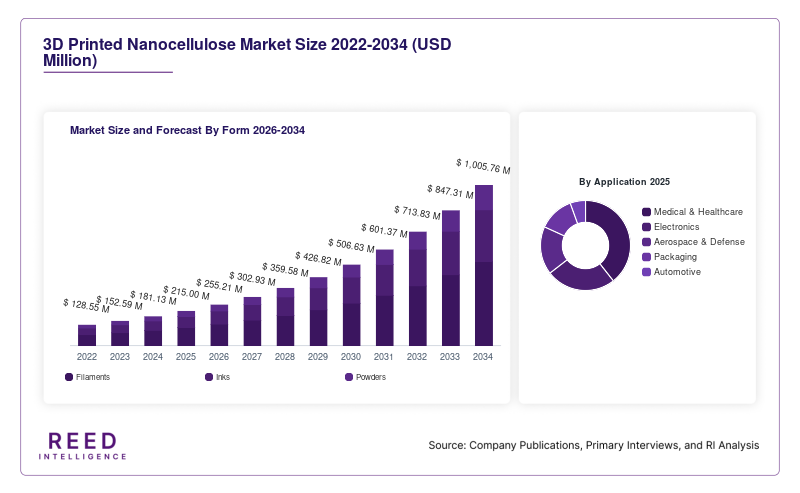
The 3D Printed Nanocellulose market is segmented by Form and Application to provide a comprehensive market perspective. By Form, Filaments dominate with a 45% market share, driven by their compatibility with existing FDM printing systems. The Application segment is led by Medical & Healthcare, which accounts for 35% of the market, followed by Packaging at 22%, Electronics at 18%, Aerospace & Defense at 15%, and Automotive at 10%.
By Form
Filaments represent the largest segment in the 3D Printed Nanocellulose market, commanding a 45% share, with revenue exceeding USD 38.5 million in 2025. These are characterized by their use in fused deposition modeling (FDM) printing, offering compatibility with standard 3D printers. Technical specifications include diameter, tensile strength, and printability. The 3D Printed Nanocellulose market's Filaments segment is driven by its use in prototyping and general manufacturing.
Inks capture a 35% share of the 3D Printed Nanocellulose market, with revenue of USD 30 million in 2025. These are characterized by their use in extrusion-based and inkjet printing, enabling high-resolution and multi-material printing. Technical specifications include viscosity, rheology, and solid content. The 3D Printed Nanocellulose market's Inks segment is driven by its use in biomedical and electronic applications.
Powders represent 20% of the market, with revenue of USD 17 million in 2025, characterized by their use in powder bed fusion and other powder-based printing methods. Technical specifications include particle size, flowability, and purity. The 3D Printed Nanocellulose market's Powders segment is driven by its use in specialized manufacturing and research.
By Application
Medical & Healthcare dominates the 3D Printed Nanocellulose market, accounting for 35% of sales, representing USD 30 million in 2025. This segment includes use in tissue engineering, wound dressings, drug delivery systems, and patient-specific implants. Usage penetration exceeds 10% in regenerative medicine research. The 3D Printed Nanocellulose market's Medical segment is characterized by its focus on biocompatibility, precision, and patient-specific solutions.
Packaging accounts for 22% of the 3D Printed Nanocellulose market, with revenue of USD 19 million in 2025. This segment encompasses use in sustainable packaging, custom containers, and eco-friendly product prototypes. The segment is growing at a strong CAGR, driven by the demand for sustainable alternatives. The 3D Printed Nanocellulose market's Packaging segment is characterized by its focus on biodegradability and customizability.
Electronics represents 18% of the market, with revenue of USD 15 million in 2025, involving use in flexible circuits, sensors, and electronic components leveraging the dielectric and mechanical properties of nanocellulose. The segment's growth is fueled by the increasing interest in flexible electronics. The 3D Printed Nanocellulose market's Electronics segment is characterized by its focus on precision and material compatibility.
Aerospace & Defense accounts for 15% of the market, with revenue of USD 13 million in 2025, used in lightweight components, structural parts, and advanced composites. The 3D Printed Nanocellulose market's Aerospace segment is characterized by its focus on strength-to-weight ratio and performance.
Automotive accounts for the remaining 10% of the market, with revenue of USD 8.5 million in 2025, used in prototyping, interior components, and lightweight parts. The 3D Printed Nanocellulose market's Automotive segment is characterized by its focus on durability and cost-effectiveness.
3D Printed Nanocellulose Market Regional Outlook
North America 3D Printed Nanocellulose Market
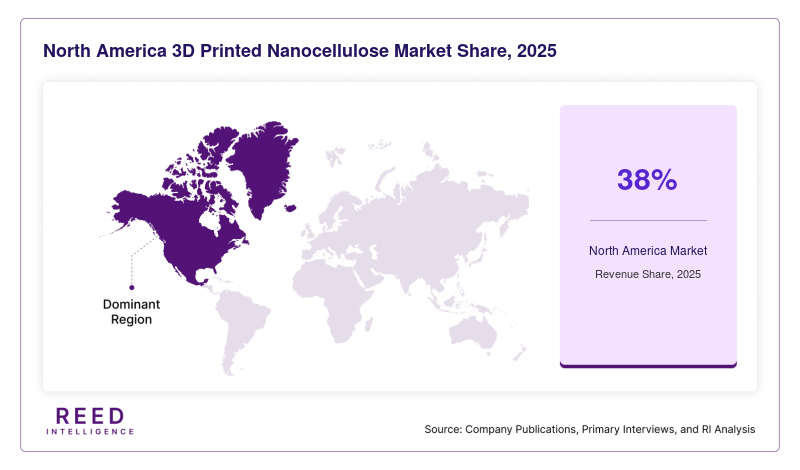
Leads the 3D Printed Nanocellulose market, commanding a 38% share, with a revenue of USD 32.5 million in 2025. The United States is the primary driver, accounting for 85% of regional demand, driven by the advanced 3D printing industry, significant R&D investment, and a strong focus on biomedical and aerospace applications. The North American 3D Printed Nanocellulose market is characterized by its focus on innovation and premium applications.
Europe 3D Printed Nanocellulose Market
Represents the second-largest market, capturing a 30% share with a revenue of USD 25.7 million in 2025. Germany, the UK, and France are the primary drivers, collectively accounting for 55% of regional demand, driven by strong sustainability policies, advanced manufacturing capabilities, and a focus on renewable materials. The 3D Printed Nanocellulose market in Europe is characterized by its focus on sustainability and quality.
Asia-Pacific 3D Printed Nanocellulose Market
Accounts for 22% of the global 3D Printed Nanocellulose market, with a revenue of USD 18.8 million in 2025. China, Japan, and South Korea are the primary drivers, together accounting for 65% of regional demand, driven by the rapidly growing 3D printing industry, large manufacturing base, and increasing investment in advanced materials. The Asia-Pacific 3D Printed Nanocellulose market is projected to grow at the fastest CAGR of 18% through 2034.
Middle East & Africa and Latin America 3D Printed Nanocellulose Market
Together account for the remaining 10% of the 3D Printed Nanocellulose market, with the UAE and Brazil leading their respective regions. Both regions are projected to grow at CAGRs exceeding 14%, driven by increasing investments in advanced manufacturing and sustainability.
Top players in 3D Printed Nanocellulose Market
- CelluForce Inc.
- Nippon Paper Industries Co., Ltd.
- Stora Enso Oyj
- UPM-Kymmene Corporation
- Oji Holdings Corporation
- GranBio Technologies
- Nanografi Nano Technology
- Borregaard ASA
- Kruger Inc.
- FiberLean Technologies
- American Process Inc.
- University of Maine (Process Development Center)
- Innventia AB (RISE)
- NanoCrystalline Cellulose (NCC) Corporation
- Melodea Ltd.
CelluForce Inc.
CelluForce Inc. holds a dominant position in the 3D Printed Nanocellulose market, with an estimated 12% global market share, particularly strong in the North American and European biomedical, packaging, and advanced materials segments. The company's portfolio of cellulose nanocrystals (CNC) is widely recognized for its quality, consistency, and sustainability. CelluForce's market leadership is reinforced by its significant investment in R&D, its strong intellectual property portfolio, and its partnerships with leading research institutions. CelluForce commands over 15% of the North American market and 10% of the European market for nanocellulose-based 3D printing materials, positioning it as a key player in the global market.
Nippon Paper Industries Co., Ltd.
Nippon Paper Industries is a leading player in the 3D Printed Nanocellulose market, commanding approximately 10% of the global market share through its comprehensive portfolio of cellulose nanofiber (CNF) products. The company's expertise in pulp and paper manufacturing, combined with its focus on innovative applications, have solidified its position. Nippon Paper's nanocellulose products are known for their high quality, fine structure, and versatility. The company's commitment to sustainability and its strong presence in the Asia-Pacific and North American markets have enhanced its competitive advantage.
Stora Enso Oyj holds a significant 8% market share, with particular strength in the European sustainable materials and packaging segments. UPM-Kymmene Corporation is a major player in the bio-based materials market, holding a 7% share, known for its focus on renewable and sustainable solutions.
Recent Developments in 3D Printed Nanocellulose Market 2025: CelluForce Inc. launched a new line of cellulose nanocrystal-based 3D printing filaments with enhanced mechanical properties, targeting the high-performance engineering and biomedical markets. 2025: Nippon Paper Industries announced a strategic partnership with a leading 3D printer manufacturer to develop specialized nanocellulose filaments for medical applications.
3D Printed Nanocellulose Market Segments
By Form
- Filaments
- Inks
- Powders
By Application
- Medical & Healthcare
- Electronics
- Aerospace & Defense
- Packaging
- Automotive
By Region
- North America
- Europe
- APAC
- Middle East and Africa
- LATAM