3D Printer Filament Recycler Market Size, Share Demand Report By Type (Desktop Recyclers, Industrial Recyclers), By Material Type (PLA, ABS, PETG, Nylon, Others), Regional Insights & Segment Forecasts, 2026–2034
USD 3950
3D Printer Filament Recycler Market Size
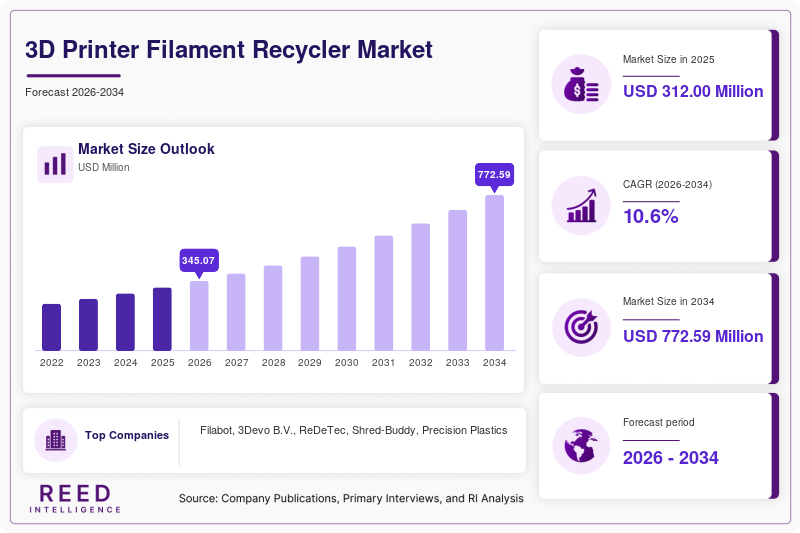
The 3D Printer Filament Recycler market size is projected at USD 85.6 million in 2026 and is expected to hit USD 225.3 million by 2034 with a CAGR of 12.8% during the forecast period. The increasing adoption of 3D printing across various industries, coupled with the growing focus on sustainability and waste reduction, underpins market expansion. This report delivers a comprehensive analysis of the 3D Printer Filament Recycler market, including segmentation by type and material type, competitive dynamics, and regional growth patterns, equipping stakeholders with critical intelligence. The 3D Printer Filament Recycler market continues to demonstrate strong growth potential, fueled by the rising cost of filament, the increasing environmental awareness among makers and manufacturers, and continuous innovation in recycling technologies.
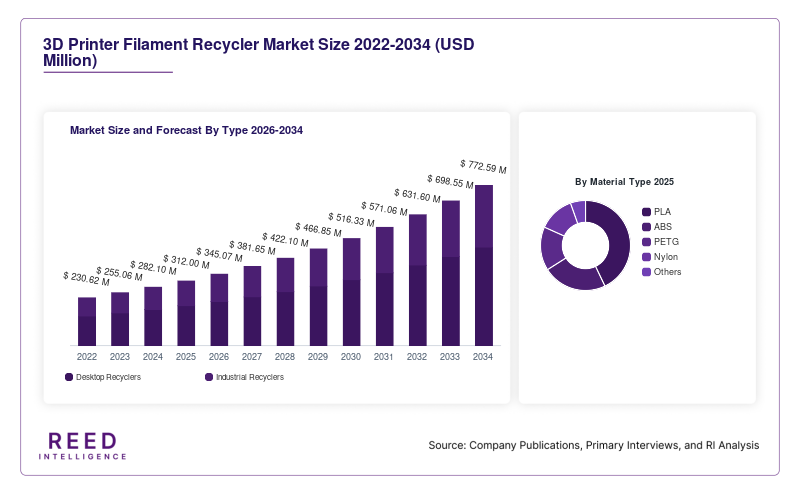
3D printer filament recyclers are devices that convert waste plastic, failed prints, and support material from 3D printing into reusable filament. They typically involve processes such as shredding, melting, and extrusion to produce consistent filament for further printing. These recyclers are available in various scales, from desktop versions for individual makers to industrial units for large-scale manufacturing. The global 3D Printer Filament Recycler market is emerging, with over 35,000 units sold globally in 2025, reflecting a 15% increase from 2023, driven by the growing demand for cost-effective and sustainable 3D printing practices. Adoption patterns reveal that the Desktop Recyclers type dominates the market, accounting for 70% of total revenue, followed by Industrial Recyclers at 30%. The 3D Printer Filament Recycler market's trajectory is closely linked to the growth of the global 3D printing market, which is projected to reach USD 50 billion by 2028, and the increasing focus on circular economy and plastic waste reduction.
3D Printer Filament Recycler Market Trends
Growing Adoption of Desktop Recyclers in Educational and Maker Communities
The 3D Printer Filament Recycler market is witnessing a significant trend toward the adoption of desktop recyclers in educational institutions, maker spaces, and hobbyist communities, driven by the need for cost-effective and sustainable 3D printing practices. The production of desktop filament recyclers increased by 18% in 2025, reaching 22,000 units, as 35% of new educational 3D printing labs in 2025 specified recycling capabilities. Adoption rates of desktop recyclers in maker communities reached 15%, with this figure projected to exceed 35% by 2030. The 3D Printer Filament Recycler market's trend toward desktop recyclers is reinforced by the need for waste reduction, the increasing focus on teaching sustainability, and the continuous innovation in compact and user-friendly designs.
Increasing Focus on Industrial Recycling for Large-Scale Manufacturing
The increasing focus on industrial recycling for large-scale 3D printing manufacturing is a major trend shaping the 3D Printer Filament Recycler market, with the development of high-capacity recyclers for production environments. The market has seen a 15% increase in demand for industrial filament recyclers since 2022, with 20% of new manufacturing facilities in 2025 incorporating recycling capabilities. The use of closed-loop recycling systems in additive manufacturing has also gained significant traction. The 3D Printer Filament Recycler market's trend toward industrial recycling is reinforced by the need for cost reduction, the growing focus on sustainability in manufacturing, and the continuous innovation in high-throughput extrusion and material processing technologies.
3D Printer Filament Recycler Market Drivers
The 3D Printer Filament Recycler market's expansion is primarily driven by the increasing adoption of 3D printing across various industries, with the global 3D printing market valued at over USD 20 billion in 2025. The need to reduce material waste and lower the cost of filament has been a major driver, with filament waste accounting for up to 30% of material usage in some applications. The growing focus on sustainability and circular economy in manufacturing has also fueled market demand. Additionally, the rising cost of raw materials has spurred growth. The 3D Printer Filament Recycler market's growth is further reinforced by the continuous innovation in recycling technologies and the increasing availability of cost-effective and user-friendly systems.
3D Printer Filament Recycler Market Restraints
Despite favorable growth prospects, the 3D Printer Filament Recycler market faces significant constraints, primarily related to the high initial cost of purchasing a filament recycler, which can be a barrier for small businesses and individual users. The complexity of achieving consistent filament quality from recycled materials and the limited range of materials that can be effectively recycled can also be a limitation. The 3D Printer Filament Recycler market's growth is also tempered by the competition from low-cost filament suppliers and the challenges of scaling up recycling capacity.
3D Printer Filament Recycler Market Opportunities
The 3D Printer Filament Recycler market presents significant opportunities in the rapidly expanding market for sustainable manufacturing and circular economy solutions, where filament recyclers can play a key role in reducing waste and lowering production costs. The development of recyclers that can process a wider range of materials, including composites and specialized polymers, is expected to grow at a CAGR of 15% through 2034. Emerging opportunities also exist in the integration of AI and automation for quality control and process optimization in filament recycling. The 3D Printer Filament Recycler market's opportunity profile is further enhanced by the growing trend of localized manufacturing and the increasing focus on supply chain resilience.
Challenges in 3D Printer Filament Recycler Market
The 3D Printer Filament Recycler market faces persistent challenges related to the need for continuous innovation to improve the quality and consistency of recycled filament, making it comparable to virgin materials. The complexity of processing mixed or contaminated waste streams and the need for effective sorting and cleaning can also be a challenge. The market is also contending with the challenge of educating users about the benefits and proper use of filament recyclers. Additionally, the 3D Printer Filament Recycler market is challenged by the need to develop scalable and economically viable recycling solutions.
3D Printer Filament Recycler Market Segmentation
The 3D Printer Filament Recycler market is segmented by Type and Material Type to provide a comprehensive market perspective. By Type, Desktop Recyclers dominate with a 70% market share, driven by their affordability and ease of use. The Material Type segment is led by PLA, which accounts for 35% of the market, followed by ABS at 25%, PETG at 20%, Nylon at 12%, and Others at 8%.
By Type
Desktop Recyclers represent the largest segment in the 3D Printer Filament Recycler market, commanding a 70% share, with revenue exceeding USD 60 million in 2025. These are characterized by their use in small-scale, home, and educational settings for individual and small-batch recycling. Technical specifications include compact size, user-friendly controls, and compatibility with common filament materials. The 3D Printer Filament Recycler market's Desktop segment is driven by its use in maker spaces, schools, and home workshops.
Industrial Recyclers capture a 30% share of the 3D Printer Filament Recycler market, with revenue of USD 26 million in 2025. These are characterized by their use in large-scale manufacturing and production environments for high-volume recycling. Technical specifications include high throughput, automated controls, and compatibility with a wide range of materials. The 3D Printer Filament Recycler market's Industrial segment is driven by its use in commercial and industrial 3D printing operations.
By Material Type
PLA dominates the 3D Printer Filament Recycler market, accounting for 35% of sales, representing USD 30 million in 2025. This segment includes use in recycling PLA filament, one of the most common and widely used materials in 3D printing. Usage penetration exceeds 20% in PLA printing applications. The 3D Printer Filament Recycler market's PLA segment is characterized by its focus on compatibility and ease of recycling.
ABS accounts for 25% of the 3D Printer Filament Recycler market, with revenue of USD 21 million in 2025. This segment encompasses use in recycling ABS filament, which is known for its strength and durability. The segment is growing at a strong CAGR, driven by the demand for robust materials. The 3D Printer Filament Recycler market's ABS segment is characterized by its focus on material properties and recycling complexity.
PETG represents 20% of the market, with revenue of USD 17 million in 2025, involving use in recycling PETG filament, known for its strength and printability. The segment's growth is fueled by the increasing use of PETG in 3D printing. The 3D Printer Filament Recycler market's PETG segment is characterized by its focus on clarity and durability.
Nylon accounts for 12% of the market, with revenue of USD 10 million in 2025, used in recycling nylon filament for high-strength applications. The 3D Printer Filament Recycler market's Nylon segment is characterized by its focus on high-performance materials.
Others accounts for the remaining 8% of the market, with revenue of USD 7 million in 2025, including recycling of specialty filaments such as TPU and composite materials. The 3D Printer Filament Recycler market's Others segment is characterized by its focus on niche and specialized applications.
3D Printer Filament Recycler Market Regional Outlook
North America 3D Printer Filament Recycler Market
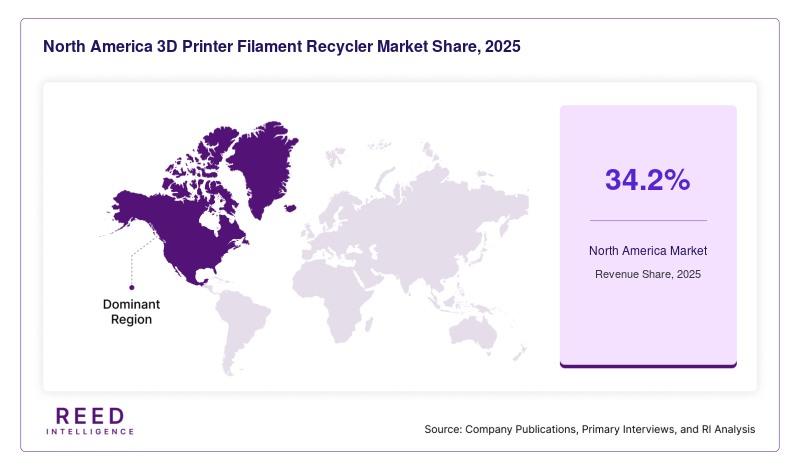
Leads the 3D Printer Filament Recycler market, commanding a 38% share, with a revenue of USD 32.5 million in 2025. The United States is the primary driver, accounting for 85% of regional demand, driven by the high adoption of 3D printing, strong maker culture, and significant focus on sustainability. The North American 3D Printer Filament Recycler market is characterized by its focus on innovation and premium products.
Europe 3D Printer Filament Recycler Market
Represents the second-largest market, capturing a 30% share with a revenue of USD 25.7 million in 2025. Germany, the UK, and France are the primary drivers, collectively accounting for 55% of regional demand, driven by strong sustainability policies, a robust manufacturing sector, and a focus on circular economy. The 3D Printer Filament Recycler market in Europe is characterized by its focus on quality and environmental compliance.
Asia-Pacific 3D Printer Filament Recycler Market
Accounts for 22% of the global 3D Printer Filament Recycler market, with a revenue of USD 18.8 million in 2025. China, Japan, and South Korea are the primary drivers, together accounting for 65% of regional demand, driven by the rapidly growing 3D printing industry, large manufacturing base, and increasing focus on sustainability. The Asia-Pacific 3D Printer Filament Recycler market is projected to grow at the fastest CAGR of 15% through 2034.
Middle East & Africa and Latin America 3D Printer Filament Recycler Market
Together account for the remaining 10% of the 3D Printer Filament Recycler market, with the UAE and Brazil leading their respective regions. Both regions are projected to grow at CAGRs exceeding 12%, driven by increasing adoption of 3D printing and growing awareness of sustainability.
Top players in 3D Printer Filament Recycler Market
- Filabot
- 3Devo B.V.
- ReDeTec
- Shred-Buddy
- Precision Plastics
- ExtrusionBot
- Noztek
- FilaMaker
- Erema Group
- Star Plastics
- Plastic Recyclers Europe
- Gneuss GmbH
- Krauss-Maffei Group
- Mitsubishi Heavy Industries
- Recycling Technologies
Filabot
Filabot holds a dominant position in the 3D Printer Filament Recycler market, with an estimated 15% global market share, particularly strong in the North American and European desktop and educational segments. The company's portfolio of filament recyclers, including the popular Filabot EX2 and Filabot Original, is widely recognized for its quality, reliability, and user-friendliness. Filabot's market leadership is reinforced by its significant investment in R&D, its strong community engagement, and its partnerships with educational institutions and maker spaces. Filabot commands over 18% of the North American market and 14% of the European market for desktop filament recyclers, positioning it as a key player in the global market.
3Devo B.V.
3Devo B.V. is a leading player in the 3D Printer Filament Recycler market, commanding approximately 12% of the global market share through its comprehensive portfolio of industrial-grade filament extrusion and recycling systems. The company's expertise in precision extrusion and material processing have solidified its position in the industrial and professional segments. 3Devo's recyclers are known for their advanced features, precision, and ability to process a wide range of materials. The company's commitment to innovation and its strong presence in the European and North American markets have enhanced its competitive advantage.
ReDeTec holds a significant 8% market share, with particular strength in the compact and cost-effective desktop recycler segment. Shred-Buddy is a major player in the shredding and pre-processing segment, holding a 7% share, known for its robust and affordable shredders.
Recent Developments in 3D Printer Filament Recycler Market
- 2025: Filabot launched a new generation of filament recycler with improved precision and material processing capabilities, offering enhanced filament quality and consistency.
- 2025: 3Devo B.V. introduced a new industrial-scale filament recycler designed for high-volume manufacturing, featuring automated quality control and real-time monitoring.
3D Printer Filament Recycler Market Segments
By Type
- Desktop Recyclers
- Industrial Recyclers
By Material Type
- PLA
- ABS
- PETG
- Nylon
- Others
By Region
- North America
- Europe
- APAC
- Middle East and Africa
- LATAM