3D Printing Education Market Size, Share & Demand Report By Component (Hardware, Software, Services), By Application (Prototyping and Design Learning, Advanced Manufacturing Training, Research and Development), By End-Use (K-12 Education, Higher Education, Vocational Training Institutes), By Region & Segment Forecasts, 2026–2034
USD 3950
Market Overview
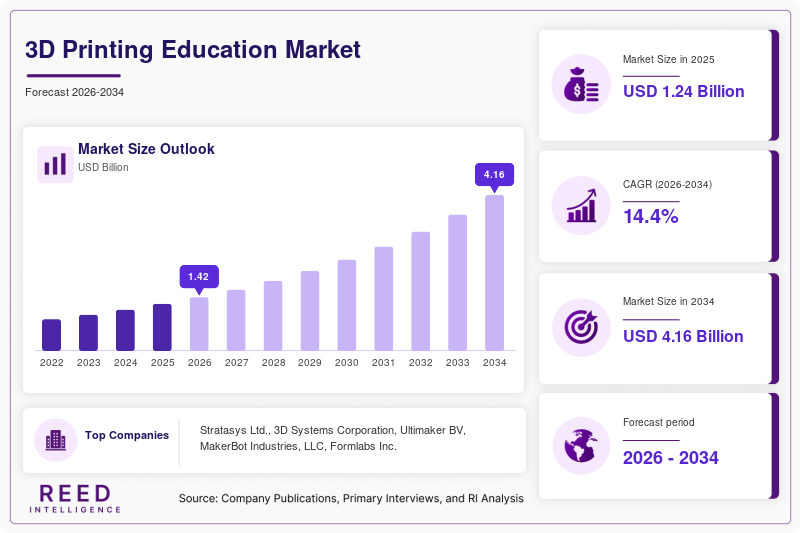
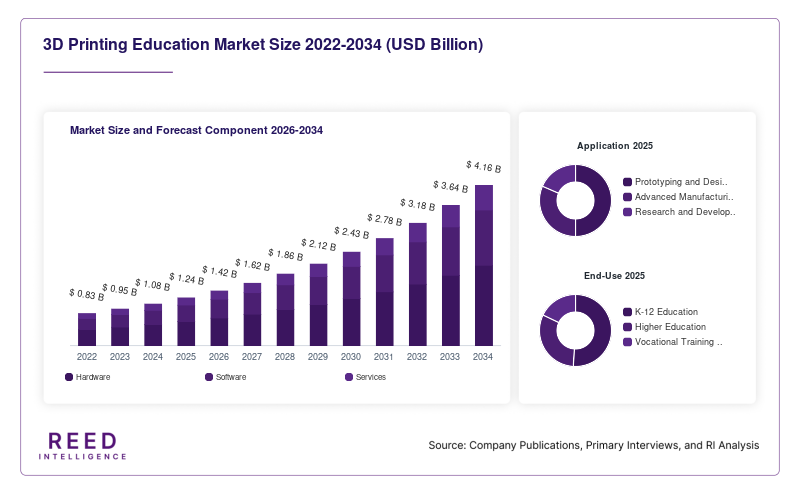
The 3D Printing Education Market size is projected to grow from an estimated value of USD 1.42 billion in 2026 to approximately USD 4.18 billion by 2034, expanding at a compound annual growth rate (CAGR) of 14.4% during the forecast period. The rapid integration of advanced manufacturing technologies into academic curricula is shaping the trajectory of this market. Educational institutions across primary, secondary, and higher education levels are increasingly incorporating additive manufacturing tools to foster practical learning and innovation. The accessibility of desktop 3D printers, combined with declining equipment costs, has enabled schools and universities to adopt these technologies at scale.
A major global factor driving market expansion is the growing emphasis on STEM (Science, Technology, Engineering, and Mathematics) education. Governments and private organizations worldwide are investing in digital learning infrastructure to prepare students for Industry 4.0 environments. As industries such as aerospace, healthcare, and automotive increasingly rely on additive manufacturing, educational institutions are aligning their curricula to meet future workforce demands. This alignment is encouraging the adoption of 3D printing labs, training modules, and certification programs.
Key Highlights
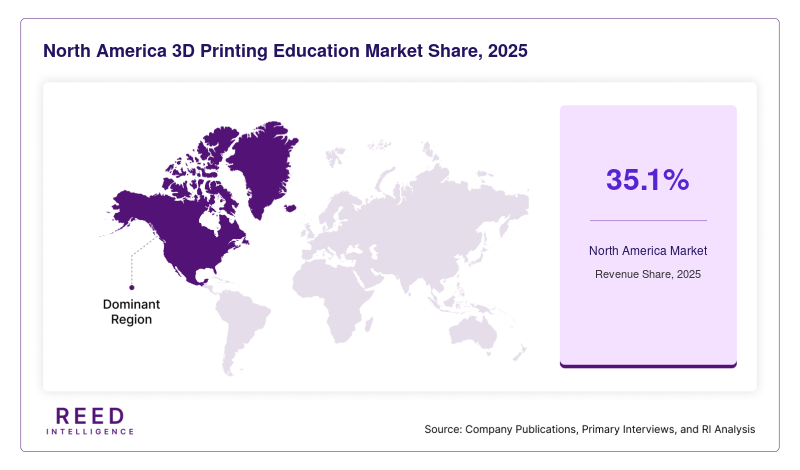
- North America dominated the market with a 35.1% share in 2025.
- Asia Pacific is expected to grow at the fastest CAGR of 16.2% during 2026–2034.
- By component, hardware accounted for the largest share of 42.8%.
- while software solutions are projected to grow at a CAGR of 15.7%.
- By application, prototyping and design learning led with a 44.6% share, whereas advanced manufacturing training is expected to expand at a CAGR of 16.5%.
- The United States remained the dominant country, with market values of USD 520 million in 2024 and USD 580 million in 2025.
Market Trends
Integration of immersive learning technologies with 3D printing
The convergence of 3D printing with immersive technologies such as augmented reality (AR) and virtual reality (VR) is shaping a notable trend in the 3D Printing Education Market. Educational institutions are increasingly adopting hybrid learning models that combine physical prototyping with digital visualization tools. This integration allows students to design, simulate, and refine objects in virtual environments before actual printing, reducing material waste and enhancing conceptual understanding. The use of immersive tools also supports remote learning, enabling students to access virtual labs and collaborate in real time. As a result, institutions are improving engagement and enabling experiential learning across disciplines such as engineering, architecture, and medical sciences.
Expansion of curriculum-based certification programs
Another emerging trend is the growing emphasis on structured certification programs tailored to additive manufacturing skills. Educational providers and technology companies are collaborating to develop standardized curricula that align with industry requirements. These certification programs are being introduced at various levels, from secondary education to professional training institutes. They focus on design software, machine operation, and material science, offering students a comprehensive understanding of 3D printing technologies. This trend is supported by employers seeking candidates with validated technical skills, thereby increasing the value of certifications. As demand for skilled professionals rises, institutions are expanding their offerings to include modular and online certification courses.
Market Drivers
Increasing adoption of STEM-focused education policies
The global shift toward STEM education is a significant driver for the 3D Printing Education Market. Governments and educational authorities are actively promoting science and technology-based learning to prepare students for future job markets. 3D printing serves as a practical tool that enhances understanding of engineering concepts, design thinking, and problem-solving skills. Schools and universities are incorporating additive manufacturing into their curricula to support hands-on learning experiences. Funding initiatives and grants are also encouraging institutions to invest in 3D printing labs and equipment. This widespread adoption is creating a strong foundation for market growth, particularly in regions with robust education reform policies.
Growing demand for industry-ready workforce skills
Industries across sectors are increasingly seeking professionals with practical knowledge of advanced manufacturing technologies. This demand is pushing educational institutions to integrate 3D printing into training programs to bridge the skills gap. Students trained in additive manufacturing gain exposure to real-world applications, including rapid prototyping and product development. As a result, graduates are better prepared for roles in engineering, design, and manufacturing industries. The alignment between academic training and industry requirements is driving institutions to invest in updated equipment and software solutions. This trend is reinforcing the role of 3D printing as a critical component of modern education systems.
Market Restraint
High initial investment and maintenance costs
Despite the growing adoption of additive manufacturing in education, high initial investment costs remain a key restraint for the 3D Printing Education Market. Advanced 3D printers, along with associated software and materials, require significant financial resources, which can be challenging for institutions with limited budgets. Additionally, ongoing maintenance, upgrades, and material costs add to the financial burden. Smaller schools and institutions in developing regions often face difficulties in allocating funds for such technologies. This limitation can hinder widespread adoption and create disparities in access to advanced educational tools. For example, institutions in rural areas may struggle to justify the cost of establishing dedicated 3D printing labs, thereby limiting student exposure to emerging technologies.
Market Opportunities
Expansion of online and remote 3D printing education platforms
The rise of digital learning platforms presents a strong opportunity for the 3D Printing Education Market. Online courses and remote learning modules are enabling students to access 3D printing education without the need for physical infrastructure. Cloud-based design tools and virtual simulation software are allowing learners to create and test models remotely. Educational providers are leveraging these technologies to offer scalable and cost-effective solutions. This approach is particularly beneficial in regions with limited access to physical labs, as it democratizes learning opportunities. As internet penetration continues to increase, the adoption of online 3D printing education platforms is expected to accelerate significantly.
Increasing partnerships between academia and industry
Collaborations between educational institutions and industry players are creating new growth avenues for the market. Companies are partnering with schools and universities to provide equipment, training programs, and curriculum support. These partnerships enable students to gain exposure to real-world applications and industry standards. In return, companies benefit from a pipeline of skilled graduates who are familiar with their technologies. Such collaborations are also fostering innovation and research in additive manufacturing. As industries continue to invest in education initiatives, these partnerships are expected to play a key role in driving market expansion.
Segmental Analysis
By Component
The hardware segment dominated the 3D Printing Education Market in 2024, accounting for a share of 42.8%. This segment includes 3D printers, scanners, and related equipment that form the foundation of additive manufacturing labs. Educational institutions are investing heavily in hardware to provide students with hands-on experience in prototyping and design. The availability of affordable desktop 3D printers has further accelerated adoption, particularly in schools and colleges. Hardware solutions are essential for practical learning, enabling students to transform digital designs into physical models. This hands-on approach enhances understanding and fosters innovation among learners, making hardware a critical component of the market.
The software segment is expected to be the fastest-growing, with a projected CAGR of 15.7% during the forecast period. Growth is driven by the increasing adoption of design and simulation tools that complement hardware solutions. Software platforms enable students to create, modify, and test designs before printing, improving efficiency and reducing material waste. Cloud-based solutions are gaining popularity, allowing remote access and collaboration. As educational institutions focus on digital transformation, the demand for advanced software tools is expected to rise significantly, supporting the overall growth of the market.
By Application
Prototyping and design learning emerged as the dominant application segment in 2024, holding a share of 44.6%. This segment focuses on teaching students the fundamentals of design, modeling, and product development using 3D printing technologies. Educational institutions are incorporating prototyping into their curricula to enhance creativity and problem-solving skills. Students gain practical experience in developing and testing prototypes, which is essential for engineering and design disciplines. The widespread adoption of this application is driven by its ability to provide hands-on learning experiences that align with industry requirements.
Advanced manufacturing training is projected to grow at the fastest CAGR of 16.5% during the forecast period. This segment focuses on equipping students with skills required for modern manufacturing processes, including additive manufacturing techniques. The growing demand for skilled professionals in industries such as aerospace and automotive is driving the adoption of advanced training programs. Educational institutions are expanding their offerings to include specialized courses and certifications in 3D printing. This trend is expected to continue as industries increasingly rely on additive manufacturing technologies.
By End-Use
Higher education institutions dominated the market in 2024, accounting for a significant share due to their extensive adoption of advanced technologies. Universities and colleges are investing in 3D printing labs and research facilities to support innovation and academic research. These institutions offer specialized courses and programs in additive manufacturing, attracting students from various disciplines. The availability of funding and resources enables higher education institutions to adopt advanced equipment and software solutions, making them a key segment in the market.
K-12 education is expected to be the fastest-growing segment, with a projected CAGR of 15.9% during the forecast period. Schools are increasingly integrating 3D printing into their curricula to introduce students to STEM concepts at an early stage. The focus on experiential learning is driving the adoption of 3D printing technologies in primary and secondary education. Educational authorities are supporting this trend through funding and policy initiatives. As awareness continues to grow, the adoption of 3D printing in K-12 education is expected to expand significantly.
Regional Analysis
North America
North America held a significant share of 35.1% in the 3D Printing Education Market in 2025 and is projected to maintain steady growth with a CAGR of 13.2% during the forecast period. The region benefits from a well-established education infrastructure and strong adoption of advanced technologies. Schools and universities are increasingly integrating 3D printing into STEM programs, supported by government funding and private investments. The presence of leading technology providers further enhances market growth, as institutions have access to advanced equipment and training solutions.
The United States dominates the regional market due to its strong focus on innovation and technology-driven education. A key growth factor is the widespread implementation of maker spaces and innovation labs across educational institutions. These facilities provide students with hands-on experience in design and prototyping, encouraging creativity and practical learning. Additionally, collaborations between universities and technology companies are strengthening the ecosystem, enabling continuous advancements in 3D printing education.
Europe
Europe accounted for a notable share of the 3D Printing Education Market in 2025 and is expected to grow at a CAGR of 13.8% during the forecast period. The region’s emphasis on research and innovation is driving the adoption of additive manufacturing in educational institutions. Governments are supporting initiatives that promote digital skills and advanced manufacturing technologies. Educational institutions are increasingly incorporating 3D printing into engineering and design programs, enhancing the overall learning experience.
Germany leads the European market, supported by its strong industrial base and focus on technical education. A unique growth factor is the integration of dual education systems that combine academic learning with practical training. This approach enables students to gain hands-on experience with 3D printing technologies while pursuing formal education. As a result, the country is producing a skilled workforce capable of supporting advanced manufacturing industries.
Asia Pacific
Asia Pacific is expected to register the fastest growth in the 3D Printing Education Market, with a projected CAGR of 16.2% during the forecast period. The region’s rapid economic development and increasing investments in education infrastructure are driving market expansion. Governments are actively promoting STEM education and digital learning initiatives, encouraging the adoption of advanced technologies such as 3D printing. The growing number of educational institutions and students further supports market growth.
China dominates the regional market due to its large population and strong focus on technological advancement. A key growth factor is the government’s investment in smart education initiatives, which includes the integration of 3D printing into school curricula. These initiatives aim to enhance innovation and creativity among students, preparing them for future industries. The availability of affordable 3D printing equipment also contributes to widespread adoption.
Middle East & Africa
The Middle East & Africa region is witnessing gradual growth in the 3D Printing Education Market, with a CAGR of 12.1% during the forecast period. The adoption of advanced technologies in education is increasing, supported by government initiatives and investments in digital infrastructure. Educational institutions are beginning to incorporate 3D printing into their curricula, particularly in engineering and technical programs. However, limited resources and infrastructure challenges may impact the pace of adoption.
The United Arab Emirates is a leading country in the region, driven by its focus on innovation and smart education. A unique growth factor is the implementation of national strategies aimed at promoting advanced technologies, including additive manufacturing. These initiatives are encouraging schools and universities to adopt 3D printing as part of their educational programs, fostering a culture of innovation and technological advancement.
Latin America
Latin America held a moderate share of the 3D Printing Education Market in 2025 and is expected to grow at a CAGR of 12.7% during the forecast period. The region is gradually adopting advanced educational technologies, supported by government initiatives and international collaborations. Educational institutions are recognizing the importance of 3D printing in enhancing practical learning and are investing in related infrastructure.
Brazil dominates the regional market due to its large education sector and growing focus on technology integration. A key growth factor is the increasing number of partnerships between educational institutions and technology providers. These collaborations are enabling access to advanced equipment and training programs, supporting the adoption of 3D printing in education. As awareness continues to grow, the market is expected to expand steadily.
Competitive Landscape
The 3D Printing Education Market is characterized by the presence of several established players and emerging companies focusing on innovation and strategic partnerships. Leading companies are investing in product development and expanding their portfolios to cater to the growing demand from educational institutions. The market is moderately competitive, with players competing based on technology, pricing, and service offerings.
Stratasys Ltd. is recognized as a leading player in the market, offering a wide range of 3D printing solutions tailored for educational applications. The company has recently introduced new curriculum-based programs aimed at enhancing student learning experiences. Other companies are focusing on collaborations with educational institutions to strengthen their market presence. These strategies are enabling companies to expand their reach and address the evolving needs of the education sector.
Key Players
- Stratasys Ltd.
- 3D Systems Corporation
- Ultimaker BV
- MakerBot Industries, LLC
- Formlabs Inc.
- XYZprinting, Inc.
- FlashForge Corporation
- Dremel Digilab
- Autodesk, Inc.
- Materialise NV
- Tinkercad (Autodesk)
- Raise3D Technologies, Inc.
- Prusa Research
- EnvisionTEC, Inc.
- Dassault Systèmes
Recent Developments
- Stratasys Ltd. launched an updated educational platform integrating cloud-based design tools and curriculum resources for institutions.
- Ultimaker BV introduced new 3D printing bundles specifically designed for classroom environments, enhancing accessibility for schools.
- Formlabs Inc. expanded its training programs by partnering with universities to provide certification courses in additive manufacturing.
3D Printing Education Market Segments
Component
- Hardware
- Software
- Services
Application
- Prototyping and Design Learning
- Advanced Manufacturing Training
- Research and Development
End-Use
- K-12 Education
- Higher Education
- Vocational Training Institutes
By Region
- North America
- Europe
- APAC
- Middle East and Africa
- LATAM