3D Printing In Low Cost Satellite Market Size, Share Demand Report By Printing Technology (Metal Additive Manufacturing, Polymer Printing, Composite Printing, Hybrid Additive Systems), By Application (Structural Components, Propulsion Systems, Antennas and RF Parts, Thermal Management Components), By End Use (Commercial Operators, Government & Defense, Academic & Research Institutions), By Region & Segment Forecasts, 2026–2034
USD 3950
Market Overview
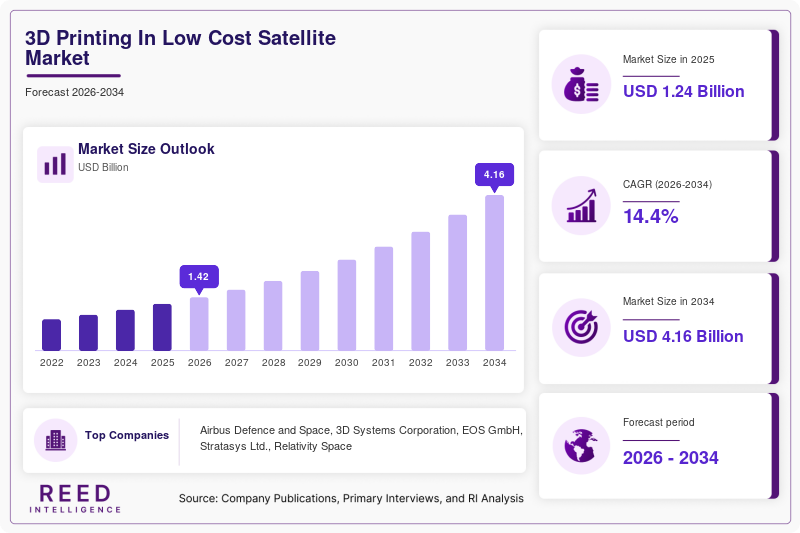
The 3D Printing In Low Cost Satellite Market size was valued at USD 1.42 billion in 2026 and is projected to reach USD 4.18 billion by 2034, expanding at a 14.4% CAGR from 2026 to 2034. The market is gaining momentum as satellite manufacturers seek faster production cycles, lower launch budgets, and flexible component design. Additive manufacturing is increasingly used to produce lightweight brackets, propulsion housings, antenna structures, thermal panels, waveguides, and customized payload enclosures for nanosatellites, microsatellites, and other cost-sensitive spacecraft classes.
One global factor supporting market growth is the rising commercialization of space infrastructure. Broadband constellations, Earth observation networks, maritime tracking systems, climate monitoring programs, and defense communication projects are creating recurring demand for compact satellites built at controlled costs. Traditional machining methods often involve longer lead times and higher material waste, while 3D printing enables rapid prototyping, topology optimization, and on-demand spare part manufacturing. This advantage is especially relevant for startups and universities entering the low-cost satellite ecosystem.
Key Highlights
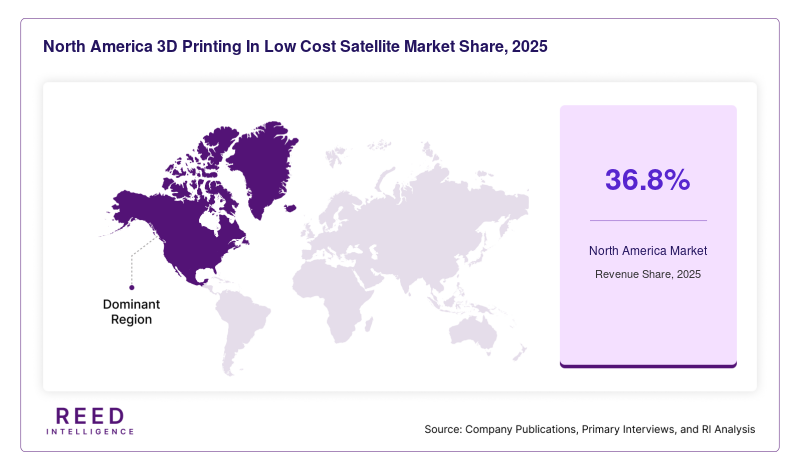
- North America dominated the market with a 36.8% share in 2025.
- Asia Pacific is expected to grow at the fastest CAGR of 16.1% during 2026–2034.
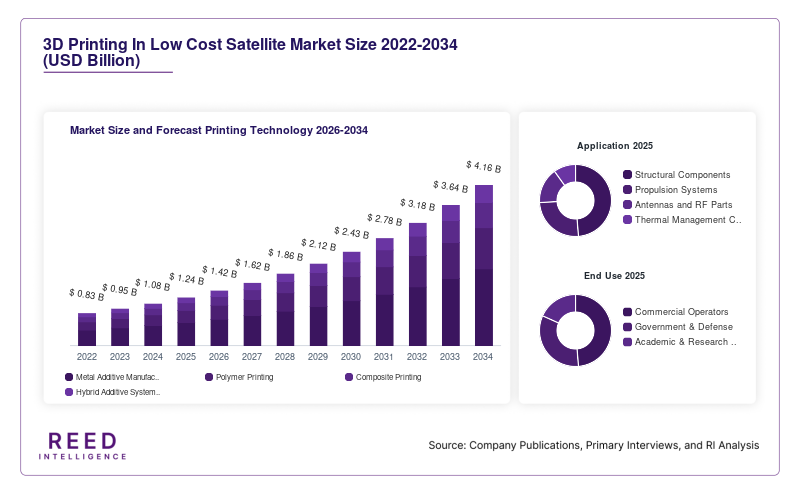
- By printing technology, metal additive manufacturing accounted for the largest share of 44.6%.
- while hybrid additive systems are projected to grow at a 17.3% CAGR.
- By application, structural components led with a 39.8% share, whereas propulsion systems are expected to expand at a 16.8% CAGR.
- The United States remained the dominant country, with market values of USD 430 million in 2024 and USD 505 million in 2025.
Market Trends
Expansion of Constellation-Based Satellite Programs
The market is witnessing strong demand from commercial constellation operators deploying hundreds of small satellites for communication, imaging, and IoT coverage. These projects require standardized yet lightweight spacecraft components that can be produced quickly. 3D printing allows manufacturers to repeat designs with rapid modifications while reducing tooling expenses. This is particularly useful for phased array mounts, thermal management structures, and compact chassis assemblies. As constellation refresh cycles shorten, additive manufacturing supports iterative upgrades without redesigning entire production lines. The trend is expected to strengthen as more private operators pursue scalable fleets with lower unit economics.
Shift Toward Multi-Material and High-Performance Printing
Satellite producers are increasingly exploring multi-material printing to combine structural strength, heat resistance, and electromagnetic performance in one component. This trend is enabling more integrated assemblies where brackets, cable channels, shielding layers, and mounting features are produced together. Advanced polymers and aerospace-grade alloys are improving durability for launch vibration and orbital temperature cycles. Manufacturers are also using digital twins and simulation tools before printing final parts. As qualification standards improve, multi-material production is expected to move from experimental programs into mainstream low-cost satellite manufacturing workflows.
Market Drivers
Demand for Lightweight and Cost-Efficient Spacecraft
Launch economics remain a critical factor for satellite operators, and every kilogram saved can improve mission affordability. 3D printing helps reduce mass through lattice structures, topology-optimized designs, and consolidated assemblies. A single printed part can replace multiple machined components, lowering fastener use and simplifying integration. This is highly valuable in nanosatellite and microsatellite programs where tight weight budgets directly affect payload capacity. As governments and private firms expand low Earth orbit missions, the ability to produce lighter satellites at lower manufacturing cost is driving sustained market growth.
Faster Development Cycles for Emerging Space Companies
New entrants in the satellite industry often compete on speed rather than legacy scale. Additive manufacturing enables rapid prototyping, testing, redesign, and final production with fewer tooling constraints. Startups can validate antenna supports, deployable hinges, propulsion manifolds, and internal frames in weeks instead of months. This shorter design loop supports investor milestones and quicker launch schedules. Universities and research organizations also benefit from lower prototype costs. As the global space startup ecosystem expands, fast-cycle manufacturing continues to strengthen demand for 3D printing in low cost satellite programs.
Market Restraint
Qualification and Reliability Challenges in Space Environments
Despite strong growth prospects, the market faces restraint from rigorous qualification requirements for space hardware. Printed components must withstand launch shock, radiation exposure, vacuum conditions, and repeated thermal cycling. Variability in powder quality, print orientation, porosity levels, and post-processing can affect mechanical consistency. Because many low-cost satellite missions still carry valuable payloads, operators remain cautious about unproven materials. Certification timelines may delay adoption, especially for propulsion chambers, pressure vessels, and mission-critical electronics housings. Smaller firms can also face high testing expenses for vibration, fatigue, and outgassing validation. These barriers slow commercialization even when printing economics appear attractive.
Market Opportunities
In-Orbit Servicing and On-Demand Spare Part Ecosystems
Future satellite servicing models may require replacement parts, adapter brackets, or repair tools manufactured close to launch schedules. Ground-based additive manufacturing can support fast spare production for failed or upgraded spacecraft components. Over time, orbital manufacturing demonstrations may create demand for feedstock-ready designs optimized for remote printing. Companies developing modular low-cost satellites are likely to benefit first, since standardized printed parts can simplify maintenance planning. This opportunity expands the role of additive manufacturing beyond initial spacecraft build cycles into long-term asset management and lifecycle revenue streams.
Growth of National Space Programs in Emerging Economies
Several emerging economies are expanding weather monitoring, border surveillance, agriculture mapping, and education satellite programs. Many of these agencies seek affordable platforms with localized manufacturing capability. 3D printing reduces dependence on imported tooling and supports domestic production of non-electronic spacecraft parts. Regional universities and technology parks are also establishing additive manufacturing centers for aerospace use. As countries in Asia, Latin America, and the Middle East increase space budgets, localized satellite production can create new demand for printers, materials, software, and engineering services within the market.
Segmental Analysis
By Printing Technology
Metal additive manufacturing held the dominant share of 44.6% in 2024. Titanium, aluminum, and nickel alloy printing is widely used for brackets, propulsion chambers, antenna mounts, and thermal structures. These materials offer high strength-to-weight performance and durability under launch stress. Manufacturers prefer metal printing because it can consolidate several machined pieces into one component, reducing assembly time and potential failure points. As more low-cost satellite builders seek flight-qualified structural parts, metal systems continue to represent the largest revenue contributor within the market.
Hybrid additive systems are projected to grow at a 17.3% CAGR through 2034. These systems combine printing with subtractive finishing, enabling tighter tolerances and smoother surface quality. Growth is supported by satellite integrators that need precision interfaces for sensors, valves, and propulsion assemblies. Hybrid machines also reduce secondary processing steps and shorten delivery timelines. As small satellite production volumes rise, manufacturers are adopting flexible platforms capable of switching between prototyping and end-use part production without separate equipment investments.
By Application
Structural components accounted for the largest 39.8% share in 2024. This category includes frames, supports, brackets, payload housings, lattice panels, and deployable mechanisms. Structural parts are early adopters of additive manufacturing because they benefit greatly from weight reduction and design freedom. Printed lattice geometries can maintain stiffness while using less material. For low-cost satellites, these savings improve launch efficiency and allow more room for payload instruments. The relatively lower certification barrier versus propulsion parts also supports strong segment leadership.
Propulsion systems are expected to grow at a 16.8% CAGR over the forecast period. Additive manufacturing enables complex internal channels, injector geometries, and integrated manifolds that are difficult to machine conventionally. Demand is increasing as low-cost satellites require maneuverability for collision avoidance, orbit raising, and constellation positioning. Electric propulsion and green monopropellant systems are creating fresh design opportunities for printed components. As more operators prioritize mission agility and end-of-life deorbit capability, propulsion-related additive manufacturing is gaining momentum.
By End Use
Commercial satellite operators led the market with 52.1% share in 2024. Broadband networks, imaging companies, maritime tracking providers, and IoT connectivity firms are major adopters of low-cost satellites. These organizations emphasize repeatable production, faster launch cadence, and efficient unit economics. Additive manufacturing helps them reduce tooling costs while allowing design upgrades between batches. Because many commercial fleets involve dozens or hundreds of spacecraft, production scalability supports continued segment dominance across the market.
Academic and research institutions are forecast to expand at a 15.9% CAGR through 2034. Universities increasingly deploy CubeSats for experimentation, student training, atmospheric studies, and technology demonstrations. 3D printing allows affordable production of frames, test fixtures, payload mounts, and rapid prototypes within campus laboratories. Government grants and private sponsorships are also improving access to aerospace-grade printers. As hands-on satellite programs grow worldwide, this end-use segment is expected to deliver strong long-term demand.
Regional Analysis
North America
North America held 36.8% market share in 2025 and is expected to expand at a 13.6% CAGR through 2034. The region benefits from mature launch services, private space investment, and strong adoption of additive manufacturing in aerospace supply chains. Satellite startups and defense contractors are using printed components to shorten mission schedules and lower assembly costs.
The United States remains the dominant country in the region. A unique growth factor is the presence of recurring constellation programs that require frequent replenishment satellites. This creates repeat manufacturing demand rather than one-time project cycles, encouraging scaled use of metal and polymer printing systems for structural assemblies and propulsion hardware.
Europe
Europe accounted for 24.7% share in 2025 and is forecast to grow at a 13.9% CAGR. The region has a strong engineering base and active research funding for lightweight spacecraft systems. European manufacturers increasingly integrate additive manufacturing into telecom and Earth observation satellite supply chains.
Germany leads regional demand due to its industrial manufacturing capabilities. A unique growth factor is cross-border collaboration between research institutes and commercial aerospace firms, which accelerates material qualification and process certification for printed satellite parts used in cost-sensitive missions.
Asia Pacific
Asia Pacific represented 21.5% share in 2025 and is projected to record the fastest 16.1% CAGR during the forecast period. Rising domestic launch capacity, expanding electronics ecosystems, and public investment in space technology support market expansion. The region is also attracting private satellite ventures.
China is the dominant country in the region. A unique growth factor is vertically integrated manufacturing clusters that combine electronics, materials, machining, and additive production in one ecosystem. This reduces sourcing delays and supports rapid production of low-cost satellite platforms.
Middle East & Africa
Middle East & Africa captured 8.9% share in 2025 and is expected to grow at a 14.2% CAGR. Governments are investing in remote sensing, environmental monitoring, and communications programs. Demand is strongest for compact satellites that can be deployed with controlled budgets.
The United Arab Emirates leads regional adoption. A unique growth factor is national innovation strategies that connect universities, advanced manufacturing centers, and space agencies. These initiatives are encouraging localized prototyping and printed subsystem development for future satellite missions.
Latin America
Latin America held 8.1% share in 2025 and is anticipated to grow at a 14.0% CAGR through 2034. Regional demand is supported by agriculture monitoring, disaster management, and connectivity needs across remote geographies. Low-cost satellite models are attractive due to budget discipline.
Brazil is the dominant country in the region. A unique growth factor is the use of satellite programs for rainforest observation and land-use monitoring, which encourages domestic production of affordable spacecraft using additive manufacturing methods.
Competitive Landscape
The market remains moderately consolidated, with aerospace incumbents and specialist additive firms competing for subsystem contracts. 3D Systems, EOS GmbH, Stratasys, Relativity Space, and Airbus Defence and Space are among notable participants. EOS GmbH is viewed as a leader due to its installed base of industrial metal printers and strong aerospace material portfolio. Companies compete on print accuracy, material qualification, speed, and post-processing support.
Recent developments include partnerships between printer manufacturers and satellite startups to co-develop lightweight antenna assemblies. Several firms have launched new aluminum powder grades optimized for thermal conductivity. Aerospace integrators are also expanding in-house additive manufacturing centers to secure supply chains. Competition is likely to intensify as satellite constellations move toward higher production volumes and recurring replenishment demand.
Key Players List
- Airbus Defence and Space
- 3D Systems Corporation
- EOS GmbH
- Stratasys Ltd.
- Relativity Space
- Lockheed Martin
- Northrop Grumman
- Nano Dimension
- TRUMPF Group
- GE Additive
- Sierra Space
- Rocket Lab
- Maxar Technologies
- Thales Alenia Space
- Mitsubishi Electric
Recent Developments
- A leading printer manufacturer introduced aerospace-grade aluminum powder tailored for satellite thermal structures.
- A small satellite startup signed a multi-year agreement for printed propulsion chambers and injector assemblies.
- A European aerospace consortium opened a dedicated additive manufacturing center for serial production of low-cost satellite components.
3D Printing In Low Cost Satellite Market Segments
Printing Technology
- Metal Additive Manufacturing
- Polymer Printing
- Composite Printing
- Hybrid Additive Systems
Application
- Structural Components
- Propulsion Systems
- Antennas and RF Parts
- Thermal Management Components
End Use
- Commercial Operators
- Government & Defense
- Academic & Research Institutions
Distribution Channel
- Direct OEM Contracts
- System Integrators
- Online Industrial Platforms
- Value-Added Resellers
By Region
- North America
- Europe
- APAC
- Middle East and Africa
- LATAM