3D Printing Plastic Powder Market Size, Share & Demand Report By Material (Nylon (Polyamide), Thermoplastic Polyurethane (TPU), Polypropylene (PP), Polystyrene (PS), Others), By Technology (Selective Laser Sintering (SLS), Multi Jet Fusion (MJF), Binder Jetting, Others), By Application (Prototyping, Functional Parts Manufacturing, Tooling), By End-Use Industry (Automotive, Aerospace & Defense, Healthcare, Consumer Goods, Industrial) By Region & Segment Forecasts, 2026–2034
USD 3950
Market Overview
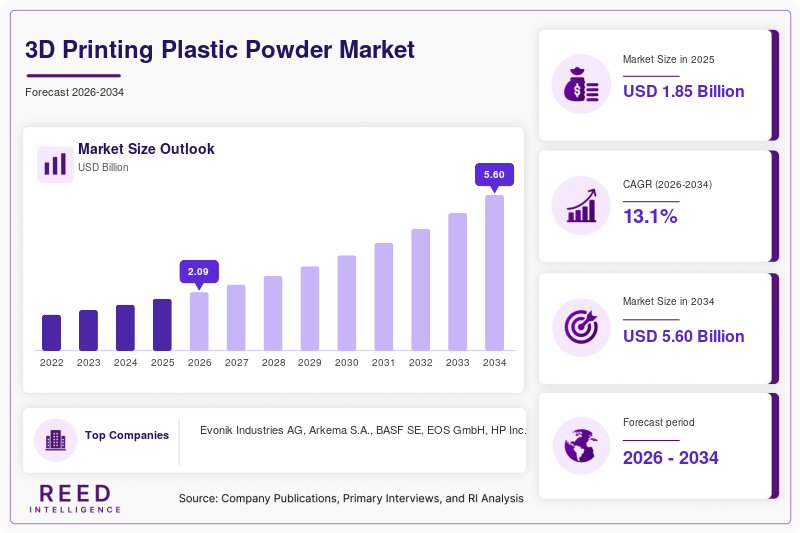
The global 3D Printing Plastic Powder Market size was valued at approximately USD 1.85 billion in 2026 and is projected to reach USD 4.92 billion by 2034, expanding at a CAGR of 13.1% during the forecast period (2026–2034). The market growth is primarily supported by the increasing adoption of additive manufacturing technologies across industrial sectors, particularly for rapid prototyping and low-volume production. The shift toward digital manufacturing workflows has enabled manufacturers to reduce waste, shorten production cycles, and enhance customization capabilities, thereby boosting the demand for plastic powder materials compatible with powder bed fusion and other advanced printing technologies.
A significant global factor contributing to market expansion is the growing integration of additive manufacturing in supply chain optimization. Industries are increasingly leveraging localized production using 3D printing to reduce dependency on traditional manufacturing hubs, thereby improving efficiency and resilience.
Key Highlights
- North America dominated the market with a share of 38.6% in 2025, while Asia Pacific is expected to grow at the fastest CAGR of 15.4% during the forecast period.
- Nylon (Polyamide) emerged as the leading material segment with a 42.3% share in 2025, while TPU (Thermoplastic Polyurethane) is anticipated to register the fastest growth at a CAGR of 16.2%.
- Selective Laser Sintering (SLS) led the technology segment with a 47.8% share, whereas Multi Jet Fusion (MJF) is projected to grow at a CAGR of 14.8%.
- The United States remained the dominant country, with market values of USD 540 million in 2024 and USD 590 million in 2025.
Market Trends
Rising Demand for Functional Prototyping
Industries are increasingly using 3D printing plastic powders to produce functional prototypes that closely mimic final products. This trend is enabling faster product development cycles and reducing time-to-market across sectors such as automotive and consumer electronics.
Material Innovation and Customization
The development of high-performance plastic powders with enhanced mechanical, thermal, and chemical properties is shaping the market. Manufacturers are focusing on tailored materials designed for specific applications, improving overall printing efficiency and part performance.
Market Drivers
Increasing Adoption of Additive Manufacturing in Industrial Production
The expansion of additive manufacturing beyond prototyping into end-use production is driving demand for plastic powders. Industries such as aerospace and healthcare are adopting these technologies to produce lightweight, complex components with reduced material waste. This shift is accelerating the need for advanced plastic powders that ensure consistent quality and performance.
Growth in Demand for Lightweight and Durable Components
The need for lightweight materials that offer durability and design flexibility is fueling the adoption of plastic powders. These materials allow manufacturers to optimize product performance while reducing overall weight, particularly in transportation and industrial applications. This advantage is contributing significantly to the growth of the 3D Printing Plastic Powder Market.
Market Restraint
High Cost of Advanced Printing Materials
The relatively high cost of specialized plastic powders compared to conventional materials remains a key challenge. This cost factor limits adoption among small and medium enterprises, especially in developing regions where budget constraints influence technology investments.
Market Opportunities
Expansion in Healthcare Applications
The healthcare sector presents strong growth potential for plastic powder-based 3D printing, particularly in customized implants, prosthetics, and surgical tools. The ability to produce patient-specific solutions is expected to create new revenue streams for market players.
Development of Sustainable and Recyclable Powders
The growing focus on environmental sustainability is encouraging the development of recyclable and bio-based plastic powders. Companies investing in eco-friendly materials are likely to gain a competitive edge as regulatory and consumer pressures increase.
Segmental Analysis
By Material
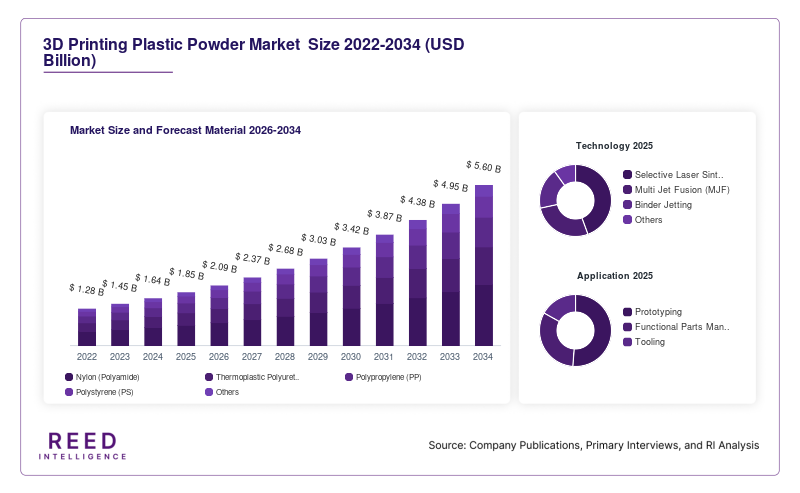
Nylon (Polyamide) dominated the material segment with a 42.3% share in 2025, owing to its superior mechanical properties and versatility across applications. TPU is anticipated to be the fastest-growing subsegment, registering a CAGR of 16.2% due to its flexibility and suitability for producing elastic components in medical and consumer goods applications.
By Technology
Selective Laser Sintering (SLS) held the largest share of 47.8% in 2025, driven by its ability to produce high-strength parts without support structures. Multi Jet Fusion (MJF) is projected to grow at a CAGR of 14.8%, supported by faster production speeds and improved surface finish, making it suitable for industrial-scale manufacturing.
By Application
Prototyping dominated the application segment with a 39.5% share in 2025, as companies continue to rely on rapid prototyping for product development. Functional part manufacturing is expected to be the fastest-growing subsegment, with a CAGR of 15.0%, due to increasing use in end-use production across industries.
By End-Use Industry
The automotive sector accounted for the largest share of 34.1% in 2025, driven by the need for lightweight and customized components. Healthcare is projected to grow at the fastest CAGR of 15.7%, supported by rising demand for personalized medical devices and implants.
Regional Analysis
North America
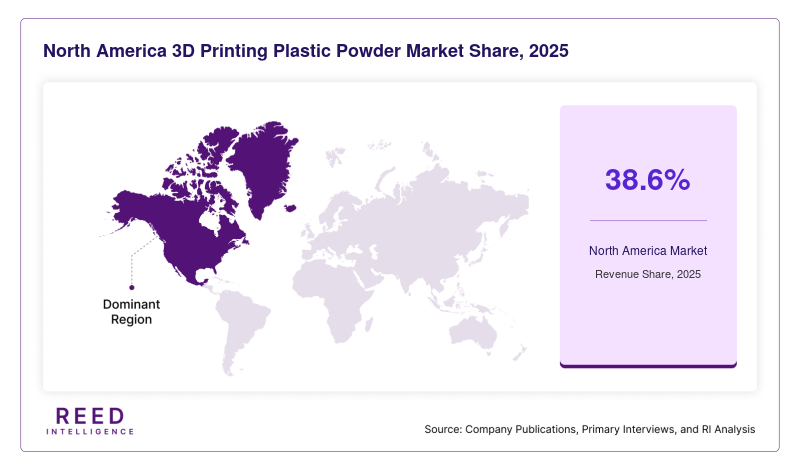
North America accounted for 38.6% of the global market share in 2025 and will grow at a CAGR of 12.4% through 2034. The United States dominated the region due to strong investments in advanced manufacturing technologies. The country’s growth is driven by the presence of established aerospace and defense industries that increasingly utilize additive manufacturing for complex component production.
Europe
Europe held a 27.2% share in 2025 and is expected to grow at a CAGR of 12.1% during the forecast period. Germany emerged as the leading country, supported by its strong industrial base and focus on engineering innovation. The country’s emphasis on precision manufacturing is fostering demand for high-quality plastic powders.
Asia Pacific
Asia Pacific represented 21.8% of the market in 2025 and is projected to expand at the fastest CAGR of 15.4% through 2034. China led the region due to rapid industrialization and government initiatives promoting advanced manufacturing technologies. The country’s growing electronics and automotive sectors are contributing to increased adoption of 3D printing materials.
Middle East & Africa
The Middle East & Africa held a 6.4% share in 2025 and will grow at a CAGR of 11.3% over the forecast period. The United Arab Emirates dominated the region, driven by investments in smart manufacturing and innovation hubs. The country’s focus on diversifying its economy beyond oil is supporting the adoption of additive manufacturing technologies.
Latin America
Latin America accounted for 6.0% of the market share in 2025 and is expected to grow at a CAGR of 11.8% during the forecast period. Brazil emerged as the leading country due to increasing adoption of 3D printing in industrial and healthcare applications. The country’s growing manufacturing sector is driving demand for cost-effective production solutions.
Competitive Landscape
The 3D Printing Plastic Powder Market is moderately consolidated, with key players focusing on material innovation and strategic collaborations to strengthen their market position. Leading companies are investing in research and development to introduce high-performance powders tailored for specific industrial applications. Evonik Industries AG stands out as a market leader, leveraging its advanced polymer expertise and expanding its product portfolio to meet evolving customer demands. The company recently introduced new bio-based polyamide powders aimed at improving sustainability in additive manufacturing.
Other prominent players such as Arkema S.A., BASF SE, EOS GmbH, and HP Inc. are actively enhancing their technological capabilities and expanding global distribution networks. These companies are focusing on partnerships with 3D printer manufacturers to ensure compatibility and optimize performance. The competitive landscape is characterized by continuous innovation, product differentiation, and efforts to address cost and sustainability challenges.
Key Players List
- Evonik Industries AG
- Arkema S.A.
- BASF SE
- EOS GmbH
- HP Inc.
- Stratasys Ltd.
- 3D Systems Corporation
- Solvay S.A.
- DSM-Firmenich
- CRP Technology S.r.l.
- Höganäs AB
- SABIC
- Materialise NV
- Renishaw plc
- Carpenter Technology Corporation
Recent Developments
- In 2025, Evonik Industries launched a new line of sustainable polyamide powders designed for industrial 3D printing applications.
- In 2025, BASF expanded its additive manufacturing portfolio with enhanced TPU powders for flexible component production.
- In 2024, HP Inc. introduced advanced Multi Jet Fusion materials aimed at improving production efficiency and part durability.
- In 2024, Arkema strengthened its global presence by expanding its specialty polymer production capacity.
- In 2025, EOS GmbH collaborated with material developers to improve powder recyclability and reduce production costs.
3D Printing Plastic Powder Market Segments
Material
- Nylon (Polyamide)
- Thermoplastic Polyurethane (TPU)
- Polypropylene (PP)
- Polystyrene (PS)
- Others
Technology
- Selective Laser Sintering (SLS)
- Multi Jet Fusion (MJF)
- Binder Jetting
- Others
Application
- Prototyping
- Functional Parts Manufacturing
- Tooling
End-Use Industry
- Automotive
- Aerospace & Defense
- Healthcare
- Consumer Goods
- Industrial
By Region
- North America
- Europe
- APAC
- Middle East and Africa
- LATAM