3D Product Visualization Platform Market Size, Share & Trends Analysis Report By Component (Software, Services), By Deployment (Cloud, On-Premises) and By Application (E-Commerce, Marketing & Advertising, Product Design & Development, Augmented Reality & Virtual Reality) and By Region (North America, Europe, Asia Pacific, Latin America, Middle East & Africa) Forecasts, 2026–2034
USD 3950
3D Product Visualization Platform Market Size
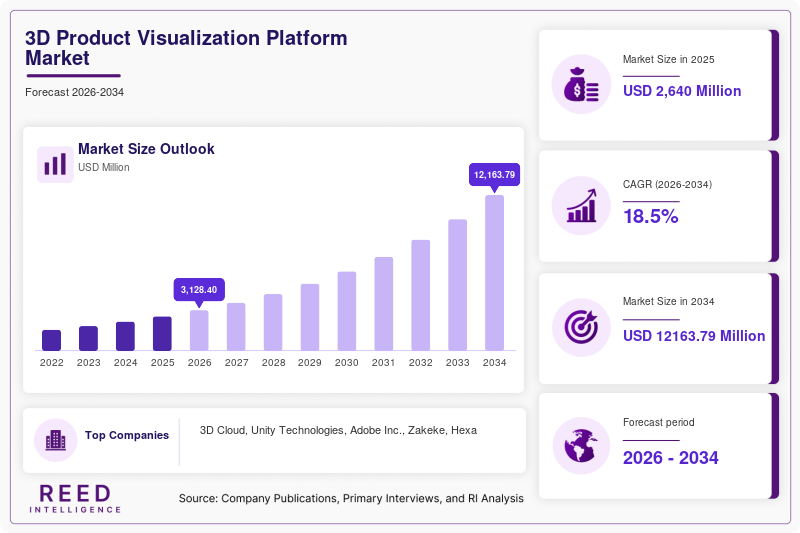
The global 3D product visualization platform market size was valued at USD 2,640 million in 2025 and is projected to grow from USD 3,128 million in 2026 to USD 12,140 million by 2034, registering a CAGR of 18.5% during the forecast period from 2026 to 2034.
3D product visualization platforms provide the software infrastructure required to create, manage, render and distribute interactive digital representations of physical products. Core capabilities include 3D modeling, real-time rendering, product configuration, digital asset management, AR visualization, virtual showrooms and integration with e-commerce systems. CB Insights identifies photorealistic rendering, real-time customization, AR integration and performance analytics as key capabilities across the 3D product visualization technology landscape.
The commercial value of these platforms is particularly strong where consumers need to understand dimensions, materials, finishes, configuration options or spatial fit before purchasing. Furniture, home improvement, fashion, jewelry, automotive products and other configurable goods can use interactive models to provide information that static images cannot communicate. Shopify's 2026 analysis highlights furniture, fashion and configurable products as particularly suitable categories for 3D and AR experiences.
3D Product Visualization Platform Market Drivers
Expansion of Interactive E-Commerce
Online shopping removes the physical interaction customers traditionally use to evaluate products. 3D visualization addresses this limitation by allowing shoppers to rotate products, zoom into details, change configurations and, where supported, place products within physical environments through AR. Shopify reports that consumers using 3D and AR can examine products from multiple angles and visualize products in their own spaces.
This changes the role of product content from a static merchandising asset into an interactive sales interface. Retailers can reuse a single digital model across product pages, configurators, AR applications and marketing content, reducing dependence on separate visual assets for every product variation. The resulting workflow supports larger catalogs and more frequent product updates.
Growth of Product Customization
Manufacturers and retailers are increasing the number of product configurations offered online, particularly across furniture, home improvement, fashion, accessories and made-to-order goods. A 3D configurator allows customers to select materials, colors, dimensions and components while immediately seeing the resulting product.
3D Cloud's Q2 2026 data reported a 16% add-to-cart rate and 2.2% purchase conversion rate for modular configurators, illustrating how interactive configuration can become directly connected with commerce activity.
Integration of AI, AR and Digital Twins
AI-assisted 3D creation and digital-twin workflows are reducing the amount of manual production required for large product catalogs. Adobe's 2026 Substance 3D developments specifically addressed digital twins, OpenPBR and more scalable 3D workflows.
At the same time, AR allows the same product model to move beyond a website into the consumer's physical environment. Unity describes product configurators, virtual showrooms and digital twins as applications for real-time 3D across retail and consumer goods.
3D Product Visualization Platform Market Restraints
High Cost of High-Fidelity 3D Content
Creating accurate, photorealistic 3D models remains resource-intensive for complex products. Large catalogs may contain thousands of SKUs, materials and product variations, requiring detailed modeling, texture creation, optimization and testing across devices. The challenge becomes greater when models must remain consistent across websites, mobile applications, AR and other visualization environments.
The operational issue is therefore not limited to acquiring visualization software. Companies must also establish workflows for model creation, quality control, asset management, product-data synchronization and ongoing updates. Platforms that provide reusable asset libraries can reduce duplication, but the initial content-production requirement remains a constraint.
Integration and Technical Complexity
Enterprise deployment often requires connections with e-commerce platforms, product information management systems, ERP systems, CRM platforms, pricing engines and configuration rules. Unity notes that deeper ERP or CRM integrations, bespoke interfaces and unusual configuration logic can still require technical development even when no-code tools are available.
Performance is another consideration because high-resolution 3D assets can increase page weight and rendering requirements. Platforms therefore need to balance visual quality with loading speed, device compatibility and mobile performance.
3D Product Visualization Platform Market Opportunities
Expansion into Configurable and Made-to-Order Products
The growing number of configurable products creates demand for platforms that connect visualization directly with pricing, configuration rules, quoting and production workflows. 3D Cloud's September 2026 launch of 3D Visual CPQ integrated interactive visualization, configurable product data, rules-based configuration, dynamic pricing and bill-of-material generation.
This expands the role of visualization software from marketing content toward commercial infrastructure. Furniture, kitchens, bathrooms, office interiors, outdoor products and other complex categories can use a single configuration environment across e-commerce, retail stores, dealer networks and sales-assisted channels.
AI-Based 3D Content Production
AI-generated models, materials, product scenes and lifestyle imagery can reduce the time required to build large visualization libraries. Shopify's 2026 coverage also highlights AI-based 3D model generation as an emerging method for turning product imagery into interactive models.
The opportunity extends beyond model creation. AI can connect customer descriptions with product catalogs, recommend configurations, generate marketing imagery and assist merchants in maintaining digital product assets. As these functions become integrated into existing platforms, visualization can become a more automated component of digital commerce operations.
3D Product Visualization Platform Market Segmental Analysis
By Component
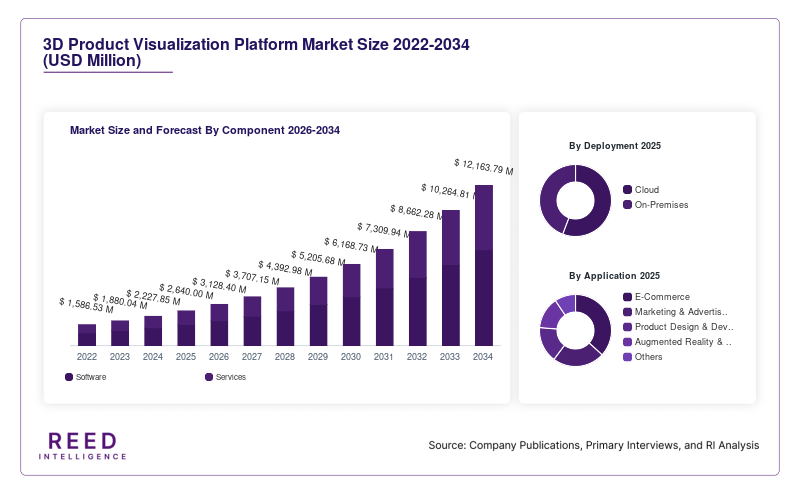
Software is the dominant component, accounting for approximately 72% share. Software platforms provide the core visualization environment, including 3D rendering, product configuration, asset management, AR deployment, analytics and commerce integrations. Enterprise platforms increasingly combine multiple functions rather than operating as isolated visualization tools.
Services are projected to register approximately 20.7% CAGR during 2026–2034. Services include 3D modeling, implementation, integration, customization, content optimization and technical support. Service demand remains important because enterprises often require assistance converting CAD files, product photography and product databases into optimized web-ready 3D assets.
By Deployment
Cloud deployment accounts for approximately 69% share. Cloud platforms allow retailers and manufacturers to manage 3D catalogs centrally and distribute assets across websites, mobile experiences, configurators and AR applications. The model also supports centralized updates when product attributes, materials or pricing rules change.
Cloud deployment is projected to register approximately 20.1% CAGR, while on-premises deployment grows at approximately 12.1%. Cloud-based delivery is particularly compatible with SaaS commerce ecosystems because visualization tools can connect with e-commerce, PIM and other enterprise applications without requiring extensive local infrastructure.
By Application
E-Commerce accounts for approximately 42% share, making it the largest application segment. Online retailers use interactive 3D models, 360-degree views, AR and configurators to communicate product details that are difficult to demonstrate through static photography. Shopify identifies these capabilities as important components of modern 3D commerce.
Augmented Reality & Virtual Reality is projected to be the fastest-growing application, with approximately 22.8% CAGR. AR allows customers to visualize products in real environments, while VR and virtual showrooms support immersive product discovery. Unity identifies interactive configurators and virtual showrooms as important retail applications for real-time 3D.
Marketing & Advertising represents approximately 21% share and is projected to grow at 17.4% CAGR as brands reuse 3D assets across campaigns, social media, digital catalogs and product launches. Product Design & Development represents approximately 24% share with an estimated 16.2% CAGR, supported by digital-twin and visualization workflows.
3D Product Visualization Platform Market Regional Analysis
North America 3D Product Visualization Platform Market
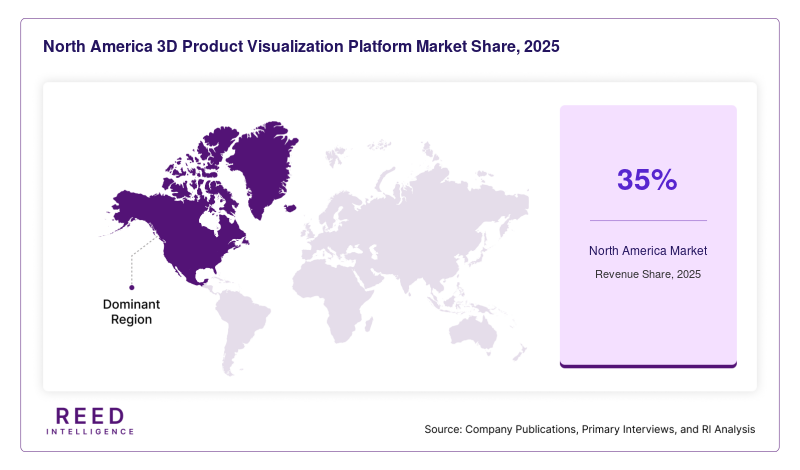
North America is the dominant region, accounting for approximately 35% share. The region benefits from mature e-commerce infrastructure, enterprise software adoption, large retail ecosystems and strong investment in immersive digital experiences. Related 3D-commerce research identifies North America as the largest regional market, while 3D Cloud's 2026 enterprise benchmark includes major deployments across the U.S. and demonstrates established adoption among retailers.
The U.S. represents the principal demand center, supported by furniture, home improvement, consumer goods, fashion and technology companies adopting interactive product experiences. Enterprise requirements increasingly extend from 3D viewers toward configurators, AR, digital asset management and visual CPQ, creating demand for integrated platforms.
Europe 3D Product Visualization Platform Market
Europe is projected to register approximately 17.2% CAGR during 2026–2034. The region has established luxury, fashion, furniture, automotive and industrial-design ecosystems where product appearance, customization and digital presentation have high commercial importance. European brands are also active users of AR and immersive product experiences.
The United Kingdom, Germany, France and Italy represent important technology and retail centers. Platform adoption is supported by cross-channel commerce, product customization and digital content requirements, while interoperability and enterprise integration remain important purchasing considerations.
Asia Pacific 3D Product Visualization Platform Market
Asia Pacific is the fastest-growing region, with an estimated 21.6% CAGR during 2026–2034. Large digital-commerce populations, expanding mobile commerce, manufacturing capabilities and growing adoption of immersive technologies provide a broad customer base for visualization platforms. Related 3D e-commerce research also identifies Asia Pacific as the fastest-growing region.
China, Japan, South Korea and India are major demand centers. China combines large e-commerce volumes with consumer-electronics, furniture and manufacturing ecosystems, while Japan and South Korea contribute advanced technology adoption. India is expanding digital commerce and enterprise technology adoption, creating additional demand for cloud-based 3D visualization.
Latin America 3D Product Visualization Platform Market
Latin America is projected to register approximately 19.0% CAGR during 2026–2034. Increasing e-commerce penetration and mobile-first shopping are creating greater demand for product experiences that provide additional visual information before purchase. Furniture, fashion, consumer products and customized merchandise represent relevant application areas.
Brazil and Mexico account for important regional demand, supported by expanding digital retail ecosystems and growing adoption of online product discovery. Cloud delivery can lower infrastructure requirements for smaller retailers, although content creation, platform integration and professional 3D-modeling costs remain adoption considerations.
Middle East & Africa 3D Product Visualization Platform Market
The Middle East & Africa region is projected to grow at approximately 19.6% CAGR during 2026–2034. Digital retail development, premium consumer markets, real-estate and interior applications, and investments in immersive customer experiences are creating demand for interactive product visualization.
The UAE and Saudi Arabia are important regional technology and retail centers, while South Africa provides demand from established digital commerce and enterprise technology markets. Adoption is increasingly linked to mobile commerce, virtual showrooms, AR experiences and configurable products, with cloud deployment providing a scalable model for regional enterprises.
3D Product Visualization Platform Market Competitive Landscape
The competitive landscape includes specialized 3D commerce platforms, real-time 3D technology providers, creative-software companies and visual-commerce platforms. Competition increasingly centers on the ability to manage the complete product-visualization lifecycle rather than simply render individual 3D models.
3D Cloud focuses on enterprise 3D commerce, offering product configurators, room planners, AR/WebAR, renders, modeling services and centralized asset management. Its September 2026 Visual CPQ launch expanded the platform into pricing, configuration rules and bill-of-material workflows.
Key Market Players
- 3D Cloud
- Unity Technologies
- Adobe Inc.
- Zakeke
- Hexa
- Threekit
- Cylindo
- VNTANA
- Epic Games
- NVIDIA
- Shopify
- Sketchfab
- Marxent
- Expivi
- Holo-Light
3D Product Visualization Platform Market Recent Developments
-
September 2026 -3D Cloud: 3D Cloud launched 3D Visual CPQ workflows for new customers, integrating interactive 3D visualization with configurable product data, rules-based configuration, dynamic pricing and bill-of-material generation.
-
July 2026 -Adobe: Adobe introduced new Substance 3D innovations covering faster workflows, expanded OpenPBR support, additional assets and digital-twin workflows designed to make 3D creation and product visualization more scalable.
3D Product Visualization Platform Market Segments
By Component
- Software
- Services
By Deployment
- Cloud
- On-Premises
By Application
- E-Commerce
- Marketing & Advertising
- Product Design & Development
- Augmented Reality & Virtual Reality
- Others
By Region
- North America
- Europe
- APAC
- Middle East and Africa
- LATAM