3D Surgical Microscope System Market Size, Share & Demand Report By Product Type (On-Cart Surgical Microscope Systems, Ceiling-Mounted Systems, Wearable Visualization Systems), By Application (Neurosurgery, Ophthalmology, ENT Surgery, Spine Surgery, Plastic and Reconstructive Surgery, Others), By End Use (Hospitals, Ambulatory Surgical Centers, Specialty Clinics, Academic and Research Institutes), By Region & Segment Forecasts, 2026–2034
USD 3950
Market Overview
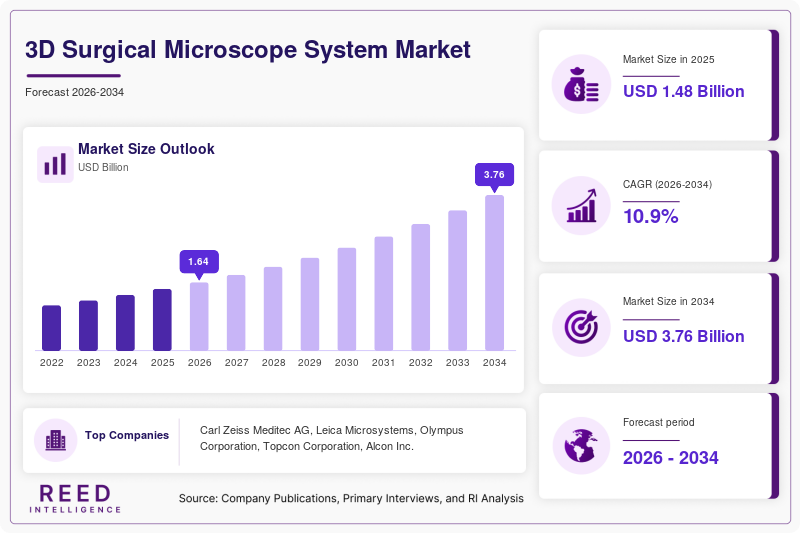
The global 3D Surgical Microscope System Market size was valued at approximately USD 1.48 billion in 2026 and is projected to reach nearly USD 3.37 billion by 2034, expanding at a CAGR of 10.9% during the forecast period from 2026 to 2034. The market is gaining momentum due to the increasing adoption of minimally invasive surgeries across neurosurgery, ophthalmology, spine surgery, ENT procedures, and reconstructive microsurgery. Hospitals and specialty surgical centers are integrating advanced visualization technologies to improve surgical precision, reduce operation time, and enhance patient outcomes.
The rising burden of chronic neurological and ophthalmic disorders has also accelerated the deployment of high-definition 3D imaging systems in operating rooms. Surgeons are increasingly preferring digital surgical microscopes equipped with augmented visualization, robotic assistance compatibility, and AI-enabled imaging capabilities. In addition, healthcare institutions are investing in operating room modernization projects that support integrated imaging workflows and ergonomic surgical environments. Growing healthcare expenditure in emerging economies and increasing awareness regarding image-guided surgery are contributing to market expansion.
Key Highlights
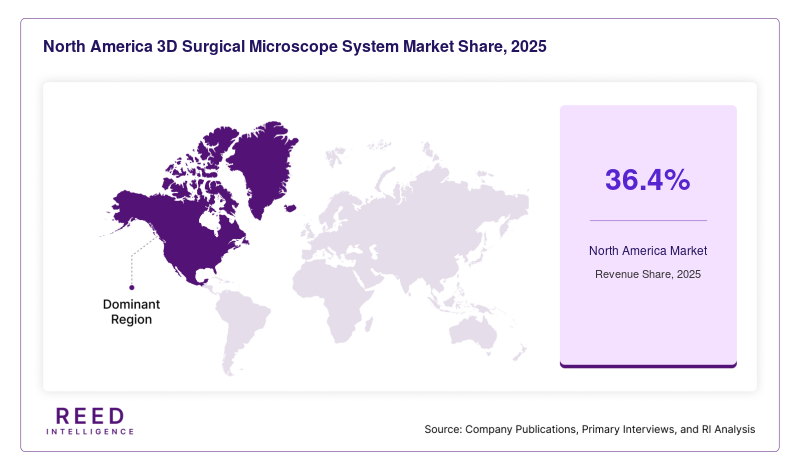
- North America dominated the market with a 36.4% share in 2025.
- Asia Pacific is expected to grow at the fastest CAGR of 12.1% during 2026–2034.
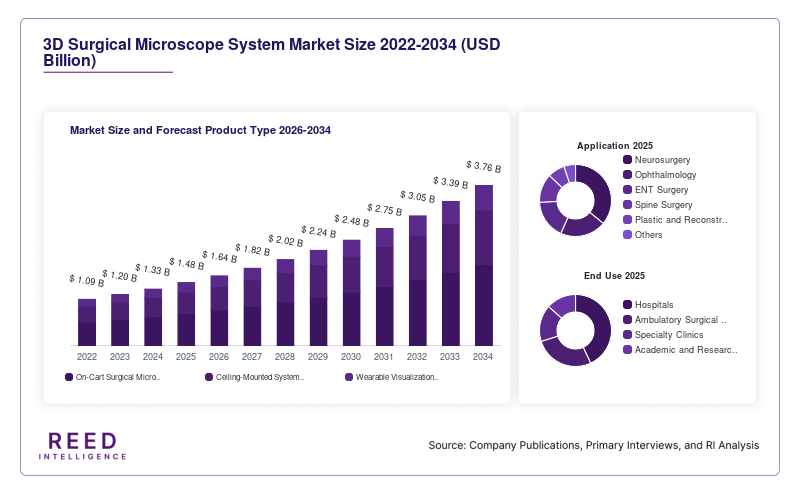
- By product type, on-cart surgical microscope systems accounted for the largest share of 57.8%, while wearable visualization systems are projected to grow at a CAGR of 13.4%.
- By application, neurosurgery led with a 33.9% share, whereas ophthalmology is expected to expand at a CAGR of 12.8%.
- By end use, hospitals held the dominant share of 61.3%, while ambulatory surgical centers are anticipated to grow at a CAGR of 11.9%.
- The United States remained the dominant country, with market values of USD 420 million in 2024 and USD 468 million in 2025.
Market Trends
Expansion of Digital Visualization Platforms in Operating Rooms
The healthcare industry is witnessing a transition from conventional optical microscopes toward digitally connected visualization systems. Modern operating rooms are increasingly integrating 3D surgical microscope systems with imaging software, robotic surgical platforms, and AI-assisted navigation technologies. These systems enable surgeons to access real-time visualization with improved depth perception and image clarity during complex procedures. Hospitals are also investing in centralized surgical data management systems that allow video recording, live streaming, and remote consultation. This trend is particularly visible in neurosurgical and ophthalmic procedures where enhanced visualization can improve procedural accuracy. Manufacturers are responding by launching microscope systems equipped with touchscreen interfaces, heads-up displays, and cloud connectivity features that support advanced workflow optimization in surgical settings.
Growing Adoption of Minimally Invasive and Precision-Based Surgeries
The increasing preference for minimally invasive surgical techniques is influencing demand across the 3D Surgical Microscope System Market. Surgeons are prioritizing technologies that provide high magnification, improved ergonomics, and enhanced illumination to reduce tissue damage during procedures. Healthcare providers are also focusing on faster patient recovery, shorter hospital stays, and reduced postoperative complications, all of which align with minimally invasive surgery trends. Advanced 3D visualization systems support these goals by enabling more accurate anatomical interpretation and better surgical navigation. Demand is also rising in spine surgery, vascular microsurgery, and ENT procedures where precision is critical. As healthcare facilities continue to modernize surgical infrastructure, the adoption of high-definition digital microscope systems is expected to increase steadily across both developed and emerging healthcare markets.
Market Drivers
Increasing Prevalence of Neurological and Ophthalmic Disorders
The growing incidence of neurological diseases, retinal disorders, cataracts, and spinal conditions is significantly supporting the expansion of the 3D Surgical Microscope System Market. Aging populations across several countries are contributing to higher surgical volumes in neurosurgery and ophthalmology. Surgical microscopes with 3D visualization capabilities improve accuracy during delicate procedures involving blood vessels, nerves, and retinal tissues. Hospitals are therefore increasing investments in advanced surgical imaging technologies to manage rising patient demand. In addition, the growing number of brain tumor surgeries and minimally invasive spinal procedures is creating continuous demand for systems that offer enhanced magnification and depth perception. The need for improved patient outcomes and lower surgical complication rates continues to strengthen adoption across healthcare institutions globally.
Rising Investments in Healthcare Infrastructure and Surgical Modernization
Governments and private healthcare organizations are expanding investments in operating room modernization and digital healthcare infrastructure. Many hospitals are replacing conventional analog microscope systems with digitally integrated 3D surgical visualization platforms that support workflow efficiency and surgeon comfort. Emerging economies are also increasing healthcare budgets to improve access to advanced surgical technologies. Several medical institutions are establishing specialized microsurgery centers equipped with robotic-assisted systems and real-time imaging solutions. In addition, rising competition among hospitals is encouraging investment in premium surgical equipment to attract skilled surgeons and improve procedural success rates. Technological advancements in optics, camera sensors, and fluorescence imaging are also driving replacement demand, particularly in large tertiary care hospitals and academic medical centers.
Market Restraint
High Equipment Costs and Limited Accessibility in Developing Economies
The high acquisition and maintenance cost associated with advanced 3D surgical microscope systems remains a major restraint for market expansion. Premium systems integrated with digital imaging, AI-assisted navigation, and robotic compatibility require significant capital investment, which can limit adoption among smaller hospitals and healthcare facilities with constrained budgets. Many developing economies continue to rely on conventional microscope systems due to affordability concerns and limited reimbursement support for technologically advanced surgical procedures. In addition, installation costs, software upgrades, and specialized training requirements add to the total operational expenditure for healthcare providers. Smaller surgical centers often face difficulties in justifying investment returns, particularly in regions where surgical procedure volumes remain inconsistent. Supply chain challenges and import dependency for advanced medical devices further increase pricing pressure in price-sensitive markets. As a result, adoption rates in several low-income and middle-income countries continue to lag behind developed healthcare systems despite growing awareness regarding the benefits of digital surgical visualization technologies.
Market Opportunities
Integration of Artificial Intelligence and Augmented Reality Technologies
The integration of artificial intelligence and augmented reality features into surgical microscope systems is creating new growth opportunities for manufacturers. AI-enabled visualization platforms can assist surgeons by identifying anatomical structures, improving image stabilization, and supporting real-time procedural guidance. Augmented reality overlays are also being used to project diagnostic information directly into the surgical field, enhancing decision-making during complex procedures. These technologies are gaining attention in neurosurgery and vascular surgery where procedural precision is essential. Companies are increasingly investing in software innovation to create intelligent surgical ecosystems that improve operational efficiency and surgical confidence. As hospitals continue adopting digital operating room solutions, demand for AI-integrated 3D microscope systems is expected to increase substantially during the forecast period.
Expansion of Ambulatory Surgical Centers and Remote Surgical Training
The rapid expansion of ambulatory surgical centers is generating additional demand for compact and cost-efficient 3D surgical microscope systems. These facilities are performing a growing number of outpatient procedures due to lower operational costs and faster patient turnaround times. Portable digital microscope systems with enhanced imaging capabilities are becoming attractive solutions for ambulatory environments. Additionally, the use of 3D visualization systems for remote surgical training and telemedicine applications is creating new commercial opportunities. Academic institutions and healthcare providers are increasingly utilizing digital microscope platforms for live surgical broadcasting and virtual training programs. This trend is particularly important in emerging regions where access to advanced surgical education remains limited. Manufacturers offering scalable and training-compatible systems are expected to gain competitive advantages in the evolving healthcare technology landscape.
Segmental Analysis
By Product Type
On-cart surgical microscope systems accounted for the largest share of the global 3D Surgical Microscope System Market in 2024, contributing approximately 57.8% of total revenue. These systems remain widely preferred due to their advanced optical performance, stability, and compatibility with complex surgical procedures. Large tertiary care hospitals and specialty surgical centers continue relying on on-cart systems for neurosurgery, ophthalmology, and reconstructive surgery applications. Their ability to support high-definition visualization, fluorescence imaging, and robotic integration has strengthened adoption among healthcare institutions. In addition, manufacturers are introducing ergonomic designs with enhanced mobility and digital connectivity features to improve workflow efficiency. The availability of customizable configurations and integrated imaging platforms has further reinforced the dominance of this subsegment across developed healthcare markets.
By Application
Neurosurgery held the dominant share of the 3D Surgical Microscope System Market in 2024, accounting for nearly 33.9% of global revenue. Neurosurgical procedures require exceptional magnification and depth perception due to the complexity of brain and spinal anatomy. Advanced 3D surgical microscope systems provide enhanced visualization of delicate neural structures and blood vessels, helping surgeons improve procedural accuracy and minimize tissue damage. Rising incidences of brain tumors, traumatic brain injuries, and spinal disorders are contributing to growing surgical volumes worldwide. Hospitals are also increasingly adopting fluorescence-guided imaging and AI-assisted navigation technologies to improve neurosurgical outcomes. The demand for technologically advanced visualization systems remains particularly strong in academic medical centers and large neurosurgical institutes.
By End Use
Hospitals represented the largest end-use segment in the global 3D Surgical Microscope System Market in 2024, holding approximately 61.3% of total revenue. Large hospitals perform high volumes of neurosurgical, ophthalmic, ENT, and reconstructive procedures, making them major adopters of advanced surgical visualization technologies. These healthcare institutions possess stronger financial capabilities for investing in premium imaging equipment and integrated operating room infrastructure. Hospitals are increasingly implementing digital surgical ecosystems that combine microscope systems with robotic platforms, navigation technologies, and AI-assisted imaging software. In addition, teaching hospitals and research institutions rely heavily on advanced visualization systems for surgeon training and clinical education. The growing emphasis on patient safety and surgical precision continues to support segment dominance globally.
Regional Analysis
North America
North America accounted for the largest share of the global 3D Surgical Microscope System Market in 2025, representing nearly 36.4% of overall revenue. The region is expected to maintain steady growth at a CAGR of 9.8% during the forecast period due to strong healthcare spending and high adoption of technologically advanced surgical systems. Hospitals across the United States and Canada are rapidly implementing digitally integrated operating room solutions that support precision-based procedures. The increasing number of neurosurgical and ophthalmic interventions is also contributing to demand for high-resolution surgical visualization systems.
Europe
Europe represented a significant share of the 3D Surgical Microscope System Market in 2025 and is projected to expand at a CAGR of 9.5% through 2034. The region benefits from established healthcare systems, rising adoption of image-guided surgery, and increasing investments in advanced medical technologies. Countries across Western Europe are focusing on improving surgical precision and reducing postoperative complications through digital operating room modernization. Growing demand for minimally invasive neurosurgical and ENT procedures continues to create favorable opportunities for market participants throughout the region.
Asia Pacific
Asia Pacific is projected to register the fastest growth in the global 3D Surgical Microscope System Market, with an anticipated CAGR of 12.1% during 2026–2034. Rising healthcare investments, expanding hospital infrastructure, and increasing awareness regarding advanced surgical technologies are driving regional growth. Several countries are modernizing healthcare facilities and increasing access to specialized surgical procedures. Demand for precision-based surgery is rising rapidly in densely populated nations where neurological disorders, cataracts, and spinal conditions are becoming more common.
Middle East & Africa
The Middle East & Africa market accounted for a smaller but steadily growing share of global revenue in 2025 and is expected to witness a CAGR of 8.7% during the forecast period. Increasing healthcare investments in Gulf countries and the gradual expansion of specialty surgical centers are contributing to regional market growth. Hospitals are focusing on acquiring advanced imaging technologies to strengthen clinical capabilities in neurosurgery, ophthalmology, and reconstructive surgery. Medical tourism development in several Middle Eastern countries is also supporting demand for premium surgical equipment.
Latin America
Latin America demonstrated moderate growth in the 3D Surgical Microscope System Market during 2025 and is forecast to expand at a CAGR of 8.9% through 2034. Growing awareness regarding precision surgery and increasing investment in private healthcare facilities are supporting market expansion. Countries across the region are gradually upgrading surgical infrastructure to improve treatment quality and attract medical tourism activities. Rising demand for ophthalmic and spinal surgeries is also contributing to the adoption of advanced surgical visualization technologies in urban healthcare centers.
Competitive Landscape
The global 3D Surgical Microscope System Market is characterized by strong competition among established medical device manufacturers and emerging imaging technology companies. Market participants are focusing on product innovation, software integration, strategic partnerships, and regional expansion to strengthen their competitive positions. Companies are investing heavily in research and development activities aimed at improving imaging precision, ergonomic design, and AI-assisted surgical capabilities. The industry is also witnessing growing collaboration between technology firms and healthcare institutions to accelerate commercialization of digitally connected operating room solutions.
Carl Zeiss Meditec AG remained a leading player in the market due to its extensive portfolio of surgical visualization systems and strong global distribution network. The company recently introduced enhanced digital visualization software for neurosurgical applications aimed at improving intraoperative imaging accuracy. Other major companies are also launching compact microscope systems with cloud-enabled surgical recording capabilities to address increasing demand for integrated surgical workflows. Competitive intensity is expected to rise further as healthcare providers continue prioritizing technologically advanced solutions that improve surgical precision and operational efficiency.
Key Players
- Carl Zeiss Meditec AG
- Leica Microsystems
- Olympus Corporation
- Topcon Corporation
- Alcon Inc.
- Haag-Streit Group
- Synaptive Medical
- Takagi Seiko Co., Ltd.
- Seiler Instrument Inc.
- ARRI Medical
- Nikon Corporation
- Danaher Corporation
- Karl Kaps GmbH
- Moeller-Wedel Optical GmbH
- Vision Engineering Ltd.
Recent Developments
- Carl Zeiss Meditec AG introduced an upgraded digital surgical visualization platform featuring AI-assisted image enhancement for neurosurgical procedures in 2025.
- Leica Microsystems expanded its 3D surgical imaging portfolio through the launch of a compact microscope system designed for ambulatory surgical centers in 2024.
- Olympus Corporation announced a strategic collaboration with a robotic surgery technology provider to develop integrated visualization solutions for minimally invasive surgeries in 2025.
- Synaptive Medical enhanced its cloud-connected surgical planning platform with real-time intraoperative imaging support for complex brain surgeries in 2024.
- Topcon Corporation invested in advanced ophthalmic imaging research aimed at improving 3D visualization accuracy and workflow efficiency for retinal surgeries in 2025.
3D Surgical Microscope System Market Segments
Product Type
- On-Cart Surgical Microscope Systems
- Ceiling-Mounted Systems
- Wearable Visualization Systems
Application
- Neurosurgery
- Ophthalmology
- ENT Surgery
- Spine Surgery
- Plastic and Reconstructive Surgery
- Others
End Use
- Hospitals
- Ambulatory Surgical Centers
- Specialty Clinics
- Academic and Research Institutes
By Region
- North America
- Europe
- APAC
- Middle East and Africa
- LATAM