4D Technology Market Size, Share & Trends Analysis Report By Technology Type (4D Imaging, 4D Sensing, 4D Digital Twins & Simulation, 4D Printing), By Component (Hardware, Software, Services), By Application (Healthcare & Medical Imaging, Automotive & Mobility, Manufacturing & Industrial, Construction & Infrastructure, Aerospace & Defense, Media & Entertainment), By End Use (Healthcare Institutions, Automotive Companies, Industrial Enterprises, Construction Firms, Government & Defense Organizatio
USD 3950
4D Technology Market Size
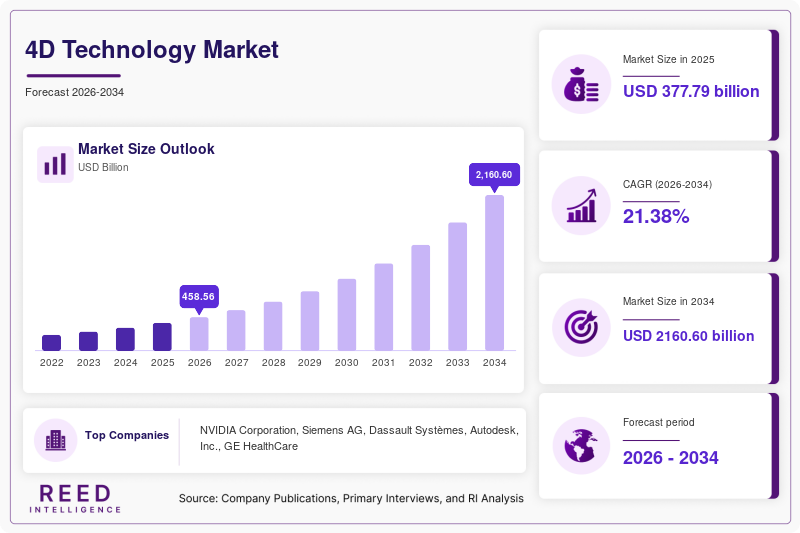
The global 4D technology market size was valued at USD 377.79 billion in 2025 and is projected to grow from USD 458.56 billion in 2026 to USD 2,160.60 billion by 2034, registering a CAGR of 21.38% during the forecast period from 2026 to 2034.
The 4D technology market is developing around technologies that add a time, motion, dynamic-state or lifecycle dimension to conventional three-dimensional data and systems. The category therefore spans several technology families rather than one standardized product class. These include 4D medical imaging, 4D radar and sensing, time-based construction models, dynamic digital twins, virtual simulation and 4D printing.
The strongest commercial development is occurring where organizations need to understand not only what an object or environment looks like, but how it changes over time. The Federal Highway Administration defines 4D construction modeling as the integration of 3D models with time to improve project communication, coordination, planning and execution. In manufacturing, NIST describes digital twins as synchronized virtual models capable of monitoring, diagnosing, predicting and optimizing physical systems.
Healthcare is another important commercialization pathway. GE HealthCare's StarGuide GX is a digital 4D SPECT/CT system designed for static and dynamic imaging, while its MIM KineticID software uses dynamic PET data to model how radiotracers move through the body over time.
At the same time, industrial technology companies are connecting 4D concepts with AI, simulation and physical-world data. NVIDIA's Omniverse supports industrial digital twins and robotics simulation, while its 2026 DSX Blueprint enables physically accurate digital twins for AI-factory design, construction and operations.
The market's main challenge is fragmentation. NIST's 2026 digital-twin workshops identified interoperability, verification and validation, cybersecurity and workforce readiness as continuing barriers to scalable adoption.
4D Technology Market Drivers
Real-time digital twins are turning static 3D models into operational systems
The commercial value of 4D technology increases when digital models are continuously connected to physical assets and real-world data. NIST describes digital twins as dynamic representations that can support monitoring, anomaly detection, prediction and operational optimization. In manufacturing, this allows companies to model equipment health, maintenance requirements, production schedules and alternative operating conditions before making changes to physical systems. NIST estimates potential annual benefits from broad digital-twin adoption across U.S. manufacturing in the tens of billions of dollars, although the estimate is subject to substantial uncertainty. Siemens similarly positions comprehensive digital twins as lifecycle models for products, machines and entire plants. The commercial mechanism is therefore straightforward: more accurate time-dependent models can reduce physical testing, downtime, design changes and operational uncertainty.
AI and advanced sensing are increasing the amount of dynamic data available
4D systems depend on continuous information about movement, condition, position and behavior. Advances in sensors, AI, simulation and high-performance computing are making that information more usable. NIST identifies smart sensors, IIoT, cloud computing, machine learning and AI as important technologies supporting manufacturing digital twins. NVIDIA's Omniverse provides another example, combining simulation, robotics, digital twins and physical-AI workflows through a common 3D data environment. The mechanism extends beyond visualization: organizations can use changing sensor data to predict future states and test scenarios digitally. This supports applications in factories, autonomous systems, infrastructure, healthcare and robotics, increasing demand for both sensing hardware and software platforms.
Time-aware imaging is expanding clinical and industrial applications
Medical imaging demonstrates why adding time to spatial information can create a different type of diagnostic or engineering dataset. GE HealthCare's MIM KineticID is designed to provide dynamic PET imaging and quantitative modeling of tracer behavior over time, while StarGuide GX combines static and dynamic SPECT with CT. In construction, 4D models connect physical geometry with project schedules and can identify sequencing conflicts before they occur. These applications turn 4D from a visualization feature into a decision-support technology. Healthcare providers can examine changing biological processes, while project and engineering teams can evaluate changing physical conditions, schedules and resource requirements.
4D Technology Market Restraints
Interoperability and data integration remain major barriers
4D systems frequently combine information from sensors, BIM models, enterprise systems, simulations and operational databases. NIST's 2026 digital-twin workshops identified interoperability as a persistent challenge, alongside verification, validation and uncertainty quantification. NIST has also noted that many digital-twin implementations remain customized and difficult to integrate or reuse. This increases implementation costs because organizations may need middleware, data engineering and system-integration expertise before a 4D platform can deliver operational value. The problem is particularly relevant to large enterprises operating equipment and software from multiple vendors.
High computational, hardware and implementation requirements
Advanced 4D applications can require high-performance sensors, GPUs, storage, simulation software and specialist personnel. NVIDIA's Omniverse ecosystem, for example, targets physically accurate simulation and industrial digital twins using accelerated computing. Healthcare 4D imaging systems similarly combine specialized detectors, imaging hardware and reconstruction software. GE HealthCare's StarGuide GX uses dual-sided CZT detector technology and accelerated computing to support dynamic imaging. Smaller organizations may therefore face higher capital and integration barriers than enterprises with established digital infrastructure.
4D Technology Market Opportunities
Industrial Digital Twins and Physical AI
Industrial digital twins represent one of the broadest opportunities because they connect 3D models, real-time data, simulation and AI. NVIDIA's 2026 DSX Blueprint enables digital twins for AI-factory design, buildout and operations, with companies including Siemens, Schneider Electric, Eaton, PTC, Procore and others participating in the ecosystem. NIST is also developing standards and testbeds intended to make digital twins more reliable, interoperable and scalable. The opportunity extends across manufacturing, energy, data centers, robotics and infrastructure because the same time-dependent model can support design, commissioning, monitoring and maintenance.
4D Printing and Programmable Materials
4D printing adds time-dependent shape or property transformation to additive manufacturing. MIT's Self-Assembly Lab describes 4D printing as the production of programmable materials that can transform in response to water, heat, light or other energy inputs. Potential applications include adaptive products, robotics-like structures, garments and responsive mechanisms. MIT's technology-transfer portfolio also identifies 4D printing as a process in which a printed object transforms from one shape into another over time. The opportunity is particularly relevant to aerospace, medical devices, robotics, smart textiles and adaptive structures, although commercialization depends on material durability, repeatability and manufacturing economics.
- By Technology Type
- 4D Imaging
- 4D Sensing
- 4D Digital Twins & Simulation
- 4D Printing
- Other 4D Technologies
- By Component
- Hardware
- Software
- Services
- By Application
- Healthcare & Medical Imaging
- Automotive & Mobility
- Manufacturing & Industrial
- Construction & Infrastructure
- Aerospace & Defense
- Media & Entertainment
- Other Applications
- By End Use
- Healthcare Institutions
- Automotive Companies
- Industrial Enterprises
- Construction Firms
- Government & Defense Organizations
- Research & Academic Institutions
- Other End Users
Segmental Analysis
Technology Type
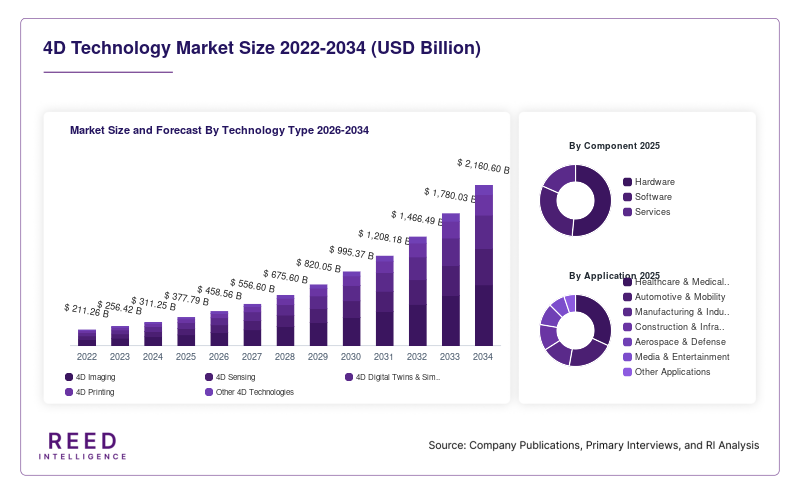
4D Digital Twins & Simulation represent approximately 31% of the global market in 2025, supported by adoption across manufacturing, construction, energy, infrastructure and robotics. NIST identifies digital twins as tools for monitoring, prediction, optimization and control, while Siemens uses lifecycle digital twins to simulate and optimize products, machines and plants.
4D Imaging accounts for approximately 27%, followed by 4D Sensing at 23%, 4D Printing at 11%, and other technologies at 8%.
4D Sensing is the fastest-growing technology segment, with a CAGR of approximately 24.2%, supported by growing requirements for real-time perception in automotive, robotics, industrial automation and autonomous systems. Bosch's radar technology, for example, provides distance, angle, relative velocity and intensity data to create comprehensive 4D environmental feedback for automated machines.
Component
Hardware represents approximately 48% of the market in 2025, reflecting the importance of imaging systems, sensors, cameras, radar, computing equipment and specialized printing systems.
Software accounts for approximately 36%, increasingly becoming the layer that converts raw spatial and temporal information into simulations, analytics, visualization and predictions.
Services represent approximately 16%.
Software is the fastest-growing component, with a CAGR of approximately 24.0%, as organizations increasingly require simulation, AI analytics, digital-twin management, data integration and lifecycle monitoring. NVIDIA's Omniverse and Siemens' Digital Twin Composer demonstrate the increasing role of software in 4D workflows.
Application
Manufacturing & Industrial applications represent approximately 28% of the market, reflecting the use of digital twins, predictive maintenance, production optimization and simulation.
Healthcare & Medical Imaging accounts for approximately 24%, while Automotive & Mobility represents 18%, Construction & Infrastructure 13%, Aerospace & Defense 8%, Media & Entertainment 5%, and other applications 4%.
Automotive & Mobility is the fastest-growing application, with a CAGR of approximately 24.6%, supported by dynamic sensing, autonomous-vehicle perception and simulation. 4D radar adds velocity and height information to conventional spatial detection, providing richer environmental information for automated systems.
End Use
Industrial Enterprises represent approximately 29% of the market in 2025, reflecting the wide use of digital twins, simulation and real-time monitoring in factories and production systems.
Healthcare Institutions account for approximately 23%, followed by Automotive Companies at 18%, Construction Firms at 12%, Government & Defense Organizations at 8%, Research & Academic Institutions at 6%, and other end users at 4%.
Automotive Companies are the fastest-growing end-user segment, with a CAGR of approximately 24.8%, driven by dynamic perception, autonomous mobility simulation and advanced sensing.
Regional Analysis
North America 4D Technology Market
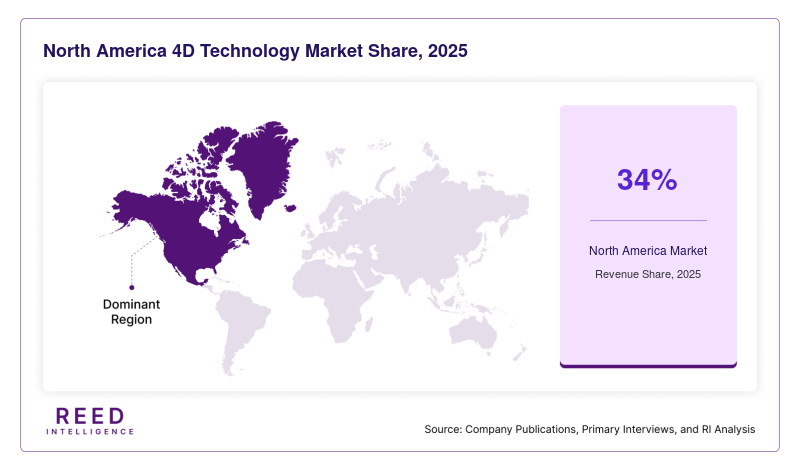
North America represents approximately 34% of the global 4D technology market in 2025, supported by strong investment in AI, advanced manufacturing, healthcare imaging, aerospace, autonomous systems and digital infrastructure. The United States has substantial research and standards activity around digital twins through NIST, including projects covering manufacturing, interoperability, cybersecurity and verification. NVIDIA is also expanding the industrial digital-twin ecosystem through Omniverse, robotics simulation and physical-AI infrastructure. Its 2026 DSX Blueprint brings digital-twin capabilities into AI-factory design and operations. Healthcare is another important regional demand center, with GE HealthCare advancing 4D SPECT/CT and dynamic PET technologies. The region benefits from large technology budgets and established enterprise software infrastructure, although implementation costs and interoperability remain constraints. North America is projected to grow at approximately 19.8% CAGR.
Europe 4D Technology Market
Europe accounts for approximately 27% of the market in 2025, supported by advanced manufacturing, automotive engineering, construction technology, medical imaging and industrial software. Digital twins are particularly relevant to Europe's manufacturing base because companies can use virtual models to simulate production, maintenance and lifecycle performance before changing physical systems. NIST's international standards work around ISO 23247 also reflects the broader importance of common digital-twin architectures. Siemens and Dassault Systèmes are important contributors to Europe's industrial virtual-twin ecosystem. In February 2026, Dassault Systèmes and NVIDIA announced a strategic partnership around industrial AI and Virtual Twin technologies. Healthcare is another contributor, with GE HealthCare receiving the CE Mark for its StarGuide GX 4D SPECT/CT in November 2025. Europe is projected to grow at approximately 20.7% CAGR.
APAC 4D Technology Market
APAC represents approximately 25% of the global market and is the fastest-growing region, with a CAGR of approximately 25.1%. The region combines large manufacturing industries with strong automotive, electronics, robotics, healthcare and construction markets. Japan, China, South Korea and India are particularly relevant because manufacturers are investing in automation, AI, simulation and smart-factory infrastructure. Siemens launched Teamcenter Digital Reality Viewer and Digital Twin Composer in India in March 2026, combining industrial software, NVIDIA libraries and AI infrastructure for engineering and production workflows. The region also provides a strong base for 4D sensing because automotive manufacturers and robotics companies require increasingly detailed environmental data. Healthcare imaging is another growth area as hospitals upgrade advanced imaging capabilities. APAC's combination of manufacturing scale, infrastructure investment and technology adoption provides the strongest expansion mechanism through 2034.
Middle East and Africa 4D Technology Market
Middle East and Africa represents approximately 7% of the market in 2025 and is projected to grow at approximately 22.9% CAGR. Large infrastructure projects, smart-city development, energy facilities and advanced healthcare investments provide adoption opportunities for 4D technologies. Construction is particularly relevant because 4D modeling can connect a 3D project representation with schedules, sequencing and resource requirements. The Federal Highway Administration has documented how 4D models can identify schedule conflicts, analyze weather impacts and improve coordination between contractors. Digital twins can extend these capabilities beyond construction into asset operations and maintenance. The region's constraints include a smaller installed technology base, specialist-skills requirements and dependence on imported advanced hardware.
Latin America 4D Technology Market
Latin America accounts for approximately 7% of the market and is projected to grow at approximately 21.8% CAGR. Adoption is developing across construction, industrial automation, healthcare, mining, energy and automotive applications. Construction represents an important entry point because 4D simulation can help project teams visualize work sequences and identify potential scheduling or site-logistics conflicts. Autodesk's 4D construction workflows connect BIM models with construction schedules and project sequencing. Industrial digital twins also have applications in mining, manufacturing and energy infrastructure, where predictive maintenance and operational monitoring can reduce downtime. The region's adoption pace will depend on digital infrastructure, access to high-performance computing and availability of trained technical personnel.
Competitive Landscape
The 4D technology market has a highly diversified competitive structure because the term covers several technology categories. No single company controls the entire market. Competition instead occurs across digital-twin software, simulation, medical imaging, sensing, construction technology and programmable materials.
NVIDIA has strengthened its position in digital twins by building Omniverse into a platform for physical AI, robotics simulation and industrial digital twins. Its March 2026 DSX Blueprint connects physically accurate digital twins with AI-factory design and operations and includes ecosystem participants such as Siemens, Schneider Electric, PTC, Procore, Eaton and Dassault Systèmes.
Siemens is expanding its industrial software position through comprehensive digital twins and Digital Twin Composer. Its 2026 India launch connected Teamcenter with NVIDIA technology to support immersive and physics-based digital twins across product and production lifecycles.
Dassault Systèmes is using its Virtual Twin platform as the foundation for industrial AI. Its 2026 partnership with NVIDIA aims to combine virtual-twin technology with AI infrastructure and science-validated industrial world models.
Key Market Players
- NVIDIA Corporation
- Siemens AG
- Dassault Systèmes
- Autodesk, Inc.
- GE HealthCare
- Bosch
- Continental AG
- PTC Inc.
- Hexagon AB
- Schneider Electric
- Honeywell International Inc.
- Altair Engineering
- Ansys
- Stratasys
- Materialise
- Microsoft
- IBM
4D Technology Market Segments
By Technology Type
- 4D Imaging
- 4D Sensing
- 4D Digital Twins & Simulation
- 4D Printing
- Other 4D Technologies
By Component
- Hardware
- Software
- Services
By Application
- Healthcare & Medical Imaging
- Automotive & Mobility
- Manufacturing & Industrial
- Construction & Infrastructure
- Aerospace & Defense
- Media & Entertainment
- Other Applications
By End Use
- Healthcare Institutions
- Automotive Companies
- Industrial Enterprises
- Construction Firms
- Government & Defense Organizations
- Research & Academic Institutions
- Other End Users
By Region
- North America
- Europe
- APAC
- Middle East and Africa
- LATAM