4K Gaming Monitors Market Size, Share & Trends Analysis Report By Panel Type (IPS, VA, OLED, TN), By Refresh Rate (Below 144 Hz, 144–240 Hz, Above 240 Hz), By Screen Size (Below 27 Inches, 27–32 Inches, Above 32 Inches), By Application (PC Gaming, Console Gaming, Esports & Competitive Gaming, Others) and By Region (North America, Europe, Asia-Pacific, Latin America, Middle East & Africa) Forecasts, 2026–2034
USD 3950
4K Gaming Monitors Market Size
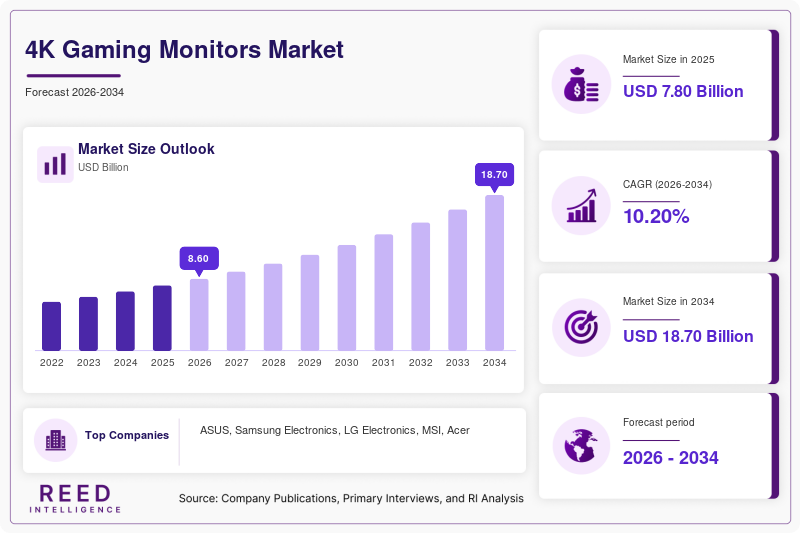
The global 4K gaming monitors market was valued at USD 7.80 billion in 2025 and is projected to grow from USD 8.60 billion in 2026 to USD 18.60 billion by 2034, registering a CAGR of 10.20% during the forecast period from 2026 to 2034.
The 4K gaming monitors market is moving from a premium image-quality category toward a broader high-performance gaming display segment, supported by improvements in graphics processing, high-refresh-rate panels, OLED technology and connectivity standards. The hardware ecosystem is increasingly capable of supporting high-frame-rate 4K gaming: NVIDIA's DLSS 4, for example, is designed to increase frame rates while maintaining high image quality and can enable 4K 240-FPS gaming on GeForce RTX 5090 systems.
The demand mechanism is therefore not simply higher resolution. Gamers purchasing 4K displays increasingly expect a combination of 4K resolution, 144 Hz or higher refresh rates, low response times, HDR, adaptive synchronization and modern connectivity. Samsung introduced its 2025 Odyssey OLED G8 as a 4K 240 Hz OLED gaming monitor, while ASUS and MSI introduced comparable 4K 240 Hz OLED products with DisplayPort 2.1 connectivity.
4K Gaming Monitors Market Drivers
Higher GPU Performance Makes High-Refresh-Rate 4K Gaming More Practical
The increasing capability of gaming GPUs is improving the usefulness of high-refresh-rate 4K monitors. NVIDIA's DLSS 4 uses AI-based rendering and Multi Frame Generation to increase frame rates, with NVIDIA stating that the technology can enable 4K 240-FPS fully ray-traced gaming on RTX 5090 hardware.
This creates a direct hardware-chain effect: as GPUs become capable of producing higher frame rates at 4K, gamers have greater reason to purchase monitors capable of displaying those frames. The effect is strongest in premium PC gaming, where consumers are more willing to match expensive graphics cards with high-end displays. The counterbalance is that 4K at very high refresh rates remains computationally demanding, leaving 1440p displays more practical for many esports users.
OLED Adoption Is Expanding the Premium Gaming Monitor Segment
OLED is becoming an increasingly important technology within gaming monitors because it combines high contrast, fast response characteristics and strong HDR performance with premium image quality. TrendForce reported 2.735 million OLED monitor shipments in 2025, representing 92% year-over-year growth, and projected further expansion in 2026.
Manufacturers are specifically bringing these capabilities into 4K gaming products. Samsung launched a 4K 240 Hz OLED Odyssey G8, ASUS introduced 4K OLED models at 240 Hz, and MSI launched a 27-inch 4K 240 Hz QD-OLED monitor using DisplayPort 2.1a UHBR20.
This creates a premiumization mechanism in which consumers are purchasing not merely higher resolution but a combination of resolution, refresh rate, HDR and OLED image quality.
Expansion of the Gaming Audience Broadens the Potential Customer Base
Gaming has developed into a mass-market entertainment activity rather than a narrowly defined enthusiast category. The Entertainment Software Association reported in 2026 that 212.3 million Americans play video games weekly, representing 67% of Americans aged 5–90. U.S. consumer spending on video games reached approximately $60.8 billion in 2025.
For gaming-monitor manufacturers, a larger and more diverse player base creates a wider potential market for display upgrades. The strongest monitor demand remains concentrated among PC gamers, console users seeking higher-quality displays and enthusiasts upgrading existing screens. However, the broad gaming population does not translate directly into 4K-monitor demand because many players use mobile devices, televisions or lower-cost PC monitors.
4K Gaming Monitors Market Restraints
High System Requirements Limit the Addressable Audience for High-Refresh-Rate 4K Displays
A 4K monitor can display high-resolution content regardless of the connected system, but achieving high frame rates at native 4K requires substantial graphics performance. NVIDIA's own DLSS 4 announcement illustrates the hardware challenge by positioning RTX 5090-class performance as capable of enabling 4K 240-FPS ray-traced gaming.
This creates an affordability barrier: consumers may need to upgrade both GPU and monitor to realize the full benefit of a 4K 240 Hz display. Consequently, gamers with mainstream hardware may choose 1440p high-refresh-rate monitors instead.
Premium OLED Pricing and Burn-In Management Can Slow Mass Adoption
OLED monitors command a premium position and require manufacturers to address long-term image-retention concerns. ASUS has incorporated OLED Care Pro and proximity-sensing technology into its gaming monitors specifically to help mitigate burn-in risks.
The constraint affects purchasing decisions because consumers comparing OLED with IPS or VA products may weigh superior contrast and response performance against price and long-term ownership considerations. As panel production scales and technologies such as tandem OLED improve durability, the relative constraint may decline, but OLED remains concentrated in the higher-value portion of the market.
4K Gaming Monitors Market Opportunities
4K 240 Hz OLED Can Create a New Premium Upgrade Cycle
The introduction of 4K 240 Hz OLED monitors is creating a distinct upgrade proposition for users who previously had to choose between high resolution and high refresh rates. Samsung's Odyssey OLED G8, ASUS's ROG 4K OLED models and MSI's MPG 272URX demonstrate manufacturers' movement toward combining these specifications in a single product.
The opportunity extends beyond esports. These displays can appeal to users who want a single monitor for high-end gaming, media consumption and productivity. MSI's 27-inch 4K QD-OLED model, for example, combines 240 Hz refresh with high pixel density and DisplayPort 2.1a.
The primary adoption barrier remains pricing and the availability of graphics hardware capable of taking advantage of the specifications.
Dual-Mode Displays Can Address Different Gaming Workloads
Monitor manufacturers are increasingly introducing displays that switch between high-resolution and high-refresh configurations. ASUS's 2026 ROG Swift OLED PG27UCWM supports 4K at 240 Hz and Full HD at 480 Hz, providing a single display for both visually intensive games and competitive gaming.
This creates an opportunity for manufacturers to broaden the use case of premium monitors rather than positioning 4K displays exclusively around visual fidelity. Dual-mode technology can appeal to gamers who play both cinematic single-player titles and fast competitive games.
Adoption will depend on the quality of mode switching, image scaling and pricing relative to purchasing separate displays.
Panel Type Segment Analysis
IPS Holds the Largest Share Because It Balances Image Quality, Price and Gaming Performance
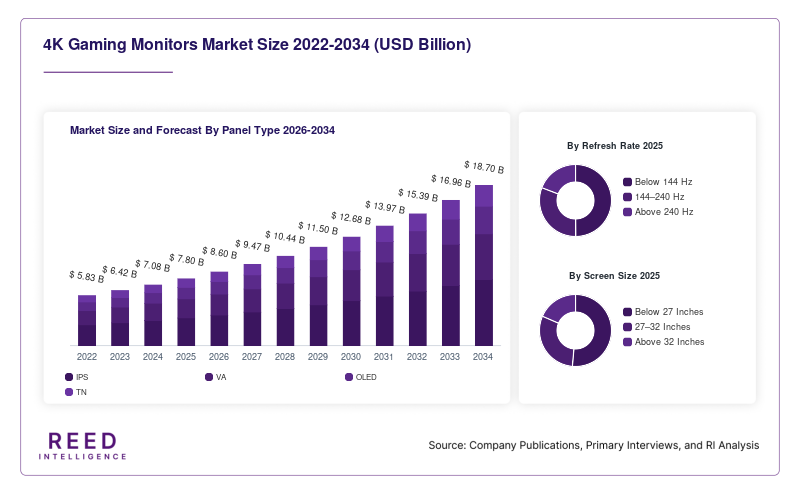
IPS accounted for approximately 42% of the global market in 2025, making it the largest panel-type segment. Its position reflects the balance between color performance, viewing angles, response characteristics and production cost.
IPS panels are widely suitable for gamers who want 4K image quality without moving to the highest-priced OLED products. This makes the technology particularly relevant to mainstream premium gaming monitors, where manufacturers can combine 4K resolution with refresh rates of 144 Hz or higher without reaching OLED pricing.
OLED accounted for approximately 28% of the market in 2025 and is the fastest-growing panel type, with a CAGR of approximately 16.5% through 2034. TrendForce's reported 92% growth in OLED monitor shipments during 2025 demonstrates the strength of the underlying premium-display transition.
VA represented approximately 24% and is projected to grow at 8.2% CAGR, while TN represented approximately 6% and is projected to grow at 5.1% CAGR.
Refresh Rate Segment Analysis
144–240 Hz Represents the Largest Refresh-Rate Segment as 4K Gaming Moves Beyond 60 Hz
The 144–240 Hz category accounted for approximately 52% of the market in 2025, making it the dominant refresh-rate segment. It provides a practical combination of smooth motion and high-resolution image quality for premium PC gaming.
Product launches increasingly support this transition. Samsung, ASUS and MSI all introduced 4K OLED monitors operating at 240 Hz in 2025, demonstrating that 240 Hz is becoming a major specification within the premium 4K segment.
Above 240 Hz represented approximately 13% and is the fastest-growing category at approximately 14.8% CAGR. Its expansion is supported by dual-mode products and increasingly specialized competitive-gaming displays.
Below 144 Hz accounted for approximately 35% and is projected to grow at 6.8% CAGR. This category remains relevant for users prioritizing resolution over extremely high refresh rates.
Screen Size Segment Analysis
27–32 Inches Dominates Because It Balances Pixel Density and Gaming Desk Compatibility
27–32-inch monitors accounted for approximately 57% of the market in 2025, making the segment the largest screen-size category. The format provides high pixel density at 4K while remaining suitable for conventional gaming desks.
Recent product launches reinforce the importance of this size range. Samsung's 4K 240 Hz Odyssey OLED G8 is available in 27- and 32-inch versions, while ASUS and MSI have also introduced 27-inch 4K OLED gaming monitors.
Above 32 inches accounted for approximately 25% and is projected to grow at 11.7% CAGR, supported by immersive gaming and large-screen curved formats.
Below 27 inches represented approximately 18% and is projected to grow at 7.6% CAGR. Its smaller share reflects the greater difficulty of justifying 4K at smaller screen sizes when lower-resolution displays can deliver lower prices and higher refresh rates.
Application Segment Analysis
PC Gaming Represents the Largest Application Because High-End GPUs Can Exploit 4K Display Capabilities
PC Gaming accounted for approximately 54% of the market in 2025, making it the dominant application. PC users can pair high-end graphics cards with high-refresh-rate 4K displays and benefit from technologies such as DLSS, adaptive synchronization and DisplayPort 2.1 connectivity.
NVIDIA's DLSS 4 technology specifically targets high-performance rendering and can enable 4K 240-FPS gaming on RTX 5090 hardware, strengthening the technical case for high-refresh 4K monitors.
Console Gaming accounted for approximately 25% and is projected to grow at 9.8% CAGR, supported by the increasing use of HDMI 2.1-equipped displays for modern consoles.
Esports & Competitive Gaming represented approximately 15% and is projected to grow at 12.9% CAGR, although much of competitive gaming continues to favor lower resolutions when maximum refresh rate is prioritized.
Other applications accounted for approximately 6% and are projected to grow at 7.4% CAGR.
4K Gaming Monitors Market Regional Analysis
Asia-Pacific Holds the Largest Share as Gaming Hardware Manufacturing and Consumer Demand Are Concentrated in the Region
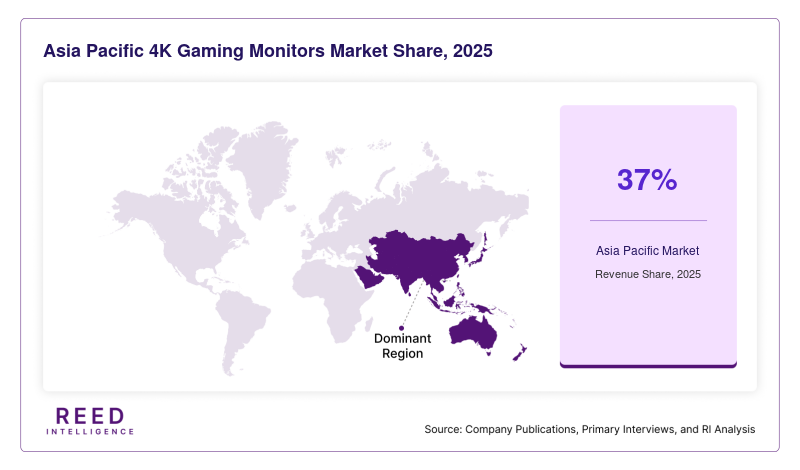
Asia-Pacific accounted for approximately 37% of the global market in 2025, making it the largest regional market. The region combines major electronics manufacturing capacity with large gaming populations and strong demand for display technology.
China, Japan, South Korea and Taiwan are particularly important to the display supply chain. The commercial mechanism extends from panel production and component availability to consumer electronics distribution. TrendForce reported strong OLED-monitor shipment momentum in 2026, including significant demand generated by China's 618 shopping festival.
Asia-Pacific is projected to grow at approximately 11.2% CAGR, making it the fastest-growing region. Expansion is supported by OLED adoption, high-end PC gaming, local monitor brands and growing consumer interest in high-refresh displays.
North America Represents a Major Market Through Premium Gaming Hardware Adoption
North America accounted for approximately 28% of the global market in 2025 and is projected to grow at approximately 10.5% CAGR.
The region has a large gaming audience and strong spending on gaming hardware. The ESA reported that U.S. consumers spent approximately $60.8 billion on video games in 2025, including $5.4 billion on hardware and $2.9 billion on accessories.
The market mechanism is particularly relevant to premium monitors because enthusiast PC users are more likely to pair high-performance graphics cards with high-refresh 4K displays. However, high retail prices can limit adoption beyond higher-income and enthusiast consumers.
Europe Maintains Demand Through Premium PC Gaming and Display Upgrades
Europe represented approximately 23% of the global market in 2025 and is projected to grow at approximately 9.6% CAGR.
Demand is supported by established PC gaming communities and consumers upgrading toward higher-resolution and HDR displays. The region also provides a substantial market for premium gaming hardware where display quality is an important component of the overall gaming setup.
OLED's expansion into 4K gaming monitors creates additional replacement demand, while products combining 4K resolution and 240 Hz refresh rates broaden the premium upgrade proposition. Samsung, ASUS and MSI have all introduced products targeting this specification class.
Latin America Develops as Gaming Hardware Accessibility Improves
Latin America accounted for approximately 7% of the global market in 2025 and is projected to grow at approximately 8.9% CAGR.
The market is supported by increasing availability of gaming PCs, consoles and dedicated gaming accessories. The principal commercial limitation is purchasing power because 4K 240 Hz and OLED displays remain substantially more expensive than mainstream gaming monitors.
Consequently, demand is likely to remain concentrated around mid-premium IPS and VA products before higher-priced OLED products become more broadly accessible.
Middle East & Africa Represents an Emerging Premium Gaming Display Market
Middle East & Africa accounted for approximately 5% of the global market in 2025 and is projected to grow at approximately 8.2% CAGR.
Demand is concentrated in markets with higher disposable incomes, developed gaming retail channels and strong interest in premium electronics. The expansion of gaming and esports ecosystems provides a pathway for high-performance display adoption.
The main constraints include product pricing, availability, distribution coverage and the relatively smaller installed base of high-end gaming PCs.
4K Gaming Monitors Market Competitive Landscape
The competitive environment is increasingly shaped by panel technology, refresh rate, OLED availability, connectivity, image processing and gaming-specific software features rather than resolution alone.
ASUS has expanded its ROG portfolio aggressively across 4K OLED and high-refresh technologies. In January 2025, the company introduced a 27-inch 4K OLED gaming monitor operating at 240 Hz with DisplayPort 2.1a UHBR20, while its 2026 lineup introduced 4K Tandem RGB OLED and dual-mode 4K/480 Hz technology.
Samsung has positioned its Odyssey portfolio around premium OLED and immersive gaming. Its 2025 Odyssey OLED G8 introduced a 4K 240 Hz OLED configuration, giving Samsung an early product position in the high-refresh 4K OLED category.
Key Market Players
- ASUS
- Samsung Electronics
- LG Electronics
- MSI
- Acer
- AOC
- GIGABYTE
- BenQ
- Dell Technologies / Alienware
- ViewSonic
- Lenovo
- Sony
4K Gaming Monitors Market Recent Developments
- January 2026 - ASUS Republic of Gamers announced new RGB Stripe OLED gaming monitors, including the ROG Swift OLED PG27UCWM with 4K 240 Hz and Full HD 480 Hz dual-mode operation. ASUS also introduced an upgraded 32-inch 4K QD-OLED monitor as part of its CES 2026 display portfolio.
- March 2025 - Samsung announced the 2025 Odyssey gaming lineup, including the Odyssey OLED G8 with a 4K 240 Hz OLED display. Samsung positioned the product around high pixel density, high refresh rate and premium gaming image quality.
4K Gaming Monitors Market Segments
By Panel Type
- IPS
- VA
- OLED
- TN
By Refresh Rate
- Below 144 Hz
- 144–240 Hz
- Above 240 Hz
By Screen Size
- Below 27 Inches
- 27–32 Inches
- Above 32 Inches
By Application
- PC Gaming
- Console Gaming
- Esports & Competitive Gaming
- Others
By Region
- North America
- Europe
- APAC
- Middle East and Africa
- LATAM