5 Hydroxytryptophan Market Size, Share & Demand Report By Type (Synthetic, Natural), By Application (Dietary Supplements, Functional Foods & Beverages, Pharmaceuticals), By End-Use (Adults, Geriatric Population, Others) By Region & Segment Forecasts, 2025–2034
USD 3950
Market Overview
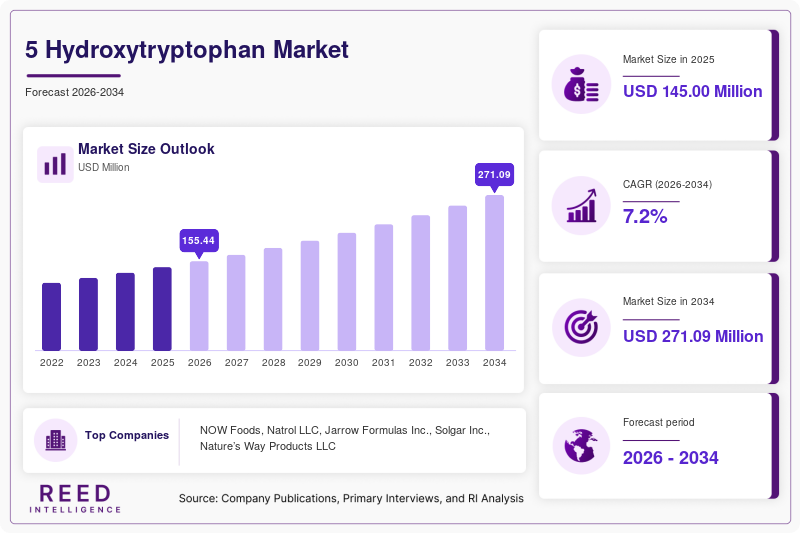
The global 5 Hydroxytryptophan Market size is estimated at USD 145 million and is projected to reach approximately USD 158 million in 2026. Over the forecast period from 2025 to 2034, the market is expected to grow at a CAGR of 7.2%, reaching nearly USD 295 million by 2034.
Several macroeconomic and healthcare trends are supporting this growth trajectory. Firstly, the increasing prevalence of anxiety, depression, and sleep disorders has accelerated demand for alternative and plant-based supplements. Consumers are actively seeking non-pharmaceutical solutions, positioning 5-HTP as a preferred ingredient. Secondly, the expansion of the nutraceutical industry and e-commerce platforms has improved accessibility and availability of 5-HTP products globally. Thirdly, rising disposable incomes and health-conscious lifestyles in emerging economies are driving consumption.
Key Highlights
- Market size valued at USD 145 million in 2025, reflecting steady demand across nutraceutical and dietary supplement applications. The market continues to benefit from increasing consumer awareness regarding mental wellness and preventive healthcare.
- Expected to reach USD 295 million by 2034, supported by consistent expansion across developed and emerging economies. Growth is driven by broader product availability and increasing integration into functional formulations.
- CAGR of 7.2% during 2025–2034 indicates stable and sustained market growth over the forecast period. The upward trajectory is influenced by rising health-conscious populations and expanding distribution channels.
- Increasing demand for natural mood-enhancing supplements is a key factor shaping the market landscape. Consumers are shifting toward plant-based alternatives that support emotional well-being with fewer perceived side effects.
Market Trends
Increasing Adoption of Plant-Based Nutraceuticals
The shift toward plant-based and natural supplements is influencing the 5 Hydroxytryptophan Market significantly. Consumers are moving away from synthetic pharmaceutical solutions due to concerns about side effects and long-term health risks. This has led to increased demand for plant-derived ingredients such as 5-HTP extracted from Griffonia simplicifolia. The trend is particularly strong among millennials and urban populations who prioritize preventive healthcare. Furthermore, regulatory support for herbal and dietary supplements in several regions is enabling market penetration. Manufacturers are capitalizing on this trend by promoting clean-label products and transparency in sourcing, which strengthens consumer trust and drives market growth.
Expansion of E-Commerce and Direct-to-Consumer Channels
The rapid expansion of online retail channels is transforming the distribution landscape of the 5 Hydroxytryptophan Market. E-commerce platforms provide easy access to a wide range of products, enabling consumers to compare formulations, prices, and reviews. Direct-to-consumer brands are leveraging digital marketing strategies to build strong customer relationships and brand loyalty. Subscription-based supplement models are also gaining traction, ensuring consistent revenue streams for manufacturers. Additionally, the use of data analytics allows companies to personalize product offerings based on consumer preferences. This trend is expected to continue driving market expansion, particularly in emerging markets with increasing internet penetration.
Market Drivers
Rising Prevalence of Mental Health Disorders
The growing incidence of mental health conditions such as depression, anxiety, and stress-related disorders is a key driver of the 5 Hydroxytryptophan Market. Modern lifestyles, characterized by high stress levels and sedentary behavior, have contributed to the increased need for mood-enhancing supplements. 5-HTP plays a crucial role in serotonin production, which regulates mood and emotional well-being. As awareness around mental health improves, consumers are actively seeking natural solutions that can complement traditional therapies. Healthcare professionals are also recommending dietary supplements as part of holistic treatment approaches, further boosting demand. This driver is expected to remain significant throughout the forecast period.
Growth of the Global Nutraceutical Industry
The expansion of the nutraceutical sector is creating favorable conditions for the growth of the 5 Hydroxytryptophan Market. Consumers are increasingly adopting supplements to support overall health, leading to higher demand for functional ingredients. 5-HTP is widely used in formulations targeting sleep improvement, weight management, and mood stabilization. The industry is witnessing continuous innovation in product formats, including gummies, beverages, and powders. Additionally, the integration of scientific research into product development enhances credibility and consumer confidence. As the nutraceutical market continues to grow globally, the demand for 5-HTP is expected to rise proportionally.
Market Restraint
Regulatory Challenges and Safety Concerns
Regulatory inconsistencies and safety concerns pose a significant restraint to the growth of the 5 Hydroxytryptophan Market. Different countries have varying guidelines regarding the use and labeling of dietary supplements, which creates challenges for manufacturers operating globally. In some regions, stringent regulations limit the marketing claims that can be made about 5-HTP products. Additionally, concerns regarding dosage, potential side effects, and interactions with medications have led to cautious adoption among certain consumer groups. For example, excessive intake of 5-HTP may lead to serotonin imbalance, which requires careful monitoring. These factors can slow down market expansion and increase compliance costs for manufacturers, thereby impacting profitability.
Market Opportunities
Integration into Functional Foods and Beverages
The incorporation of 5-HTP into functional foods and beverages presents a significant growth opportunity for the market. Consumers are increasingly seeking convenient ways to incorporate health benefits into their daily routines, and fortified food products offer an effective solution. The addition of 5-HTP to energy drinks, protein bars, and wellness beverages can enhance product appeal and differentiation. Food manufacturers are exploring innovative formulations that maintain ingredient stability while delivering health benefits. This trend is expected to expand the application scope of 5-HTP beyond traditional supplements, opening new revenue streams and attracting a broader consumer base.
Expansion in Emerging Markets
Emerging economies in Asia Pacific, Latin America, and Africa present untapped potential for the 5 Hydroxytryptophan Market. Rising disposable incomes, urbanization, and increasing awareness about health and wellness are driving demand for dietary supplements in these regions. Governments are also promoting preventive healthcare, which supports the adoption of nutraceutical products. Local manufacturers are entering the market with cost-effective offerings, increasing competition and accessibility. Furthermore, the growing influence of digital platforms is enabling companies to reach consumers in remote areas. These factors collectively create a favorable environment for market expansion in emerging regions.
Segmental Analysis
By Type
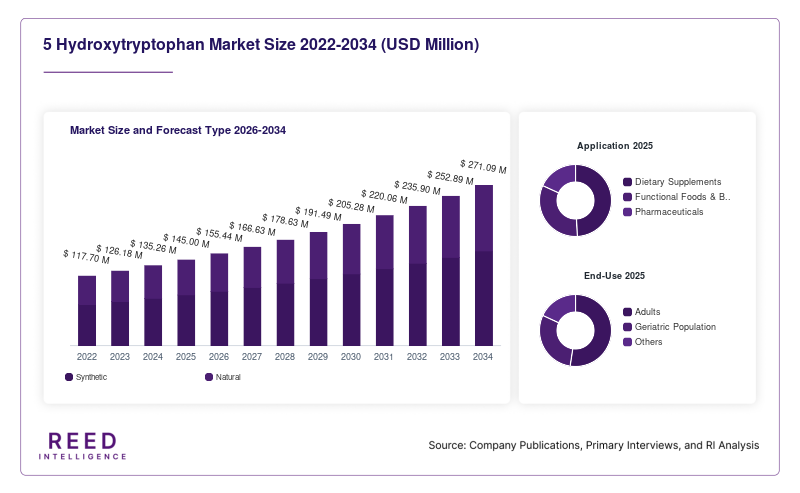
The synthetic 5-HTP segment dominated the market in 2024, accounting for approximately 58% of the total share. This dominance is attributed to consistent quality, controlled production processes, and scalability. Synthetic variants offer higher purity levels, making them suitable for pharmaceutical and nutraceutical applications. Manufacturers prefer synthetic production methods due to lower dependency on raw material availability and reduced supply chain risks. Additionally, regulatory approvals are often easier to obtain for standardized synthetic products, which further supports their adoption. The segment continues to benefit from advancements in chemical synthesis technologies, ensuring cost efficiency and reliability.
The natural 5-HTP segment is expected to be the fastest-growing, with a CAGR of 8.4% during the forecast period. Growth is driven by increasing consumer preference for plant-based and organic products. Natural 5-HTP derived from Griffonia simplicifolia seeds is gaining popularity due to its perceived safety and sustainability. Manufacturers are investing in sustainable sourcing practices and certifications to enhance product appeal. The rising trend of clean-label products is also contributing to the growth of this segment. As consumers become more health-conscious, the demand for natural alternatives is expected to increase significantly.
By Application
The dietary supplements segment held the largest share of the 5 Hydroxytryptophan Market in 2024, accounting for nearly 62% of total revenue. This dominance is driven by the widespread use of 5-HTP in mood enhancement, sleep improvement, and weight management products. The increasing prevalence of lifestyle-related disorders has led to higher demand for supplements that support mental and physical well-being. Manufacturers are continuously innovating product formulations to enhance effectiveness and consumer convenience. The availability of various dosage forms, including capsules and tablets, further supports segment growth.
The functional food and beverages segment is projected to grow at the highest CAGR of 9.1% during the forecast period. This growth is fueled by the increasing demand for convenient and health-focused food products. Consumers are seeking products that offer multiple health benefits, leading to the incorporation of 5-HTP into various food items. Innovations in food technology are enabling manufacturers to maintain ingredient stability and efficacy. The rising popularity of fortified foods and beverages is expected to drive significant growth in this segment.
By End-Use
The adult population segment dominated the market in 2024, accounting for approximately 65% of total share. Adults are the primary consumers of 5-HTP supplements due to higher prevalence of stress, anxiety, and sleep disorders. The increasing adoption of preventive healthcare practices among working professionals is driving demand. Additionally, the availability of targeted products for specific health concerns is enhancing consumer engagement. Manufacturers are focusing on marketing strategies that highlight the benefits of 5-HTP for mental well-being, further supporting segment growth.
The geriatric population segment is expected to be the fastest-growing, with a CAGR of 8.7% during the forecast period. Growth is driven by the increasing aging population and rising awareness about cognitive health. Older adults are more likely to use supplements to manage mood disorders and improve sleep quality. Healthcare providers are also recommending dietary supplements as part of comprehensive treatment plans. The growing focus on healthy aging is expected to drive significant demand in this segment.
Regional Analysis
North America
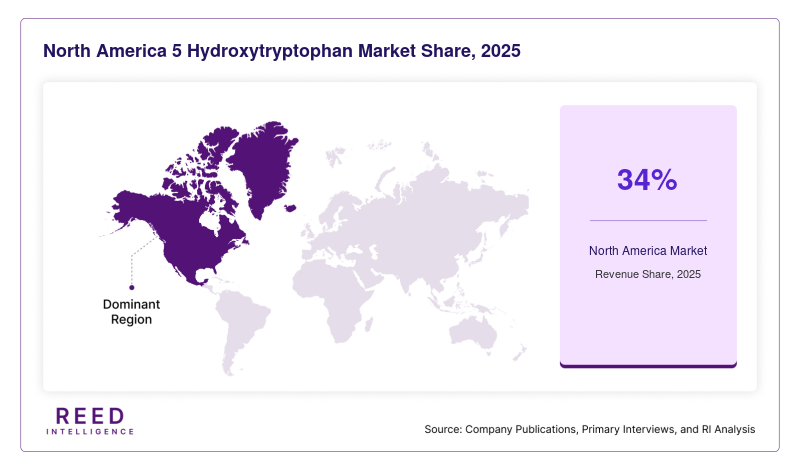
North America held the largest share of the 5 Hydroxytryptophan Market in 2025, accounting for approximately 34% of global revenue. The region is expected to maintain its dominance with a CAGR of 6.8% during the forecast period. High consumer awareness, strong presence of nutraceutical companies, and advanced distribution networks are key factors supporting growth. The demand for natural supplements continues to rise, driven by increasing health consciousness and preventive healthcare practices.
The United States dominates the regional market due to its well-established dietary supplement industry. A unique growth factor is the high adoption of personalized nutrition solutions, where consumers tailor supplement intake based on individual health needs. This trend is supported by technological advancements in health tracking and data analytics, enabling targeted marketing strategies and improved product development.
Europe
Europe accounted for around 27% of the global market share in 2025 and is projected to grow at a CAGR of 6.5% through 2034. The region benefits from a strong regulatory framework that ensures product quality and safety, enhancing consumer trust. Increasing demand for plant-based supplements and rising awareness about mental health are key drivers in this region.
Germany leads the European market due to its robust healthcare system and high consumer spending on wellness products. A unique growth factor is the increasing preference for organic and sustainably sourced ingredients. Consumers in Germany are particularly conscious about product transparency, prompting manufacturers to adopt eco-friendly practices and certifications.
Asia Pacific
Asia Pacific is expected to witness the fastest growth in the 5 Hydroxytryptophan Market, with a CAGR of 8.5% during the forecast period. The region accounted for approximately 22% of the market share in 2025. Rapid urbanization, increasing disposable incomes, and growing awareness of dietary supplements are contributing to market expansion.
China dominates the regional market due to its large population and expanding middle class. A unique growth factor is the integration of traditional medicine practices with modern nutraceutical products. Consumers are increasingly combining herbal remedies with scientifically backed supplements, creating strong demand for products like 5-HTP.
Middle East & Africa
The Middle East & Africa region held a market share of about 9% in 2025 and is expected to grow at a CAGR of 7.0%. The market is gradually expanding due to increasing awareness about health and wellness, along with improvements in healthcare infrastructure. The demand for dietary supplements is rising, particularly in urban areas.
The United Arab Emirates leads the regional market due to its high standard of living and growing health-conscious population. A unique growth factor is the increasing influence of fitness and wellness trends, supported by government initiatives promoting healthy lifestyles. This has led to higher adoption of supplements among younger consumers.
Latin America
Latin America accounted for approximately 8% of the global market share in 2025 and is projected to grow at a CAGR of 7.3%. The region is experiencing steady growth due to rising consumer awareness and increasing availability of nutraceutical products. Economic development and urbanization are also contributing to market expansion.
Brazil dominates the regional market due to its large population and growing supplement industry. A unique growth factor is the increasing demand for affordable wellness products, which has led to the introduction of cost-effective 5-HTP supplements. Local manufacturers are focusing on price competitiveness to attract a wider consumer base.
Competitive Landscape
The 5 Hydroxytryptophan Market is moderately fragmented, with several global and regional players competing on product quality, pricing, and innovation. Leading companies are focusing on expanding their product portfolios and strengthening distribution networks to gain a competitive edge. Strategic partnerships, mergers, and acquisitions are common strategies adopted by market participants.
One of the leading players in the market is NOW Foods, which has established a strong presence through its extensive range of dietary supplements and commitment to quality. The company recently introduced a new line of 5-HTP capsules with enhanced bioavailability, targeting consumers seeking effective mood support solutions. Other companies are also investing in research and development to improve product efficacy and differentiate their offerings. The competitive landscape is expected to evolve with increasing consolidation and entry of new players.
Key Players
- NOW Foods
- Natrol LLC
- Jarrow Formulas Inc.
- Solgar Inc.
- Nature’s Way Products LLC
- Doctor’s Best Inc.
- Source Naturals Inc.
- Pure Encapsulations LLC
- Swanson Health Products
- Douglas Laboratories
- Life Extension
- BulkSupplements.com
- Herbal Secrets
- Zhou Nutrition
- NutraBio Labs
Recent Developments
- In 2024, a leading nutraceutical company launched a new 5-HTP supplement line with improved absorption technology, targeting sleep and mood enhancement applications.
- In 2023, a major player expanded its distribution network in Asia Pacific, strengthening its presence in emerging markets.
- In 2025, a global supplement manufacturer introduced plant-based 5-HTP formulations with sustainable sourcing certifications, aligning with consumer demand for eco-friendly products.
5 Hydroxytryptophan Market Segments
Type
- Synthetic
- Natural
Application
- Dietary Supplements
- Functional Foods & Beverages
- Pharmaceuticals
End-Use
- Adults
- Geriatric Population
- Others
By Region
- North America
- Europe
- APAC
- Middle East and Africa
- LATAM