5 Isopropyl M Xylene Market Size, Share Demand Report By Type (High Purity Grade, Ultra-High Purity Grade), By Application (Chemical Intermediates, Specialty Formulations, Catalyst Systems), By End-Use (Pharmaceutical Manufacturing, Specialty Chemicals), By Distribution Channel (Direct Sales, Specialized Distributors), By Region & Segment Forecasts, 2026–2034
USD 3950
Market Overview
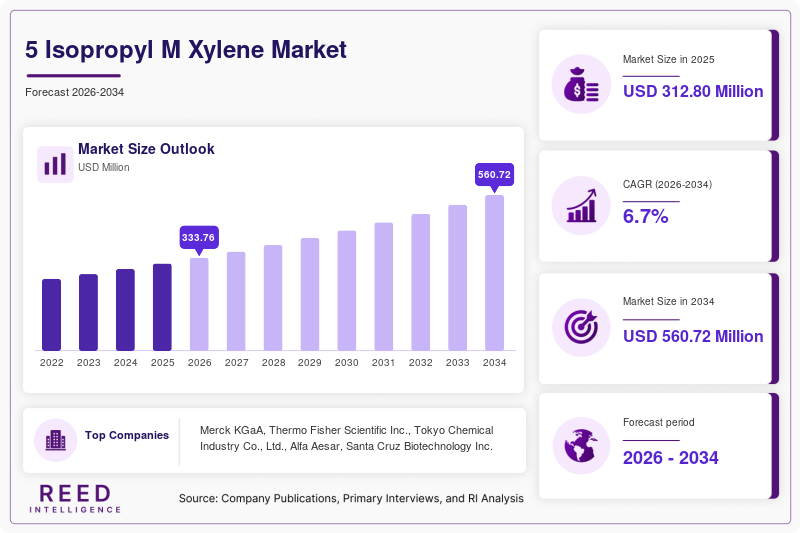
The global 5 Isopropyl M Xylene Market was valued at USD 312.8 million in 2026 and is projected to reach USD 524.6 million by 2034, expanding at a CAGR of 6.7% during 2026–2034. Market growth has been supported by increasing demand for specialty aromatic intermediates used in pharmaceutical synthesis, performance chemicals, and advanced material formulations. A major global factor supporting expansion has been the rising investment in specialty chemical manufacturing, particularly in high-purity intermediates required for precision synthesis and formulation optimization.
The market has also benefited from increased use of substituted xylene derivatives in custom synthesis applications, where product purity, molecular stability, and process efficiency are essential. Demand remained steady across industrial production chains as manufacturers prioritized high-performance aromatic compounds for use in resin modifiers, catalyst carriers, and chemical intermediates. In addition, evolving downstream industries have increased procurement volumes, creating favorable conditions for long-term market penetration.
Key Highlights
- Asia Pacific held the dominant market share of 38.9% in 2025, while Latin America is projected to register the fastest CAGR of 7.6% through 2034.
- By type, High Purity Grade led with 62.4% share in 2025, while Ultra-High Purity Grade is expected to grow at 7.5% CAGR.
- By application, Chemical Intermediates accounted for 41.7% share, while Specialty Formulations will expand at 7.3% CAGR.
- By end-use, Pharmaceutical Manufacturing remained dominant at 34.6% share, while Advanced Materials is forecast to grow at 7.4% CAGR.
- The United States represented the dominant country market, valued at USD 54.8 million in 2024 and USD 58.2 million in 2025.
Market Trends
Rising Demand for High-Purity Aromatic Intermediates
A major trend shaping the 5 Isopropyl M Xylene Market is the rising demand for high-purity aromatic intermediates in precision chemical synthesis. Producers are increasingly supplying refined grades to meet stricter industrial specifications. The trend is influencing procurement contracts, pricing models, and production technologies, especially in pharmaceutical and specialty chemical applications where consistency and purity affect output efficiency.
Shift Toward Custom Synthesis and Functional Formulations
Another significant trend is the shift toward custom synthesis and multifunctional formulations. Buyers increasingly prefer specialized aromatic compounds that can improve compatibility in targeted formulations. This trend is supporting innovation in molecular engineering and increasing adoption in advanced industrial formulations, expanding the addressable scope of the market.
Market Drivers
Expansion of Specialty Chemical Production
Growth in specialty chemical manufacturing has been a key driver for the 5 Isopropyl M Xylene Market. Manufacturers are increasing output of customized compounds used in coatings additives, process intermediates, and engineered chemicals. This has increased consumption volumes and supported market growth across industrial supply chains.
Growth in Pharmaceutical Intermediate Demand
Increasing use of aromatic intermediates in pharmaceutical synthesis has also driven market expansion. The compound’s structural properties make it suitable for synthesis pathways requiring controlled reaction behavior, supporting demand across contract manufacturing and active ingredient production.
Market Restraint
Volatility in Raw Material Pricing
Fluctuating feedstock prices have remained a major restraint in the 5 Isopropyl M Xylene Market. Variations in upstream petrochemical costs have impacted margins, raised procurement uncertainty, and affected long-term supply planning for smaller manufacturers.
Market Opportunities
Growth Potential in Advanced Material Applications
Emerging applications in engineered polymers and advanced materials are creating opportunities for market participants. Producers are expected to benefit from growing use in specialty formulations designed for thermal and chemical resistance.
Expansion in Emerging Chemical Manufacturing Hubs
Developing manufacturing hubs in Southeast Asia, Eastern Europe, and parts of Latin America offer significant opportunity. Capacity additions in these regions are expected to create demand for specialty intermediates and improve supply chain localization.
Segmental Analysis
By Type
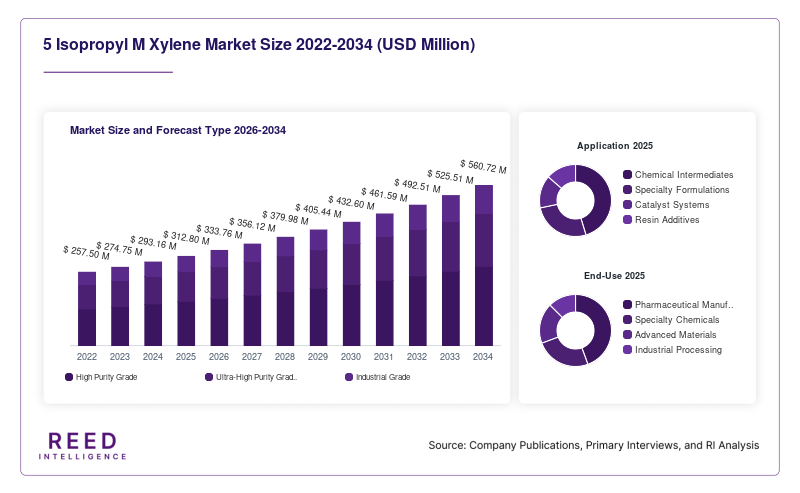
High Purity Grade Dominated the Market: High Purity Grade accounted for 62.4% of the 5 Isopropyl M Xylene Market in 2025 due to broad usage across industrial synthesis and specialty formulations. Demand remained strong because this grade balanced performance consistency and commercial viability.
Ultra-High Purity Grade Will Grow the Fastest: Ultra-High Purity Grade is projected to expand at 7.5% CAGR through 2034. Growth will be driven by increasing use in high-specification synthesis applications where impurity control is critical. Demand will rise as advanced production processes require tighter purity thresholds.
By Application
Chemical Intermediates Led the Segment: Chemical Intermediates held 41.7% share in 2025 due to widespread use of 5 Isopropyl M Xylene in reaction pathways and downstream processing. The segment benefited from broad industrial demand.
Specialty Formulations Will Register Faster Growth: Specialty Formulations are projected to grow at 7.3% CAGR. Growth will be driven by increasing use in functional blends and performance additives designed for enhanced chemical compatibility.
By End-Use
Pharmaceutical Manufacturing Held the Largest Share: Pharmaceutical Manufacturing accounted for 34.6% of market revenue in 2025. The segment remained dominant due to increasing use in synthesis processes involving aromatic intermediates.
Advanced Materials Will Be the Fastest-Growing Segment: Advanced Materials is forecast to expand at 7.4% CAGR through 2034. Growth will be supported by demand for specialty compounds in engineered material formulations with improved stability and performance.
By Distribution Channel
Direct Sales Dominated: Direct Sales represented 68.2% of the market in 2025 as industrial buyers preferred long-term procurement agreements and direct sourcing for quality assurance.
Specialized Distributors Will Grow Faster: Specialized Distributors are expected to grow at 6.9% CAGR due to rising demand from smaller-volume buyers requiring flexible sourcing and regional supply support.
Regional Analysis
North America
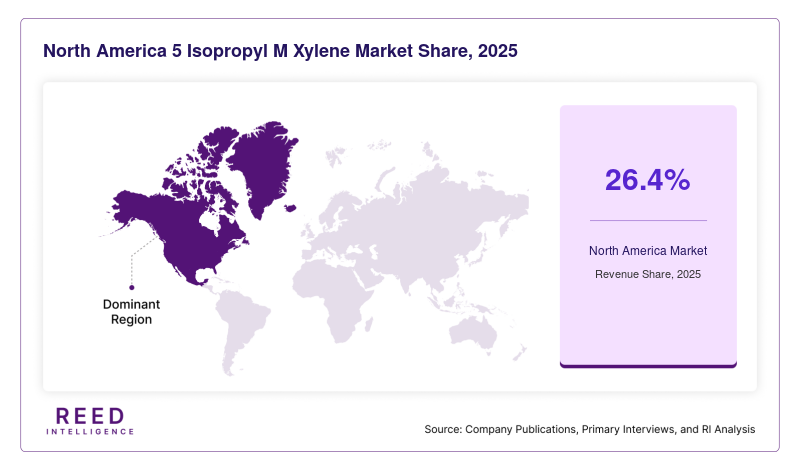
North America accounted for 26.4% of the 5 Isopropyl M Xylene Market in 2025 and is projected to grow at a 6.3% CAGR through 2034. Regional growth will be supported by demand for precision chemical intermediates and high-purity synthesis compounds. The United States dominated the region due to strong specialty chemical production infrastructure. Growth is being supported by increasing investment in process optimization technologies and higher adoption of aromatic intermediates in performance formulations.
Europe
Europe held 22.1% market share in 2025 and will expand at 6.1% CAGR during the forecast period. Regional growth will be driven by industrial modernization and demand for regulated specialty compounds. Germany remained the dominant country due to its strong fine chemicals manufacturing base. Demand is expected to rise as producers expand use of substituted aromatic compounds in industrial synthesis systems.
Asia Pacific
Asia Pacific represented 38.9% of the market in 2025 and is expected to grow at 7.2% CAGR through 2034. Regional dominance was supported by high-volume chemical manufacturing and strong downstream consumption. China led the region due to integrated supply networks and large-scale specialty chemical output. Future growth will be supported by capacity expansion and increasing domestic demand for industrial intermediates.
Middle East & Africa
Middle East & Africa captured 7.2% market share in 2025 and is forecast to grow at 6.5% CAGR. Growth will be supported by industrial diversification and investments in downstream chemical production. Saudi Arabia dominated the region due to feedstock availability and developing specialty chemical capacity. Rising focus on value-added chemical production will support long-term demand.
Latin America
Latin America accounted for 5.4% of the market in 2025 and is projected to witness the fastest growth at 7.6% CAGR. Growth will be supported by expanding industrial chemical demand and increasing investments in regional production. Brazil led the region due to rising specialty chemicals demand from manufacturing industries. Market expansion is expected to benefit from improving domestic processing capacity.
Competitive Landscape
The 5 Isopropyl M Xylene Market remains moderately consolidated, with competition centered on product purity, synthesis efficiency, supply consistency, and regional distribution capabilities. Leading participants focus on production optimization, portfolio expansion, and contract-based supply partnerships. The market leader, Merck KGaA, maintains a strong position through high-purity product offerings and investments in specialty intermediates.
The company recently expanded its aromatic intermediates portfolio to support advanced synthesis applications. Other major players continue to strengthen their market presence through process innovation and geographic expansion. Competition is also increasing from regional manufacturers supplying customized grades for targeted industrial use. Strategic priorities across the competitive landscape include expanding high-margin applications, improving purification technologies, and enhancing supply chain resilience. As downstream industries demand greater performance and quality consistency, competitive differentiation is increasingly tied to technical specifications, scalability, and formulation support rather than pricing alone.
Key Players List
- Merck KGaA
- Thermo Fisher Scientific Inc.
- Tokyo Chemical Industry Co., Ltd.
- Alfa Aesar
- Santa Cruz Biotechnology Inc.
- Toronto Research Chemicals
- Oakwood Chemical
- Sigma-Aldrich Corporation
- Spectrum Chemical Manufacturing Corp.
- LGC Standards
- Acros Organics
- Biosynth Ltd.
- Combi-Blocks Inc.
- Apollo Scientific Ltd.
- Chem-Impex International
- Central Drug House
- Anhui Haihua Chemical Co. Ltd.
- Tokyo Fine Chemicals Co. Ltd.
Recent Developments
- In 2025, major producers expanded purification capacity to support growing demand for high-purity 5 Isopropyl M Xylene grades.
- Several manufacturers introduced improved synthesis routes aimed at reducing process losses and improving product yield efficiency.
- In early 2025, suppliers increased long-term supply agreements with pharmaceutical manufacturers for secure raw material sourcing.
- Producers expanded product portfolios with specialty-grade variants designed for advanced formulation applications.
- Regional manufacturers in Asia increased investments in production scale-up to support export demand.
- Several companies implemented process digitalization tools to improve quality monitoring in aromatic intermediate production.
- Strategic collaborations emerged between specialty chemical suppliers and contract synthesis firms to support custom applications.
- European producers invested in process upgrades to improve consistency in high-specification product grades.
- New distribution partnerships were established in Latin America to improve supply availability in emerging markets.
- Manufacturers increased focus on feedstock optimization strategies to reduce cost exposure linked to raw material volatility.
5 Isopropyl M Xylene Market Segments
Type
- High Purity Grade
- Ultra-High Purity Grade
- Industrial Grade
Application
- Chemical Intermediates
- Specialty Formulations
- Catalyst Systems
- Resin Additives
End-Use
- Pharmaceutical Manufacturing
- Specialty Chemicals
- Advanced Materials
- Industrial Processing
Distribution Channel
- Direct Sales
- Specialized Distributors
- Online Chemical Platforms
By Region
- North America
- Europe
- APAC
- Middle East and Africa
- LATAM