5G Baseband Units (BBU) Market Size, Share & Trends Analysis Report By Type (Traditional Baseband Units, Distributed Baseband Units and Virtualized Baseband Units), By Deployment (Macro Cells, Small Cells and Private 5G Networks) and By Application (Telecommunication Operators, Enterprises and Industrial Networks) and By Region (North America, Europe, Asia Pacific, Latin America, Middle East & Africa) Forecasts, 2026–2034
USD 3950
5G Baseband Units (BBU) Market Size
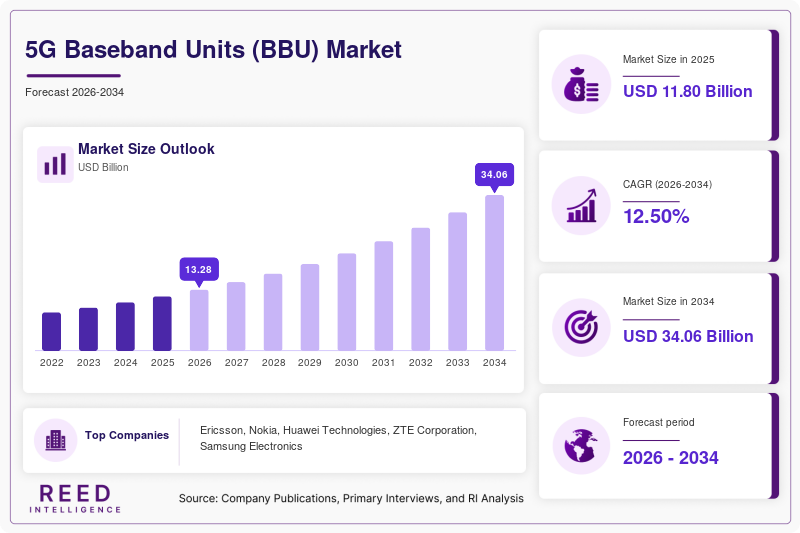
The global 5G Baseband Units (BBU) Market size was valued at USD 11.80 billion in 2025 and is projected to grow from USD 13.28 billion in 2026 to USD 34.06 billion by 2034, registering a CAGR of 12.50% during the forecast period from 2026 to 2034.
5G BBUs process the digital signals required for wireless communication and coordinate functions such as scheduling, coding, modulation and radio-resource management. Traditional BBUs remain important for macro-cell networks, while distributed and virtualized architectures are gaining relevance as operators seek greater flexibility in network deployment and computing-resource utilization.
The technology is increasingly being influenced by AI. Ericsson's September 2026 deployment with Vodafone Egypt uses the RAN Processor 6672 to bring AI processing closer to the radio site, with the company reporting up to four times higher processing capacity and more than 50% lower energy consumption compared with its previous-generation basebands.
5G Baseband Units (BBU) Market Drivers
Expansion of 5G Network Capacity
5G traffic growth requires baseband platforms capable of processing higher volumes of data while supporting wider bandwidths, massive MIMO and multiple spectrum bands. Operators upgrading existing 4G sites or deploying new 5G infrastructure need processing architectures that can support increased cell capacity without proportionally increasing site complexity.
The requirement is particularly strong in dense urban environments and high-traffic locations. Higher-capacity BBUs can consolidate processing functions and reduce the number of physical components required at a site, while software-based upgrades can extend the useful life of installed infrastructure.
Shift Toward Virtualized and Open RAN
Virtualized RAN is changing the traditional relationship between baseband processing and dedicated hardware. Samsung's commercial vRAN deployment demonstrates how RAN workloads can be consolidated on COTS servers using high-core-count processors and hardware acceleration.
Open RAN further separates network components through standardized interfaces, allowing operators to evaluate multi-vendor architectures. Nokia states that its Open RAN approach supports interoperability between radio units and distributed units while providing operators with greater deployment flexibility.
AI Integration at the RAN Edge
AI is increasingly being incorporated into baseband processing to optimize radio resources, spectral efficiency, energy consumption and user experience. Ericsson and SoftBank's August 2026 5G commercial-network trial reported up to approximately 25% improvement in spectral efficiency and up to approximately 50% higher downlink user throughput using an AI-native scheduling function operating on baseband equipment.
This creates demand for processors capable of handling conventional RAN workloads alongside AI inference. The resulting architecture increases the computational requirements of BBUs while also creating opportunities for hardware acceleration, software-defined processing and more efficient power management.
5G Baseband Units (BBU) Market Restraints
High Infrastructure and Modernization Costs
5G BBU deployments require substantial capital expenditure across baseband processing, radios, antennas, transport, power systems, cooling and site modernization. Operators with large installed 4G networks must balance new 5G investments against the continued operation of existing infrastructure.
The transition to virtualized architectures can reduce hardware dependence over time, but it introduces requirements for high-performance processors, cloud infrastructure, orchestration software and skilled engineering resources. This can increase deployment complexity during migration.
Power Consumption and Thermal Constraints
Higher-capacity baseband processors require substantial computing resources, creating power and thermal-management challenges at dense network sites. Operators are therefore evaluating architectures that increase processing efficiency while reducing energy use.
Recent product development illustrates the importance of this constraint. Ericsson reported that its RAN Processor 6672 can provide up to four times higher processing capacity while reducing energy consumption by more than 50% compared with the previous generation.
5G Baseband Units (BBU) Market Opportunities
AI-Native Baseband Processing
The integration of AI directly into RAN processing creates an opportunity to transform BBUs from fixed signal-processing systems into programmable computing platforms. AI can support traffic prediction, interference management, energy optimization, link adaptation and automated network configuration.
Nokia's July 2026 AI-RAN platform illustrates this transition by combining its anyRAN software with NVIDIA accelerated computing and introducing multiple AI-RAN hardware options, including an upgrade path for existing AirScale deployments and cloud-native configurations.
Growth of Private 5G and Industrial Networks
Private 5G networks are expanding the addressable application base beyond conventional public mobile operators. Manufacturing plants, ports, logistics centers, utilities, mining operations and large campuses require localized connectivity with predictable latency, reliability and network control.
BBUs and virtualized distributed units can be deployed as part of localized RAN architectures supporting industrial applications. The ability to combine RAN processing with edge computing can also allow enterprises to process workloads closer to connected equipment, reducing dependence on centralized infrastructure.
5G Baseband Units (BBU) Market Segmental Analysis
By Type
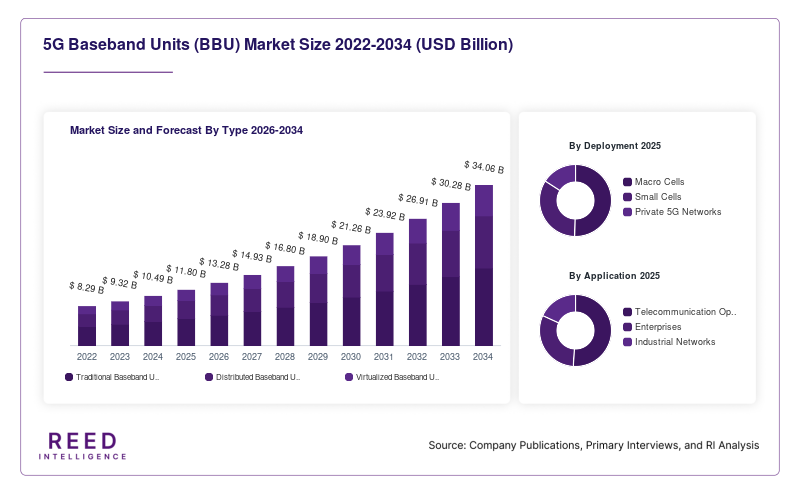
Traditional Baseband Units account for approximately 49% share, supported by their extensive installed base across conventional macro-cell networks. Operators continue to rely on purpose-built platforms because they provide predictable performance, integrated hardware-software optimization and established deployment procedures.
Virtualized Baseband Units are projected to be the fastest-growing type, with approximately 17.8% CAGR. vBBUs allow baseband workloads to operate on COTS computing infrastructure and can support more flexible capacity allocation. Samsung's commercial vRAN deployment on an Intel Xeon 6-powered server illustrates the industry's movement toward this architecture. Distributed BBUs account for approximately 29% share and are projected to grow at 12.8% CAGR as operators distribute processing closer to radio sites.
By Deployment
Macro Cells account for approximately 63% share, reflecting the continuing importance of wide-area 5G coverage and high-capacity mobile networks. Macro-cell deployments require powerful baseband processing to coordinate multiple radio sectors, spectrum bands and massive-MIMO configurations.
Private 5G Networks are projected to be the fastest-growing deployment category, with approximately 16.9% CAGR. Industrial users are adopting private cellular infrastructure for controlled connectivity, automation, machine communications and edge applications. Small cells account for approximately 24% share and are projected to grow at 13.6% CAGR as operators densify urban and indoor networks.
By Application
Telecommunication Operators account for approximately 76% share, reflecting the scale of public 5G deployments and the continuing requirement for macro-cell and distributed RAN infrastructure. Operators are also leading the transition toward vRAN, Open RAN and AI-assisted RAN architectures.
Industrial Networks are projected to be the fastest-growing application, with approximately 16.4% CAGR. Manufacturing, logistics, mining, utilities and other industrial environments require low-latency and reliable connectivity for connected equipment, automation and real-time monitoring. Enterprises account for approximately 16% share and are projected to grow at 13.8% CAGR.
5G Baseband Units (BBU) Market Regional Analysis
North America 5G Baseband Units (BBU) Market
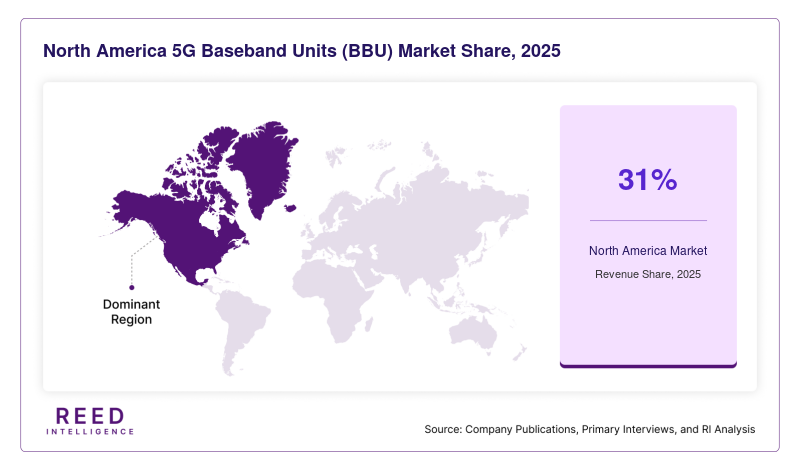
North America is the dominant region, accounting for approximately 31% share. The region benefits from extensive 5G infrastructure investment, advanced telecommunications operators, cloud-computing capabilities and early adoption of Open RAN and virtualized RAN technologies. U.S. operators and technology suppliers are also active in integrating AI acceleration into network infrastructure.
The U.S. represents the principal regional demand center, supported by large-scale mobile networks and enterprise connectivity requirements. Samsung's commercial vRAN milestone with a Tier-1 U.S. operator demonstrates the region's role in validating cloud-native baseband architectures on commercial networks.
Europe 5G Baseband Units (BBU) Market
Europe is projected to register approximately 10.9% CAGR during 2026–2034. Operators are modernizing 5G networks while evaluating Open RAN, cloud-native RAN and energy-efficient processing architectures. Network modernization is increasingly linked to software-defined infrastructure and multi-vendor interoperability.
Germany, the United Kingdom, France, Italy and other European markets contribute through established telecommunications infrastructure and industrial applications. Samsung and Orange expanded their European vRAN and Open RAN collaboration in 2026, including deployments using AI-powered vRAN and Intel Xeon 6 technology.
Asia Pacific 5G Baseband Units (BBU) Market
Asia Pacific is the fastest-growing region, with an estimated 14.1% CAGR during 2026–2034. Large mobile subscriber populations, extensive 5G deployment programs, dense urban networks and strong telecommunications equipment manufacturing capabilities support regional demand for high-capacity baseband platforms.
China, Japan, South Korea and India represent major regional markets. Japan is advancing AI-enabled RAN, while South Korea has strong 5G infrastructure and semiconductor capabilities. China's large-scale mobile infrastructure and domestic RAN ecosystem support demand for integrated BBU platforms, while India continues expanding 5G coverage and capacity.
Latin America 5G Baseband Units (BBU) Market
Latin America is projected to register approximately 11.8% CAGR during 2026–2034. 5G network expansion, spectrum utilization and rising mobile-data consumption are increasing requirements for upgraded RAN infrastructure. Operators are also evaluating architectures that can deliver greater capacity without proportionally increasing site complexity.
Brazil and Mexico represent important regional markets due to their telecommunications scale and industrial bases. Demand is concentrated around urban network modernization, enterprise connectivity and gradual expansion of 5G services, while capital expenditure levels and equipment financing influence deployment speed.
Middle East & Africa 5G Baseband Units (BBU) Market
The Middle East & Africa region is projected to grow at approximately 13.2% CAGR during 2026–2034. Telecommunications modernization, smart-city programs, enterprise digitization and expanding 5G coverage are creating requirements for higher-capacity and more energy-efficient RAN processing.
Saudi Arabia, the UAE, Egypt and South Africa are important regional markets. Ericsson's September 2026 commercial deployment of its RAN Processor 6672 with Vodafone Egypt demonstrates increasing adoption of AI-enabled baseband processing in the region, including a focus on processing efficiency and energy reduction.
5G Baseband Units (BBU) Market Competitive Landscape
The 5G BBU competitive landscape is concentrated around major RAN infrastructure vendors and technology providers with established relationships with mobile network operators. Competition is increasingly based on processing capacity, energy efficiency, software flexibility, Open RAN compatibility and the ability to support 5G-Advanced and AI workloads.
Ericsson maintains a broad baseband portfolio covering traditional and virtualized RAN architectures. Its RAN Compute portfolio is increasingly incorporating AI capabilities, with the RAN Processor 6672 designed for 5G-Advanced and AI workloads. The company is also demonstrating AI-enabled processing directly at radio sites.
Key Market Players
- Ericsson
- Nokia
- Huawei Technologies
- ZTE Corporation
- Samsung Electronics
- NEC Corporation
- Fujitsu
- Intel Corporation
- NVIDIA
- Qualcomm Technologies
- Cisco Systems
- Hewlett Packard Enterprise
- Dell Technologies
- Marvell Technology
- Mavenir
5G Baseband Units (BBU) Market Recent Market Developments
-
September 2026 - Ericsson and Vodafone Egypt commercially deployed the Ericsson RAN Processor 6672, with Ericsson reporting up to four times higher processing capacity and more than 50% lower energy consumption compared with the previous generation.
-
July 2026 - Nokia launched its commercial AI-RAN platform, combining anyRAN software with NVIDIA accelerated computing and introducing three AI-native baseband platform paths, including an AirScale upgrade option and cloud-native deployment.
5G Baseband Units (BBU) Market Segments
By Type
- Traditional Baseband Units
- Distributed Baseband Units
- Virtualized Baseband Units
By Deployment
- Macro Cells
- Small Cells
- Private 5G Networks
By Application
- Telecommunication Operators
- Enterprises
- Industrial Networks
By Region
- North America
- Europe
- APAC
- Middle East and Africa
- LATAM