A2 Milk Market Size, Share & Trends Analysis Report By Product Type (Liquid A2 Milk, A2 Milk Powder, A2 Infant Formula, A2-Based Other Nutritionals), By Distribution Channel (Supermarkets & Hypermarkets, Convenience & Specialty Stores, Online & E-Commerce, Foodservice & Direct Sales), By End User (Infants & Children, Adults, Seniors, Foodservice & Commercial Users) and By Region (North America, Europe, APAC, Middle East and Africa, LATAM) Forecasts, 2026–2034
USD 3950
A2 Milk Market Size
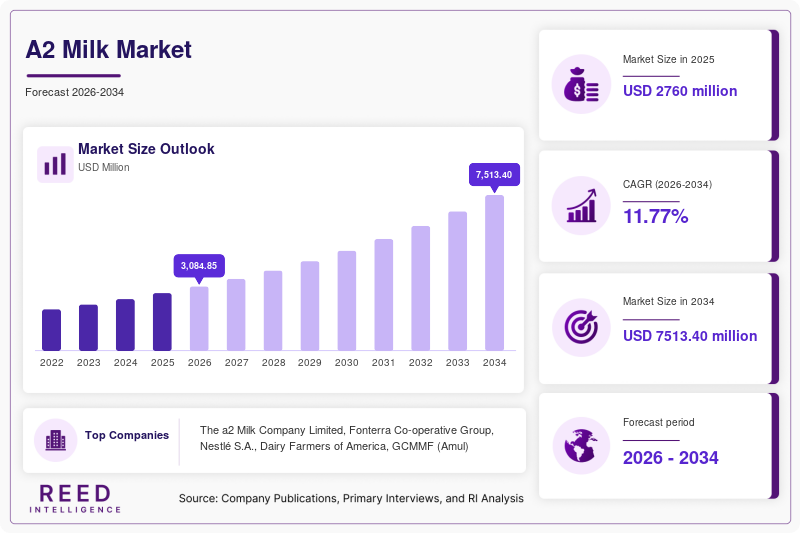
The global A2 milk market size was valued at USD 2,760 million in 2025 and is projected to grow from USD 3,060 million in 2026 to USD 7,513.40 million by 2034, registering a CAGR of 11.77% during the forecast period from 2026 to 2034.
The A2 milk market is shifting from a niche premium-milk proposition toward a broader dairy nutrition category spanning liquid milk, infant formula, milk powders, fortified products, and other nutritionals. The commercial mechanism is increasingly based on consumers seeking differentiated dairy products associated with digestion, protein quality, premium nutrition, and traceable sourcing. The a2 Milk Company’s FY2026 results illustrate this broadening: total revenue increased 12.4% to NZD 1.975 billion, while liquid milk revenue increased 21.8% and other nutritionals increased 59.9%. Infant milk formula remained the largest product category for the company, with total IMF sales increasing 4.7%.
Asia-Pacific remains central to category development because China combines a large premium infant-nutrition market with established demand for imported and cross-border dairy products, while India provides a large and expanding dairy-consumption base. China recorded 7.92 million births in 2025, although its overall birth rate remains structurally low, making premiumization and higher-value nutrition products more important than simple population expansion. India produced 247.87 million tonnes of milk in 2024–25, supporting a substantial domestic platform for specialized dairy products.
The market is also becoming more science-led. Recent clinical studies have investigated gastrointestinal tolerance and microbiome effects associated with milk containing only A2 beta-casein, while new infant-formula research is expanding the evidence base around A1-protein-free nutrition. At the same time, regulatory restrictions on A1/A2 claims in markets such as India and product-safety requirements for infant formula remain important commercial constraints.
A2 Milk Market Drivers
Premiumization and differentiated dairy consumption:
A2 milk provides dairy companies with a way to differentiate conventional milk through protein composition rather than competing only on fat content, lactose content, price, or packaging. The a2 Milk Company operates across fresh milk, infant formula, powders, and other nutritionals, showing how the A2 proposition can be extended across multiple price points and life stages. In FY2026, its U.S. revenue increased 28.6%, while Australia and New Zealand revenue increased 10.2%, indicating that demand is not restricted to a single geographic market. This creates a premiumization mechanism in which consumers can pay for a defined protein profile and branded sourcing standards. The opportunity is particularly relevant in urban markets where consumers are increasingly exposed to specialized dairy categories through supermarkets, pharmacies, e-commerce, and direct-to-consumer channels.
Expansion of A2-based infant and life-stage nutrition:
Infant formula has become a major commercial application for A2 milk because protein composition can be incorporated directly into specialized nutritional formulations. In FY2026, the a2 Milk Company generated NZD 1.334 billion from infant milk formula, while English-label IMF sales increased 23.2%. The company also expanded beyond infant nutrition into kids and seniors products, with other nutritionals revenue increasing 59.9% in FY2026. This creates a broader addressable customer base and allows manufacturers to extend the A2 proposition across multiple life stages rather than relying exclusively on liquid milk consumption.
Growing scientific attention to A2 beta-casein:
Clinical research is increasing the amount of evidence available to companies marketing A2-based products. A 2024 randomized crossover study found differences in several gastrointestinal symptoms between A2 milk and conventional A1/A2 milk, although the findings were mixed across individual measures. A 2025 study involving 35 participants reported changes in gut-microbiota composition following A2 milk consumption. In July 2026, the a2 Milk Company presented additional research at NUTRITION 2026 covering infant growth, digestive tolerance, protein utilization, and the gut-brain axis. The commercial implication is stronger differentiation, but companies still need to communicate health-related benefits within the limits of local food regulations and the strength of available evidence.
A2 Milk Market Restraints
Regulatory restrictions on A1/A2 claims:
Regulatory treatment differs significantly across markets, creating compliance costs for companies attempting to position A2 milk around digestive benefits. In India, FSSAI stated in August 2024 that A1/A2 differentiation is related to beta-casein structure and instructed e-commerce food businesses to remove A1/A2 claims from milk and milk products where the claims were not compliant with applicable standards. China also maintains strict registration requirements for infant-formula products, including scientific and safety documentation, manufacturing controls, and formula registration. These requirements can slow launches, increase testing and documentation costs, and limit how companies communicate the functional distinction between conventional and A2 milk.
Supply-chain complexity and premium sourcing costs:
A2 milk requires access to cows genetically selected to produce only A2 beta-casein, making sourcing more specialized than conventional milk procurement. The a2 Milk Company’s FY2026 experience demonstrates how the wider supply chain can affect commercial performance. China-label IMF sales fell 14.0% because of freight challenges, production backlogs, extended product-release times, customs requirements, and testing measures. The company subsequently acquired the Pōkeno nutritional manufacturing facility to increase manufacturing control and supply-chain resilience. For smaller A2 producers, maintaining a consistent A2/A2 milk pool while managing premium farm payments, processing capacity, cold-chain requirements, and international logistics can limit scalability.
A2 Milk Market Opportunities
Expansion into emerging Asian markets:
Asia offers a combination of large dairy-consumption bases, premium nutrition demand, and expanding digital commerce. India produced 247.87 million tonnes of milk in 2024–25 and has continued investment in milk collection, chilling, processing, and value-added dairy infrastructure. The a2 Milk Company also reported continued expansion in Vietnam, Singapore, South Korea, and other Southeast Asian markets during FY2026. This creates opportunities for A2 products positioned around premium nutrition, protein differentiation, convenience, and life-stage formulations. The principal commercial requirement is localized positioning because regulatory treatment, dairy preferences, price sensitivity, and channel structures differ substantially between China, India, Southeast Asia, Japan, and South Korea.
Precision-fermented A2 beta-casein and ingredient applications:
A2 beta-casein is beginning to move beyond conventional cow-milk sourcing. In July 2026, FSANZ opened consultation on a beta-casein protein preparation produced through precision fermentation using a genetically modified yeast containing the cow A2 beta-casein gene. The proposed ingredient is intended for products including dairy substitutes, protein beverages, and baked goods. This development could eventually broaden the market beyond genetically selected dairy herds by providing manufacturers with an additional source of A2 protein. Commercial adoption will depend on regulatory approval, consumer acceptance, labeling requirements, economics, and the ability to reproduce the sensory and nutritional characteristics expected from dairy-based A2 products.
Segmental Analysis
By Product Type
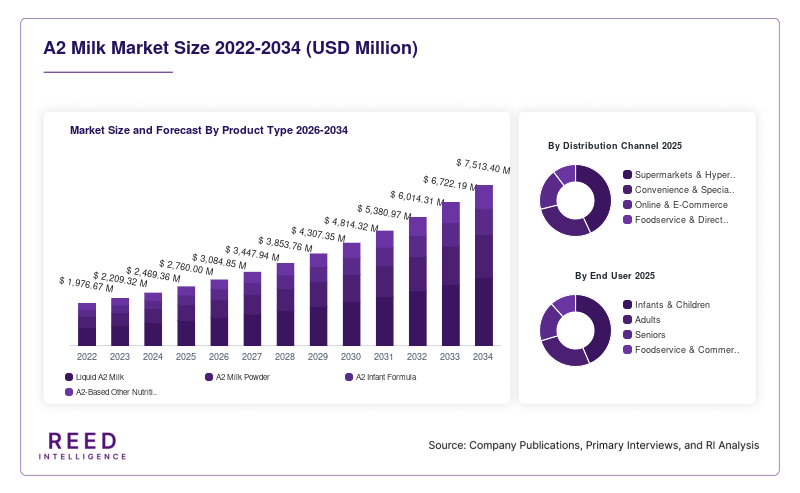
A2 Infant Formula represents approximately 40% of the global market in 2025, supported by the established use of A2-based nutrition in infant and growing-up formulations, particularly across China and other Asia-Pacific markets. The a2 Milk Company reported NZD 1.334 billion of infant milk formula revenue in FY2026, making IMF its largest product category, while total IMF sales increased 4.7%. China's regulatory framework also provides a formal registration pathway for infant-formula products, reinforcing the importance of compliant formulation, manufacturing, and labeling.
Liquid A2 Milk remains a major category because it provides the most direct consumer-facing application of A2 protein. In Australia, the a2 Milk Company identifies its brand as the leader in the fresh liquid milk category, while U.S. sales have expanded through whole, reduced-fat, grass-fed, and other formats.
A2-Based Other Nutritionals are the fastest-growing product subsegment, with a CAGR of approximately 14.6% through 2034. The mechanism is portfolio expansion into children, seniors, fortified powders, and functional nutrition. The a2 Milk Company’s other-nutritionals revenue increased 59.9% in FY2026, including growth from kids and seniors products.
By Distribution Channel
Supermarkets & Hypermarkets account for approximately 43% of the market, reflecting the importance of branded fresh milk and premium dairy placement. Physical grocery remains important because consumers often purchase milk as a recurring household staple.
Online & E-Commerce is the fastest-growing channel, with a CAGR of approximately 14.1%. Cross-border e-commerce is particularly important for premium A2 infant nutrition in China. The a2 Milk Company reported that English-label IMF growth was driven by cross-border e-commerce and offline-to-online channels, while its China business also uses domestic e-commerce and mother-and-baby stores.
By End User
Infants & Children represent approximately 52% of market demand, reflecting the large role of A2-based infant formula, growing-up milk, fortified powders, and pediatric nutrition products. China's registered infant-formula framework covers products for infants from birth through 36 months, creating a defined regulatory and commercial category.
Seniors are the fastest-growing end-user group, with a CAGR of approximately 13.9%, as manufacturers broaden A2-based nutrition beyond early-life products. The a2 Milk Company reported strong growth in fortified milk powder products for kids and seniors during FY2026.
Regional Analysis
North America A2 Milk Market
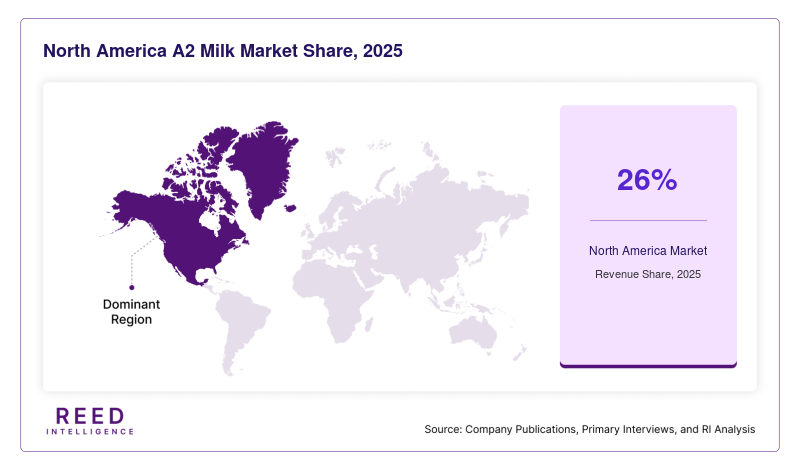
North America represents approximately 26% of the global A2 milk market in 2025 and is growing at around 10.4% CAGR. The United States has become an important market for branded A2 liquid milk and infant nutrition. The a2 Milk Company launched its U.S. brand in 2015 and has expanded distribution and product formats since then. Its FY2026 U.S. revenue increased 28.6%, driven primarily by core and grass-fed liquid milk. The U.S. market also has a broad dairy manufacturing base, with USDA maintaining detailed data on fluid milk sales, milk production, dairy plants, and consumption.
The market mechanism is based primarily on premium liquid milk and specialized infant nutrition. FDA records show that a2 Platinum Premium is marketed in the U.S., while FDA's current list of infant formulas marketed in the country also includes A2-positioned products from other manufacturers. However, the May 2026 recall of three batches of a2 Platinum USA-label formula because of cereulide contamination demonstrates the importance of quality controls, supplier oversight, and regulatory compliance in the premium infant-nutrition segment.
Europe A2 Milk Market
Europe accounts for approximately 15% of the global market and is expanding at about 9.3% CAGR. European demand is supported by premium dairy consumption, specialized nutrition, clean-label positioning, and increasing consumer attention to protein characteristics. The region's mature dairy-processing infrastructure can support A2 product development, but fragmented national markets mean that labeling, health claims, retail structures, and consumer awareness vary across countries.
The commercial opportunity is strongest where premium dairy products already command higher shelf prices and where consumers are familiar with lactose-free, organic, grass-fed, and specialty-protein propositions. A2 milk therefore competes within a broader premiumization environment rather than as an isolated category. The main constraint is that European consumers have many alternative differentiated dairy products, increasing the need for clear evidence and meaningful product differentiation.
APAC A2 Milk Market
APAC represents approximately 46% of the global A2 milk market in 2025 and is the fastest-growing region, with a CAGR of approximately 14.2%. China is the primary commercial engine, supported by premium infant nutrition, cross-border e-commerce, domestic mother-and-baby retail, and established awareness of imported dairy products. The a2 Milk Company reported NZD 1.448 billion in China & Other Asia revenue in FY2026, up 11.2%, with English-label IMF, other nutritionals, and emerging markets contributing to growth.
China's regulatory environment remains central. SAMR requires infant-formula products to undergo registration and scientific and safety review, while the regulator had approved 1,251 infant-formula product formulas as of April 2025. The a2 Milk Company also received approval for two additional China-label products during FY2026, targeting lower-tier cities and the organic segment.
India provides another major structural opportunity. Milk production reached 247.87 million tonnes in 2024–25, with per-capita availability reaching 485 grams per day. However, regulatory restrictions on A1/A2 marketing claims create a different commercialization model from China and Australia. Southeast Asia, Japan, and South Korea provide additional expansion routes as premium dairy and specialized nutrition categories develop.
Middle East and Africa A2 Milk Market
Middle East and Africa holds approximately 7% of the global market and is growing at around 11.8% CAGR. Growth is supported by premium imported dairy, urbanization, modern grocery retail, and demand for specialized nutrition products. Gulf markets provide relatively strong opportunities for premium packaged dairy because consumers have access to international brands through organized retail and e-commerce.
The region remains smaller than APAC and North America because local A2 cattle pools, processing capacity, and consumer awareness are less developed. This increases the importance of imported milk powder and finished products. For suppliers, the commercial mechanism is therefore more dependent on shelf-stable formats, infant nutrition, and distributor partnerships than on locally sourced fresh A2 milk.
LATAM A2 Milk Market
LATAM accounts for approximately 6% of the market and is expanding at about 11.2% CAGR. The region has a substantial dairy-production base and a large consumer population, providing a foundation for specialized milk categories. Brazil and Mexico represent the principal commercial markets because of their population scale, established dairy industries, and modern retail networks.
The opportunity is concentrated in premium liquid milk, powdered nutrition, and online specialty channels. However, purchasing power differences and relatively strong price competition in mainstream dairy can limit the ability of A2 products to command a substantial premium. Local sourcing and efficient farm-to-processing networks will therefore be important for improving price competitiveness.
Competitive Landscape
The competitive landscape combines specialized A2 brands, multinational dairy companies, infant-nutrition manufacturers, dairy cooperatives, and regional premium-milk producers. The a2 Milk Company remains the most focused branded participant, with operations spanning Australia, New Zealand, Greater China, North America, and emerging international markets. Its FY2026 strategy emphasized China infant formula, product innovation, new markets, and supply-chain transformation.
A major competitive change occurred through the acquisition of the Pōkeno nutritional manufacturing facility. The site provides integrated manufacturing capability and China-label registrations, allowing the company to increase control over a substantial portion of its infant-formula supply chain. The company also received approval to transition two acquired China-label registrations to its own a2 branding, supporting future China-market expansion.
Key Market Players
- The a2 Milk Company Limited
- Fonterra Co-operative Group
- Nestlé S.A.
- Dairy Farmers of America
- GCMMF (Amul)
- Noumi Limited
- Synlait Milk Limited
- Vinamilk
- Arla Foods
- Organic Valley
- China Mengniu Dairy Company
- Provilac Dairy Farms
- Ripley Farms
- Agropur Cooperative
Recent Market Developments
- September 2026 – FSANZ: Food Standards Australia New Zealand continued the regulatory assessment of a precision-fermented A2 beta-casein ingredient. The proposed ingredient could be used in dairy substitutes, protein beverages, and baked goods, potentially expanding A2 protein beyond conventional cow-milk sourcing.
- July 2026 – The a2 Milk Company: New research presented at NUTRITION 2026 covered infant growth and safety, protein utilization, digestive tolerance, and the gut-brain axis, strengthening the company's research-led positioning around A1-protein-free products.
A2 Milk Market Segments
By Product Type
- Liquid A2 Milk
- A2 Milk Powder
- A2 Infant Formula
- A2-Based Other Nutritionals
By Distribution Channel
- Supermarkets & Hypermarkets
- Convenience & Specialty Stores
- Online & E-Commerce
- Foodservice & Direct Sales
By End User
- Infants & Children
- Adults
- Seniors
- Foodservice & Commercial Users
By Region
- North America
- Europe
- APAC
- Middle East and Africa
- LATAM