AAA Games Market Size, Share & Trends Analysis Report By Game Type (Single-Player AAA Games, Multiplayer AAA Games, Live-Service AAA Games, AAA Sports & Racing Games), By Platform (Console, PC, Cloud Gaming), By Genre (Action & Adventure, Role-Playing Games, Shooter, Sports & Racing, Other Genres), By Distribution Channel (Digital, Physical) and By Region (North America, Europe, APAC, Middle East and Africa, LATAM) Forecasts, 2026–2034
USD 3950
AAA Games Market Size
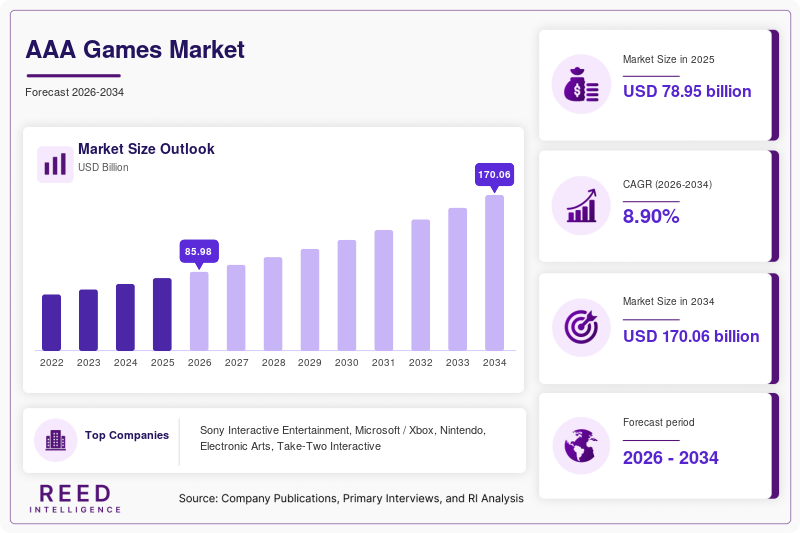
The global AAA games market size was valued at USD 78.95 billion in 2025 and is projected to grow from USD 85.98 billion in 2026 to USD 170.05 billion by 2034, registering a CAGR of 8.90% during the forecast period from 2026 to 2034.
The commercial environment for AAA games is being shaped by a combination of blockbuster releases, premium pricing, digital distribution, recurring spending, cross-platform availability and increasingly long post-launch support cycles. The wider global games market reached USD 201.6 billion in 2025, according to Newzoo's latest full-year assessment, while PC and console revenues together accounted for nearly USD 88.3 billion. Newzoo also reported that full-game revenue increased 25% year over year on PC and 8.1% on console during 2025.
AAA publishers are consequently relying on fewer, larger productions while extending the commercial life of successful franchises. Electronic Arts generated USD 5.383 billion from live services and other revenue in FY2026, compared with USD 2.148 billion from full games, while Take-Two reported recurrent consumer spending at 82% of fourth-quarter net bookings.
AAA games occupy the high-budget end of the video-game industry and typically involve large development teams, sophisticated graphics and audio, extensive content, major intellectual property, global marketing and multi-platform distribution. The commercial model has changed from relying primarily on a one-time game purchase toward a combination of premium sales, downloadable content, subscriptions, microtransactions and long-term live-service engagement.
Newzoo's 2025 data shows why this transition matters: PC and console revenue increasingly concentrated around a smaller number of high-impact releases, while long-running live-service titles continued to capture significant player engagement.
AAA Games Market Drivers
Expansion of Blockbuster Franchises and Premium Game Spending
The strongest demand mechanism for AAA games remains the ability of established franchises to generate concentrated consumer spending around major launches. Newzoo's 2025 PC and console analysis found that revenue success increasingly clustered around a smaller number of high-impact releases, while established franchises continued to attract player attention and spending.
The commercial impact is visible in publisher results. Electronic Arts reported that Battlefield 6 was the best-performing Battlefield title in a fiscal year, contributing to record FY2026 net bookings of USD 8.026 billion. Take-Two reported that NBA 2K26 sold more than 12 million units by August 2026, while the Grand Theft Auto series had sold more than 230 million units of Grand Theft Auto V.
Blockbuster launches also generate secondary spending through downloadable content, premium editions, subscriptions and in-game purchases. This gives publishers a longer revenue window than the initial retail release.
Growth of Recurring Monetization and Live-Service Models
AAA publishers are increasingly designing games around recurring player engagement rather than treating launch sales as the end of the product cycle. Take-Two reported that recurrent consumer spending represented 82% of fourth-quarter net bookings in FY2026, while EA generated USD 5.383 billion from live services and other revenue during FY2026.
Sony similarly identifies software titles, add-on content and network services as recurring revenue sources within its PlayStation business. Its platform had 124 million monthly active users at March 31, 2025.
The mechanism is commercially important because a successful AAA game can continue generating revenue through expansions, seasonal content, subscriptions, cosmetic items, competitive systems and community events. This can improve revenue visibility but also requires continued content investment, server infrastructure and community management.
Growth in Cross-Platform and Digital Distribution
Digital distribution has reduced dependence on physical retail and allowed AAA publishers to reach PC and console audiences simultaneously. Newzoo reported that PC generated USD 43.6 billion in 2025, with PC full-game revenue rising 25% year over year, while console full-game revenue grew 8.1%.
Publishers are also increasingly releasing major titles across multiple ecosystems. Ubisoft's Assassin's Creed Black Flag Resynced, released in July 2026, launched simultaneously on PlayStation 5, Xbox Series X|S and PC through Ubisoft Store, Steam and Epic Games Store.
This expands the addressable player base for each major production and allows publishers to distribute development costs across several platforms. Cross-platform progression, digital storefronts and subscriptions further increase the commercial value of a single IP.
AAA Games Market Restraints
Rising Development Costs and Production Risk
AAA development requires large teams, long production cycles, sophisticated technology and substantial marketing expenditure. The financial consequences of production delays or commercial underperformance are therefore much larger than for smaller games.
GDC's 2026 industry survey shows the labor-side pressure: 28% of respondents had experienced layoffs within two years, and two-thirds of developers at AAA studios reported layoffs at their companies.
This creates a difficult production equation. Publishers must deliver increasingly sophisticated graphics, open worlds, multiplayer systems, and cinematic content while controlling schedules and workforce costs. Large projects can also require years of development before revenue begins, increasing the financial exposure associated with cancellation or delay.
Concentration of Player Attention
AAA publishers compete not only against other new releases but also against established games that can retain players for years. Newzoo found that long-running live-service titles continued to dominate PC and console engagement during 2025, while only a limited number of new releases entered the highest monthly-active-user rankings.
This means launching a high-budget game does not guarantee sustained engagement. A new title must compete with established franchises, subscription libraries and free-to-play games for limited player time. The result is greater pressure on launch quality, post-launch content, community management and marketing efficiency.
AAA Games Market Opportunities
Expansion of AAA IP Across Entertainment Formats
AAA intellectual property increasingly has value outside the original game. Games can generate films, television series, merchandise, music, licensing, theme experiences and other forms of entertainment. GDC's 2025 State of the Game Industry reported that approximately one-third of AAA games were being adapted for film or television, illustrating the increasing connection between game development and broader entertainment franchises.
Sony's strategy also emphasizes expanding gaming IP beyond games, including synergies across its entertainment businesses.
This creates an opportunity for publishers to monetize successful characters and fictional worlds over longer periods. The mechanism is particularly relevant for franchises with strong narrative identities and recognizable characters because each additional media format can increase audience exposure and reinforce demand for the original game ecosystem.
AI-Assisted Development and Production Efficiency
Generative AI is becoming part of game-production workflows, although its adoption remains contested. GDC's 2025 survey found that 52% of respondents worked at companies implementing generative AI, while 36% personally used the technology. Developers also raised concerns around intellectual-property ownership, energy consumption, quality and regulation.
For AAA studios, the commercial opportunity is less about replacing entire creative teams and more about accelerating repetitive tasks such as coding assistance, localization, testing, asset workflows, documentation and internal production processes. Even modest reductions in development time can have material financial implications when projects involve hundreds of employees over several years.
Segmental Analysis
By Game Type
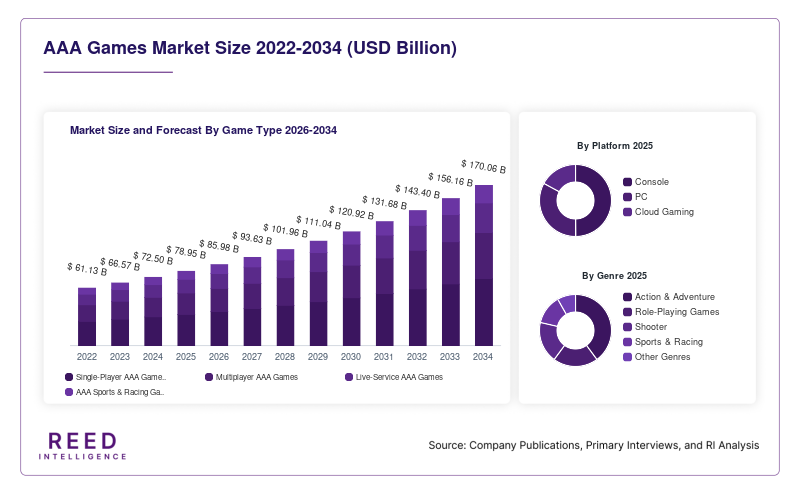
Single-Player AAA Games account for approximately 38% of the global market in 2025, making them the largest game-type segment. Large-scale narrative games remain an important commercial category because premium players continue to purchase high-production-value titles as complete entertainment experiences. Sony continues to emphasize its single-player creative franchises as a strategic component of PlayStation's studio business.
Multiplayer AAA Games represent approximately 25%, supported by competitive play, cooperative modes and social engagement.
Live-Service AAA Games account for approximately 27% and are the fastest-growing game type, with a CAGR of approximately 11.4%. The recurring-revenue model allows publishers to monetize content after launch through seasons, expansions, subscriptions and digital purchases. EA's FY2026 results and Take-Two's recurrent-consumer-spending figures demonstrate the commercial importance of this model.
AAA Sports & Racing Games represent approximately 10%, supported by annual or frequent franchise updates and established player communities.
By Platform
Console represents approximately 49% of the AAA games market in 2025, supported by PlayStation and Xbox installed bases and the ability of blockbuster releases to stimulate hardware and software spending. Newzoo forecasts console revenue at USD 46.9 billion for the overall games market in 2026 and identifies major releases as an important demand catalyst.
PC accounts for approximately 43% and is the fastest-growing platform, with a CAGR of approximately 9.7%. PC benefits from digital storefronts, high-end hardware, modding communities and increasingly simultaneous releases from major publishers. Newzoo reported 12% PC games-market growth in 2025, the strongest annual growth rate in its dataset.
Cloud Gaming represents approximately 8%. Cloud delivery remains strategically relevant because it can reduce hardware barriers, although performance, bandwidth and subscription economics continue to influence adoption.
By Genre
Action & Adventure represents approximately 31% of the global AAA games market in 2025, making it the largest genre category. Open-world exploration, cinematic storytelling and recognizable franchises make the genre particularly suited to large production budgets.
Role-Playing Games account for approximately 23%, supported by extensive worlds, character progression, customization and long playtimes.
Shooter games represent approximately 21% and remain important to multiplayer and competitive AAA ecosystems. EA reported Battlefield 6 as its strongest Battlefield fiscal-year performer in FY2026.
Sports & Racing represents approximately 16%, supported by recurring franchise releases and established player communities.
Other Genres account for approximately 9%.
Role-Playing Games are the fastest-growing genre, with a CAGR of approximately 10.1%, supported by demand for large-scale worlds, character progression and long-form gameplay.
By Distribution Channel
Digital distribution accounts for approximately 87% of the global AAA games market in 2025, reflecting the continued shift away from physical discs toward direct digital storefronts, platform stores, subscriptions and downloadable content.
Sony's PlayStation business reported a business composition in which digital software, add-on content and network services represented major revenue sources, while Ubisoft reported 85.9% digital revenue in its 2025 corporate reporting.
Physical distribution represents approximately 13%. It remains relevant for collectors, console buyers and markets where physical retail retains meaningful penetration.
Digital distribution is also the fastest-growing channel, with a CAGR of approximately 9.5%, supported by direct downloads, digital premium editions, subscription integration and post-launch downloadable content.
Regional Analysis
North America AAA Games Market
North America represents approximately 31% of the global AAA games market in 2025, making it the largest regional market. The United States is a major source of consumer spending, publisher revenue and AAA development investment.
ESA data shows that U.S. consumer spending on video games reached USD 60.8 billion in 2025, including USD 52.4 billion in content, USD 5.4 billion in hardware and USD 2.9 billion in accessories. The 2026 ESA report also recorded 212.3 million U.S. players, equivalent to 67% of Americans playing at least one hour per week.
North America has a strong ecosystem of publishers, developers, platform operators and technology suppliers. Major companies including Microsoft, Electronic Arts, Take-Two and Activision-related studios contribute to AAA production and distribution.
Subscription services are becoming more relevant to the region's business model. ESA reported that U.S. subscription spending increased 20% in 2025, contributing to overall consumer-spending growth.
North America is projected to grow at approximately 8.1% CAGR. Its mature installed base creates stable premium-game demand, while higher development costs and competition for player attention constrain unit growth.
Europe AAA Games Market
Europe accounts for approximately 25% of the global AAA games market in 2025, supported by strong PC and console participation and an established development ecosystem.
Newzoo reported that European games revenue grew 10.7% in 2025, while PC revenue increased 15.7%, the highest regional PC growth rate recorded for the year.
The region also has a broad development base spanning the United Kingdom, France, Germany, Poland, Sweden, Finland, Spain and other countries. Ubisoft's AAA production model illustrates the distributed European development structure: Assassin's Creed Black Flag Resynced involved studios across multiple countries and launched across PlayStation 5, Xbox Series X|S and PC.
European players also support both premium and live-service models. Strong PC penetration creates opportunities for simultaneous PC/console launches and digital distribution.
Europe is projected to grow at approximately 8.7% CAGR. Labor costs, regulatory requirements and development restructuring remain constraints for studios, while PC's strong regional performance provides an important growth mechanism.
APAC AAA Games Market
APAC represents approximately 29% of the global AAA games market in 2025 and is the fastest-growing region, with an estimated CAGR of 10.6%.
The region combines large player populations with major gaming markets including China, Japan and South Korea. Newzoo reported that APAC represented 47% of global games revenue in 2025, while Japan and South Korea outperformed global PC growth.
China is particularly important to AAA publishers because of its enormous consumer base and growing domestic development industry. Newzoo's 2026 forecast identifies China as an important contributor to PC growth, while the broader regional ecosystem continues to combine PC, console and mobile gaming.
Japan remains a major source of premium console and role-playing content, while South Korea has strong multiplayer and online-game expertise. Southeast Asian markets provide additional player-growth potential.
The region's fastest-growth mechanism is the combination of premium releases, PC expansion, local content production and increasing spending among established players. The principal constraint is regulatory variation across markets, particularly around game approvals, monetization and content.
Middle East and Africa AAA Games Market
Middle East and Africa represents approximately 7% of the global AAA games market in 2025 and is projected to grow at approximately 10.2% CAGR.
The region is developing through a combination of rising digital connectivity, younger gaming audiences, esports infrastructure and investment in entertainment industries. Saudi Arabia, the UAE, Egypt and other markets are increasing their role in the international gaming ecosystem.
Newzoo identified MEA as the fastest-growing regional games market in 2025 at 15.0% year over year, although from a smaller base than APAC, Europe and North America.
AAA publishers benefit from expanding digital distribution because consumers can access major releases without depending entirely on physical retail networks. PC gaming is particularly relevant where consumers seek high-end experiences without adopting multiple console ecosystems.
The main constraints are differences in purchasing power, local distribution, internet infrastructure and regulatory requirements. Localized pricing, subscription access and digital storefront availability can therefore influence adoption.
LATAM AAA Games Market
LATAM represents approximately 8% of the global AAA games market in 2025 and is projected to grow at approximately 9.8% CAGR.
The region has a large and engaged gaming population, with Brazil and Mexico serving as major markets. Digital distribution is particularly important because it reduces physical retail and logistics barriers and allows publishers to distribute AAA releases directly through platform storefronts.
LATAM also benefits from multi-platform gaming. Players often use PCs, consoles and mobile devices, creating opportunities for publishers to extend major franchises across several ecosystems.
Newzoo reported Latin America as one of the faster-growing regional games markets in 2025, while its broader market data shows continued growth in player and revenue bases.
The principal constraint is purchasing power and currency volatility, which can affect premium game pricing. Publishers therefore increasingly rely on regional pricing, digital promotions, subscription access and localized payment systems to expand the addressable audience.

Competitive Landscape
The AAA games market is highly concentrated around major publishers and platform owners because large-scale development requires substantial capital, intellectual property, technology, distribution capabilities and marketing resources. Competition is therefore based on franchise strength, development capacity, release timing, platform reach, monetization systems, live-service capabilities and post-launch support.
Electronic Arts reported record FY2026 net bookings of USD 8.026 billion, with Battlefield 6 and its live-services portfolio contributing to performance. Live services and other revenue represented 71% of FY2026 net revenue.
Take-Two is similarly focused on long-lived franchises. Its FY2026 fourth-quarter recurrent consumer spending represented 82% of net bookings, with NBA 2K, Grand Theft Auto Online, Grand Theft Auto V and other established franchises among the largest contributors.
Sony combines platform ownership with first-party content development. Its PlayStation ecosystem had 124 million monthly active users at March 2025, while the company continues to invest in premium single-player IP and live-service titles.
Key Market Players
- Sony Interactive Entertainment
- Microsoft / Xbox
- Nintendo
- Electronic Arts
- Take-Two Interactive
- Ubisoft
- Activision
- Epic Games
- Square Enix
- Capcom
- Bandai Namco Entertainment
- Krafton
- CD Projekt
- Warner Bros. Games
- Sega
Recent Market Developments
August 2026 – Take-Two reiterated its expectation for Grand Theft Auto VI to launch on November 19, 2026, while maintaining its FY2027 net-bookings outlook of USD 8.0–8.2 billion. The company also reported that NBA 2K26 had sold in more than 12 million units and that recurrent spending for the title increased alongside player engagement.
February 2026 – GDC's 2026 State of the Game Industry reported that two-thirds of surveyed AAA-studio respondents had experienced layoffs at their companies, while 28% of all respondents had personally been laid off during the preceding two years. The data indicates continued workforce restructuring across large-scale game development.
AAA Games Market Segments
By Game Type
- Single-Player AAA Games
- Multiplayer AAA Games
- Live-Service AAA Games
- AAA Sports & Racing Games
By Platform
- Console
- PC
- Cloud Gaming
By Genre
- Action & Adventure
- Role-Playing Games
- Shooter
- Sports & Racing
- Other Genres
By Distribution Channel
- Digital
- Physical
By Region
- North America
- Europe
- APAC
- Middle East and Africa
- LATAM