AB Testing Tools Market Size, Share & Trends Analysis Report By Type (Web-Based A/B Testing, Mobile A/B Testing, Server-Side A/B Testing and Multivariate Testing), By Application (Website Optimization, Mobile App Optimization, Product Development and Marketing Optimization) and By Enterprise Size (SMEs and Large Enterprises) and By Region (North America, Europe, Asia Pacific, Latin America, Middle East & Africa) Forecasts, 2026–2034
USD 3950
AB Testing Tools Market Size
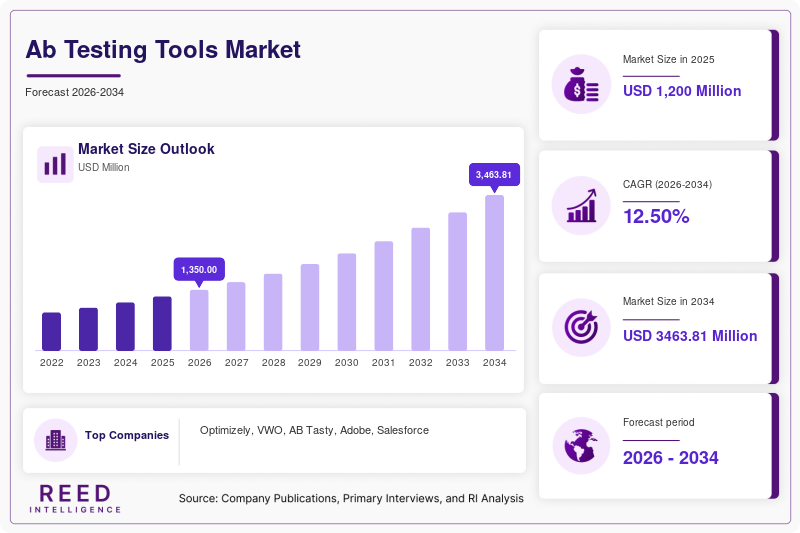
The global AB testing tools market size was valued at USD 1,200 million in 2025 and is projected to grow from USD 1,350 million in 2026 to USD 3,463.81 million by 2034, registering a CAGR of 12.50% during the forecast period from 2026 to 2034.
AB testing tools allow organizations to compare alternative versions of digital experiences against predefined performance metrics. Typical applications include testing landing pages, navigation, calls to action, product recommendations, checkout flows, mobile interfaces and product features. The tools generally provide experiment configuration, traffic allocation, statistical analysis and reporting.
Enterprise experimentation is increasingly moving across the full technology stack. Client-side testing remains important for marketing and website optimization, while server-side testing enables companies to experiment with application logic, APIs, product features and backend experiences. AB Tasty's 2025 One Platform launch specifically combined client-side and server-side experimentation to support testing across backend, web and mobile environments.
AB Testing Tools Market Drivers
Increasing Demand for Data-Driven Digital Optimization
Digital businesses increasingly need measurable evidence before changing customer-facing experiences. A/B testing allows teams to compare alternative experiences using controlled traffic rather than relying solely on qualitative feedback or assumptions. This is particularly important for e-commerce, SaaS, financial services, media and subscription businesses where small conversion changes can influence recurring revenue.
The expansion of experimentation across product, marketing and engineering teams is broadening the addressable market. Instead of limiting testing to landing pages, organizations are applying controlled experiments to features, onboarding, pricing interfaces, recommendations and customer journeys.
Expansion of Server-Side Experimentation
Server-side experimentation allows companies to test product functionality and business logic before changes reach every customer. This makes experimentation relevant to software engineering and product-management teams in addition to marketing departments.
AB Tasty's One Platform combines client-side and server-side experimentation with feature rollouts and APIs, illustrating the movement toward experimentation across backend, web and mobile environments. This broader deployment model increases the number of potential experiments while connecting testing with release-management processes.
Integration of AI into Experimentation
AI is reducing the manual effort required to formulate hypotheses, develop variations, analyze results and identify subsequent tests. Optimizely's 2026 releases introduced AI-powered idea generation, variation development and program-level reporting, while its contextual-bandit capabilities use user attributes to adapt variation selection.
This creates a shift from manually managed experimentation programs toward more automated optimization workflows. The commercial impact is strongest for organizations running large numbers of experiments where experiment creation, segmentation and analysis can otherwise consume substantial analyst and developer resources.
AB Testing Tools Market Restraints
Statistical and Data Quality Challenges
Reliable A/B testing requires sufficient traffic, clearly defined metrics, appropriate experiment design and statistically valid interpretation. Low-traffic websites and applications can struggle to produce sufficiently informative results within practical testing periods.
Organizations also need to account for seasonality, overlapping experiments, sample-ratio mismatches, novelty effects and changes in customer behavior. As platforms introduce more sophisticated statistical methods, users require stronger experimentation governance and analytical expertise to interpret results correctly.
Integration Complexity
A/B testing tools often need integration with analytics platforms, customer-data systems, content-management systems, e-commerce platforms, product databases and application infrastructure. Complex enterprise environments can therefore require significant implementation work.
Server-side and feature experimentation can further involve engineering teams, APIs, deployment pipelines and monitoring systems. Although unified platforms reduce tool fragmentation, enterprises still need consistent experimentation governance across marketing, product and engineering functions.
AB Testing Tools Market Opportunities
AI-Powered Experiment Automation
AI-enabled experimentation provides an opportunity to automate much of the testing lifecycle. Platforms can generate hypotheses, identify testable page elements, create variations, recommend metrics and summarize results. Optimizely's 2026 Idea Builder and Build agent demonstrate this progression from assisted ideation toward automated experiment construction.
The opportunity extends into continuous experimentation, where AI can analyze historical test results and recommend subsequent experiments based on observed customer behavior. This can increase the utilization of experimentation platforms within organizations that have historically struggled to maintain large testing programs.
Expansion Across Product Development
Experimentation is moving beyond marketing websites into product development, mobile applications, backend services and feature-release processes. Server-side experimentation allows organizations to validate functionality before broad deployment, while feature flags enable controlled rollouts.
This creates a larger market opportunity because product and engineering teams can become direct users of experimentation infrastructure. AB Tasty's unified platform illustrates this convergence by combining experimentation with feature management and progressive rollouts.
AB Testing Tools Market Segmental Analysis
By Type
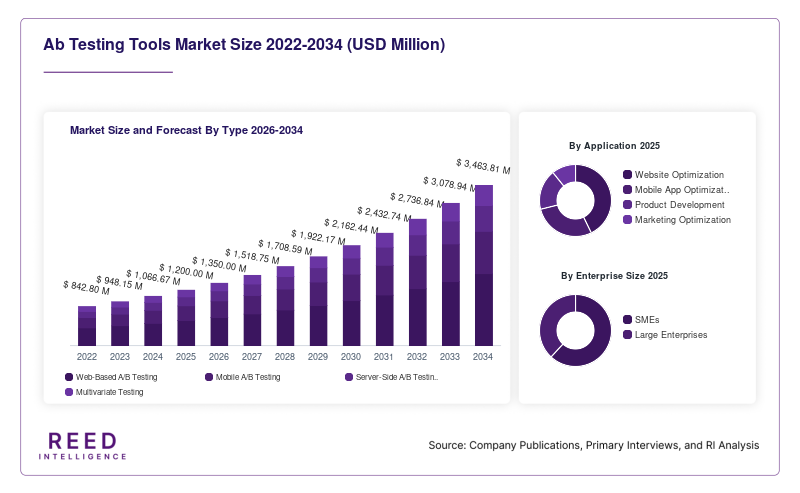
Web-Based A/B Testing accounts for approximately 46% share, making it the dominant type. Website experimentation remains widely adopted because businesses can test page layouts, headlines, calls to action, navigation, forms and conversion journeys without requiring substantial changes to backend infrastructure.
Server-Side A/B Testing is projected to be the fastest-growing type, with approximately 15.8% CAGR. Server-side experimentation supports testing of application logic, APIs, feature behavior and personalized experiences. AB Tasty's integration of client-side and server-side experimentation illustrates the expansion of experimentation beyond traditional webpage testing. Mobile A/B Testing accounts for approximately 24% share, while Multivariate Testing accounts for approximately 12% share and grows at approximately 10.8% CAGR.
By Application
Website Optimization accounts for approximately 39% share, supported by continued demand for conversion-rate optimization across e-commerce, SaaS, media and digital-service websites. Testing page design, content, navigation and checkout experiences remains one of the most accessible applications of experimentation technology.
Product Development is projected to be the fastest-growing application, with approximately 14.9% CAGR. Product teams increasingly use experimentation to validate new features, onboarding flows and product experiences before broad deployment. Server-side experimentation and feature-management capabilities are strengthening this transition.
Mobile App Optimization accounts for approximately 27% share and is projected to grow at approximately 13.1% CAGR. Marketing Optimization represents approximately 20% share and grows at approximately 11.8% CAGR as businesses integrate testing with personalization and campaign optimization.
By Enterprise Size
Large Enterprises account for approximately 68% share, reflecting their larger digital footprints, greater traffic volumes and ability to maintain dedicated experimentation teams. Large organizations also have more complex customer journeys where controlled testing can be applied across multiple digital channels.
SMEs are projected to be the fastest-growing enterprise segment, with approximately 14.6% CAGR. Cloud-based SaaS delivery lowers infrastructure requirements and allows smaller organizations to adopt experimentation without building extensive internal technology stacks. Simplified visual editors and AI-assisted experiment creation further reduce technical barriers.
AB Testing Tools Market Regional Analysis
North America AB Testing Tools Market
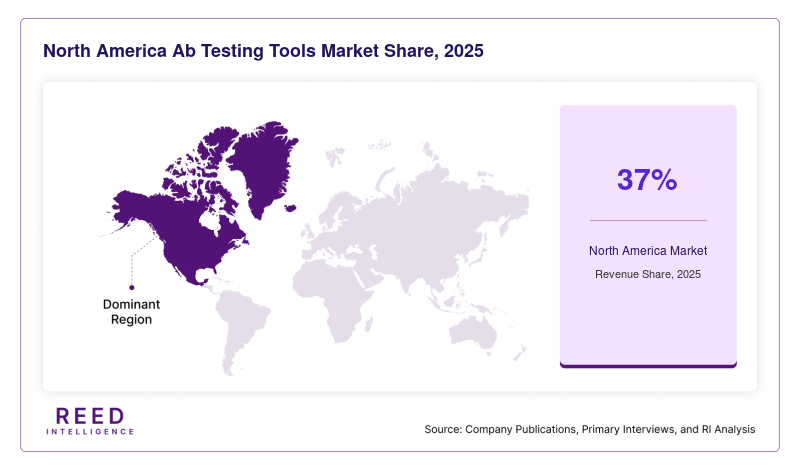
North America is the dominant region, accounting for approximately 37% share. The region benefits from mature SaaS adoption, large digital-commerce ecosystems, advanced analytics infrastructure and established experimentation practices among technology and consumer-facing companies. The concentration of enterprise software providers also supports rapid adoption of AI-enhanced experimentation.
The U.S. represents the primary demand center, supported by e-commerce, software, financial services, media and digital-native companies. Leading vendors such as Optimizely have continued expanding experimentation through AI agents, advanced statistical analysis and integrations with AI development environments, strengthening the region's experimentation ecosystem.
Europe AB Testing Tools Market
Europe is projected to register approximately 11.7% CAGR during 2026–2034. Mature e-commerce markets, SaaS adoption and growing emphasis on measurable customer-experience optimization support demand for A/B testing tools. Data governance and privacy requirements also increase the importance of controlled experimentation and responsible data use.
The United Kingdom, Germany, France and the Netherlands represent important digital markets, with experimentation increasingly applied across websites, mobile applications and product experiences. European vendors are also strengthening integrated experimentation offerings, with AB Tasty expanding its platform across client-side and server-side use cases.
Asia Pacific AB Testing Tools Market
Asia Pacific is the fastest-growing region, with an estimated 15.1% CAGR during 2026–2034. Expanding e-commerce, mobile applications, digital payments and technology services are increasing the number of digital experiences that can be optimized through controlled experimentation.
China, Japan, South Korea, India, Singapore and Australia represent important demand centers. India and Southeast Asia provide additional expansion potential because of rapidly scaling digital businesses, while Japan and South Korea have mature technology ecosystems. Mobile-first customer journeys also increase the relevance of mobile and server-side experimentation.
Latin America AB Testing Tools Market
Latin America is projected to register approximately 13.0% CAGR during 2026–2034. Growing digital commerce, fintech, subscription services and mobile applications are increasing demand for tools that can measure customer behavior and improve conversion performance.
Brazil and Mexico represent major regional markets, supported by expanding online retail and digital-service ecosystems. Cloud-based experimentation tools can reduce implementation requirements for growing companies, while localized testing of pricing, content, payment flows and customer journeys supports regional adoption.
Middle East & Africa AB Testing Tools Market
The Middle East & Africa region is projected to grow at approximately 13.6% CAGR during 2026–2034. Digital transformation programs, e-commerce expansion, financial technology and mobile applications are creating greater demand for analytics-driven optimization tools.
The UAE, Saudi Arabia and South Africa represent important adoption centers. Digital-native businesses and enterprises modernizing customer journeys are increasingly able to deploy cloud-based experimentation without large infrastructure investments, while AI-assisted testing can reduce the technical resources required to operate experimentation programs.
AB Testing Tools Market Competitive Landscape
The AB testing tools market includes dedicated experimentation platforms, digital-experience suites, personalization providers and product-optimization platforms. Competition increasingly centers on experiment velocity, statistical capabilities, AI automation, server-side functionality, integrations and the ability to support experimentation across multiple digital channels.
Optimizely has expanded its experimentation capabilities through AI-assisted hypothesis generation, variation development, advanced statistical engines and contextual bandits. Its 2026 releases also introduced an MCP server connecting experimentation data with AI clients, increasing interoperability with developer and AI workflows.
Key Market Players
- Optimizely
- VWO
- AB Tasty
- Adobe
- Salesforce
- Amplitude
- LaunchDarkly
- Kameleoon
- Convert.com
- SiteSpect
- Dynamic Yield
- GrowthBook
- Statsig
- Eppo
AB Testing Tools Market Recent Market Developments
-
September 2026 - Optimizely added a Build agent to its experimentation Idea Builder, allowing saved ideas to be converted into complete A/B tests with suggested variations, metrics and audiences.
-
November 2025 - AB Tasty launched Evi, an agentic AI tool designed to automate stages of the experimentation lifecycle from hypothesis creation through experiment execution and post-test analysis.
Ab Testing Tools Market Segments
By Type
- Web-Based A/B Testing
- Mobile A/B Testing
- Server-Side A/B Testing
- Multivariate Testing
By Application
- Website Optimization
- Mobile App Optimization
- Product Development
- Marketing Optimization
By Enterprise Size
- SMEs
- Large Enterprises
By Region
- North America
- Europe
- APAC
- Middle East and Africa
- LATAM