Abdominal Aortic Aneurysm Market Size, Share & Demand Report By Treatment Type (Endovascular Aneurysm Repair, Open Surgical Repair, Pharmaceutical Management), By Diagnosis (Imaging Techniques, Blood Tests, Genetic Testing), By End-Use (Hospitals, Ambulatory Surgical Centers, Specialty Clinics) By Region & Segment Forecasts, 2026–2034
USD 3950
Market Overview
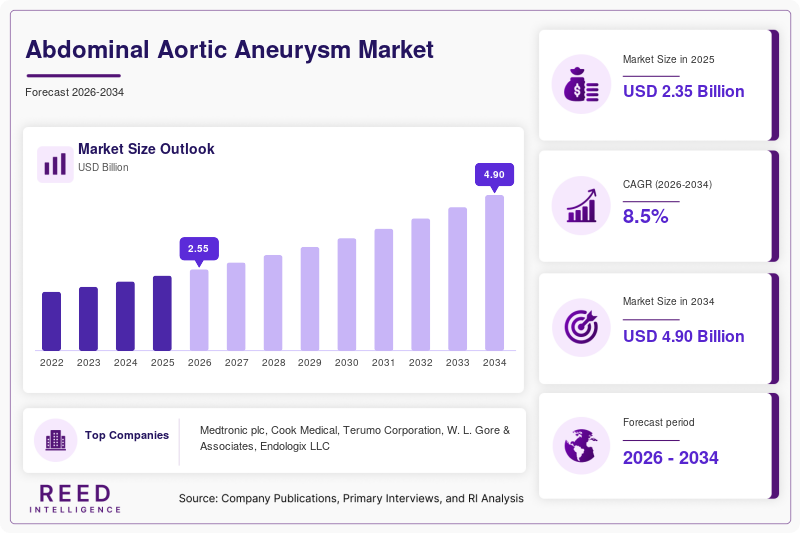
The Abdominal Aortic Aneurysm Market size was valued at approximately USD 2.35 billion in 2026 and is projected to reach USD 4.52 billion by 2034, registering a compound annual growth rate (CAGR) of 8.5% during the forecast period (2026–2034). The market continues to expand steadily due to the rising global prevalence of cardiovascular disorders and the increasing aging population. Abdominal aortic aneurysm (AAA) is primarily diagnosed in older adults, particularly those above 60 years, making demographic shifts a key contributor to market expansion.
One major global factor supporting market growth is the increasing adoption of minimally invasive surgical procedures, especially endovascular aneurysm repair (EVAR). These procedures reduce hospital stay, improve recovery time, and lower complication risks, encouraging both patients and healthcare providers to prefer advanced treatment options. Additionally, government-backed screening programs in developed countries have significantly improved early diagnosis rates, further strengthening the market outlook.
Key Highlights
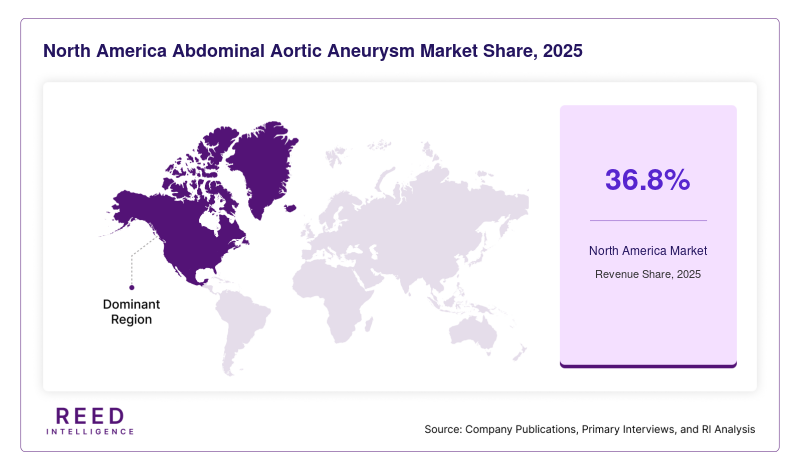
- North America dominated the market with a 36.8% share in 2025.
- Asia Pacific is expected to grow at the fastest CAGR of 9.6% during 2026–2034.
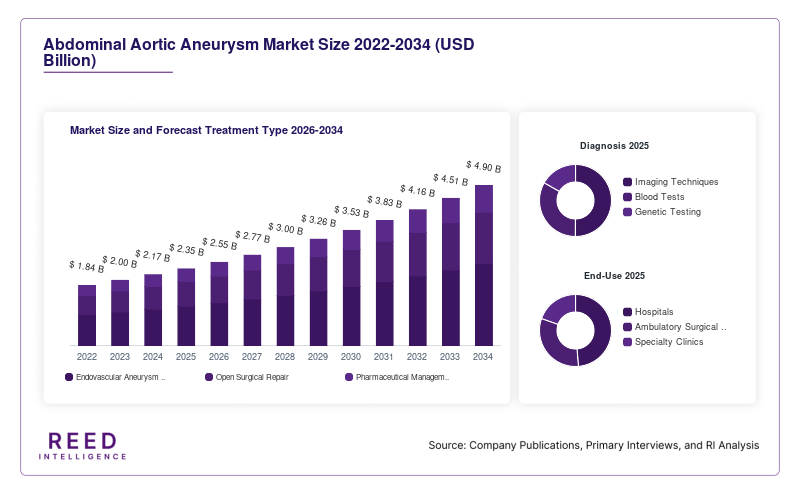
- By treatment type, endovascular aneurysm repair accounted for the largest share of 44.3%.
- while pharmaceutical management is projected to grow at a CAGR of 9.9%.
- By diagnosis, imaging techniques led with a 52.7% share, whereas genetic testing is expected to expand at a CAGR of 10.4%.
- The United States remained the dominant country, with market values of USD 690 million in 2024 and USD 740 million in 2025.
Market Trends
A notable trend shaping the abdominal aortic aneurysm market is the growing integration of advanced imaging technologies with artificial intelligence. Healthcare providers are increasingly adopting AI-assisted diagnostic tools to improve the accuracy and speed of aneurysm detection. These systems analyze imaging data such as CT scans and ultrasounds to identify early-stage aneurysms that may otherwise go unnoticed. The use of predictive analytics also allows clinicians to assess rupture risk more effectively, enabling personalized treatment planning. As healthcare systems emphasize early intervention and preventive care, AI-driven diagnostics are expected to gain further traction, particularly in developed regions with established digital health infrastructure.
Another important trend is the increasing preference for minimally invasive procedures, especially endovascular aneurysm repair. Patients and physicians are moving away from open surgical repair due to the lower risk profile and faster recovery associated with minimally invasive techniques. Device manufacturers are continuously innovating to develop flexible stent graft systems that can be used in complex anatomies. This has expanded the eligibility of patients for EVAR procedures. Additionally, outpatient surgical settings are becoming more common for certain interventions, reducing overall healthcare costs. This trend is expected to accelerate as hospitals aim to optimize efficiency and patient outcomes.
Market Drivers
The rising prevalence of cardiovascular diseases is a key driver of the abdominal aortic aneurysm market. Lifestyle-related risk factors such as smoking, hypertension, obesity, and sedentary habits contribute significantly to the development of aneurysms. As these risk factors become more widespread globally, particularly in urban populations, the incidence of AAA continues to increase. Governments and healthcare organizations are implementing awareness campaigns and screening programs to address this issue. Early diagnosis through routine screening in high-risk populations has led to increased treatment rates, directly contributing to market growth. The growing burden of cardiovascular diseases ensures a sustained demand for diagnostic and therapeutic solutions in this market.
Another major driver is the rapid advancement of medical device technologies. Innovations in stent graft design, imaging systems, and surgical tools have improved the safety and effectiveness of AAA treatment. Modern devices offer better adaptability to patient anatomy, reducing complications such as endoleaks. Furthermore, the development of hybrid operating rooms equipped with advanced imaging systems has enhanced procedural precision. These technological improvements not only increase treatment success rates but also encourage healthcare providers to adopt newer solutions. As research and development investments continue to rise, the availability of advanced treatment options is expected to expand, supporting long-term market growth.
Market Restraint
High treatment costs and limited access to advanced healthcare facilities remain significant challenges for the abdominal aortic aneurysm market. Procedures such as endovascular aneurysm repair require specialized equipment, skilled professionals, and advanced hospital infrastructure, which can be costly. In many developing regions, healthcare systems lack the necessary resources to provide these treatments widely. This creates disparities in access to care, leading to delayed diagnosis and treatment.
The financial burden on patients can also limit the adoption of advanced therapies, particularly in countries with limited insurance coverage. Even in developed regions, the high cost of devices and surgical procedures can strain healthcare budgets. For example, the cost of stent graft systems and imaging procedures can significantly increase the overall expense of treatment. This restraint affects both patient access and hospital decision-making, potentially slowing market growth despite increasing disease prevalence.
Market Opportunities
Expanding healthcare infrastructure in emerging economies presents a strong opportunity for the abdominal aortic aneurysm market. Countries in Asia Pacific, Latin America, and the Middle East are investing heavily in healthcare development, including the establishment of advanced diagnostic and surgical facilities. These investments are improving access to screening and treatment services for a larger population. As awareness of AAA increases, more patients are seeking medical attention, creating a growing demand for diagnostic tools and treatment devices. Market players can capitalize on this opportunity by forming partnerships with local healthcare providers and expanding their presence in these regions.
Another opportunity lies in the development of personalized medicine and targeted therapies. Advances in genomics and biomarker research are enabling a better understanding of the underlying mechanisms of aneurysm formation and progression. This has opened the door to tailored treatment approaches that consider individual patient characteristics. Pharmaceutical companies are exploring drug therapies that can slow aneurysm growth, potentially reducing the need for surgical intervention. The integration of personalized medicine into AAA management could transform the treatment landscape and create new revenue streams for market participants.
Segmental Analysis
By Treatment Type
Endovascular aneurysm repair emerged as the dominant subsegment in 2024, accounting for approximately 44.3% of the total market share. This dominance is largely due to the growing preference for minimally invasive procedures among both patients and healthcare providers. EVAR offers several advantages over traditional open surgery, including shorter hospital stays, reduced recovery time, and lower complication rates. Hospitals are increasingly investing in advanced surgical equipment to support these procedures. Additionally, improvements in stent graft design have expanded the range of patients eligible for EVAR, further strengthening its position as the leading treatment option in the market.
Pharmaceutical management is expected to be the fastest-growing subsegment, with a projected CAGR of 9.9% during the forecast period. This growth is driven by ongoing research into drug therapies that can slow aneurysm progression and reduce the risk of rupture. Pharmaceutical approaches are particularly appealing for patients who are not suitable candidates for surgery. Advances in targeted therapies and the identification of molecular pathways involved in aneurysm development are supporting this trend. As clinical trials continue to demonstrate the effectiveness of these treatments, their adoption is expected to increase significantly.
By Diagnosis
Imaging techniques dominated the diagnosis segment in 2024, capturing a market share of 52.7%. Technologies such as ultrasound, CT angiography, and MRI play a critical role in detecting and monitoring abdominal aortic aneurysms. These methods provide detailed visualization of the aorta, enabling accurate assessment of aneurysm size and growth. The widespread availability of imaging equipment in hospitals and diagnostic centers has contributed to the dominance of this subsegment. Furthermore, advancements in imaging technology have improved diagnostic accuracy and reduced procedure times, enhancing their overall effectiveness.
Genetic testing is projected to be the fastest-growing subsegment, with a CAGR of 10.4% during the forecast period. This growth is driven by increasing interest in personalized medicine and the identification of genetic risk factors associated with AAA. Genetic testing can help identify individuals at high risk, enabling early intervention and preventive measures. As research in this field advances, the integration of genetic testing into routine clinical practice is expected to increase. This will not only improve patient outcomes but also create new opportunities for market growth.
By End-Use
Hospitals accounted for the largest share of the end-use segment in 2024, representing approximately 48.9% of the market. This dominance is attributed to the availability of advanced diagnostic and surgical facilities within hospital settings. Hospitals are the primary centers for AAA treatment, offering a wide range of services from screening to complex surgical procedures. The presence of skilled healthcare professionals and access to advanced technologies further strengthen their position. Additionally, hospitals often serve as referral centers for patients with severe or complicated cases, contributing to their significant market share.
Ambulatory surgical centers are expected to be the fastest-growing subsegment, with a CAGR of 9.1% during the forecast period. This growth is driven by the increasing shift towards outpatient care and cost-effective treatment options. Ambulatory centers offer shorter wait times and lower costs compared to traditional hospital settings, making them an attractive option for certain procedures. Advances in minimally invasive techniques have made it possible to perform some AAA interventions in these settings. As healthcare systems continue to focus on efficiency and cost reduction, the role of ambulatory surgical centers is expected to expand.
Regional Analysis
North America
North America accounted for the largest share of the abdominal aortic aneurysm market in 2025, holding approximately 36.8% of the global market. The region is expected to maintain steady growth with a CAGR of 7.9% during the forecast period. This dominance is attributed to well-established healthcare infrastructure, high awareness levels, and the widespread adoption of advanced diagnostic and treatment technologies. Government-supported screening programs and favorable reimbursement policies further contribute to market growth.
The United States remains the dominant country in this region, driven by its strong healthcare system and high prevalence of cardiovascular diseases. A key growth factor is the extensive use of preventive screening programs for high-risk populations, particularly older adults. These programs have significantly improved early detection rates, leading to timely interventions and better patient outcomes.
Europe
Europe holds a significant share of the abdominal aortic aneurysm market, accounting for around 28.5% in 2025, with a projected CAGR of 7.6% through 2034. The region benefits from advanced healthcare systems and strong regulatory frameworks that ensure the quality and safety of medical devices. Increasing government initiatives for early diagnosis and treatment are supporting market growth.
Germany stands out as the dominant country in this region, supported by its robust healthcare infrastructure and strong focus on research and development. A unique growth factor is the increasing adoption of minimally invasive procedures, driven by favorable reimbursement policies and a high level of physician expertise in advanced surgical techniques.
Asia Pacific
Asia Pacific is expected to witness the fastest growth in the abdominal aortic aneurysm market, with a CAGR of 9.6% during the forecast period. The region accounted for approximately 20.3% of the global market in 2025. Rapid urbanization, increasing healthcare expenditure, and growing awareness of cardiovascular diseases are key factors driving market expansion.
China dominates the Asia Pacific market due to its large population and improving healthcare infrastructure. A significant growth factor is the government's focus on expanding access to healthcare services in rural and underserved areas. This has led to increased screening and diagnosis rates, creating a strong demand for AAA treatment solutions.
Middle East & Africa
The Middle East & Africa region held a smaller share of the abdominal aortic aneurysm market, accounting for about 7.2% in 2025, with a projected CAGR of 8.1%. Growth in this region is driven by increasing investments in healthcare infrastructure and rising awareness of cardiovascular diseases. However, limited access to advanced medical facilities remains a challenge.
Saudi Arabia is the leading country in this region, supported by significant government investments in healthcare modernization. A unique growth factor is the development of specialized medical centers equipped with advanced diagnostic and surgical technologies, which are improving treatment accessibility and outcomes.
Latin America
Latin America accounted for approximately 7.2% of the abdominal aortic aneurysm market in 2025 and is expected to grow at a CAGR of 8.3% during the forecast period. The region is experiencing gradual improvements in healthcare infrastructure and increasing awareness of aneurysm-related conditions.
Brazil dominates the Latin American market due to its large population and expanding healthcare system. A key growth factor is the increasing adoption of private healthcare services, which provide access to advanced diagnostic and treatment options. This trend is contributing to the overall growth of the market in the region.
Competitive Landscape
The abdominal aortic aneurysm market is moderately competitive, with several global and regional players focusing on innovation and strategic partnerships. Leading companies are investing in research and development to enhance their product portfolios and maintain a competitive edge. The market is characterized by the presence of established medical device manufacturers as well as emerging players introducing novel technologies.
Medtronic plc is recognized as a leading player in this market, driven by its extensive range of stent graft systems and strong global presence. The company has recently focused on expanding its product offerings through technological advancements and strategic collaborations. Other key players are also adopting similar strategies, including mergers, acquisitions, and product launches, to strengthen their market position. Continuous innovation and a focus on improving patient outcomes remain central to competitive strategies in this market.
Key Players
- Medtronic plc
- Cook Medical
- Terumo Corporation
- W. L. Gore & Associates
- Endologix LLC
- MicroPort Scientific Corporation
- Cardinal Health
- Abbott Laboratories
- Boston Scientific Corporation
- Becton, Dickinson and Company
- Getinge AB
- Meril Life Sciences
- Lombard Medical
- Cordis Corporation
- Biotronik
Recent Developments
- Several companies have introduced next-generation stent graft systems designed to improve flexibility and durability, enhancing patient outcomes in complex cases.
- A major medical device manufacturer expanded its production capacity to meet the growing global demand for minimally invasive AAA treatment solutions.
- Collaborations between healthcare providers and technology firms have led to the development of AI-based diagnostic tools aimed at improving early detection rates and treatment planning.
Abdominal Aortic Aneurysm Market Segments
Treatment Type
- Endovascular Aneurysm Repair
- Open Surgical Repair
- Pharmaceutical Management
Diagnosis
- Imaging Techniques
- Blood Tests
- Genetic Testing
End-Use
- Hospitals
- Ambulatory Surgical Centers
- Specialty Clinics
By Region
- North America
- Europe
- APAC
- Middle East and Africa
- LATAM