Abdominal Pads Market Size, Share, Demand Report By Type (Sterile Abdominal Pads, Non-Sterile Abdominal Pads, Non-Adherent Abdominal Pads), By Material (Cotton-Based, Nonwoven Synthetic, Blended Fibers), By Application (Surgical Wound Care, Trauma Care, Chronic Wound Management), By End-Use (Hospitals, Clinics, Home Healthcare, Ambulatory Surgical Centers), By Distribution Channel (Hospital Pharmacies, Retail Pharmacies, Online Pharmacies), By Region & Segment Forecasts, 2026–2034
USD 3950
Market Overview
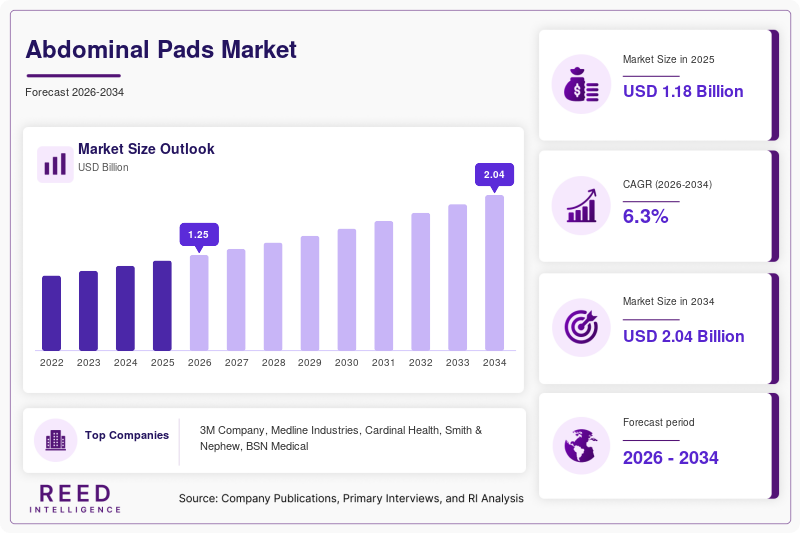
The Abdominal Pads Market size is estimated at USD 1.25 billion, and it is expected to reach USD 2.05 billion by 2034, registering a CAGR of 6.3% during the forecast period.One of the primary global factors supporting the growth of the Abdominal Pads Market is the increasing prevalence of chronic diseases such as diabetes and obesity, which significantly contribute to surgical interventions and post-operative wound care requirements. Additionally, expanding healthcare infrastructure in emerging economies has further strengthened product accessibility and adoption.
Key Highlights
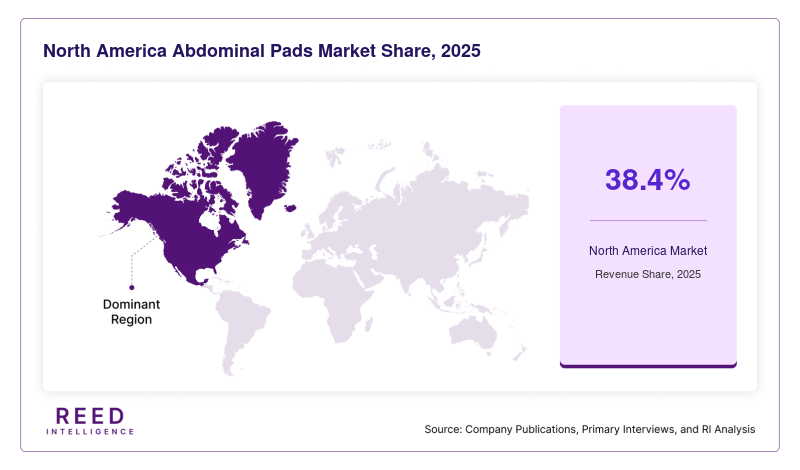
- Dominant region share (2025): North America accounted for approximately 38.4% of the global Abdominal Pads Market.
- Fastest-growing region CAGR (2026–2034): Asia Pacific is expected to grow at a CAGR of 7.4%.
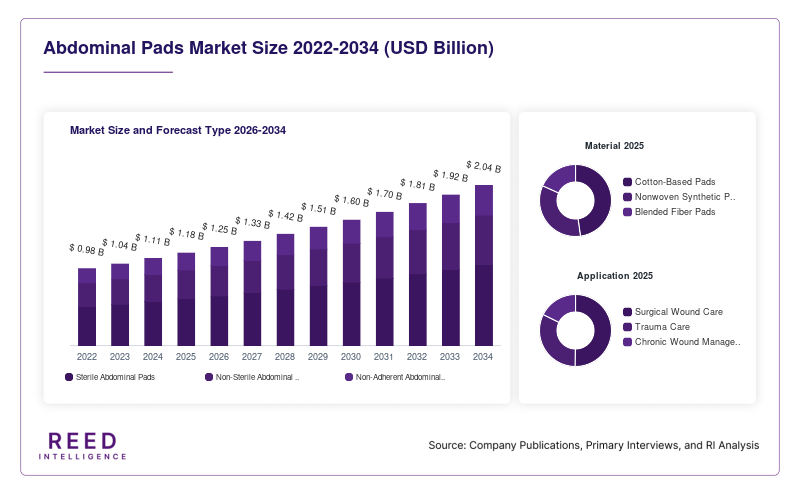
- Leading subsegment (Type): Sterile abdominal pads held the dominant share of 61.2% in 2025.
- Fastest-growing subsegment (Application): Surgical wound care is expected to grow at a CAGR of 6.9%.
- Dominant country (2024–2025): The United States recorded USD 320 million in 2024 and USD 340 million in 2025 in the Abdominal Pads Market.
Market Trends
Rising Demand for Advanced Sterile Wound Care Products
The Abdominal Pads Market is witnessing a significant shift toward sterile, highly absorbent, and infection-resistant wound care solutions. Hospitals are increasingly adopting multilayered abdominal pads designed with enhanced fluid retention capabilities to reduce post-surgical complications. This trend is further supported by strict infection control protocols across healthcare facilities.
Integration of Antimicrobial and Superabsorbent Technologies
Manufacturers in the Abdominal Pads Market are focusing on integrating antimicrobial coatings and superabsorbent polymer (SAP) layers to improve healing outcomes. These innovations help minimize bacterial contamination and reduce dressing change frequency, thereby improving patient comfort and reducing healthcare costs.
Market Drivers
Rising Surgical Procedures and Trauma Cases
One of the major drivers of the Abdominal Pads Market is the increasing number of surgical interventions globally. Road accidents, sports injuries, and emergency surgeries have surged, creating sustained demand for high-performance abdominal wound dressings. Hospitals rely heavily on abdominal pads for post-operative wound management due to their high absorbency and cushioning properties.
Growing Geriatric Population and Chronic Diseases
The expanding elderly population is another critical growth driver for the Abdominal Pads Market. Older adults are more prone to chronic wounds, ulcers, and surgical procedures, all of which require effective wound dressing solutions. Additionally, diabetes-related complications continue to increase demand for advanced abdominal wound care products.
Market Restraint
Price Sensitivity in Emerging Economies
Despite steady growth, the Abdominal Pads Market faces challenges due to price sensitivity in low- and middle-income countries. Limited reimbursement policies and preference for low-cost alternatives restrict the adoption of advanced abdominal pads, particularly in rural healthcare settings.
Market Opportunities
Expansion of Home Healthcare Services
The increasing shift toward home-based healthcare presents a major opportunity for the Abdominal Pads Market. Patients recovering from surgeries are increasingly opting for home care settings, driving demand for easy-to-use and sterile abdominal pads suitable for non-clinical environments.
Technological Innovation in Biodegradable Materials
The development of eco-friendly and biodegradable wound care materials offers a promising opportunity for manufacturers in the Abdominal Pads Market. Sustainable products made from natural fibers such as bamboo and organic cotton are gaining attention due to rising environmental concerns and hospital sustainability initiatives.
Segmental Analysis
The Abdominal Pads Market is segmented based on type, material, application, and end-use. Each segment plays a crucial role in defining market structure and growth dynamics.
By Type
In 2025, sterile abdominal pads dominated the segment with a 61.2% share of the Abdominal Pads Market, primarily due to their widespread use in surgical procedures and infection-sensitive wound care environments. Hospitals and surgical centers prefer sterile pads to minimize infection risks and ensure post-operative safety.
The fastest-growing subsegment is non-adherent abdominal pads, expected to grow at a CAGR of 6.8% during 2026–2034. Their growth is driven by increasing demand for patient comfort and reduced trauma during dressing removal. These pads are particularly beneficial in chronic wound care and long-term treatment settings.
By Material
The cotton-based abdominal pads segment held 54.6% share in 2025, dominating the Abdominal Pads Market due to high absorbency, softness, and cost-effectiveness. Cotton remains the most widely used material in hospitals and clinics globally.
The fastest-growing subsegment is nonwoven synthetic material pads, projected to grow at a CAGR of 7.1%. Their growth is driven by superior fluid management properties, reduced linting, and enhanced durability compared to traditional cotton-based products.
By Application
Surgical wound care dominated with 46.3% share in 2025 in the Abdominal Pads Market, supported by rising surgical procedures and post-operative care requirements. Abdominal pads are extensively used in abdominal surgeries, trauma care, and cesarean sections.
The fastest-growing subsegment is trauma and emergency care, expected to grow at a CAGR of 6.9%. Increasing road accidents and emergency admissions are driving demand for rapid wound management solutions.
By End-Use
Hospitals accounted for 58.7% share in 2025, making them the dominant end-use segment in the Abdominal Pads Market. Hospitals require large volumes of abdominal pads for surgical wards, emergency rooms, and intensive care units.
The fastest-growing subsegment is home healthcare, projected to grow at a CAGR of 7.0%. The rise of outpatient surgeries and patient preference for home recovery are driving this segment’s expansion.
Regional Analysis
North America
North America held a 38.4% share of the Abdominal Pads Market in 2025 and is expected to grow at a CAGR of 5.8% during 2026–2034. The region’s dominance is attributed to advanced healthcare infrastructure, high surgical volumes, and strong presence of key manufacturers. The United States leads the region due to high healthcare expenditure and rapid adoption of advanced wound care products.
Europe
Europe accounted for 27.1% share in 2025 of the Abdominal Pads Market and is projected to grow at a CAGR of 5.5%. Growth is driven by rising elderly population, increased hospital admissions, and stringent hygiene regulations. Germany leads the region due to strong medical device manufacturing capabilities and robust healthcare reimbursement systems.
Asia Pacific
Asia Pacific held a 21.6% share in 2025 of the Abdominal Pads Market and is expected to grow at the fastest CAGR of 7.4%. Growth is fueled by expanding healthcare infrastructure, rising medical tourism, and increasing surgical procedures in countries such as China and India. China dominates due to large patient population and government healthcare investments.
Middle East & Africa
The Middle East & Africa region accounted for 7.2% share in 2025 and is projected to grow at a CAGR of 6.1% in the Abdominal Pads Market. Growth is supported by improving hospital infrastructure and increasing awareness of advanced wound care solutions. The UAE leads the region due to its rapidly developing healthcare sector.
Latin America
Latin America represented 5.7% share in 2025 and is expected to grow at a CAGR of 5.9%. Brazil dominates the region due to rising surgical procedures and increasing healthcare accessibility. Government initiatives aimed at improving public healthcare systems are further supporting market expansion.
Competitive Landscape
The Abdominal Pads Market is moderately consolidated, with key players focusing on product innovation, sterile manufacturing processes, and global distribution expansion. Leading companies include 3M Company, Medline Industries, Cardinal Health, Smith & Nephew, and BSN Medical. These players dominate through strong healthcare partnerships and diversified product portfolios.
3M Company remains a market leader due to its advanced wound care technologies and consistent product innovation in sterile dressing solutions. Recently, the company expanded its advanced absorbent dressing line to improve post-surgical recovery outcomes.
Other players are focusing on cost-effective product development and expansion into emerging markets to strengthen their global presence in the Abdominal Pads Market.
Key Players List
- 3M Company
- Medline Industries
- Cardinal Health
- Smith & Nephew
- BSN Medical
- Paul Hartmann AG
- ConvaTec Group
- Mölnlycke Health Care
- Dynarex Corporation
- McKesson Corporation
- Johnson & Johnson
- Ahlstrom-Munksjö
- Winner Medical Group
- Naugra Medical
- Covidien (Medtronic)
Recent Developments
- In 2025, leading manufacturers in the Abdominal Pads Market introduced antimicrobial-coated abdominal pads to reduce post-surgical infections.
- Several companies expanded production facilities in Asia Pacific to meet rising demand for cost-effective wound care products.
- New biodegradable abdominal pad prototypes were launched focusing on eco-friendly healthcare solutions.
- Strategic partnerships between hospitals and medical device companies increased bulk procurement of advanced abdominal pads.
- Digital supply chain integration improved distribution efficiency across the global Abdominal Pads Market.
Abdominal Pads Market Segments
Type
- Sterile Abdominal Pads
- Non-Sterile Abdominal Pads
- Non-Adherent Abdominal Pads
Material
- Cotton-Based Pads
- Nonwoven Synthetic Pads
- Blended Fiber Pads
Application
- Surgical Wound Care
- Trauma Care
- Chronic Wound Management
End-Use
- Hospitals
- Clinics
- Home Healthcare
- Ambulatory Surgical Centers
Distribution Channel
- Hospital Pharmacies
- Retail Pharmacies
- Online Pharmacies
By Region
- North America
- Europe
- APAC
- Middle East and Africa
- LATAM