Absorbable Tissue Spacer Market Size, Share & Demand Report By Type (Hydrogel Spacers, Balloon Spacers), By Material (Polyethylene Glycol (PEG), Biodegradable Polymers), By Application (Prostate Cancer, Gynecological Cancer, Other Oncology Applications), By End-Use (Hospitals, Ambulatory Surgical Centers, Specialty Clinics), By Region & Segment Forecasts, 2025–2034
USD 3950
Market Overview
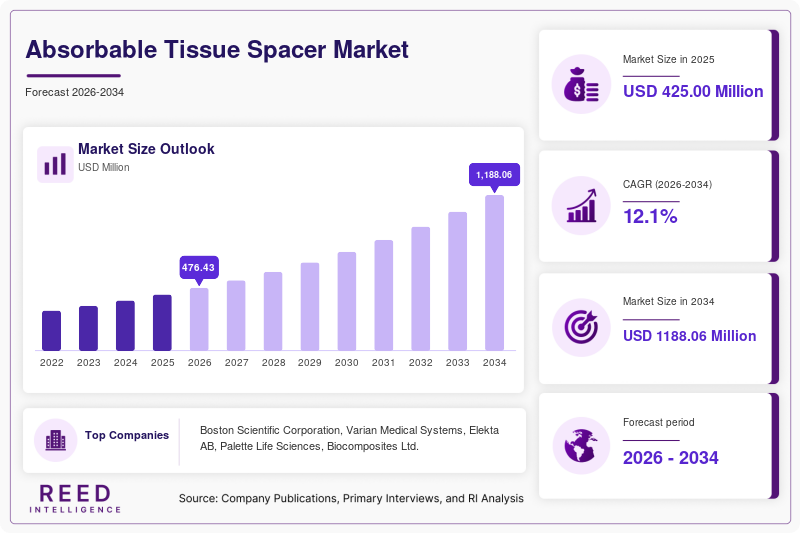
The global Absorbable Tissue Spacer Market size was valued at approximately USD 425 million in 2025 and is projected to reach USD 1.18 billion by 2034, expanding at a compound annual growth rate (CAGR) of 12.1% during the forecast period. The market growth is being shaped by the rising demand for precision-driven radiation therapy, where absorbable spacers are increasingly used to protect healthy tissues during oncological procedures.
A major global factor supporting market expansion is the growing prevalence of cancer and the corresponding increase in radiotherapy procedures. As healthcare systems prioritize minimally invasive and targeted treatment approaches, absorbable tissue spacers have emerged as a critical adjunct in reducing radiation-induced toxicity, thereby improving patient outcomes and quality of life.
Key Highlights
- North America dominated the market with a 42.3% share in 2025, while Asia Pacific is expected to grow at the fastest CAGR of 14.2% through 2034.
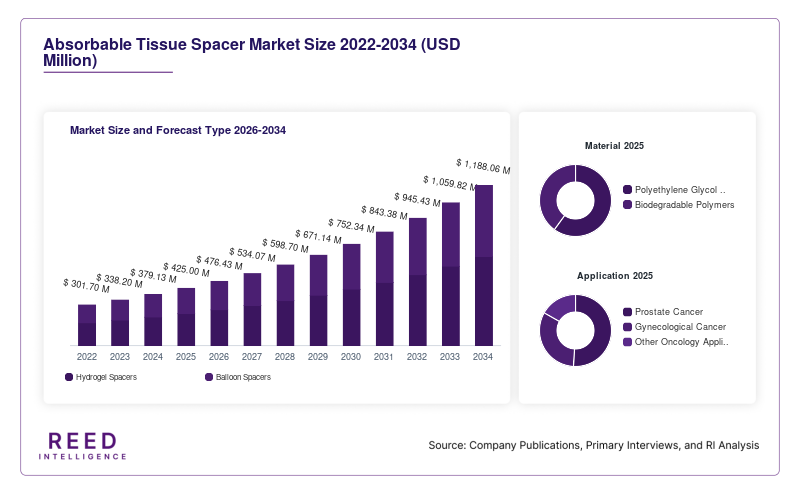
- By type, hydrogel-based spacers led with a 61.5% share, whereas balloon spacers are projected to grow at a CAGR of 13.6%.
- By application, prostate cancer treatment accounted for the largest share at 58.7%, while gynecological cancer applications are expected to expand at a CAGR of 13.9%.
- The United States remained the dominant country, with market values of USD 150 million in 2024 and USD 165 million in 2025.
Market Trends
Increasing Adoption of Hydrogel-Based Spacer Technologies
Hydrogel-based absorbable spacers are gaining traction due to their biocompatibility, ease of application, and predictable degradation profile. These spacers can be precisely injected and conform to anatomical structures, making them particularly effective in prostate cancer radiotherapy. Their ability to maintain consistent separation between organs at risk and target tissues has made them a preferred choice among clinicians. Continuous innovation in hydrogel formulations is further improving performance and expanding clinical applications.
Integration with Image-Guided Radiation Therapy (IGRT)
The integration of absorbable tissue spacers with advanced imaging technologies such as MRI and CT-based planning is reshaping treatment protocols. This trend allows clinicians to achieve higher accuracy in radiation delivery while minimizing collateral damage. The compatibility of spacers with imaging systems enhances visualization and procedural precision. As healthcare providers adopt more image-guided techniques, the demand for spacers that complement these systems is expected to rise steadily.
Market Drivers
Rising Incidence of Cancer Worldwide
The increasing global burden of cancer is a primary driver of the Absorbable Tissue Spacer Market. With a growing number of patients requiring radiation therapy, the need for protective solutions that minimize side effects has intensified. Absorbable spacers play a crucial role in reducing radiation exposure to adjacent organs, making them an essential component of modern oncology treatment protocols.
Growing Preference for Minimally Invasive Procedures
Healthcare providers and patients are increasingly favoring minimally invasive interventions due to shorter recovery times and reduced complications. Absorbable tissue spacers align with this trend, as they can be administered through minimally invasive techniques without requiring surgical removal. This convenience has significantly boosted their adoption across various clinical settings.
Market Restraint
High Cost of Procedures and Limited Accessibility
One of the primary challenges facing the Absorbable Tissue Spacer Market is the high cost associated with spacer implantation procedures. These costs include not only the device itself but also specialized equipment and trained personnel required for accurate placement. In many developing regions, limited healthcare infrastructure and lack of reimbursement policies further restrict access to these advanced solutions.
Additionally, the need for skilled practitioners to perform spacer placement can limit widespread adoption. Training requirements and procedural complexity may deter smaller healthcare facilities from integrating these devices into their treatment offerings. As a result, market growth may be uneven across regions, with slower adoption in cost-sensitive and resource-constrained environments.
Market Opportunities
Expansion into Emerging Markets
Emerging economies present significant growth potential for the Absorbable Tissue Spacer Market. Increasing healthcare investments, improving infrastructure, and rising awareness about advanced cancer treatments are creating favorable conditions for market expansion. As governments prioritize oncology care, the adoption of absorbable spacers is expected to increase.
Development of Multi-Application Spacer Solutions
The development of spacers that can be used across multiple cancer types and treatment modalities offers a promising opportunity. Innovations that enable broader clinical applicability, such as use in gastrointestinal or head and neck cancers, can significantly expand the market scope. Companies focusing on versatile and customizable solutions are likely to gain a competitive edge.
Segmental Analysis
By Type
Hydrogel-based spacers dominated the Absorbable Tissue Spacer Market with a 61.5% share in 2024. Their widespread use is attributed to their flexibility, ease of administration, and compatibility with imaging technologies.
Balloon spacers are expected to grow at the fastest CAGR of 13.6% through 2034. Their ability to create consistent and adjustable spacing between tissues will drive their adoption, particularly in complex procedures requiring precise separation.
By Material
Polyethylene glycol (PEG)-based materials held the largest share of 54.2% in 2024. These materials are widely used due to their biocompatibility and predictable degradation characteristics.
Biodegradable polymers are projected to grow at a CAGR of 13.4% over the forecast period. Their enhanced mechanical properties and adaptability to various clinical applications will support their growth.
By Application
Prostate cancer treatment accounted for the largest share of 58.7% in 2024. The high prevalence of prostate cancer and the effectiveness of spacers in reducing radiation toxicity have driven this dominance.
Gynecological cancer applications are expected to grow at a CAGR of 13.9% through 2034. Increasing awareness and expanding treatment options for women’s health will contribute to this growth.
By End-Use
Hospitals dominated the market with a 68.3% share in 2024, owing to their advanced infrastructure and availability of specialized healthcare professionals.
Ambulatory surgical centers are projected to grow at a CAGR of 13.1% during the forecast period. Their cost-effectiveness and increasing adoption of minimally invasive procedures will drive growth.
Regional Analysis
North America
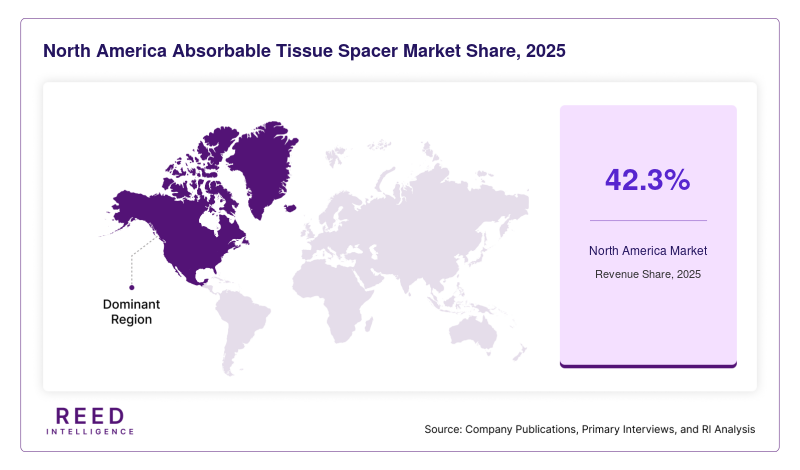
North America accounted for 42.3% of the Absorbable Tissue Spacer Market share in 2025 and will grow at a CAGR of 11.4% through 2034. The region’s mature healthcare infrastructure and widespread adoption of advanced radiotherapy techniques will continue to support steady growth.
The United States dominated the regional market due to strong clinical adoption and advanced oncology practices. A key growth factor has been the integration of innovative treatment planning systems, which enhance the effectiveness of absorbable spacers in radiation therapy.
Europe
Europe held a 27.8% market share in 2025 and will expand at a CAGR of 11.8% over the forecast period. The region has shown consistent growth due to increasing investments in cancer care and supportive regulatory frameworks.
Germany emerged as the leading country, driven by its robust healthcare system and emphasis on precision medicine. The adoption of advanced radiotherapy techniques has supported the use of absorbable spacers in clinical practice.
Asia Pacific
Asia Pacific captured 18.6% of the market share in 2025 and is expected to grow at the fastest CAGR of 14.2% through 2034. Rapid healthcare development and increasing cancer incidence will drive regional expansion.
China dominated the region due to its large patient population and expanding oncology infrastructure. Government initiatives aimed at improving cancer treatment accessibility have significantly boosted market growth.
Middle East & Africa
The Middle East & Africa accounted for 6.1% of the market share in 2025 and will grow at a CAGR of 12.5% during the forecast period. The region is witnessing gradual improvements in healthcare infrastructure.
Saudi Arabia led the regional market, supported by investments in advanced medical technologies and expanding oncology centers. The focus on improving healthcare quality has contributed to increased adoption of absorbable spacers.
Latin America
Latin America held a 5.2% market share in 2025 and is projected to grow at a CAGR of 12.0% through 2034. The region is experiencing steady growth due to rising awareness and improving healthcare systems.
Brazil dominated the market, driven by expanding access to cancer treatment and growing adoption of modern radiotherapy techniques. Increasing investments in healthcare infrastructure have supported market development.
Competitive Landscape
The Absorbable Tissue Spacer Market is moderately consolidated, with several key players focusing on product innovation and strategic collaborations. The leading companies are investing in research and development to enhance product performance and expand clinical applications.
Boston Scientific Corporation stands out as a market leader, driven by its strong product portfolio and global presence. The company recently introduced an advanced hydrogel spacer designed to improve procedural accuracy and patient outcomes.
Other major players are also focusing on expanding their geographic footprint and strengthening distribution networks. Partnerships with healthcare providers and research institutions are helping companies accelerate product adoption and innovation.
Key Players
- Boston Scientific Corporation
- Varian Medical Systems
- Elekta AB
- Palette Life Sciences
- Biocomposites Ltd.
- Medtronic plc
- Johnson & Johnson
- Cook Medical
- Merit Medical Systems
- BD (Becton, Dickinson and Company)
Recent Developments
- 2024: A major player launched a next-generation hydrogel spacer with enhanced imaging visibility.
- 2023: Strategic collaboration between medical device companies to expand spacer applications in oncology.
- 2023: Regulatory approvals granted for new absorbable spacer products in Europe and Asia.
- 2022: Increased investment in R&D for biodegradable materials to improve product efficiency.
Absorbable Tissue Spacer Market Segments
Type
- Hydrogel Spacers
- Balloon Spacers
Material
- Polyethylene Glycol (PEG)
- Biodegradable Polymers
Application
- Prostate Cancer
- Gynecological Cancer
- Other Oncology Applications
End-Use
- Hospitals
- Ambulatory Surgical Centers
- Specialty Clinics
By Region
- North America
- Europe
- APAC
- Middle East and Africa
- LATAM