Accessory Dwelling Unit Market Size, Share & Trends Analysis Report By Unit Type (Detached ADUs, Attached ADUs, Interior ADUs), By Construction Type (New Construction, Conversion & Renovation), By Design (Studio/1-Bedroom, 2-Bedroom, 3-Bedroom & Larger), By Application (Rental Housing, Multigenerational Housing, Guest & Family Housing, Home Office & Other Uses), By Ownership (Owner-Occupied, Investor-Owned) and By Region (North America, Europe, APAC, Middle East and Africa, LATAM) Forecasts, 202
USD 3950
Accessory Dwelling Unit Market Size
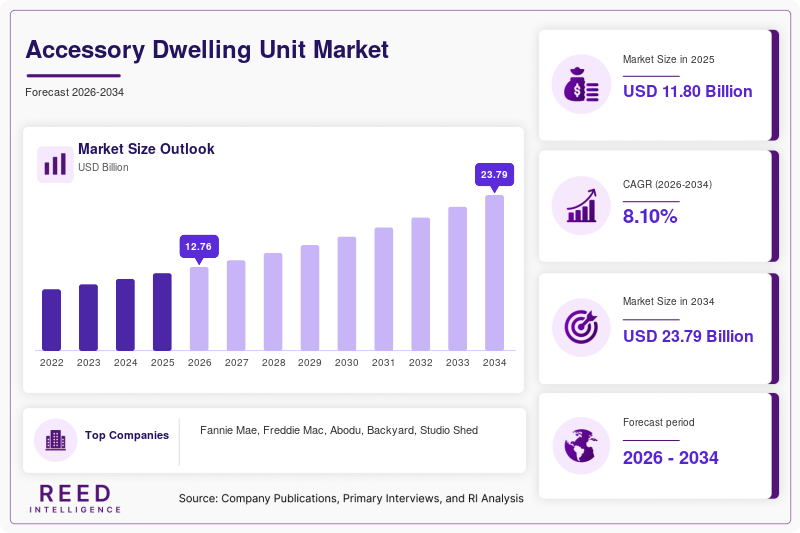
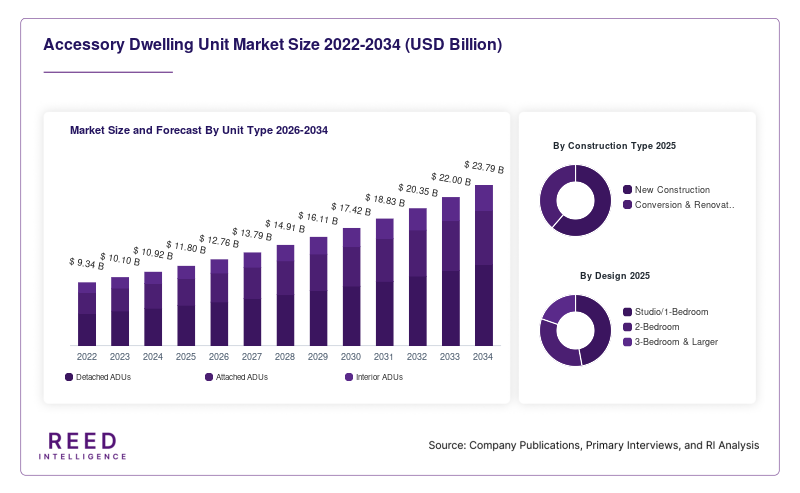
The global accessory dwelling unit market size was valued at USD 11.80 billion in 2025 and is projected to grow from USD 12.76 billion in 2026 to USD 23.79 billion by 2034, registering a CAGR of 8.10% during the forecast period from 2026 to 2034.
Accessory dwelling units are shifting from a niche residential construction format toward a recognized housing-supply mechanism as governments seek additional homes without requiring large-scale greenfield development. Freddie Mac estimates that the U.S. housing stock is approximately 3.7 million units below the level needed to meet current population and historical housing-cost conditions, explicitly identifying ADUs as one potential response to the shortage.
Financing availability is also becoming more supportive. Fannie Mae reported that it financed the creation or preservation of more than 10,000 ADUs in 2025, while Freddie Mac expanded its mortgage offerings so borrowers can finance, refinance, build or renovate ADUs. Fannie Mae's March 2026 policy changes further allow eligible properties to contain multiple ADUs under specified conditions.
Regulatory reform is widening the addressable market. California updated its ADU handbook in March 2026 following changes to state law, while Washington requires many jurisdictions to allow at least two ADUs on qualifying residential lots. Oregon requires qualifying cities and counties to permit ADUs in areas zoned for detached single-family housing without unreasonable cost or delay. Similar secondary-dwelling policies are being used in Canada and Australia, giving the market an increasingly international footprint.
Accessory Dwelling Unit Market Drivers
Housing shortages are creating demand for small-scale infill housing
The strongest demand mechanism is the shortage of conventional housing in high-cost urban and suburban markets. Freddie Mac's estimate of a 3.7-million-unit U.S. housing shortage illustrates why policymakers are considering housing formats that can add units without acquiring new development sites. ADUs use existing residential land and infrastructure, allowing homeowners to add a rental unit, accommodate family members or create a separate living space without purchasing another property. California's housing department describes ADUs as an effective option for adding housing, while Oregon identifies them as a way to increase housing choices and affordability. The commercial mechanism extends beyond construction: architects, prefab manufacturers, contractors, lenders, utilities and property-service providers can participate in the additional housing created on existing lots.
Zoning reform is reducing regulatory barriers
State and municipal policy is converting ADUs from discretionary projects into more predictable residential development. Washington requires qualifying jurisdictions to allow at least two ADUs on many single-family lots and limits impact fees for ADUs to no more than 50% of those charged for the principal unit. California's framework uses ministerial approval for qualifying ADUs, reducing discretionary review and making project timelines more predictable. Oregon similarly requires certain cities and counties to allow ADUs in single-family zones without unreasonable cost or delay. These changes directly affect market conversion: when homeowners can predict zoning, permitting and development requirements, more properties become economically viable for ADU construction. Washington's 2026 legislation also expanded the framework governing detached ADUs outside urban growth areas.
Financing and standardized construction are improving project feasibility
Financing has historically been one of the main barriers because ADU projects can be difficult to value and finance separately from the primary residence. That mechanism is changing. Fannie Mae's 2025 housing activities report states that it financed more than 10,000 ADUs and expanded lending options, while its March 2026 policy allows certain properties to contain multiple ADUs. Freddie Mac also expanded ADU financing through its mortgage products. In Canada, the federal government introduced insured refinancing for homeowners adding qualifying secondary suites and launched an CAD 80,000 Canada Secondary Suite Loan Program. Standardized designs can further reduce planning friction; Canada's 2025 Housing Design Catalogue included ADU designs alongside other infill housing types.
Accessory Dwelling Unit Market Restraints
Construction costs and site-specific complexity
Although ADUs are smaller than conventional homes, their economics are not determined by floor area alone. Projects may require new foundations, utility connections, electrical upgrades, plumbing, drainage, fire separation, accessibility measures and site preparation. Fannie Mae's 2026 material places typical ADU construction costs at approximately USD 120,000–300,000, depending on size, geography and site conditions. This means a relatively small unit can still require a substantial investment. Existing-site conditions can also create unpredictable costs, particularly when converting garages, basements or other structures. California's energy code, for example, treats many secondary-dwelling projects as new residential construction for energy-code purposes.
Local regulation and homeowner decision-making remain fragmented
State reforms do not eliminate all local project constraints. Setbacks, lot configuration, utility capacity, fire requirements, design standards, parking rules and permitting processes can still affect individual projects. California's HCD maintains an enforcement and technical-assistance system because local ADU ordinances must comply with state requirements. In Australia, secondary dwellings remain subject to state planning provisions and development standards, while in New South Wales they generally cannot be separately subdivided from the principal dwelling. Homeowners must also decide whether the additional investment is justified by rental income, family use or property value. This keeps conversion rates below the theoretical number of properties capable of hosting an ADU.
Accessory Dwelling Unit Market Opportunities
Prefab and modular ADUs can shorten construction cycles and improve cost predictability. Canada's 2025 Housing Design Catalogue includes standardized ADU designs intended to give homeowners, builders and communities a head start in planning. Standardization can reduce architectural repetition, simplify procurement and make production more scalable. The commercial opportunity extends to factory-built walls, roof systems, bathroom pods, modular units and standardized mechanical packages. However, manufacturers still need to adapt products to local building codes, site conditions, utility connections and climate requirements.
ADUs can also become an important rental-income and multigenerational housing product. Fannie Mae identifies rental income, additional family space and affordability as major ADU use cases. Canada's secondary-suite policy similarly supports both family-use units and rental apartments. As housing costs remain elevated, homeowners can use an ADU to house aging parents or adult children, generate rental income or create a flexible workspace. This broadens demand beyond traditional homebuilders to renovation contractors, architects, lenders, prefab manufacturers and property-management companies.
Segmental Analysis
By Unit Type
Detached ADUs: Detached ADUs represent approximately 52% of the global market in 2025, making them the largest unit type. They provide greater separation from the primary residence and allow homeowners to create a dedicated rental or family dwelling in a backyard or other underused portion of the property. Washington's regulatory framework specifically recognizes detached ADUs alongside attached configurations, while California's framework similarly covers detached units.
Interior ADUs: Interior ADUs are the fastest-growing unit type, with an estimated CAGR of 9.2%. Converting basements, garages and other existing spaces can avoid some of the land and site-development costs associated with new detached structures. Fannie Mae explicitly recognizes ADUs created within primary residences and conversions of existing spaces as qualifying formats.
By Construction Type
New Construction: New construction accounts for approximately 61% of the market in 2025, reflecting demand for purpose-designed detached and attached units. New-build ADUs offer greater flexibility in layout, energy performance and accessibility than many conversions.
Conversion & Renovation: Conversion and renovation is the fastest-growing construction category at approximately 9.4% CAGR. Existing garages, basements and other underused spaces can be transformed into independent units without requiring a completely new structure. California and Australia's regulatory frameworks explicitly address conversions of existing spaces into secondary dwellings.
By Design
2-Bedroom ADUs: Two-bedroom units account for approximately 44% of the market in 2025. The format provides flexibility for families, roommates and rental tenants while maintaining a smaller footprint than a conventional standalone house.
Studio/1-Bedroom ADUs: Studio and one-bedroom units are the fastest-growing design category at approximately 9.1% CAGR. Smaller units require less floor area and can be more accessible to homeowners seeking rental income or accommodation for one or two occupants.
By Application
Rental Housing: Rental housing represents approximately 48% of the market in 2025, reflecting the financial incentive created when homeowners can generate rental income from underused land or space. Fannie Mae specifically identifies rental income as one of the principal benefits of ADU ownership.
Multigenerational Housing: Multigenerational housing is the fastest-growing application at approximately 9.5% CAGR. An ADU allows older parents, adult children or other relatives to live independently while remaining on the same property. Government housing programs in both the U.S. and Canada recognize family accommodation as an important secondary-suite use.
By Ownership
Owner-Occupied: Owner-occupied properties account for approximately 68% of the market in 2025. Most ADUs are developed by homeowners who retain the primary property and use the additional unit for rental income, family accommodation or flexible household needs.
Investor-Owned: Investor-owned ADUs are the fastest-growing ownership category at approximately 9.0% CAGR. Improved financing, standardized designs and rental demand can make ADUs relevant to small-scale residential investors, although zoning and lending restrictions limit the opportunity in some markets.
Regional Analysis
North America Accessory Dwelling Unit Market
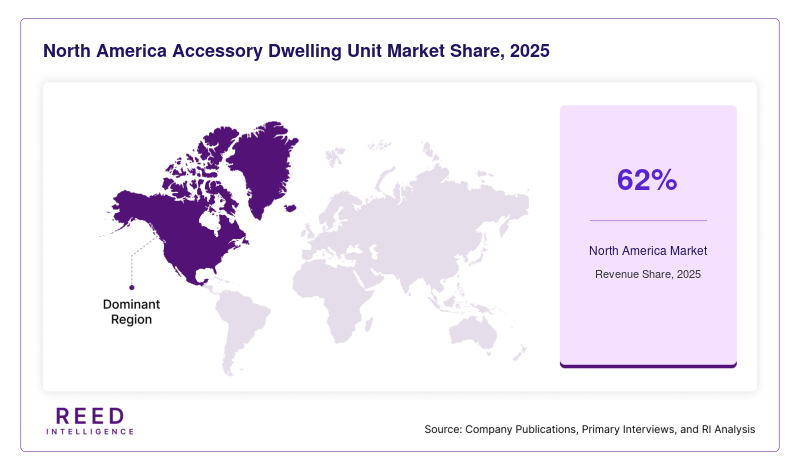
North America represents approximately 62% of the global accessory dwelling unit market in 2025, reflecting the concentration of established ADU policy, financing infrastructure and housing demand in the U.S. and Canada. The U.S. housing shortage is an important structural demand driver; Freddie Mac estimates a 3.7-million-unit housing shortfall and identifies ADUs among the possible supply responses.
California remains a major regulatory market. The state's Department of Housing and Community Development updated its ADU handbook in March 2026, following changes to state law effective January 1, 2026. California's framework covers detached, attached and repurposed-space ADUs and requires qualifying projects to receive ministerial consideration.
Washington has also expanded the permitted scale of ADU development. Qualifying jurisdictions must allow at least two ADUs on many single-family lots and cannot impose impact fees exceeding 50% of those for the principal unit. A 2026 Washington law further addressed detached ADUs outside urban growth areas.
Financing is becoming a stronger demand channel. Fannie Mae financed more than 10,000 ADUs in 2025, while its March 2026 policy expanded eligibility for multiple ADUs in specified property configurations. Canada has also introduced insured refinancing and an CAD 80,000 secondary-suite loan program.
North America is projected to grow at approximately 7.6% CAGR through 2034.
Europe Accessory Dwelling Unit Market
Europe accounts for approximately 14% of the global market in 2025 and is projected to expand at approximately 7.0% CAGR. The regional market is less standardized than the North American ADU market because terminology and planning systems differ considerably between countries.
Demand is nevertheless supported by housing affordability pressure, multigenerational living and urban land constraints. Small secondary dwellings can provide additional accommodation without requiring a separate development plot. The most relevant European applications are likely to involve garden homes, annexes, converted garages and small independent rental units.
The main commercial constraint is regulatory fragmentation. Building codes, planning permissions, land-use rules and property taxation differ substantially between countries and municipalities. This creates a larger requirement for local design and permitting expertise than in jurisdictions with standardized ADU rules.
APAC Accessory Dwelling Unit Market
APAC represents approximately 13% of the global market in 2025 and is the fastest-growing region, with a CAGR of approximately 10.2%. Australia provides the strongest established secondary-dwelling framework in the region, particularly through state-level granny-flat policies.
New South Wales permits secondary dwellings in multiple residential zones, including detached, attached and internal configurations. The state also permits certain granny flats to be approved through a complying-development pathway when specified requirements are met. In May 2026, the NSW government expanded housing options around Western Sydney International Airport by allowing small secondary dwellings in specified lower-noise areas where they had previously been restricted.
The Australian market benefits from strong housing affordability pressures and established consumer familiarity with granny flats. However, energy requirements remain relevant: NSW guidance states that new secondary dwellings must meet applicable BASIX requirements.
Japan and other densely populated Asian markets provide additional long-term potential through small-format residential construction, although local housing definitions and planning systems differ from the North American ADU model. APAC's growth therefore depends on the expansion of secondary-dwelling policies and the adoption of compact, standardized construction.
Middle East and Africa Accessory Dwelling Unit Market
Middle East and Africa account for approximately 5% of the global market in 2025 and are projected to expand at approximately 7.4% CAGR. ADU-style development remains less institutionalized than in North America and Australia, but demand can emerge around multigenerational households, guest accommodation and additional rental units.
Gulf markets have relatively strong construction activity and high household investment in residential properties, creating potential for detached guest units and secondary accommodation. However, the commercial model differs from North American ADUs because land-use regulations, household structures and property ownership systems vary substantially.
Africa presents a larger affordability-driven opportunity, particularly where homeowners can incrementally add rental rooms or independent units. Financing availability, construction-material costs, infrastructure and formal permitting remain major constraints. The region is therefore likely to favor low-cost construction and locally adapted designs rather than standardized premium ADU products.
Latin America Accessory Dwelling Unit Market
LATAM represents approximately 6% of the global market in 2025 and is projected to expand at approximately 8.3% CAGR. The region has strong cultural relevance for multigenerational housing, which can support demand for independent living spaces on existing residential properties.
Mexico, Brazil, Colombia and Chile provide potential markets where urban land costs and household density create incentives to use existing residential plots more efficiently. ADU-style construction can also provide incremental rental income to homeowners.
The primary limitations are access to formal financing, inconsistent zoning, permitting complexity and construction costs. As mortgage products and municipal housing policies improve, smaller independent units can become more commercially viable. Local builders and contractors are likely to remain important because project requirements differ substantially between municipalities.
Competitive Landscape
The accessory dwelling unit market is fragmented and differs from conventional residential construction because competition occurs across architects, general contractors, specialist ADU builders, modular manufacturers, design platforms, lenders and housing-policy programs.
The financing ecosystem is becoming increasingly important. Fannie Mae provides mortgage products that can be used to purchase homes with ADUs, renovate existing ADUs or add an ADU to an existing property. In 2025, Fannie Mae financed the creation or preservation of more than 10,000 ADUs, indicating that lenders can materially influence adoption.
Freddie Mac has similarly expanded its ADU financing options and in September 2026 published updated appraisal guidance recognizing ADUs as an increasingly important housing and affordability solution.
Key Market Players
- Fannie Mae
- Freddie Mac
- Abodu
- Backyard
- Studio Shed
- Connect Homes
- Cover
- Plant Prefab
- Veev
- Boxabl
- Modern Shed
- Mighty Buildings
- Dwellito
- United Dwelling
- Honomobo
- SnapADU
- Acton ADU
- California ADU
- Maxable
- Cottage
- Icon Building Group
- Champion Homes
- Clayton Homes
- Method Homes
Recent Market Developments
- March 2026 – Fannie Mae's updated appraisal policy expanded ADU eligibility, including specified properties with up to three ADUs and certain two- and three-unit properties with additional ADUs.
- May 2026 – NSW expanded housing options around Western Sydney International Airport by allowing secondary dwellings in specified areas previously affected by restrictions.
Accessory Dwelling Unit Market Segments
By Unit Type
- Detached ADUs
- Attached ADUs
- Interior ADUs
By Construction Type
- New Construction
- Conversion & Renovation
By Design
- Studio/1-Bedroom
- 2-Bedroom
- 3-Bedroom & Larger
By Application
- Rental Housing
- Multigenerational Housing
- Guest & Family Housing
- Home Office & Other Uses
By Ownership
- Owner-Occupied
- Investor-Owned
By Region
- North America
- Europe
- APAC
- Middle East and Africa
- LATAM