Acetonitrile Market Size, Share, Demand Report By Grade (Pharmaceutical Grade, HPLC Grade, Industrial Grade), By Application (Pharmaceuticals, Analytical Applications, Agrochemicals, Chemical Synthesis, Extraction Applications), By End Use (Pharmaceutical Companies, Biotechnology Laboratories, Academic & Research Institutes, Chemical Manufacturers, Environmental Testing Laboratories), By Region & Segment Forecasts, 2026–2034
USD 3950
Market Overview
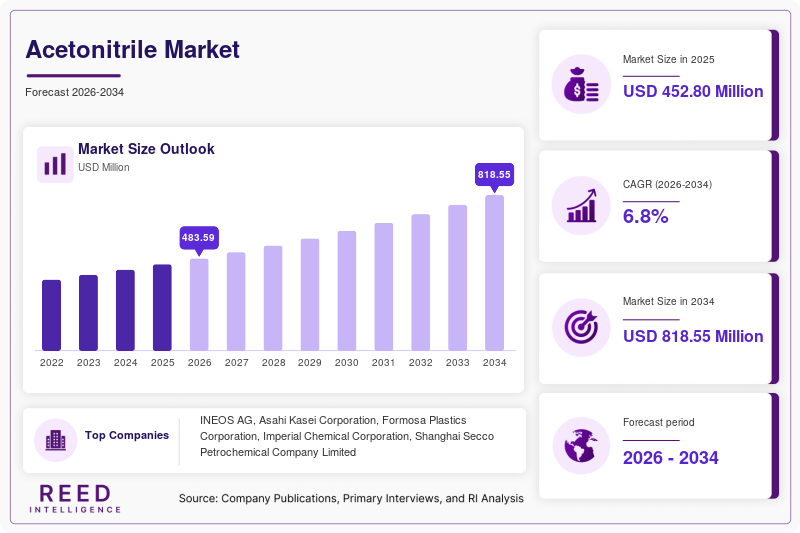
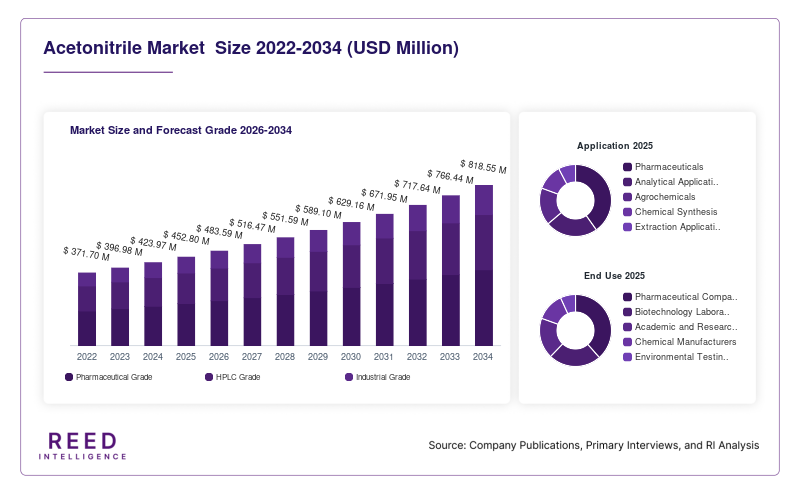
The global Acetonitrile Market size was valued at approximately USD 452.8 million in 2026 and is projected to reach nearly USD 768.4 million by 2034, expanding at a CAGR of 6.8% during the forecast period from 2026 to 2034. The market continues to witness steady expansion due to increasing demand from pharmaceutical manufacturing, analytical chemistry applications, and agrochemical production. Acetonitrile remains an essential solvent because of its high polarity, low viscosity, and compatibility with chromatographic techniques, particularly high-performance liquid chromatography (HPLC). Rising investments in pharmaceutical research and biotechnology activities across developed and emerging economies continue to strengthen long-term market demand.
The expansion of the global pharmaceutical industry has been one of the primary contributors supporting market growth. Acetonitrile is widely utilized in drug formulation, purification, and laboratory testing processes. The rapid increase in generic drug production and clinical research programs has elevated the need for high-purity solvents in manufacturing environments. Additionally, the chemical industry has increasingly adopted acetonitrile in extraction and synthesis applications due to its favorable chemical stability and low reactivity profile.
Key Highlights
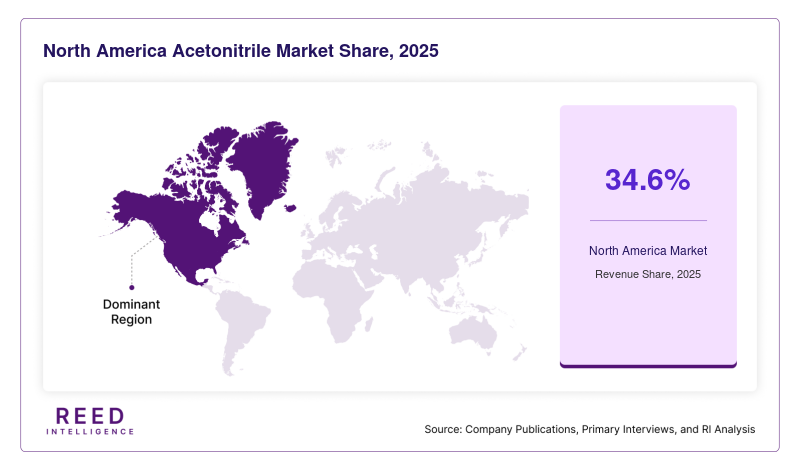
- North America dominated the market with a 34.6% share in 2025, while Asia Pacific is expected to grow at the fastest CAGR of 8.9% during 2026–2034.
- By grade, pharmaceutical grade accounted for the largest share of 46.3%, while HPLC grade is projected to grow at a CAGR of 8.4%.
- By application, pharmaceuticals led with a 39.8% share, whereas analytical applications are expected to expand at a CAGR of 8.7%.
- By end use, pharmaceutical companies accounted for the dominant share of 42.1%, while biotechnology laboratories are projected to grow at a CAGR of 9.1%.
- The United States remained the dominant country, with market values of USD 121 million in 2024 and USD 132 million in 2025.
Market Trends
Rising Demand for High-Purity Solvents in Pharmaceutical Manufacturing
The pharmaceutical industry has significantly increased the use of high-purity acetonitrile for drug development, active pharmaceutical ingredient synthesis, and analytical testing procedures. Pharmaceutical manufacturers increasingly prefer solvents with high consistency and low contamination levels to comply with evolving regulatory standards. Acetonitrile is widely utilized in chromatography processes because it provides efficient separation performance and stable analytical outcomes. The rise in biologics production and generic medicine manufacturing has accelerated the need for premium-grade solvents across global production facilities. Contract research organizations and pharmaceutical testing laboratories are also expanding solvent procurement activities to support rising clinical trial volumes. This trend continues to create long-term opportunities for suppliers focused on high-purity product development and advanced purification technologies.
Expansion of Analytical Testing and Laboratory Automation
The increasing adoption of automated laboratory systems and advanced analytical equipment has strengthened acetonitrile consumption across research institutions and industrial laboratories. Modern testing environments require solvents that deliver precision, reproducibility, and compatibility with automated instruments. Acetonitrile has become widely preferred in HPLC and mass spectrometry applications because of its excellent solvent characteristics and low ultraviolet absorbance. Environmental monitoring agencies, food testing laboratories, and biotechnology firms are increasing investments in sophisticated analytical technologies to improve testing accuracy and productivity. Additionally, the growth of quality control procedures across pharmaceutical and chemical industries has elevated solvent demand. Laboratories are increasingly focusing on operational efficiency, further supporting the adoption of acetonitrile-based analytical solutions worldwide.
Market Drivers
Growth of Pharmaceutical and Biotechnology Industries
The rapid expansion of pharmaceutical and biotechnology industries has become a major growth driver for the Acetonitrile Market. Acetonitrile is extensively used during drug synthesis, purification, and laboratory testing activities because of its chemical stability and solvent efficiency. Rising global healthcare expenditure and increasing investments in drug discovery programs have generated substantial demand for high-quality solvents. Biotechnology firms are also increasing their reliance on chromatography and analytical testing techniques, which require consistent acetonitrile supply. Emerging economies are witnessing strong growth in pharmaceutical manufacturing facilities due to government incentives and expanding healthcare infrastructure. Furthermore, increasing production of generic medicines and vaccines continues to create stable demand for acetonitrile across multiple stages of pharmaceutical processing and research operations.
Increasing Adoption of Chromatography Techniques
The growing use of chromatography techniques across pharmaceutical, environmental, and food testing industries has accelerated demand for acetonitrile worldwide. Laboratories increasingly depend on HPLC and liquid chromatography-mass spectrometry systems for accurate compound separation and chemical analysis. Acetonitrile is preferred because it offers excellent solvency, lower viscosity, and reduced system pressure compared to several alternative solvents. Food safety testing and environmental monitoring programs are also contributing to rising analytical solvent consumption. Government regulations concerning product quality and contamination detection have encouraged industries to implement advanced testing methods. Academic research institutions and diagnostic laboratories continue to invest in sophisticated analytical equipment, further increasing demand for chromatography-grade acetonitrile in both developed and developing markets.
Market Restraint
Volatility in Raw Material Availability and Pricing
Fluctuations in raw material availability and pricing remain a significant restraint for the Acetonitrile Market. Acetonitrile is commonly produced as a byproduct during acrylonitrile manufacturing, making its supply highly dependent on acrylonitrile production levels. Any decline in acrylonitrile demand or production disruptions can create supply shortages and substantial price instability within the acetonitrile industry. Such volatility directly affects pharmaceutical manufacturers, analytical laboratories, and chemical companies that rely on continuous solvent availability for operational efficiency. Smaller end users often face procurement challenges during periods of limited supply, resulting in increased operating expenses and delayed production schedules. In addition, stringent environmental regulations associated with chemical processing activities may elevate production costs for manufacturers. Market participants are therefore focusing on supply chain diversification, long-term procurement contracts, and alternative production technologies to reduce the impact of pricing uncertainty and raw material dependency.
Market Opportunities
Expansion of Pharmaceutical Manufacturing in Emerging Economies
Emerging economies across Asia Pacific, Latin America, and the Middle East are creating substantial opportunities for the Acetonitrile Market due to rapid pharmaceutical industry expansion. Governments in countries such as India, China, Brazil, and Saudi Arabia are increasing investments in domestic drug manufacturing capabilities to strengthen healthcare security and reduce import dependency. The establishment of new pharmaceutical production plants and research laboratories has increased the consumption of analytical and pharmaceutical-grade solvents. Rising healthcare access and growing generic medicine production are further supporting solvent demand across these regions. International pharmaceutical companies are also expanding manufacturing partnerships in emerging economies because of favorable labor costs and supportive industrial policies. These developments are expected to create long-term opportunities for acetonitrile suppliers seeking regional expansion and production capacity enhancement.
Increasing Utilization in Advanced Analytical and Biotechnology Research
The growth of advanced analytical testing and biotechnology research activities presents another strong opportunity for the global acetonitrile industry. Biotechnology firms, research laboratories, and academic institutions are increasingly utilizing chromatography-based techniques for molecular analysis, biomarker detection, and pharmaceutical testing. Acetonitrile plays a critical role in ensuring accurate analytical performance and consistent separation efficiency in modern laboratory systems. The expansion of precision medicine research and genomic studies has accelerated investments in sophisticated analytical technologies worldwide. Environmental testing agencies and food safety laboratories are also increasing their use of high-purity solvents for contamination analysis and quality assurance programs. As research intensity continues to rise globally, manufacturers capable of supplying premium-grade acetonitrile products are expected to benefit from sustained market demand and expanding laboratory infrastructure.
Segmental Analysis
By Grade
Pharmaceutical grade acetonitrile accounted for the largest share of approximately 46.3% in 2024 due to its extensive use in drug manufacturing and laboratory testing applications. Pharmaceutical companies require high-purity solvents to maintain product consistency, comply with regulatory standards, and ensure reliable analytical outcomes during drug formulation processes. The growth of generic medicine production and rising investments in biologics manufacturing significantly strengthened demand for pharmaceutical-grade products. In addition, contract research organizations and clinical testing laboratories increased procurement of premium-grade solvents to support expanding research activities. Manufacturers continue to focus on quality enhancement and advanced purification technologies to meet evolving pharmaceutical industry requirements and maintain long-term supply reliability.
HPLC grade acetonitrile is expected to register the fastest CAGR of 8.4% during the forecast period because of increasing adoption of chromatography-based analytical techniques worldwide. Laboratories across pharmaceutical, environmental, and food testing sectors are increasingly utilizing HPLC systems for accurate compound analysis and quality control procedures. HPLC-grade solvents are preferred because they provide lower impurity levels and stable analytical performance. Rising investments in automated laboratory infrastructure and analytical instrumentation have further accelerated demand for high-performance solvents. Biotechnology research institutions and academic laboratories are also expanding their use of chromatography technologies for advanced molecular studies, supporting long-term growth opportunities for HPLC-grade acetonitrile manufacturers globally.
By Application
Pharmaceutical applications held the dominant market share of approximately 39.8% in 2024 due to the widespread use of acetonitrile in drug synthesis, purification, and formulation activities. Pharmaceutical manufacturers rely on acetonitrile for its strong solvency characteristics and compatibility with analytical testing systems. Increasing global demand for prescription medicines, vaccines, and generic drugs has strengthened solvent consumption across manufacturing and research operations. Additionally, rising regulatory emphasis on product quality testing has encouraged pharmaceutical companies to increase adoption of high-purity solvents. The expansion of clinical research programs and contract manufacturing services has further contributed to stable demand within this application segment.
Analytical applications are projected to expand at the fastest CAGR of 8.7% during the forecast period owing to increasing use of chromatography and mass spectrometry systems in laboratories worldwide. Environmental monitoring agencies, food safety organizations, and biotechnology firms are investing heavily in advanced analytical technologies to improve testing precision and operational efficiency. Acetonitrile remains a preferred solvent for analytical procedures because it offers reliable separation performance and compatibility with sensitive laboratory instruments. The growth of research activities in genomics, proteomics, and biomarker analysis is also driving solvent demand. Rising laboratory automation and increasing adoption of digital analytical platforms are expected to further strengthen segment growth over the coming years.
By End Use
Pharmaceutical companies represented the largest end-use segment with a market share of approximately 42.1% in 2024. These organizations utilize acetonitrile extensively across manufacturing, purification, and analytical testing operations. The increasing production of generic medicines and biologics has created substantial demand for high-purity solvents within pharmaceutical facilities worldwide. Regulatory requirements related to product safety and quality assurance continue to encourage the use of reliable analytical chemicals. Pharmaceutical manufacturers are also expanding research and development programs focused on innovative drug therapies, further increasing solvent consumption. The growing importance of precision medicine and vaccine production is expected to maintain strong demand from this end-use category.
Biotechnology laboratories are anticipated to witness the fastest CAGR of 9.1% during the forecast period because of increasing investments in molecular research, genomic analysis, and biomarker discovery programs. Biotechnology firms are rapidly adopting advanced chromatography and analytical testing techniques that require high-performance solvents for accurate outcomes. Rising global investments in life sciences research and personalized medicine are supporting laboratory expansion activities across developed and emerging markets. Academic institutions and research organizations are also increasing their focus on biotechnology innovation, creating additional demand for analytical-grade acetonitrile. Growing collaboration between pharmaceutical and biotechnology companies is expected to further accelerate solvent consumption within this rapidly expanding end-use segment.
Regional Analysis
North America
North America accounted for approximately 34.6% of the global Acetonitrile Market in 2025 and maintained its position as the largest regional market. The region is expected to expand at a CAGR of 6.1% during the forecast period due to the presence of advanced pharmaceutical manufacturing facilities and sophisticated analytical laboratories. Strong investments in biotechnology research and rising adoption of chromatography systems across industrial laboratories continue to support solvent demand. Regulatory emphasis on pharmaceutical quality testing has also increased the use of high-purity acetonitrile in laboratory applications throughout the region.
The United States dominated the North American market because of its extensive pharmaceutical production infrastructure and large concentration of biotechnology companies. Increasing clinical research activities and expanding generic drug manufacturing have strengthened demand for analytical solvents across the country. Government support for biomedical innovation and rising investments in life sciences research continue to create favorable growth conditions for acetonitrile suppliers. Canada is also witnessing steady growth due to expanding laboratory testing capabilities and increasing pharmaceutical exports.
Europe
Europe represented nearly 27.3% of the global market in 2025 and is projected to grow at a CAGR of 5.9% during 2026–2034. The region benefits from a strong pharmaceutical sector, advanced chemical manufacturing infrastructure, and increasing environmental testing requirements. European laboratories continue to adopt modern analytical technologies to comply with strict quality standards and product safety regulations. Demand for acetonitrile is also supported by rising research activities in biotechnology and life sciences across major European economies.
Germany remained the dominant country in the European Acetonitrile Market due to its large pharmaceutical manufacturing base and strong specialty chemical industry. The country has witnessed increasing investments in analytical research facilities and laboratory modernization projects. France and the United Kingdom are also contributing to regional growth through expanding biotechnology research and pharmaceutical innovation programs. Additionally, strict environmental monitoring regulations across Europe have elevated the use of chromatography-based analytical testing methods, supporting long-term solvent consumption.
Asia Pacific
Asia Pacific held approximately 24.1% of the global market in 2025 and is anticipated to register the fastest CAGR of 8.9% over the forecast period. Rapid industrialization, expanding pharmaceutical production, and increasing laboratory infrastructure investments are supporting strong regional growth. Countries across the region are increasing healthcare expenditure and promoting domestic pharmaceutical manufacturing capabilities. Growing use of analytical testing techniques in food safety, environmental monitoring, and biotechnology applications has further accelerated acetonitrile demand across Asia Pacific markets.
China emerged as the leading contributor within the region because of its large-scale chemical production capacity and rapidly expanding pharmaceutical industry. The country continues to invest heavily in biotechnology research, analytical testing facilities, and specialty chemical manufacturing. India is also experiencing significant market expansion due to rising generic drug production and increasing research and development activities. Furthermore, favorable government policies encouraging pharmaceutical exports and laboratory modernization are creating new opportunities for acetonitrile manufacturers across Asia Pacific.
Middle East & Africa
The Middle East & Africa region accounted for nearly 7.2% of the global Acetonitrile Market in 2025 and is expected to grow at a CAGR of 5.4% during the forecast period. The market is gradually expanding due to rising investments in healthcare infrastructure and increasing industrial diversification efforts. Governments across the region are focusing on strengthening pharmaceutical manufacturing capabilities to reduce dependency on imported medicines. Expanding environmental testing activities and laboratory modernization projects are also contributing to rising demand for analytical solvents.
Saudi Arabia dominated the regional market because of its increasing investments in pharmaceutical production and healthcare development initiatives. The country continues to support industrial diversification programs aimed at expanding domestic chemical and biotechnology industries. South Africa is also witnessing steady demand growth due to increasing laboratory testing activities and improvements in healthcare research infrastructure. Rising adoption of advanced analytical techniques in food safety and environmental monitoring applications is expected to support long-term market expansion across the region.
Latin America
Latin America captured approximately 6.8% of the global market in 2025 and is projected to expand at a CAGR of 5.7% during the forecast period. The region is benefiting from increasing pharmaceutical production activities and growing laboratory testing requirements across healthcare and environmental sectors. Governments are investing in healthcare modernization and supporting domestic pharmaceutical manufacturing to strengthen supply chain resilience. Demand for chromatography-grade solvents has also increased as research institutions and industrial laboratories adopt more advanced analytical technologies.
Brazil remained the dominant country within the Latin American Acetonitrile Market because of its established pharmaceutical industry and expanding biotechnology sector. The country has experienced increasing investments in laboratory infrastructure and drug manufacturing facilities. Mexico is also contributing to regional growth due to rising pharmaceutical exports and stronger integration with international healthcare supply chains. Growing awareness regarding food safety and environmental quality testing continues to increase the adoption of analytical solvents throughout Latin America.
Competitive Landscape
The global Acetonitrile Market remains moderately consolidated, with several multinational chemical manufacturers competing through product quality, production capacity expansion, and long-term supply agreements. Major companies are focusing on enhancing purification technologies and strengthening distribution networks to address rising demand from pharmaceutical and analytical laboratories. Strategic collaborations with pharmaceutical companies and research institutions are becoming increasingly common as suppliers aim to secure stable demand and improve market positioning.
INEOS AG maintained a leading position in the market due to its strong global manufacturing footprint and extensive solvent portfolio. The company recently expanded its specialty chemical distribution operations to improve supply chain efficiency for pharmaceutical customers. Asahi Kasei Corporation continues to strengthen its presence through investments in advanced purification processes and production optimization initiatives. Formosa Plastics Corporation has increased focus on capacity expansion projects to support rising demand from Asian pharmaceutical manufacturers. Imperial Chemical Corporation and Shanghai Secco Petrochemical Company Limited are also actively investing in production efficiency and regional distribution capabilities to enhance competitive performance in international markets.
Key Players
- INEOS AG
- Asahi Kasei Corporation
- Formosa Plastics Corporation
- Imperial Chemical Corporation
- Shanghai Secco Petrochemical Company Limited
- Nova Molecular Technologies
- Tedia Company Inc.
- Merck KGaA
- Thermo Fisher Scientific Inc.
- Honeywell International Inc.
- Tokyo Chemical Industry Co., Ltd.
- Avantor Inc.
- Central Drug House Pvt. Ltd.
- Spectrum Chemical Manufacturing Corp.
- Mitsubishi Chemical Corporation
Recent Developments
- In February 2026, INEOS AG announced the expansion of its solvent purification facility in Europe to strengthen pharmaceutical-grade acetonitrile production capacity.
- In September 2025, Asahi Kasei Corporation introduced an upgraded high-purity acetonitrile product line designed for advanced chromatography and analytical laboratory applications.
- In November 2025, Formosa Plastics Corporation expanded its specialty chemicals distribution network across Asia Pacific to improve supply chain responsiveness for pharmaceutical manufacturers.
- In January 2026, Thermo Fisher Scientific Inc. launched a new range of chromatography solvents aimed at improving analytical precision in biotechnology and environmental testing laboratories.
Acetonitrile Market Segments
Grade
- Pharmaceutical Grade
- HPLC Grade
- Industrial Grade
Application
- Pharmaceuticals
- Analytical Applications
- Agrochemicals
- Chemical Synthesis
- Extraction Applications
End Use
- Pharmaceutical Companies
- Biotechnology Laboratories
- Academic and Research Institutes
- Chemical Manufacturers
- Environmental Testing Laboratories
By Region
- North America
- Europe
- APAC
- Middle East and Africa
- LATAM