Acetophenone Market Size, Share & Trends Analysis Report By Grade (Technical Grade, Refined Grade, Perfumery Grade and High-Purity Grade), By Application (Fragrances, Flavoring Agents, Pharmaceuticals and Chemical Synthesis, Plastics and Resins, Solvents) and By End User (Chemical Industry, Pharmaceutical Industry, Food & Beverage Industry, Cosmetics & Personal Care, Plastics & Polymer Industry) Forecasts, 2026–2034
USD 3950
Acetophenone Market Size
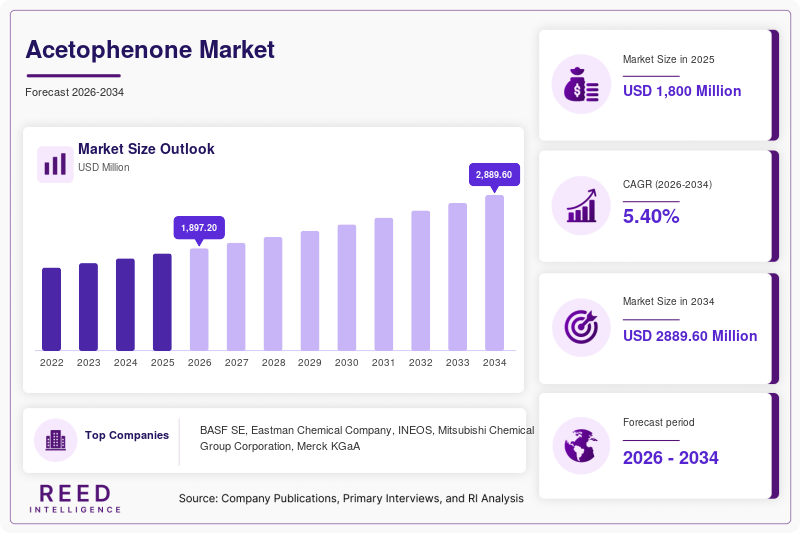
The global acetophenone market size was valued at USD 1,800 million in 2025 and is projected to grow from USD 1,897 million in 2026 to USD 2,889.60 million by 2034, registering a CAGR of 5.40% during the forecast period from 2026 to 2034.
Acetophenone, also known as 1-phenylethanone or methyl phenyl ketone, has a molecular weight of 120.15 g/mol and is commercially available in technical, refined, and perfumery grades. Its chemical characteristics support applications spanning fragrance formulation, flavoring, solvent use, polymerization, and organic synthesis.
The compound's application base is diversified across consumer and industrial value chains. EPA documentation identifies its use in perfumes, soaps, detergents, creams, lotions, foods, non-alcoholic beverages, plastics, resins, pharmaceutical manufacturing, rubber, dyestuffs, and corrosion-inhibitor production.
Acetophenone Market Drivers
Expanding Fragrance and Flavor Applications
Acetophenone has established applications in fragrance and flavor formulations, including perfumes, soaps, detergents, creams, lotions, foods, non-alcoholic beverages, and tobacco products. Its sensory properties allow formulators to use the compound in products requiring specific floral, sweet, or fruity characteristics. This creates recurring demand across personal-care, household, and food-related manufacturing chains.
Broad Industrial and Chemical-Synthesis Applications
Beyond fragrance and flavor applications, acetophenone is used as a specialty solvent for plastics and resins, a polymerization catalyst, and a photosensitizer in organic synthesis. EPA records also identify its role as an intermediate in the manufacture of pharmaceuticals, rubber products, dyestuffs, and corrosion inhibitors. This application diversity supports demand from several industrial processing categories.
Established Chemical Production Infrastructure
The U.S. production volume reported through EPA Chemical Data Reporting was between 10 million and less than 25 million lb in both 2022 and 2023. The persistence of industrial-scale production indicates established manufacturing and distribution infrastructure. Existing supply capabilities allow downstream users to procure acetophenone for both high-volume industrial uses and more specification-sensitive applications.
Acetophenone Market Restraints
Chemical Handling and Regulatory Requirements
Acetophenone requires controlled handling because exposure to concentrated vapors can cause irritation and other acute effects. EPA documentation identifies occupational exposure during manufacture and use, while acetophenone's combustible characteristics require appropriate storage, transportation, and process controls. Compliance requirements can add costs to manufacturing and downstream processing operations.
Feedstock and Production-Cost Volatility
Acetophenone production can be linked to petrochemical feedstocks and processes such as ethylbenzene oxidation. Consequently, feedstock prices, energy costs, catalyst requirements, and plant operating conditions can influence production economics. Changes in these inputs can affect supplier margins and downstream procurement costs, particularly for buyers operating under fixed-price contracts.
Acetophenone Market Opportunities
Development of High-Purity and Specialty Grades
Commercial availability of technical, refined, and perfumery grades creates opportunities for suppliers to serve differentiated customer requirements. High-purity material can address applications where impurity control and consistent chemical specifications are important, including specialty synthesis, laboratory chemicals, and selected pharmaceutical-related processes.
Expansion Across Specialty Chemical Applications
Acetophenone's documented use as an intermediate, photosensitizer, polymerization catalyst, and specialty solvent provides opportunities beyond conventional fragrance and flavor consumption. Greater utilization in specialty synthesis, plastics, resins, coatings-related processing, and advanced chemical formulations can broaden supplier customer bases and reduce dependence on individual downstream industries.
Acetophenone Market Segmental Analysis
By Grade
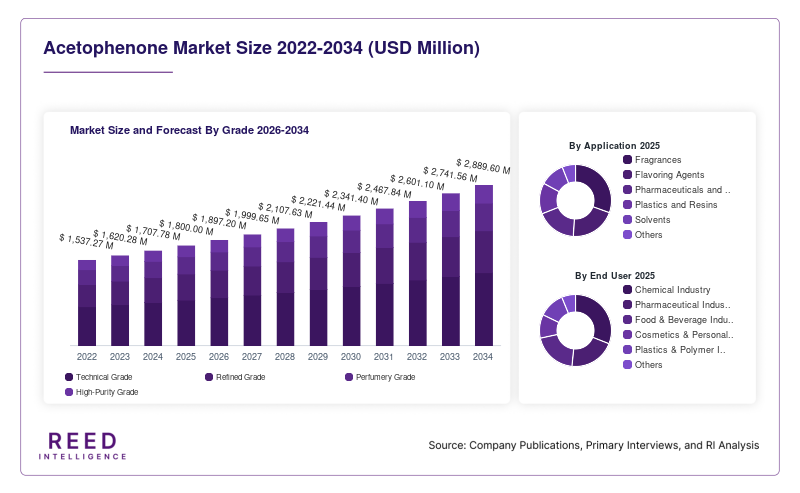
Technical Grade is the dominant grade segment, accounting for approximately 39% share, supported by industrial synthesis, solvent, and chemical-processing applications. High-Purity Grade is the fastest-growing segment at approximately 6.3% CAGR, supported by applications requiring tighter specifications. Refined Grade accounts for around 34% share and is projected to grow at 5.2% CAGR, while Perfumery Grade represents approximately 18% share with a 4.8% CAGR. Other specialized grades account for about 9% share and are projected to grow at 4.1% CAGR. The grade structure reflects differentiation between volume-oriented industrial consumption and specification-sensitive downstream applications.
By Application
Fragrances represent the dominant application with approximately 31% share, reflecting established use in perfumes, soaps, detergents, creams, and lotions. Pharmaceuticals and Chemical Synthesis represent the fastest-growing application at approximately 6.4% CAGR, supported by acetophenone's role as an organic-synthesis intermediate and photosensitizer. Flavoring Agents account for around 24% share and grow at 5.6% CAGR, while Plastics and Resins represent approximately 17% share at 5.1% CAGR. Solvents account for approximately 13% share with a 4.7% CAGR, while Others represent about 15% share and expand at 4.3% CAGR.
By End User
The Chemical Industry is the dominant end-user segment with approximately 36% share, reflecting acetophenone's use as an intermediate, solvent, catalyst, and processing chemical. The Pharmaceutical Industry is the fastest-growing end user at approximately 6.5% CAGR. Food & Beverage accounts for around 21% share and grows at 5.4% CAGR, while Cosmetics & Personal Care represents approximately 18% share at 5.7% CAGR. Plastics & Polymer Industry accounts for approximately 14% share and grows at 5.0% CAGR, while Others represent 11% share with a 4.2% CAGR.
Acetophenone Market Regional Analysis
North America Acetophenone Market
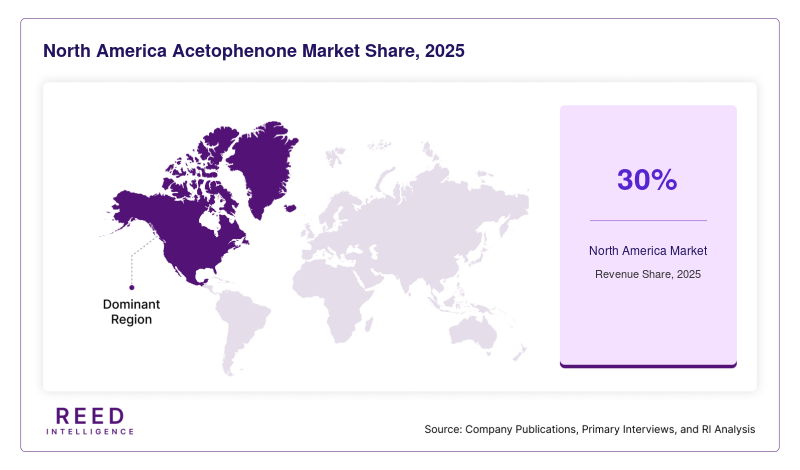
North America is the dominant region, accounting for approximately 30% share. The region benefits from established chemical-processing infrastructure and diversified downstream applications. U.S. EPA Chemical Data Reporting data indicates acetophenone production of 10–25 million lb in both 2022 and 2023, demonstrating an established domestic production base.
The United States represents the principal regional demand center across chemical synthesis, plastics and resins, fragrance, flavor, and specialty chemical applications. Canada contributes through chemical distribution and downstream formulation, while regulatory compliance and product stewardship remain important considerations for manufacturers and industrial users.
Europe Acetophenone Market
Europe is projected to register approximately 5.1% CAGR during 2026–2034. Demand is supported by established fragrance, cosmetics, specialty chemical, pharmaceutical, and industrial-processing industries. Acetophenone's use across formulations and chemical synthesis provides demand from several mature European manufacturing sectors.
Germany, France, Italy, and the United Kingdom represent important downstream markets. Regional demand is influenced by specialty chemical production, personal-care formulations, pharmaceutical manufacturing, chemical safety requirements, and procurement preferences for consistent grades and documented specifications.
Asia Pacific Acetophenone Market
Asia Pacific is projected to be the fastest-growing region at approximately 6.2% CAGR. The region combines extensive chemical manufacturing capacity with large fragrance, flavor, pharmaceutical, plastics, and consumer-product industries. China and India provide substantial downstream manufacturing capacity, while Japan and South Korea contribute advanced chemical and formulation capabilities.
China represents a major production and consumption center, while India benefits from pharmaceutical and specialty chemical manufacturing. Japan and South Korea add demand from high-specification chemical applications, creating a diversified regional consumption base supported by both domestic manufacturing and export-oriented industries.
Latin America Acetophenone Market
Latin America is projected to expand at approximately 5.0% CAGR. Demand is connected to fragrance, flavor, food processing, personal-care products, plastics, and chemical distribution. Brazil represents a major regional demand center because of its large consumer-product manufacturing base.
Mexico contributes through industrial manufacturing and chemical distribution networks, while Argentina, Colombia, and Chile provide additional downstream demand. Regional procurement remains influenced by import costs, exchange-rate movements, logistics expenses, and availability of locally distributed chemical grades.
Middle East & Africa Acetophenone Market
The Middle East & Africa region is projected to grow at approximately 5.3% CAGR. Demand is supported by chemical processing, personal-care products, food and beverage formulation, and industrial manufacturing. Gulf economies provide chemical distribution infrastructure and downstream processing capabilities.
Saudi Arabia and the United Arab Emirates contribute through expanding chemical and industrial ecosystems, while South Africa represents an important downstream consumer market. Regional demand is shaped by manufacturing capacity, import dependence, logistics infrastructure, and growth in formulation industries.
Acetophenone Market Competitive Landscape
The acetophenone market includes large chemical manufacturers, specialty chemical suppliers, laboratory-chemical companies, and distributors. Competition is shaped by product purity, manufacturing consistency, supply reliability, geographic reach, technical documentation, and the ability to serve different grade requirements.
Large chemical producers compete through manufacturing scale, integrated supply chains, established distribution networks, and access to multiple downstream industries. Specialty suppliers differentiate through high-purity products, smaller-volume packaging, application support, and customer-specific specifications. Commercially recognized grades include technical, refined, and perfumery grades.
Key Market Players
- BASF SE
- Eastman Chemical Company
- INEOS
- Mitsubishi Chemical Group Corporation
- Merck KGaA
- Tokyo Chemical Industry Co., Ltd.
- Thermo Fisher Scientific Inc.
- Sigma-Aldrich
- Alfa Chemistry
- Spectrum Chemical Manufacturing Corp.
- Central Drug House
- Otto Chemie Pvt. Ltd.
Recent Market Developments
- Eastman expands specialty-fluid portfolio through Jarylec acquisition -2026: Eastman Chemical Company acquired the Jarylec dielectric-fluid brand and related assets from Arkema France, including trademarks, customer relationships, technical documentation, and intellectual property. The transaction strengthens Eastman's specialty-chemicals portfolio and global manufacturing and technical-service capabilities.
- TCI maintains commercial availability of acetophenone in India -2026: Tokyo Chemical Industry continues to offer acetophenone (CAS 98-86-2) in India at >98.5% GC purity, with pack sizes from 25 g to 2.5 kg and domestic Hyderabad stock available for same-day dispatch. This indicates continued commercial supply of specification-controlled acetophenone for laboratory and chemical applications.
Acetophenone Market Segments
By Grade
- Technical Grade
- Refined Grade
- Perfumery Grade
- High-Purity Grade
By Application
- Fragrances
- Flavoring Agents
- Pharmaceuticals and Chemical Synthesis
- Plastics and Resins
- Solvents
- Others
By End User
- Chemical Industry
- Pharmaceutical Industry
- Food & Beverage Industry
- Cosmetics & Personal Care
- Plastics & Polymer Industry
- Others
By Region
- North America
- Europe
- APAC
- Middle East and Africa
- LATAM