Acetylated Starch Market Size, Share & Demand Report By Source (Corn-Based Acetylated Starch, Potato-Based Acetylated Starch), By Form (Powder, Liquid, Granules, Paste), By Application (Food & Beverages, Pharmaceuticals), By End-Use Industry (Processed Food Manufacturing, Pharmaceutical Manufacturing, Packaging Industries, Textile Manufacturing), By Distribution Channel (Direct Sales, Distributors & Wholesalers), By Region & Segment Forecasts, 2026–2034
USD 3950
Market Overview
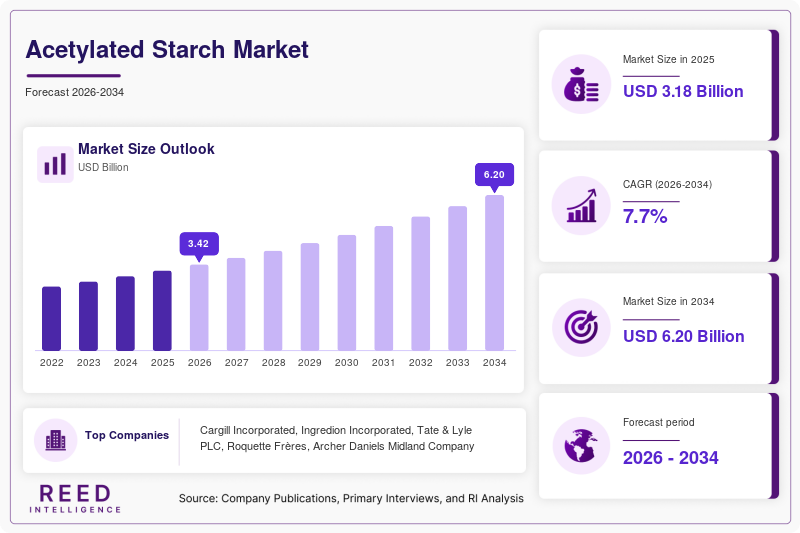
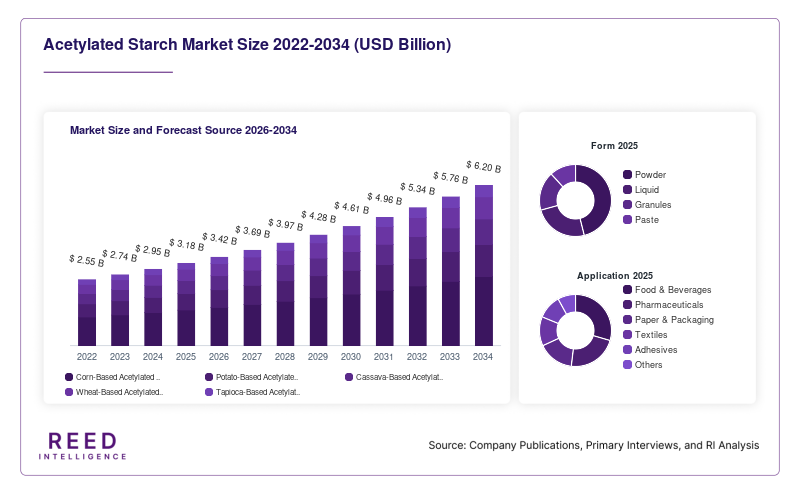
The global Acetylated Starch Market size was valued at USD 3.18 billion in 2026 and is projected to reach USD 5.74 billion by 2034, expanding at a CAGR of 7.7% during the forecast period (2026–2034). The market growth was supported by the increasing demand for modified starch ingredients across food processing, pharmaceutical, paper, textile, and industrial manufacturing sectors. Rising consumption of convenience foods and processed food products globally accelerated the adoption of acetylated starch due to its enhanced stability, thickening, and moisture-retention properties.
The growing focus on clean-label ingredients and improved product texture contributed significantly to the expansion of the Acetylated Starch Market. Food manufacturers increasingly incorporated acetylated starch into sauces, bakery products, dairy formulations, and frozen foods to improve shelf stability and processing efficiency. In addition, the expanding use of biodegradable and plant-based ingredients across industrial applications strengthened long-term market development.
Key Highlights
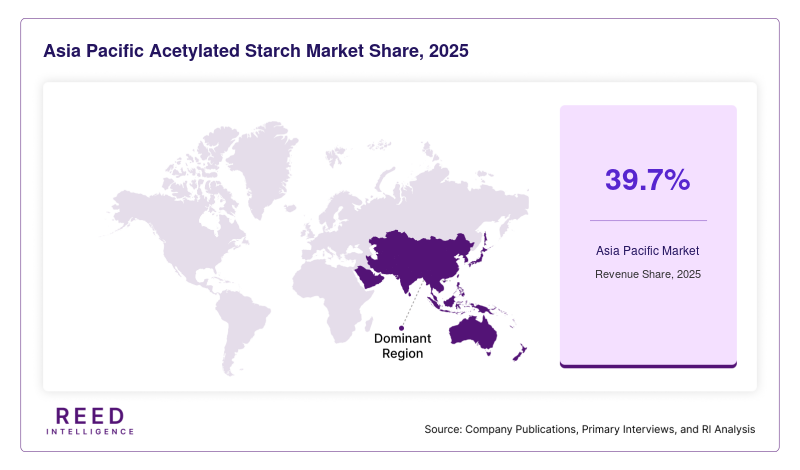
- Asia Pacific accounted for 39.7% of the global Acetylated Starch Market share in 2025, while Latin America is projected to register the fastest CAGR of 8.5% during the forecast period.
- By source, corn-based acetylated starch held the leading share of 44.9% in 2025, whereas cassava-based acetylated starch is expected to witness the fastest CAGR of 9.1% through 2034.
- By form, powder acetylated starch dominated with a 61.3% share in 2025, while liquid acetylated starch is forecast to grow at a CAGR of 8.3%.
- By application, food & beverages represented the largest share of 48.2% in 2025, whereas pharmaceutical applications are anticipated to record the fastest CAGR of 8.9%.
- By end-use industry, processed food manufacturing accounted for 33.8% of the market share in 2025, while biodegradable packaging industries are projected to expand at a CAGR of 9.2%.
- China dominated the Acetylated Starch Market with a market value of USD 462 million in 2024 and USD 495 million in 2025.
Market Trends
Rising Demand for Clean-Label Food Ingredients
The increasing preference for clean-label and plant-based food ingredients emerged as a major trend influencing the Acetylated Starch Market. Consumers increasingly favored processed foods formulated with recognizable and naturally derived ingredients. Food manufacturers responded by incorporating modified starches derived from corn, potato, cassava, and tapioca into various food products.
Acetylated starch gained wider acceptance due to its functional properties, including improved texture, freeze-thaw stability, and moisture retention. Manufacturers also focused on developing non-GMO and allergen-free starch formulations to align with evolving consumer preferences and regulatory standards.
Expansion of Biodegradable Packaging Applications
The use of acetylated starch in biodegradable packaging materials gained strong momentum across industrial sectors. Packaging manufacturers increasingly adopted starch-based materials to reduce dependence on petroleum-based plastics and improve sustainability performance.
Acetylated starch provided enhanced flexibility, film-forming capability, and biodegradability for sustainable packaging production. The trend accelerated as governments and industries implemented stricter regulations targeting plastic waste reduction. Growing investments in eco-friendly packaging technologies are expected to continue supporting the Acetylated Starch Market outlook.
Market Drivers
Increasing Consumption of Processed and Convenience Foods
The rapid growth in processed and convenience food consumption significantly supported the expansion of the Acetylated Starch Market. Changing lifestyles, urbanization, and rising demand for ready-to-eat meals accelerated the use of modified starch ingredients in food manufacturing.
Food producers increasingly utilized acetylated starch as a stabilizer, thickener, and emulsifier in sauces, soups, bakery products, and frozen meals. The ingredient improved product consistency, texture, and shelf stability, making it suitable for large-scale food processing applications.
Expanding Pharmaceutical and Nutraceutical Applications
The increasing use of acetylated starch in pharmaceutical and nutraceutical formulations contributed to market growth. Pharmaceutical manufacturers adopted modified starches as binders, fillers, and disintegrants in tablet production and drug delivery systems.
Acetylated starch offered improved stability and compatibility with active pharmaceutical ingredients. Rising demand for nutraceutical products and dietary supplements further strengthened market adoption across healthcare manufacturing industries.
Market Restraint
Fluctuating Agricultural Raw Material Prices
Volatility in agricultural commodity prices restrained the growth of the Acetylated Starch Market to a certain extent. The production of acetylated starch depends heavily on raw materials such as corn, potato, cassava, and tapioca, which are influenced by climate conditions, crop yields, and supply chain disruptions. Rising raw material costs increased production expenses and impacted pricing stability for starch manufacturers.
Market Opportunities
Growth of Plant-Based Food Products
The expanding market for plant-based food products presents significant growth opportunities for the Acetylated Starch Market. Food manufacturers increasingly require plant-derived stabilizers and texture-enhancing ingredients for vegan and dairy-alternative products.
Acetylated starch is expected to witness growing demand in plant-based beverages, meat substitutes, and dairy-free desserts due to its functional versatility and natural origin. Rising consumer preference for vegan diets will continue supporting long-term market opportunities.
Increasing Adoption in Industrial Adhesives
The growing use of modified starches in industrial adhesive formulations is anticipated to create favorable opportunities for the market. Packaging, paperboard, and corrugated box manufacturers increasingly adopted starch-based adhesives to improve bonding performance and reduce environmental impact.
Acetylated starch-based adhesives are projected to gain traction due to their biodegradability and cost efficiency. Expanding e-commerce packaging demand will further support industrial application growth.
Segmental Analysis
By Source
Based on source, the Acetylated Starch Market is segmented into corn-based, potato-based, cassava-based, wheat-based, and tapioca-based acetylated starch.
Corn-based acetylated starch accounted for the largest market share of 44.9% in 2025. Its dominance was attributed to abundant corn production, cost efficiency, and broad industrial applicability. Corn-derived starches were widely utilized across food processing, paper manufacturing, pharmaceuticals, and adhesive production due to their stable viscosity and strong thickening properties.
Manufacturers increasingly preferred corn-based acetylated starch because of its availability and compatibility with large-scale industrial processing systems. The segment also benefited from strong demand in bakery products, sauces, and frozen foods.
Cassava-based acetylated starch is projected to register the fastest CAGR of 9.1% during the forecast period. Its growth will be supported by increasing demand for gluten-free and allergen-free food ingredients. Cassava starch offers excellent freeze-thaw stability and improved texture characteristics, making it suitable for processed food and beverage applications.
Tapioca-based acetylated starch is also expected to witness stable growth due to rising consumer preference for plant-derived ingredients and expanding demand in clean-label food formulations.
By Form
Based on form, the Acetylated Starch Market is categorized into powder, liquid, granules, and paste forms.
Powder acetylated starch dominated the market with a 61.3% share in 2025. Its widespread adoption was supported by ease of storage, long shelf life, and compatibility with dry blending operations. Powder starch formulations remained highly preferred across food processing and pharmaceutical manufacturing industries.
Manufacturers favored powder-based acetylated starch because it enabled simplified transportation and improved production flexibility. The segment also maintained strong demand in industrial adhesive and paper processing applications.
Liquid acetylated starch is projected to grow at a CAGR of 8.3% during the forecast period. The growth will be driven by increasing adoption in automated industrial processing systems and liquid food formulations. Liquid starch products will gain importance in applications requiring rapid solubility and uniform dispersion.
Paste forms are also expected to witness moderate growth due to rising demand in textile processing and specialty coating applications.
By Application
Based on application, the Acetylated Starch Market is divided into food & beverages, pharmaceuticals, paper & packaging, textiles, adhesives, and others.
Food & beverages accounted for the leading market share of 48.2% in 2025. The segment dominance was attributed to increasing consumption of processed foods and expanding use of modified starches as stabilizers and texture enhancers. Acetylated starch improved moisture retention, viscosity control, and freeze-thaw stability in food products.
Manufacturers increasingly incorporated acetylated starch into soups, sauces, dairy products, confectionery, and ready-to-eat meals. Rising demand for convenience foods globally further supported segment growth.
Pharmaceutical applications are projected to register the fastest CAGR of 8.9% during the forecast period. The growth will be driven by increasing utilization of modified starches in drug formulations and controlled-release delivery systems. Pharmaceutical manufacturers are expected to adopt advanced starch ingredients to improve tablet stability and manufacturing efficiency.
Paper & packaging applications are also anticipated to maintain steady growth due to increasing use of starch-based coatings and biodegradable packaging materials.
By End-Use Industry
Based on end-use industry, the Acetylated Starch Market is segmented into processed food manufacturing, pharmaceutical manufacturing, packaging industries, textile manufacturing, paper industries, and others.
Processed food manufacturing held the largest market share of 33.8% in 2025. The segment growth was supported by increasing production of packaged foods, frozen meals, bakery products, and dairy formulations. Food manufacturers utilized acetylated starch to improve product texture, stability, and shelf life.
The growing demand for convenience foods and ready-to-cook products accelerated the use of modified starch ingredients across industrial food production facilities. Expanding urban populations and changing dietary habits further contributed to segment dominance.
Biodegradable packaging industries are projected to register the fastest CAGR of 9.2% during the forecast period. The growth will be supported by increasing adoption of sustainable packaging materials and government initiatives targeting plastic waste reduction. Packaging manufacturers are expected to incorporate starch-based materials into eco-friendly packaging films and biodegradable containers.
Pharmaceutical manufacturing is also anticipated to witness strong growth due to increasing production of nutraceuticals and generic medicines.
By Distribution Channel
Based on distribution channel, the Acetylated Starch Market is segmented into direct sales, distributors & wholesalers, online industrial suppliers, and specialty ingredient suppliers.
Direct sales accounted for the dominant market share in 2025 due to long-term supply agreements between starch manufacturers and industrial buyers. Large food and pharmaceutical manufacturers preferred direct procurement for customized formulations and bulk purchasing.
Online industrial suppliers are projected to witness the fastest CAGR during the forecast period due to increasing digitalization of ingredient sourcing and expanding global supply chain networks.
Regional Analysis
Asia Pacific
Asia Pacific held 39.7% of the global Acetylated Starch Market share in 2025 and is projected to expand at a CAGR of 8.1% during the forecast period. The region maintained a dominant position due to strong food processing industries and abundant agricultural raw material availability.
China dominated the regional market owing to increasing production of processed food products and rising industrial starch manufacturing capacity. Expanding investments in sustainable packaging materials and pharmaceutical production further supported market growth across the country.
North America
North America accounted for 25.4% of the Acetylated Starch Market share in 2025 and is anticipated to grow at a CAGR of 7.2% through 2034. The region experienced stable demand due to increasing adoption of clean-label food ingredients and advanced pharmaceutical manufacturing.
The United States led the regional market owing to rising demand for convenience foods and biodegradable packaging solutions. Food manufacturers increasingly incorporated modified starches into frozen meals, bakery products, and dairy applications to improve product stability and texture.
Europe
Europe represented 21.6% of the global Acetylated Starch Market share in 2025 and is expected to register a CAGR of 7.0% during the forecast period. The region witnessed growing demand due to expanding sustainable packaging initiatives and increasing focus on environmentally compatible food ingredients.
Germany dominated the European market due to strong industrial starch processing infrastructure and rising use of biodegradable materials across packaging industries. Increasing investments in pharmaceutical manufacturing also supported regional market expansion.
Middle East & Africa
The Middle East & Africa accounted for 7.2% of the Acetylated Starch Market share in 2025 and is forecast to grow at a CAGR of 7.6% during the forecast period. Increasing food manufacturing investments and expanding packaging industries contributed to regional growth.
Saudi Arabia emerged as the dominant country due to rising processed food imports and growing industrial diversification activities. The development of local food production facilities accelerated demand for modified starch ingredients.
Latin America
Latin America held 6.1% of the global Acetylated Starch Market share in 2025 and is projected to expand at the fastest CAGR of 8.5% during the forecast period. The regional market benefited from increasing cassava cultivation and expanding food processing industries.
Brazil dominated the Latin American market due to strong agricultural production and growing demand for starch-based industrial applications. Rising investments in packaged food manufacturing and paper processing industries further strengthened market growth.
Competitive Landscape
The Acetylated Starch Market remains moderately competitive with the presence of global starch manufacturers and specialty ingredient suppliers focusing on product innovation, sustainable formulations, and industrial expansion strategies. Companies continue investing in modified starch technologies to improve texture stability, biodegradability, and industrial performance.
Cargill Incorporated maintained a strong market position due to its diversified starch ingredient portfolio and extensive agricultural sourcing network. The company recently expanded its specialty modified starch production capabilities to support rising demand from food processing and sustainable packaging industries.
Other major companies including Ingredion Incorporated, Tate & Lyle PLC, Roquette Frères, and ADM focused on developing clean-label starch ingredients and expanding regional manufacturing operations. Strategic collaborations with food manufacturers and packaging companies also remained a key competitive strategy among market participants.
Key Players List
- Cargill Incorporated
- Ingredion Incorporated
- Tate & Lyle PLC
- Roquette Frères
- Archer Daniels Midland Company
- AGRANA Beteiligungs-AG
- Avebe U.A.
- Grain Processing Corporation
- Global Bio-Chem Technology Group Company Limited
- Emsland Group
- BENEO GmbH
- SPAC Starch Products India Limited
- Gulshan Polyols Ltd.
- Tereos Group
- Südzucker AG
Recent Developments
- In 2025, Cargill Incorporated expanded its modified starch production capabilities for food and biodegradable packaging applications.
- Ingredion Incorporated introduced clean-label acetylated starch solutions focused on plant-based food formulations.
- Tate & Lyle PLC enhanced specialty starch research programs to improve texture stability in processed foods.
- Roquette Frères invested in sustainable starch ingredient manufacturing technologies for industrial applications.
- ADM expanded starch processing operations to support rising demand from pharmaceutical and nutraceutical industries.
- AGRANA Beteiligungs-AG strengthened partnerships with food manufacturers for customized modified starch solutions.
- Emsland Group increased production capacity for potato-based modified starch products used in packaging and adhesive industries.
Acetylated Starch Market Segments
Source
- Corn-Based Acetylated Starch
- Potato-Based Acetylated Starch
- Cassava-Based Acetylated Starch
- Wheat-Based Acetylated Starch
- Tapioca-Based Acetylated Starch
Form
- Powder
- Liquid
- Granules
- Paste
Application
- Food & Beverages
- Pharmaceuticals
- Paper & Packaging
- Textiles
- Adhesives
- Others
End-Use Industry
- Processed Food Manufacturing
- Pharmaceutical Manufacturing
- Packaging Industries
- Textile Manufacturing
- Paper Industries
- Others
Distribution Channel
- Direct Sales
- Distributors & Wholesalers
- Online Industrial Suppliers
- Specialty Ingredient Suppliers
By Region
- North America
- Europe
- APAC
- Middle East and Africa
- LATAM