Acetylene Cylinder Market Size, Share & Demand Report By Cylinder Material (Steel Cylinders, Composite Cylinders, Aluminum Cylinders), By Application (Welding and Cutting, Chemical Processing, Metal Fabrication, Maintenance and Repair), By End-Use Industry (Manufacturing, Construction, Automotive, Shipbuilding, Energy and Utilities, Others), By Region & Segment Forecasts, 2026–2034
USD 3950
Market Overview
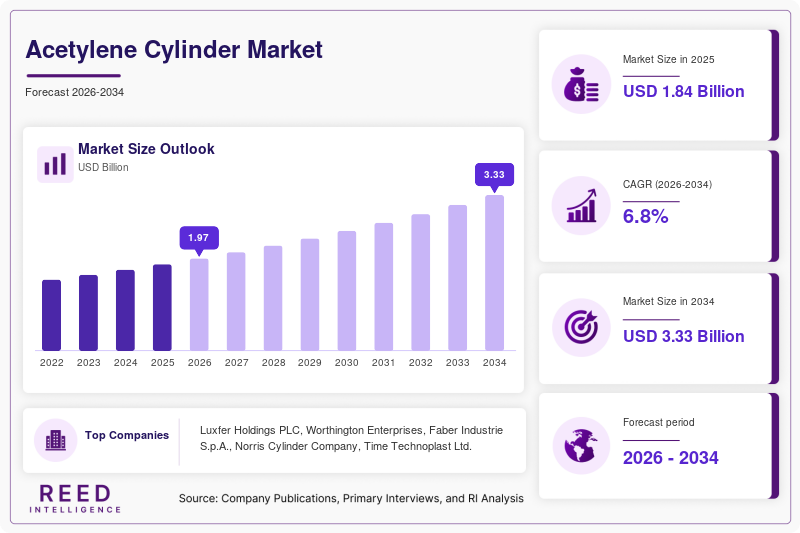
The global Acetylene Cylinder Market size was valued at USD 1.84 billion in 2026 and is projected to reach USD 3.12 billion by 2034, expanding at a CAGR of 6.8% during 2026–2034. The market continues to witness stable expansion due to increasing demand for industrial gases across manufacturing, metal fabrication, automotive production, shipbuilding, and construction sectors. Acetylene cylinders remain essential for the safe storage and transportation of acetylene gas, which is widely used in oxy-acetylene welding, cutting, brazing, and various chemical synthesis processes.
Growing industrialization across emerging economies has created sustained demand for welding and metalworking operations, supporting market growth. Investments in infrastructure development projects, transportation networks, industrial facilities, and energy installations have increased the consumption of acetylene-based equipment and storage solutions. Furthermore, technological improvements in cylinder manufacturing have enhanced safety performance, durability, and gas containment efficiency, encouraging replacement demand from end users.
Key Highlights
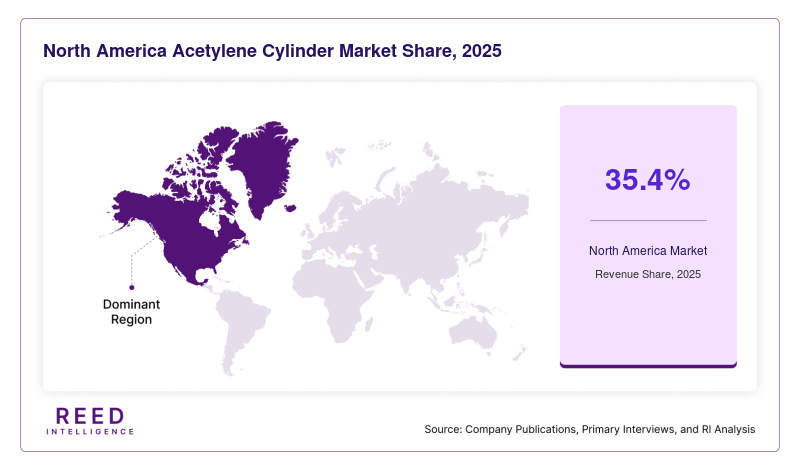
- North America dominated the market with a 35.4% share in 2025, while Asia Pacific is expected to grow at the fastest CAGR of 8.4% during 2026–2034.
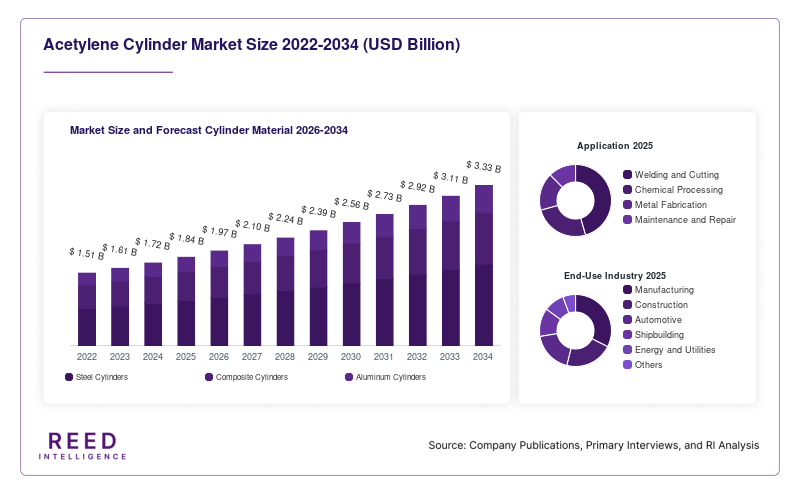
- By cylinder material, steel cylinders accounted for the largest share of 68.7%, while composite cylinders are projected to grow at a CAGR of 8.9%.
- By application, welding and cutting led with a 56.2% share, whereas chemical processing is expected to expand at a CAGR of 8.1%.
- By end-use industry, manufacturing held a 44.8% share, while construction is anticipated to grow at a CAGR of 8.3%.
- The United States remained the dominant country, with market values of USD 462 million in 2024 and USD 495 million in 2025.
Market Trends
Adoption of Lightweight Composite Cylinder Technologies
The acetylene cylinder industry is increasingly moving toward lightweight composite cylinder technologies designed to improve transportation efficiency and workplace safety. Traditional steel cylinders continue to dominate commercial usage; however, manufacturers are investing in advanced composite materials that reduce overall cylinder weight while maintaining structural integrity and regulatory compliance. These products offer improved handling characteristics, lower transportation costs, and enhanced corrosion resistance. Industries with frequent cylinder movement, including construction and field maintenance services, are adopting these solutions to improve operational productivity. As logistics costs remain a significant concern for industrial gas suppliers, demand for lightweight cylinder alternatives is expected to accelerate throughout the forecast period.
Integration of Smart Monitoring and Cylinder Tracking Systems
Digital transformation is becoming an important trend across industrial gas distribution networks. Manufacturers and gas suppliers are increasingly integrating smart monitoring systems, RFID tags, and IoT-enabled tracking technologies into cylinder fleets. These solutions provide real-time visibility regarding cylinder location, gas levels, inspection schedules, and maintenance requirements. Improved inventory management helps reduce losses, optimize asset utilization, and enhance customer service. Large industrial users are also adopting connected cylinder management systems to support safety compliance and operational planning. As industrial facilities prioritize efficiency and data-driven decision-making, the incorporation of smart technologies into acetylene cylinder operations is expected to become more widespread.
Market Drivers
Expansion of Global Manufacturing and Metal Fabrication Activities
Growing manufacturing output across automotive, machinery, aerospace, and heavy engineering industries is a major factor supporting the acetylene cylinder market. Welding, cutting, and metal joining processes continue to rely extensively on acetylene gas due to its high flame temperature and operational effectiveness. Industrial expansion in developing economies has increased the number of fabrication workshops and production facilities requiring reliable gas storage solutions. Governments are also supporting industrial development through infrastructure investments and manufacturing incentives. As production volumes increase across various sectors, the demand for acetylene cylinders used in industrial gas supply chains is expected to remain strong throughout the forecast period.
Rising Infrastructure and Construction Investments
Large-scale infrastructure development projects are generating substantial demand for welding and metalworking activities. Transportation networks, commercial buildings, industrial facilities, energy plants, and public infrastructure projects require extensive fabrication and cutting operations. Acetylene cylinders play a critical role in supporting these activities by ensuring safe and efficient gas storage and delivery. Rapid urbanization in emerging economies has further accelerated construction spending, creating favorable conditions for market growth. Continuous investments in modernization and renovation projects across developed regions also contribute to sustained demand. These factors collectively support long-term expansion opportunities for cylinder manufacturers and industrial gas distributors.
Market Restraint
Stringent Safety Regulations and Alternative Technology Adoption
The market faces challenges associated with strict safety requirements governing the storage, transportation, and handling of acetylene gas. Regulatory authorities across multiple countries have implemented comprehensive standards covering cylinder inspection, maintenance, testing, and certification procedures. Compliance with these requirements increases operational costs for manufacturers, distributors, and end users. Additionally, some industries are gradually adopting alternative welding and cutting technologies that rely on different fuel gases or advanced electric systems. Laser cutting and plasma technologies have gained popularity in certain applications due to their precision and efficiency advantages. Although acetylene remains widely utilized across industrial operations, the growing availability of alternative solutions and compliance-related expenditures may moderate market growth in specific segments during the forecast period.
Market Opportunities
Growth Potential in Emerging Industrial Economies
Emerging economies across Asia, Africa, and Latin America present significant opportunities for acetylene cylinder manufacturers. Rapid industrialization, urban development, and infrastructure expansion continue to create demand for welding, fabrication, and maintenance activities. Many developing nations are investing heavily in manufacturing capacity, transportation infrastructure, and energy projects. These investments require extensive use of industrial gases and associated storage equipment. Rising foreign direct investment and favorable industrial policies further support market development. Manufacturers that establish regional production facilities and distribution networks are expected to benefit from increasing demand and improving market accessibility in these high-growth regions.
Expansion of Industrial Gas Distribution Networks
Industrial gas suppliers are expanding their distribution infrastructure to reach new customer segments and underserved locations. This trend creates opportunities for acetylene cylinder manufacturers to supply modern storage solutions tailored to evolving logistics requirements. Growth in small and medium-sized enterprises has increased the need for flexible gas supply systems capable of supporting diverse industrial applications. Enhanced distribution capabilities improve product availability and encourage cylinder replacement cycles. In addition, investments in safety-focused cylinder technologies and advanced tracking systems provide opportunities for value-added product offerings. As industrial gas consumption expands globally, demand for reliable cylinder solutions is expected to grow steadily.
Segmental Analysis
By Cylinder Material
Steel cylinders represented the dominant subsegment, accounting for approximately 68.7% of market revenue in 2024. Their widespread adoption is attributed to durability, cost-effectiveness, and compatibility with existing industrial gas handling infrastructure. Steel cylinders remain the preferred option across manufacturing, construction, and maintenance applications due to their ability to withstand demanding operating conditions. Regulatory familiarity and established supply chains also contribute to continued market leadership. Many industrial users prefer steel cylinders because of their long service life and proven safety performance. As a result, this segment continues to generate significant revenue despite increasing interest in alternative materials.
Composite cylinders are expected to register the fastest CAGR of 8.9% during the forecast period. These cylinders offer several advantages including lower weight, improved corrosion resistance, and enhanced handling efficiency. Industries requiring frequent cylinder transportation are increasingly adopting composite solutions to reduce labor requirements and transportation expenses. Technological advancements in composite material engineering have improved product reliability and safety performance. Growing awareness regarding workplace ergonomics and logistics optimization is further encouraging adoption. Manufacturers are also introducing innovative composite cylinder designs to address evolving customer requirements, creating substantial growth opportunities throughout the forecast period.
By Application
Welding and cutting applications accounted for the largest market share of 56.2% in 2024. Acetylene remains one of the most widely used fuel gases for oxy-fuel welding and cutting operations due to its high flame temperature and effectiveness in metalworking processes. Industries such as automotive manufacturing, shipbuilding, machinery production, and construction continue to rely heavily on acetylene-based equipment. The versatility of welding and cutting applications supports consistent demand across multiple end-use sectors. Furthermore, ongoing infrastructure investments and industrial expansion projects contribute to sustained consumption of acetylene cylinders used in these operations.
Chemical processing is projected to grow at the fastest CAGR of 8.1% during the forecast period. Acetylene serves as an important feedstock in the production of various chemical compounds and specialty materials. Increasing demand for industrial chemicals, synthetic materials, and specialty intermediates is supporting market growth. Emerging economies are expanding domestic chemical manufacturing capacity to meet rising industrial demand. Investments in chemical production facilities and process modernization initiatives are expected to increase acetylene consumption. Consequently, cylinder demand associated with chemical processing applications is likely to experience notable expansion over the forecast period.
By End-Use Industry
Manufacturing emerged as the dominant end-use industry, capturing approximately 44.8% of market revenue in 2024. The sector encompasses automotive production, machinery manufacturing, metal fabrication, and industrial equipment assembly. Acetylene cylinders are extensively utilized for welding, cutting, maintenance, and fabrication operations within manufacturing facilities. The continued expansion of industrial production activities across developed and developing economies supports strong cylinder demand. Additionally, replacement requirements for existing cylinder inventories contribute to recurring revenue generation. Manufacturers continue to prioritize operational efficiency and safety compliance, further strengthening demand for high-quality cylinder products.
Construction is expected to witness the fastest CAGR of 8.3% during 2026–2034. Large-scale infrastructure projects, urban development initiatives, and commercial construction activities are driving increased demand for welding and metalworking services. Acetylene cylinders are widely used for steel fabrication, maintenance work, and installation processes associated with construction projects. Government investments in transportation infrastructure, industrial facilities, and public utilities are creating favorable growth conditions. Rapid urbanization and population growth in emerging economies further support construction sector expansion, making it one of the most promising end-use segments for acetylene cylinder manufacturers.
Regional Analysis
North America
North America accounted for approximately 35.4% of the global acetylene cylinder market in 2025, maintaining its position as the largest regional market. Strong industrial infrastructure, extensive manufacturing operations, and established industrial gas distribution networks continue to support demand. The region is expected to register a CAGR of 5.8% during the forecast period. Investments in industrial modernization and equipment replacement programs contribute to sustained market activity across the United States and Canada.
The United States remains the dominant country within the region. A major growth factor is the continued expansion of advanced manufacturing and energy infrastructure projects. The country’s extensive metal fabrication industry requires reliable acetylene storage systems for welding and cutting operations. Replacement demand for aging cylinder fleets and increasing adoption of smart asset management technologies further support market growth.
Europe
Europe represented around 27.6% of global revenue in 2025 and is projected to grow at a CAGR of 5.9% through 2034. Demand is supported by established industrial sectors including automotive manufacturing, machinery production, and heavy engineering. The region also benefits from comprehensive industrial safety regulations that encourage periodic cylinder replacement and modernization.
Germany remains the leading country in Europe due to its strong industrial base and export-oriented manufacturing sector. A unique growth factor is the region’s focus on industrial efficiency and sustainability initiatives. Companies are increasingly investing in durable and lightweight cylinder solutions that reduce operational costs and improve logistics performance while meeting environmental objectives.
Asia Pacific
Asia Pacific held approximately 24.1% of the global market in 2025 and is anticipated to record the fastest CAGR of 8.4% during the forecast period. Rapid industrialization, urbanization, and infrastructure development continue to create significant demand for welding and fabrication activities. Expanding manufacturing output across multiple industries further strengthens market opportunities throughout the region.
China remains the dominant contributor to regional revenue. A key growth factor is the country’s ongoing investment in industrial capacity expansion and transportation infrastructure. Large-scale construction projects, manufacturing facilities, and engineering developments require substantial consumption of industrial gases and storage equipment, creating favorable conditions for acetylene cylinder suppliers.
Middle East & Africa
The Middle East & Africa accounted for approximately 7.2% of global market revenue in 2025 and is projected to expand at a CAGR of 6.7% through 2034. Industrial diversification initiatives, infrastructure investments, and energy sector developments are contributing to increasing demand for welding and cutting applications. Growing industrial gas utilization supports the adoption of modern cylinder solutions.
Saudi Arabia represents the leading market within the region. One unique growth factor is the implementation of large-scale industrial and economic diversification programs aimed at reducing dependence on oil revenues. New manufacturing facilities, construction projects, and industrial zones are generating additional demand for acetylene cylinders and related gas storage products.
Latin America
Latin America captured nearly 5.7% of the global market in 2025 and is expected to achieve a CAGR of 6.3% during the forecast period. Industrial expansion, mining activities, and infrastructure development projects are supporting regional demand. Increasing investments in transportation and public utility projects contribute to greater utilization of welding and fabrication equipment.
Brazil remains the dominant country in the region. A significant growth factor is the continued development of mining and industrial manufacturing operations. These sectors require extensive maintenance, repair, and fabrication services that depend on reliable acetylene gas supply systems. Expanding industrial activity is expected to sustain market growth over the coming years.
Competitive Landscape
The acetylene cylinder market remains moderately consolidated, with several international and regional manufacturers competing through product quality, safety compliance, distribution capabilities, and technological innovation. Companies are focusing on lightweight cylinder development, enhanced corrosion resistance, and digital asset management solutions to strengthen their market positions.
Luxfer Holdings is recognized as a leading participant due to its diversified cylinder portfolio and strong global presence. The company recently expanded investments in advanced composite cylinder technologies aimed at improving transportation efficiency and operational safety. Other prominent manufacturers continue to pursue strategic partnerships, production capacity expansion, and product innovation initiatives. Competitive intensity is expected to increase as companies target emerging markets and invest in advanced cylinder monitoring systems. Long-term success will depend on regulatory compliance, manufacturing efficiency, and the ability to address evolving industrial gas storage requirements.
Key Players
- Luxfer Holdings PLC
- Worthington Enterprises
- Faber Industrie S.p.A.
- Cyl-Tec Inc.
- Norris Cylinder Company
- ECS Cylinders
- Time Technoplast Ltd.
- Beijing Tianhai Industry Co., Ltd.
- Everest Kanto Cylinder Ltd.
- Catalina Cylinders
- Linde plc
- Air Liquide S.A.
- Messer Group GmbH
- Hexagon Composites ASA
- Rama Cylinders Pvt. Ltd.
Recent Developments
- In 2025, Luxfer Holdings introduced an advanced composite acetylene cylinder series featuring enhanced corrosion resistance and reduced weight to improve transportation efficiency across industrial gas distribution networks.
- In 2025, Worthington Enterprises expanded its cylinder manufacturing capacity in North America to support growing demand from welding, metal fabrication, and construction industries.
- In 2024, Time Technoplast launched a new range of lightweight industrial gas cylinders designed to improve handling safety and operational efficiency for end users.
- In 2024, Beijing Tianhai Industry upgraded its production facilities with automated manufacturing technologies to enhance product quality consistency and increase output capacity.
- In 2025, Hexagon Composites accelerated research and development initiatives focused on next-generation composite cylinder solutions aimed at improving durability, safety performance, and lifecycle efficiency.
Acetylene Cylinder Market Segments
Cylinder Material
- Steel Cylinders
- Composite Cylinders
- Aluminum Cylinders
Application
- Welding and Cutting
- Chemical Processing
- Metal Fabrication
- Maintenance and Repair
End-Use Industry
- Manufacturing
- Construction
- Automotive
- Shipbuilding
- Energy and Utilities
- Others
By Region
- North America
- Europe
- APAC
- Middle East and Africa
- LATAM