Achalasia Treatment Market Size, Share Demand Report By Treatment Type (Minimally Invasive Surgical Procedures, Pneumatic Dilation), By Diagnosis Method (Esophageal Manometry, Endoscopy), By End User (Hospitals, Specialty Gastroenterology Clinics), By Procedure Type (Laparoscopic Heller Myotomy, POEM, Pneumatic Balloon Dilation, Others), By Patient Age Group (Pediatric, Adult, Geriatric), By Region & Segment Forecasts, 2026–2034
USD 3950
Market Overview
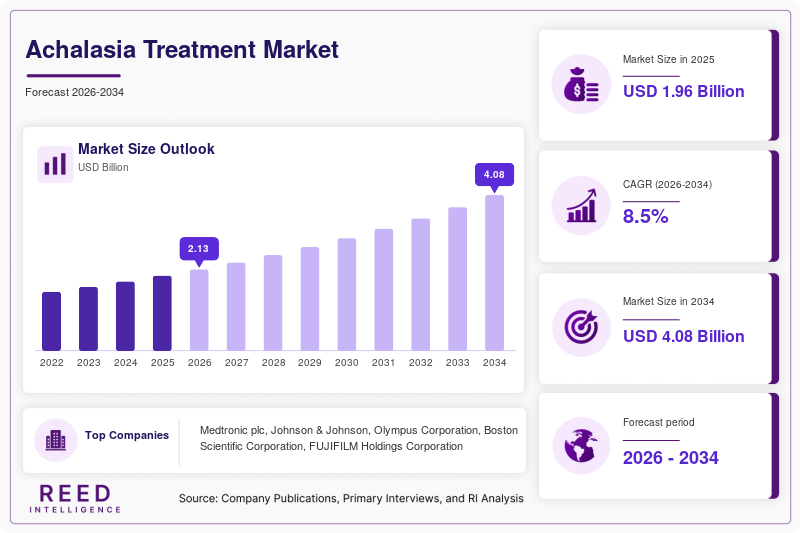
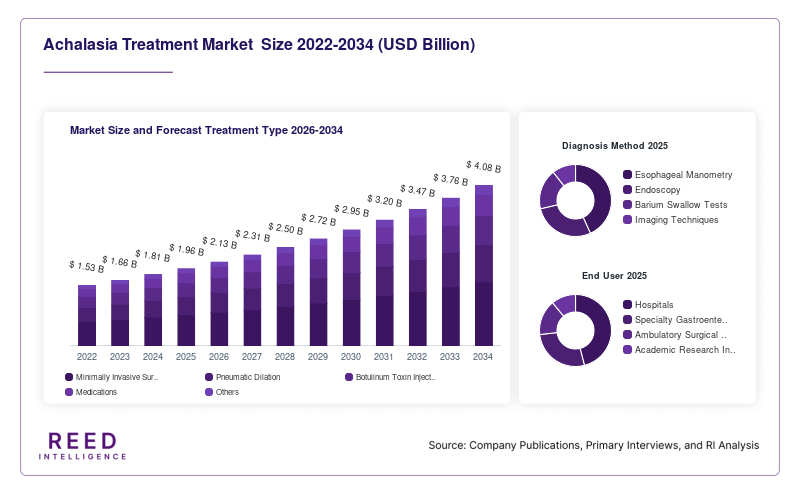
The Achalasia Treatment Market size was valued at USD 1.96 billion in 2026 and is projected to reach USD 3.78 billion by 2034, expanding at a CAGR of 8.5% during 2026–2034. The global Achalasia Treatment Market growth has been supported by the increasing prevalence of esophageal motility disorders and rising awareness regarding minimally invasive gastrointestinal treatment procedures. Growing healthcare investments, improved diagnostic capabilities, and expanding access to specialty gastroenterology services significantly contributed to the expansion of the Achalasia Treatment Market.
Achalasia is a rare chronic esophageal disorder characterized by impaired lower esophageal sphincter relaxation and abnormal esophageal motility. Increasing diagnosis rates through high-resolution manometry and endoscopic imaging technologies accelerated the demand for advanced treatment approaches. Healthcare providers increasingly adopted minimally invasive procedures such as peroral endoscopic myotomy (POEM), pneumatic dilation, and laparoscopic Heller myotomy to improve patient outcomes and reduce recovery periods.
Key Highlights
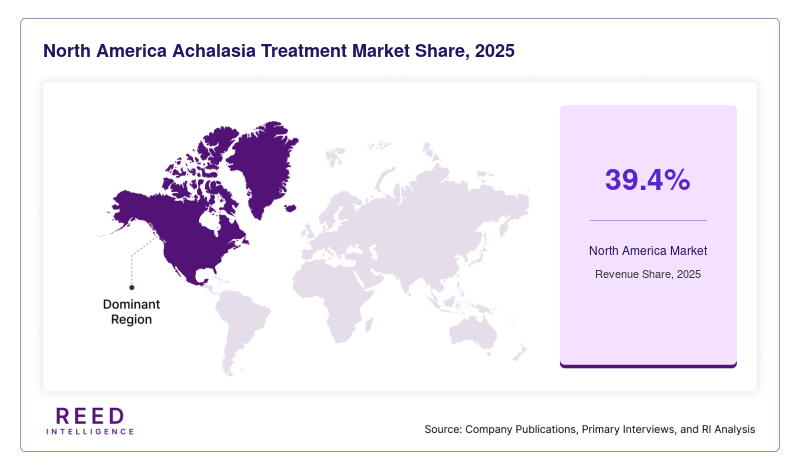
- North America accounted for 39.4% of the global Achalasia Treatment Market share in 2025, while Asia Pacific is projected to register the fastest CAGR of 9.6% during 2026–2034.
- By treatment type, minimally invasive surgical procedures held the leading market share of 44.2% in 2025, while POEM procedures are projected to expand at a CAGR of 10.1% during the forecast period.
- By diagnosis method, esophageal manometry represented 37.8% of the Achalasia Treatment Market share in 2025, while endoscopic diagnosis is anticipated to grow at a CAGR of 9.4%.
- By end user, hospitals dominated with 52.6% share in 2025, whereas specialty gastroenterology clinics are expected to grow at a CAGR of 9.3%.
- The United States remained the dominant country market and was valued at USD 612 million in 2024 and USD 658 million in 2025.
Market Trends
Increasing Adoption of Peroral Endoscopic Myotomy Procedures
One of the major trends shaping the Achalasia Treatment Market is the increasing adoption of peroral endoscopic myotomy procedures. POEM emerged as a preferred minimally invasive treatment option due to reduced postoperative complications, shorter hospital stays, and faster patient recovery compared to conventional surgical techniques.
Healthcare institutions increasingly invested in advanced endoscopic systems and physician training programs to support procedural expansion. The growing success rate of POEM procedures encouraged broader adoption across developed and emerging healthcare markets.
Expansion of Advanced Diagnostic Technologies
Another notable trend influencing the Achalasia Treatment Market is the rising integration of advanced gastrointestinal diagnostic technologies. High-resolution manometry systems, digital imaging platforms, and endoscopic visualization tools improved diagnostic precision and early disease identification.
Hospitals and specialty centers increasingly implemented AI-assisted diagnostic platforms capable of enhancing procedural planning and treatment monitoring. This trend contributed to improved patient management and more accurate treatment selection.
Market Drivers
Rising Prevalence of Gastrointestinal Motility Disorders
The increasing incidence of esophageal motility disorders significantly supported the growth of the Achalasia Treatment Market. Sedentary lifestyles, dietary changes, and growing awareness regarding digestive health conditions contributed to higher diagnosis rates globally.
Healthcare providers experienced increased patient volumes requiring specialized gastroenterology treatments. The demand for effective long-term symptom management accelerated the adoption of advanced surgical and endoscopic treatment approaches.
Growing Preference for Minimally Invasive Procedures
The rising preference for minimally invasive treatment procedures acted as another major driver for the Achalasia Treatment Market. Patients and healthcare providers increasingly favored techniques associated with lower procedural risk, reduced hospitalization time, and faster recovery outcomes.
Technological advancements in endoscopic surgery systems and robotic-assisted gastrointestinal procedures further supported treatment adoption across hospitals and specialty clinics.
Market Restraint
Limited Awareness and Delayed Diagnosis in Developing Regions
Limited awareness regarding achalasia symptoms and delayed disease diagnosis remained a major restraint for the market. Many patients in developing economies experienced delayed access to specialized gastroenterology services and advanced diagnostic technologies.
The rarity of the disease also contributed to misdiagnosis and prolonged treatment timelines, restricting early intervention opportunities in several healthcare systems.
Market Opportunities
Expansion of Robotic-Assisted Gastrointestinal Procedures
The increasing use of robotic-assisted surgical systems presents significant opportunities for the Achalasia Treatment Market. Healthcare facilities are expected to adopt advanced robotic platforms to improve procedural precision and reduce complications during esophageal surgeries.
The growing availability of robotic-assisted endoscopic technologies will likely support procedural efficiency and improved patient outcomes.
Growth of Ambulatory Surgical Centers
The expansion of ambulatory surgical centers is anticipated to create new growth opportunities for market participants. Outpatient treatment facilities increasingly perform minimally invasive achalasia procedures due to lower operational costs and shorter patient recovery durations.
Healthcare providers are expected to increase investments in specialized outpatient gastrointestinal treatment centers during the forecast period.
Segmental Analysis
By Treatment Type
Based on treatment type, the Achalasia Treatment Market is segmented into minimally invasive surgical procedures, pneumatic dilation, botulinum toxin injection therapy, medications, and others.
Minimally invasive surgical procedures dominated the market with a 44.2% share in 2025 due to higher long-term treatment effectiveness and lower recurrence rates. Hospitals and specialty centers increasingly preferred laparoscopic and endoscopic procedures for symptom management.
POEM procedures are projected to grow at the fastest CAGR of 10.1% during the forecast period. The growth will be driven by increasing physician adoption and rising patient demand for less invasive gastrointestinal surgeries.
By Diagnosis Method
Based on diagnosis method, the Achalasia Treatment Market is categorized into esophageal manometry, endoscopy, barium swallow tests, and imaging techniques.
Esophageal manometry accounted for 37.8% of the market share in 2025 due to its high diagnostic accuracy and widespread use in specialty gastroenterology centers.
Endoscopic diagnosis is expected to register the fastest CAGR of 9.4% during 2026–2034. Increasing adoption of advanced digital endoscopy systems and AI-supported visualization tools will support segment growth.
By End User
Based on end user, the Achalasia Treatment Market is divided into hospitals, specialty gastroenterology clinics, ambulatory surgical centers, and academic research institutions.
Hospitals held the dominant market share of 52.6% in 2025 because of higher procedural volumes, availability of advanced surgical infrastructure, and access to multidisciplinary care teams.
Specialty gastroenterology clinics are forecast to grow at the fastest CAGR of 9.3% during the assessment period. The segment will benefit from increasing patient preference for focused digestive healthcare services and shorter treatment waiting periods.
By Procedure Type
Based on procedure type, the Achalasia Treatment Market is segmented into laparoscopic Heller myotomy, POEM, pneumatic balloon dilation, and others.
Laparoscopic Heller myotomy represented 34.9% of the market share in 2025 due to established clinical success rates and widespread surgeon familiarity with the procedure.
POEM is anticipated to expand at a CAGR of 10.4% over the forecast period. Increasing procedural advancements and expanding physician training programs are expected to support segment adoption.
By Patient Age Group
Based on patient age group, the Achalasia Treatment Market is segmented into pediatric, adult, and geriatric patients.
Adult patients dominated the market with a 61.8% share in 2025 due to the higher prevalence of achalasia diagnosis among middle-aged individuals.
The geriatric segment is expected to grow at the fastest CAGR of 8.9% during the forecast period. Rising global aging populations and increasing prevalence of chronic gastrointestinal disorders among elderly patients will support segment expansion.
Regional Analysis
North America
North America accounted for 39.4% of the global Achalasia Treatment Market share in 2025 and is projected to grow at a CAGR of 7.8% during 2026–2034. The regional market benefited from advanced healthcare infrastructure, high procedural awareness, and increasing adoption of minimally invasive gastrointestinal surgeries.
The United States dominated the regional market due to strong availability of specialized gastroenterology centers and rising investments in robotic-assisted surgical technologies. The country also witnessed increasing patient preference for outpatient treatment procedures.
Europe
Europe held 28.6% of the Achalasia Treatment Market share in 2025 and is expected to expand at a CAGR of 8.1% over the forecast period. The region experienced steady growth due to rising adoption of advanced diagnostic systems and growing healthcare expenditure for digestive disease management.
Germany represented the leading country market in Europe. The country witnessed increased utilization of high-resolution manometry systems and minimally invasive esophageal treatment procedures within university hospitals and specialty clinics.
Asia Pacific
Asia Pacific represented 21.7% of the global Achalasia Treatment Market share in 2025 and is forecast to register the fastest CAGR of 9.6% during 2026–2034. Expanding healthcare infrastructure, growing awareness regarding gastrointestinal disorders, and improving access to endoscopic procedures supported regional market growth.
China emerged as the dominant country market due to increasing hospital investments in advanced endoscopic technologies and rising patient access to specialty digestive healthcare services.
Middle East & Africa
The Middle East & Africa accounted for 5.8% of the Achalasia Treatment Market share in 2025 and is anticipated to grow at a CAGR of 8.3% during the forecast period. Rising healthcare modernization programs and increasing investments in tertiary care hospitals contributed to regional market expansion.
Saudi Arabia remained the dominant country market due to expanding gastroenterology treatment facilities and increasing adoption of advanced minimally invasive surgical technologies.
Latin America
Latin America captured 4.5% of the global Achalasia Treatment Market share in 2025 and is expected to grow at a CAGR of 8.0% through 2034. The regional market benefited from improving healthcare accessibility and rising awareness regarding digestive disease treatment options.
Brazil dominated the Latin American market due to increasing demand for minimally invasive gastrointestinal procedures and expanding investments in hospital infrastructure modernization.
Competitive Landscape
The Achalasia Treatment Market remained moderately competitive, with companies focusing on minimally invasive technologies, advanced diagnostic systems, and endoscopic innovation. Market participants emphasized product development, physician training, and healthcare partnerships to strengthen market presence.
Medtronic plc remained one of the leading companies in the market due to its strong gastrointestinal device portfolio and advanced minimally invasive surgical technologies. The company recently expanded its endoscopic treatment platform designed for esophageal procedures and digestive healthcare applications.
Johnson & Johnson focused on robotic-assisted surgical technologies and advanced endoscopic instrumentation for gastrointestinal procedures.
Olympus Corporation strengthened its gastrointestinal endoscopy portfolio to support minimally invasive achalasia treatments.
Boston Scientific Corporation invested in advanced balloon dilation and therapeutic endoscopy technologies for digestive disorder management.
FUJIFILM Holdings Corporation expanded its medical imaging and endoscopic visualization solutions for specialty gastroenterology procedures.
Key Players List
- Medtronic plc
- Johnson & Johnson
- Olympus Corporation
- Boston Scientific Corporation
- FUJIFILM Holdings Corporation
- Stryker Corporation
- KARL STORZ SE & Co. KG
- Cook Medical
- B. Braun Melsungen AG
- CONMED Corporation
- PENTAX Medical
- Abbott Laboratories
- STERIS plc
- Intuitive Surgical, Inc.
- Richard Wolf GmbH
Recent Developments
- In 2025, Medtronic plc expanded its minimally invasive gastrointestinal treatment platform for esophageal disorder management.
- In 2024, Olympus Corporation introduced upgraded therapeutic endoscopy systems for advanced gastrointestinal procedures.
- In 2025, Boston Scientific Corporation strengthened its balloon dilation technology portfolio for digestive healthcare applications.
- In 2024, Johnson & Johnson expanded robotic-assisted surgery training programs for gastrointestinal specialists.
- In 2025, FUJIFILM Holdings Corporation launched advanced imaging technologies for enhanced endoscopic visualization and gastrointestinal diagnostics.
Achalasia Treatment Market Segments
Treatment Type
- Minimally Invasive Surgical Procedures
- Pneumatic Dilation
- Botulinum Toxin Injection Therapy
- Medications
- Others
Diagnosis Method
- Esophageal Manometry
- Endoscopy
- Barium Swallow Tests
- Imaging Techniques
End User
- Hospitals
- Specialty Gastroenterology Clinics
- Ambulatory Surgical Centers
- Academic Research Institutions
Procedure Type
- Laparoscopic Heller Myotomy
- POEM
- Pneumatic Balloon Dilation
- Others
Patient Age Group
- Pediatric
- Adult
- Geriatric
By Region
- North America
- Europe
- APAC
- Middle East and Africa
- LATAM