Acid Proof Lining Market Size, Share & Trends Analysis Report By Material Type (Ceramic, Carbon Brick, Thermoplastic, FRP, Rubber and Others), By Application (Chemical Processing, Power Generation, Mining & Metallurgy, Petrochemicals, Pharmaceuticals, Food & Beverage and Others), By Installation Method (Trowel Applied, Spray Applied, Sheet Lining and Tile Lining) and By Region (North America, Europe, Asia-Pacific, Latin America, Middle East & Africa) Forecasts, 2026–2034
USD 3950
Acid Proof Lining Market Size
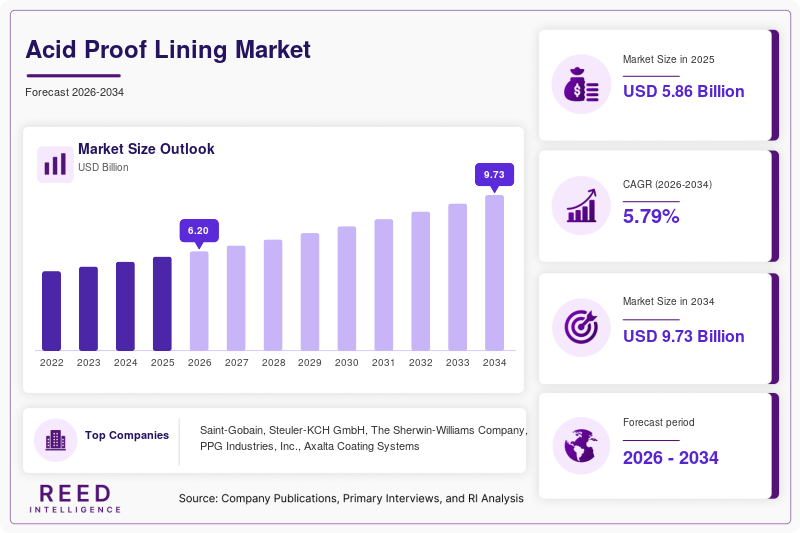
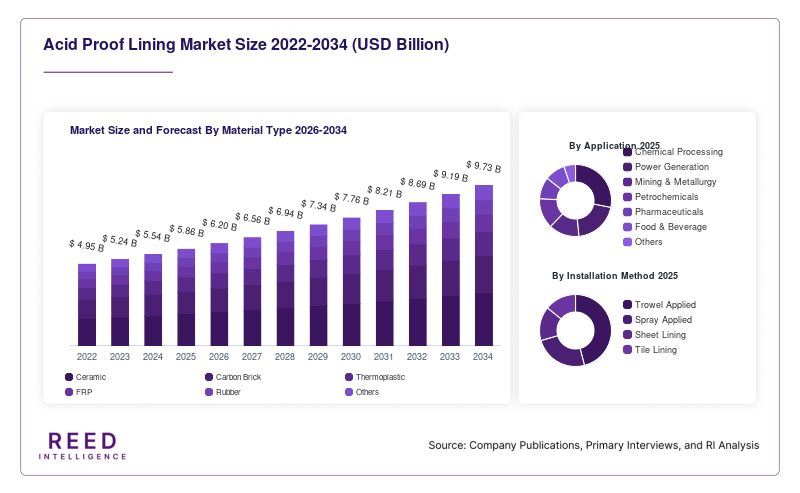
The global acid proof lining market was valued at USD 5.86 billion in 2025 and is projected to grow from USD 6.20 billion in 2026 to USD 9.73 billion by 2034, registering a CAGR of 5.79% during the forecast period from 2026 to 2034.
Acid proof lining refers to protective materials installed over concrete, steel, masonry and other substrates to protect equipment and structures from aggressive acids, alkalis, solvents, salts and other corrosive chemicals. These systems are used extensively in chemical processing, power generation, mining and metallurgy, petrochemicals, pharmaceuticals, wastewater treatment and industrial manufacturing.
The market is supported by the need to extend the service life of tanks, vessels, floors, ducts, pipes, stacks and processing equipment exposed to corrosive environments. Manufacturers offer several technologies, including ceramic and tile systems, carbon brick, thermoplastics, fiberglass-reinforced plastic, rubber linings and resin-based protective systems.
Acid Proof Lining Market Drivers
Expansion of Chemical Processing and Industrial Infrastructure Supports Demand
Chemical-processing facilities use acid-resistant linings in tanks, reactors, storage vessels, process floors, trenches, ducts and other infrastructure exposed to aggressive chemicals. Manufacturers such as Saint-Gobain position ceramic and engineered-material solutions for chemical-processing environments where corrosion and chemical resistance are essential.
The market mechanism is linked to asset protection: replacing a deteriorated substrate can require significantly more downtime and capital than installing a protective lining during maintenance. As chemical-processing capacity expands and existing plants undergo refurbishment, demand for protective lining systems increases.
However, installation specifications are highly dependent on chemical concentration, temperature and substrate conditions, limiting the use of standardized lining solutions across all industrial applications.
Corrosion Control in Power Generation Creates Recurring Replacement Demand
Power-generation facilities contain multiple areas exposed to corrosive gases, chemicals, wastewater and high-temperature operating conditions. Acid-resistant materials are used in flue-gas treatment systems, wastewater areas, chemical storage and process environments.
The mechanism supporting demand is primarily asset-life extension. Lining systems can protect concrete and steel surfaces from chemical attack, reducing deterioration and helping operators maintain equipment availability.
Growth is particularly relevant to facilities modernizing environmental-control systems and wastewater infrastructure. Nevertheless, changes in power-generation technologies and the retirement of older plants can offset some replacement demand.
Mining and Metallurgy Require Protection Against Highly Aggressive Processing Environments
Mining and metallurgical facilities expose equipment to acids, mineral slurries, salts and abrasive materials. Acid-proof linings are used in tanks, launders, pipelines, floors and processing vessels to protect substrates from chemical and mechanical degradation.
The commercial value is particularly strong where corrosive materials are combined with abrasion because equipment failure can interrupt continuous processing. Ceramic, rubber, FRP and specialized resin systems can therefore compete based on the exact combination of chemical and mechanical exposure.
Acid Proof Lining Market Restraints
High Installation and Surface-Preparation Costs Can Delay Adoption
Acid-proof lining performance depends heavily on substrate preparation, bonding, curing and installation quality. Poor surface preparation or incorrect material selection can result in blistering, delamination or premature failure.
This increases the total installed cost compared with basic protective coatings. Facilities may consequently postpone lining projects until scheduled shutdowns or major maintenance periods.
Material Selection Is Complex Because Chemical Resistance Varies by Application
No single lining material provides universal resistance to every chemical environment. Concentration, temperature, exposure duration and mechanical loading can all influence performance.
Ceramic systems, for example, provide strong chemical and temperature resistance but can require careful installation, while polymeric systems can provide flexibility but have application-specific temperature limitations. This complexity can increase engineering and specification costs and extend procurement cycles.
Acid Proof Lining Market Opportunities
Advanced Composite Linings Can Address Combined Chemical and Mechanical Exposure
Industrial facilities increasingly require lining systems capable of handling multiple degradation mechanisms simultaneously. FRP, thermoplastic, rubber and engineered ceramic systems can be selected for applications involving combinations of chemical exposure, impact, abrasion and temperature.
This creates opportunities for manufacturers offering customized multilayer systems rather than single-material solutions.
Infrastructure Rehabilitation Creates a Large Replacement Opportunity
Many industrial facilities rely on aging concrete and steel infrastructure. Instead of replacing entire structures, operators can use protective lining systems to restore chemical resistance and extend service life.
This creates a retrofit opportunity across chemical plants, wastewater facilities, mining operations and power-generation sites. The opportunity is particularly relevant where shutdown time and replacement costs are high.
Environmentally Improved Resin and Installation Technologies Can Differentiate Suppliers
Manufacturers are increasingly developing systems that reduce installation time, improve worker exposure conditions and lower environmental impact. Low-VOC formulations, faster-curing systems and prefabricated lining components can reduce project duration.
These technologies can gain adoption where industrial customers prioritize shorter shutdown periods and tighter environmental requirements.
Material Type Segment Analysis
Ceramic Holds the Largest Share Due to High Chemical and Temperature Resistance
Ceramic acid-proof lining accounted for approximately 29% of the global market in 2025, making it the largest material segment. Ceramic systems are widely used in aggressive chemical environments because of their resistance to many acids, solvents and elevated temperatures.
Their use is particularly relevant to chemical processing, metallurgy, power generation and industrial flooring. The primary limitation is that ceramic and tile systems require careful substrate preparation, joint design and installation.
FRP represented approximately 20% of the market and is projected to grow at approximately 6.8% CAGR, making it the fastest-growing major material segment. FRP systems offer a combination of corrosion resistance, relatively low weight and structural reinforcement potential.
Carbon brick accounted for approximately 18%, thermoplastic for 14%, rubber for 12%, and other materials for approximately 7%.
FRP Is the Fastest-Growing Material Segment Through Lightweight Corrosion Protection
FRP is projected to expand at approximately 6.8% CAGR through 2034. Its growth is supported by demand for lightweight, corrosion-resistant systems in tanks, ducts, pipes, scrubbers and process equipment.
FRP can also be manufactured in prefabricated forms, supporting faster installation and reduced downtime. Its temperature and chemical compatibility limitations nevertheless mean that ceramic, carbon brick or specialized polymer systems remain preferable in certain severe environments.
Application Segment Analysis
Chemical Processing Represents the Largest Application
Chemical processing accounted for approximately 27% of the market in 2025, making it the largest application segment. Chemical plants require lining systems across storage tanks, reactors, containment areas, floors, process equipment and wastewater systems.
The diversity of chemical exposure creates demand for several lining technologies rather than a single dominant material.
Mining & Metallurgy accounted for approximately 21% and is projected to grow at approximately 6.7% CAGR, making it the fastest-growing major application. Mineral processing frequently combines acidic chemistry with abrasive slurries, increasing the need for specialized protective materials.
Power generation represented approximately 18%, petrochemicals 15%, pharmaceuticals 8%, food & beverage 5%, and other applications approximately 6%.
Installation Method Segment Analysis
Trowel-Applied Systems Account for the Largest Share
Trowel-applied lining represented approximately 36% of the market in 2025. The method remains widely used for industrial floors, tanks, containment areas and localized rehabilitation because it allows installers to apply relatively thick protective layers and accommodate irregular substrates.
Spray-applied systems accounted for approximately 24% and are projected to grow at approximately 7.0% CAGR. Their faster coverage and suitability for large or geometrically complex surfaces support adoption in industrial rehabilitation and new construction.
Sheet lining represented approximately 22%, while tile lining accounted for approximately 18%.
Acid Proof Lining Market Regional Analysis
Asia-Pacific Holds the Largest Share Through Chemical, Mining and Manufacturing Activity
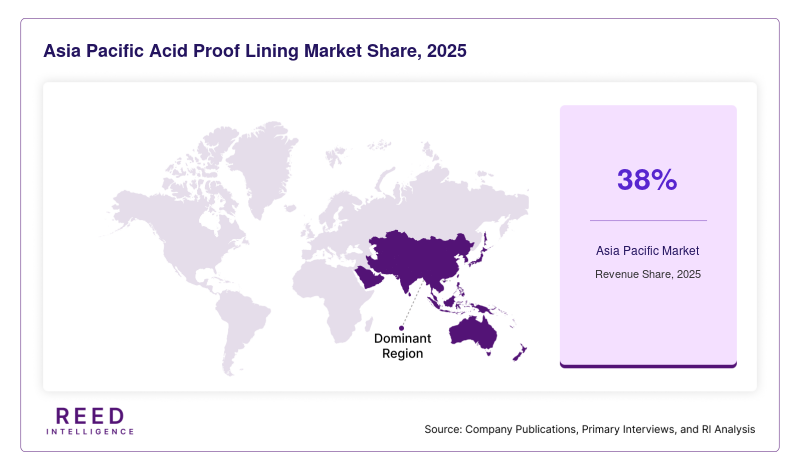
Asia-Pacific accounted for approximately 38% of the global acid proof lining market in 2025, making it the largest regional market. The region combines extensive chemical manufacturing, petrochemical capacity, mining, metals production and industrial infrastructure.
China, Japan, India and Southeast Asian economies provide significant end-use demand through chemical processing, industrial manufacturing and infrastructure development.
Asia-Pacific is also the fastest-growing region, with approximately 6.6% CAGR through 2034. Growth is supported by industrial capacity additions, plant modernization and rehabilitation of aging infrastructure.
North America Maintains Demand Through Industrial Rehabilitation
North America represented approximately 25% of the market in 2025 and is projected to grow at approximately 5.2% CAGR.
The regional market is supported by chemical processing, oil and gas infrastructure, power generation, mining and wastewater treatment. A substantial installed industrial base creates recurring demand for rehabilitation and replacement lining.
The market increasingly emphasizes lifecycle cost, reduced downtime and installation technologies that can shorten planned shutdowns.
Europe Focuses on Corrosion Protection and Infrastructure Efficiency
Europe accounted for approximately 21% of the market in 2025 and is projected to grow at approximately 4.8% CAGR.
Demand is supported by established chemical, pharmaceutical, energy and manufacturing industries. Industrial operators are increasingly focused on extending asset life and improving environmental performance.
Stringent industrial and environmental requirements also encourage investment in containment, wastewater treatment and chemical-resistant infrastructure.
Latin America Benefits From Mining and Chemical Processing
Latin America represented approximately 9% of the market in 2025 and is projected to grow at approximately 5.4% CAGR.
Mining and metals processing are important sources of demand because of exposure to corrosive chemicals and mineral slurries. Chemical processing and industrial infrastructure projects provide additional demand.
Investment remains sensitive to commodity cycles and infrastructure spending.
Middle East & Africa Develops Through Petrochemical and Industrial Projects
Middle East & Africa accounted for approximately 7% of the market in 2025 and is projected to grow at approximately 5.1% CAGR.
Petrochemical facilities, water infrastructure, mining and industrial-processing projects support regional demand. New industrial projects can generate significant initial lining requirements, while established facilities create recurring maintenance demand.
Acid Proof Lining Market Competitive Landscape
The acid proof lining market is fragmented across material manufacturers, lining-system suppliers and specialized installation contractors. Competition is based on chemical resistance, temperature performance, abrasion resistance, installation reliability, curing time, service life and application engineering.
Large material suppliers compete through proprietary ceramic, resin, FRP, thermoplastic and rubber technologies, while specialist contractors differentiate through installation expertise and project execution.
Key Market Players
- Saint-Gobain
- Steuler-KCH GmbH
- The Sherwin-Williams Company
- PPG Industries, Inc.
- Axalta Coating Systems
- Duromar, Inc.
- Belzona International Ltd.
- Sauereisen, Inc.
- Kansai Paint Co., Ltd.
- Denso GmbH
Acid Proof Lining Market Recent Developments
- Saint-Gobain continues to develop engineered ceramic materials and industrial protection technologies designed for demanding chemical and high-temperature environments. Its ceramic-material portfolio supports applications where chemical resistance, temperature stability and dimensional durability are important. This product direction supports the continued use of ceramic-based systems in severe acid environments where conventional polymeric protection may have limitations.
- Steuler-KCH provides integrated corrosion-protection solutions combining ceramic, rubber, thermoplastic and FRP lining technologies. The approach enables material selection based on the chemical, mechanical and thermal conditions of individual industrial processes. The development reflects the market's shift toward application-specific lining systems rather than single-material solutions.
Acid Proof Lining Market Segments
By Material Type
- Ceramic
- Carbon Brick
- Thermoplastic
- FRP
- Rubber
- Others
By Application
- Chemical Processing
- Power Generation
- Mining & Metallurgy
- Petrochemicals
- Pharmaceuticals
- Food & Beverage
- Others
By Installation Method
- Trowel Applied
- Spray Applied
- Sheet Lining
- Tile Lining
By Region
- North America
- Europe
- APAC
- Middle East and Africa
- LATAM