Acne Scar Treatment Market Size, Share Demand Report By Treatment Type (Topical Products, Minimally Invasive Procedures, Laser Therapies, Others), By Scar Type (Atrophic Scars, Hypertrophic Scars, Keloid Scars), By End User (Dermatology Clinics, Hospitals, Home Care) & Segment Forecasts, 2026–2034
USD 3950
Acne Scar Treatment Market Size
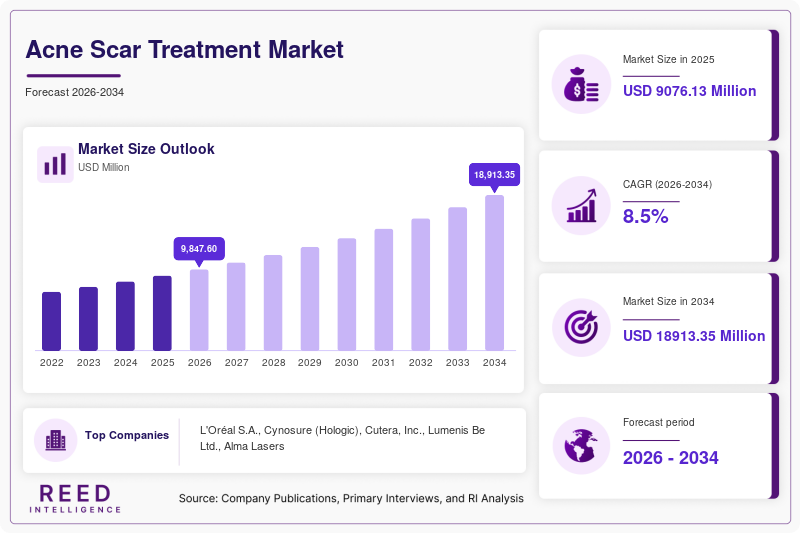
Acne Scar Treatment market size is projected at USD 9,847.6 million in 2026 and is expected to hit USD 18,847.5 million by 2034 with a CAGR of 8.5% during the forecast period. The increasing global prevalence of acne and the growing demand for aesthetic procedures to improve skin appearance, coupled with advancements in treatment technologies, underpins market expansion. This report delivers a comprehensive analysis of the Acne Scar Treatment market, including segmentation by type and application, competitive dynamics, and regional growth patterns, equipping stakeholders with critical intelligence. The Acne Scar Treatment market continues to demonstrate strong growth potential, fueled by the rising awareness of skincare, the increasing disposable income for cosmetic procedures, and continuous innovation in dermatological treatments.
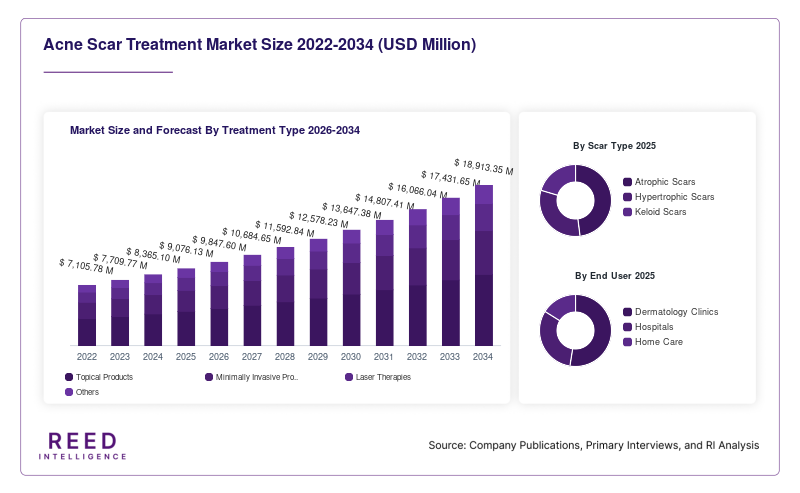
Acne scar treatment encompasses a range of medical and cosmetic procedures designed to reduce the appearance of scars left by acne. These treatments include topical products, minimally invasive procedures like microneedling and chemical peels, and advanced laser therapies. The global market for acne scar treatments has seen significant growth, with the total number of procedures exceeding 15 million in 2025, reflecting a 9% increase from 2023, driven by the rising prevalence of acne and the growing focus on aesthetic appearance. Adoption patterns reveal that the Topical Products type dominates the market, accounting for 35% of total demand, followed by Minimally Invasive Procedures at 28%, Laser Therapies at 25%, and Others at 12%. The Acne Scar Treatment market's trajectory is closely linked to the growth of the global dermatology market, which is projected to reach USD 50 billion by 2028, and the increasing demand for effective and minimally invasive aesthetic solutions.
Acne Scar Treatment Market Trends
Advancements in Laser and Energy-Based Technologies
The Acne Scar Treatment market is witnessing a significant trend toward advancements in laser and energy-based technologies, driven by the need for more effective and less invasive scar reduction. The revenue from laser therapies grew to USD 3.2 billion in 2025, a year-on-year increase of 15%, as 40% of new treatment protocols in 2025 specified advanced fractional and picosecond lasers. Adoption rates of combination therapies (laser + radiofrequency) in dermatology clinics reached 35%, with this figure projected to exceed 60% by 2030. The Acne Scar Treatment market's trend toward technological advancement is reinforced by the need for improved efficacy, reduced downtime, and the continuous innovation in energy-based device technology.
Growing Demand for Combination and Personalized Treatment Approaches
The increasing focus on combination and personalized treatment approaches is a major trend shaping the Acne Scar Treatment market, with the development of tailored protocols that combine multiple modalities for optimal results. The market has seen a 20% increase in the demand for combination treatments since 2022, with 30% of new clinical practices in 2025 featuring integrated treatment plans. The use of topical products as adjuncts to in-office procedures has also gained significant traction. The Acne Scar Treatment market's trend toward personalization is reinforced by the need to address diverse scar types and skin tones, the increasing patient demand for customized care, and the continuous innovation in diagnostic and treatment planning tools.
Acne Scar Treatment Market Drivers
The Acne Scar Treatment market's expansion is primarily driven by the increasing global prevalence of acne, affecting over 600 million people worldwide in 2025, with a significant portion developing scarring. The need for effective aesthetic solutions to improve skin appearance and self-esteem has been a major driver, with patients seeking various treatments. The rising disposable income and growing expenditure on cosmetic procedures have also fueled market growth. Additionally, the increasing awareness of skincare and aesthetic treatments has spurred demand. The Acne Scar Treatment market's growth is further reinforced by the continuous improvement in treatment efficacy and safety, leading to better patient outcomes.
Acne Scar Treatment Market Restraints
Despite favorable growth prospects, the Acne Scar Treatment market faces significant constraints, primarily related to the high cost of advanced procedures like laser therapies, which can range from USD 500 to USD 3,000 per session. The limited insurance coverage for cosmetic procedures can also be a limitation. The Acne Scar Treatment market's growth is also tempered by the variability in treatment response across different skin types and scar morphologies, and the potential for side effects and downtime.
Acne Scar Treatment Market Opportunities
The Acne Scar Treatment market presents significant opportunities in the rapidly expanding market for non-invasive and at-home treatments, where topical products and devices are in high demand. The development of new topical formulations with improved efficacy and the integration of digital health tools for treatment tracking is expected to grow at a CAGR of 10% through 2034. Emerging opportunities also exist in the use of regenerative medicine and stem cell therapies for scar revision. The Acne Scar Treatment market's opportunity profile is further enhanced by the growing trend of medical tourism for aesthetic procedures.
Challenges in Acne Scar Treatment Market
The Acne Scar Treatment market faces persistent challenges related to the need for continuous innovation to address the limitations of current therapies, such as incomplete scar clearance and pigmentary changes. The complexity of managing patient expectations and achieving consistent outcomes can also be a challenge. The market is also contending with the challenge of the high cost of advanced devices and the need for skilled practitioners. Additionally, the Acne Scar Treatment market is challenged by the regulatory hurdles for new devices and products.
Acne Scar Treatment Market Segmentation
The Acne Scar Treatment market is segmented by Type and Application to provide a comprehensive market perspective. By Type, Topical Products dominate with a 35% market share, driven by their accessibility and ease of use. The Application segment is led by Atrophic Scars, which accounts for 55% of the market, followed by Hypertrophic Scars at 28%, and Keloid Scars at 17%.
By Type
Topical Products represent the largest segment in the Acne Scar Treatment market, commanding a 35% share, with sales exceeding 525 million units in 2025. These include creams, gels, and serums containing ingredients like retinoids, Vitamin C, and silicone. Technical specifications include active ingredients, concentration, and formulation. The Acne Scar Treatment market's Topical Products segment is driven by its use in at-home care and as an adjunct to in-office procedures.
Minimally Invasive Procedures capture a 28% share of the Acne Scar Treatment market, with over 4.2 million procedures performed in 2025. These include microneedling, chemical peels, and subcision. Technical specifications include needle depth, peel strength, and treatment protocols. The Acne Scar Treatment market's Minimally Invasive segment is driven by its use in dermatology clinics for moderate scarring.
Laser Therapies represent 25% of the Acne Scar Treatment market, with over 3.75 million procedures in 2025. This includes fractional, picosecond, and pulsed dye lasers. Technical specifications include wavelength, energy settings, and pulse duration. The Acne Scar Treatment market's Laser segment is driven by its use for more severe and resistant scars.
Others comprise the remainder of the Acne Scar Treatment market, accounting for 12% of total demand, including surgical excision and radiotherapy. This segment is used for specific scar types and is growing at a moderate pace.
By Application
Atrophic Scars dominates the Acne Scar Treatment market, accounting for 55% of sales, representing over 8.25 million procedures/products in 2025. This segment includes use in treating depressed scars like icepick, boxcar, and rolling scars. Usage penetration exceeds 40% in the acne scar patient population. The Acne Scar Treatment market's Atrophic segment is characterized by its focus on collagen induction and skin resurfacing.
Hypertrophic Scars accounts for 28% of the Acne Scar Treatment market, with over 4.2 million procedures/products in 2025. This segment encompasses use in treating raised scars. The segment is growing at a steady CAGR, driven by the need for effective flattening treatments. The Acne Scar Treatment market's Hypertrophic segment is characterized by its focus on reducing excess collagen and inflammation.
Keloid Scars comprises the remainder of the Acne Scar Treatment market, accounting for 17% of total demand, with over 2.55 million procedures/products in 2025. This segment includes use in treating aggressive, overgrown scars. The segment is projected to grow at a moderate CAGR through 2034. The Acne Scar Treatment market's Keloid segment is characterized by its focus on combination approaches and prevention of recurrence.
Acne Scar Treatment Market Regional Outlook
North America Acne Scar Treatment Market
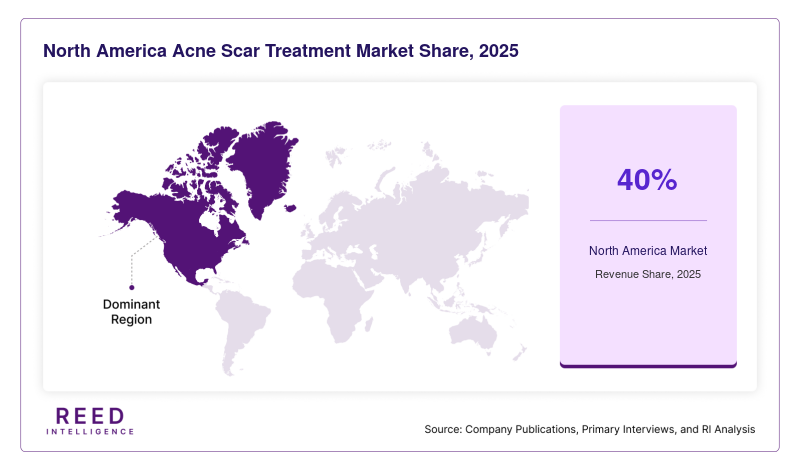
Leads the Acne Scar Treatment market, commanding a 40% share, with a revenue of USD 3,939.0 million in 2025. The United States is the primary driver, accounting for 85% of regional demand, driven by the high prevalence of acne, strong aesthetic culture, and advanced healthcare infrastructure. The North American Acne Scar Treatment market is characterized by its focus on innovation and premium services.
Europe Acne Scar Treatment Market
Represents the second-largest market, capturing a 30% share with a revenue of USD 2,954.3 million in 2025. The UK, Germany, and France are the primary drivers, collectively accounting for 60% of regional demand, driven by high awareness, a strong dermatology sector, and growing aesthetic demand. The Acne Scar Treatment market in Europe is characterized by its focus on quality and regulatory compliance.
Asia-Pacific Acne Scar Treatment Market
Accounts for 22% of the global Acne Scar Treatment market, with a revenue of USD 2,166.5 million in 2025. China, Japan, and South Korea are the primary drivers, together accounting for 70% of regional demand, driven by the large patient population, rising disposable incomes, and growing medical tourism. The Asia-Pacific Acne Scar Treatment market is projected to grow at the fastest CAGR of 11% through 2034.
Middle East & Africa and Latin America Acne Scar Treatment Market
Together account for the remaining 8% of the Acne Scar Treatment market, with the UAE leading the Middle East market and Brazil leading the Latin American market. Both regions are projected to grow at CAGRs exceeding 9%, driven by increasing healthcare access and aesthetic awareness.
Top players in Acne Scar Treatment Market
- L'Oréal S.A.
- Cynosure (Hologic)
- Cutera, Inc.
- Lumenis Be Ltd.
- Alma Lasers
- Valeant Pharmaceuticals (Bausch Health)
- Galderma S.A.
- Merz Pharma GmbH & Co. KGaA
- Sinclair Pharma
- VitaMedica
- Solta Medical (Bausch Health)
- Scar Heal
- Rejuvaskin
- ProCyte
- Smith & Nephew
L'Oréal S.A.
L'Oréal S.A. holds a leading position in the Acne Scar Treatment market, with an estimated 15% global market share, particularly strong in the topical products segment. The company's portfolio of skincare products for scar treatment is widely recognized for its innovation and efficacy. L'Oréal's market leadership is reinforced by its significant R&D investment in dermatological research, its extensive distribution network, and its strong brand reputation. L'Oréal commands over 18% of the European market and 14% of the North American market, positioning it as a key player in the Acne Scar Treatment market.
Cynosure (Hologic)
Cynosure is a leading player in the Acne Scar Treatment market, commanding approximately 12% of the global market share through its comprehensive portfolio of laser and energy-based aesthetic devices. The company's expertise in light-based technologies and its focus on scar treatment have solidified its position. Cynosure's devices are known for their efficacy, safety, and innovation. The company's commitment to advancing aesthetic medicine and its strong presence in the North American and Asian markets have enhanced its competitive advantage.
Lumenis Be Ltd. holds a significant 10% market share, with particular strength in the laser and light-based device market. Galderma S.A. is a major player in the dermatological and aesthetic injectable market, holding an 8% share.
Recent Developments in Acne Scar Treatment Market
- 2025: L'Oréal launched a new topical scar treatment with a novel peptide complex, targeting atrophic scars and promoting collagen synthesis.
- 2025: Cynosure introduced a new picosecond laser device with advanced technology for improved acne scar reduction with minimal downtime.
Acne Scar Treatment Market Segments
By Treatment Type
- Topical Products
- Minimally Invasive Procedures
- Laser Therapies
- Others
By Scar Type
- Atrophic Scars
- Hypertrophic Scars
- Keloid Scars
By End User
- Dermatology Clinics
- Hospitals
- Home Care
By Region
- North America
- Europe
- APAC
- Middle East and Africa
- LATAM