Acoustic Emission Testing Market Size, Share & Demand Report By Equipment Type (Sensors, Data Acquisition Systems, Software), By Application (Structural Health Monitoring, Leak Detection, Corrosion Detection, Crack Detection), By End-Use Industry (Oil & Gas, Aerospace, Manufacturing, Power Generation, Construction), By Technique (Continuous Monitoring, Portable Testing), By Region & Segment Forecasts, 2026–2034
USD 3950
Market Overview
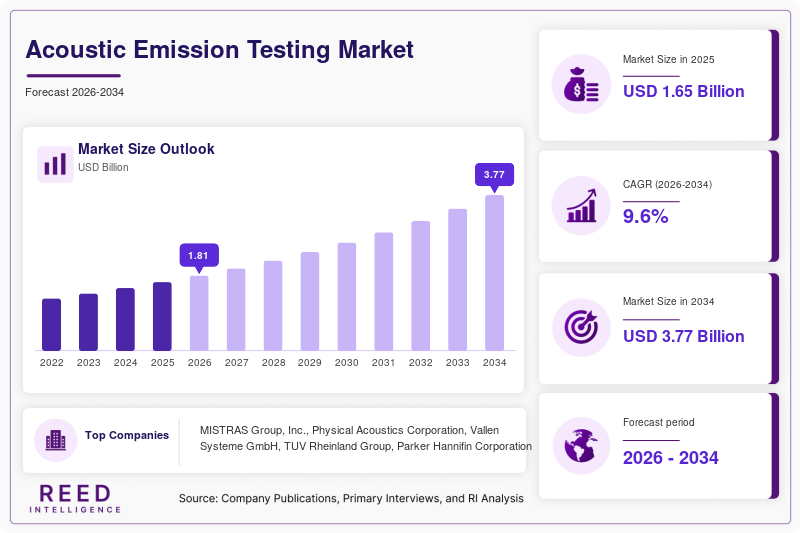
The Acoustic Emission Testing Market size was valued at USD 1.65 billion in 2026 and is projected to reach approximately USD 3.45 billion by 2034, expanding at a CAGR of 9.6% during the forecast period (2026–2034). The market growth is primarily driven by the increasing need for real-time structural health monitoring across industries such as oil & gas, aerospace, and power generation.
One of the key global factors supporting market growth is the rising emphasis on asset integrity management and predictive maintenance strategies. Organizations are shifting from traditional inspection methods to advanced non-destructive testing (NDT) techniques, including acoustic emission testing, to reduce downtime and enhance operational safety. This transition has significantly accelerated the adoption of acoustic emission systems globally.
Key Highlights:
- North America dominated the market with a 34.2% share in 2025, while Asia Pacific is expected to grow at the fastest CAGR of 11.2% during 2026–2034.
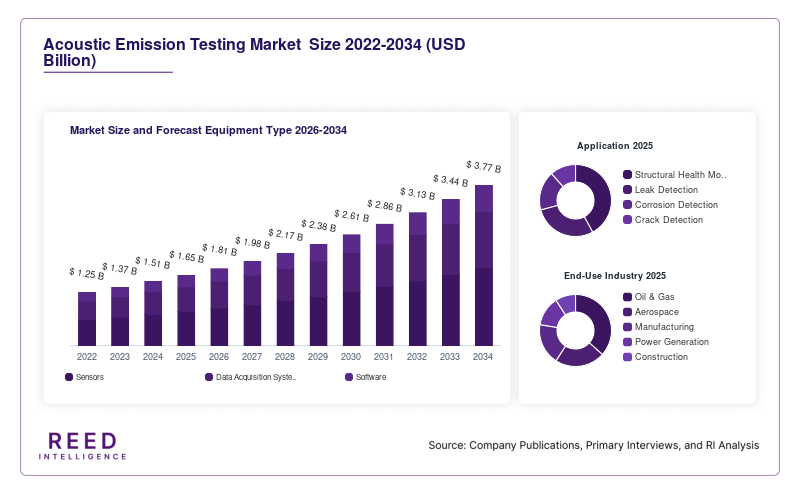
- By equipment type, sensors accounted for the largest share of 38.5%, while software solutions are projected to grow at a CAGR of 12.4%.
- By application, structural health monitoring led with a 41.7% share, whereas corrosion detection is expected to expand at a CAGR of 11.8%.
- The United States remained the dominant country, with market values of USD 510 million in 2024 and USD 560 million in 2025.
Market Trends
Integration of Digital Monitoring Systems
The Acoustic Emission Testing Market is experiencing a shift toward the integration of digital monitoring platforms and IoT-enabled solutions. Advanced sensors connected to cloud-based systems allow real-time data collection and analysis, enabling predictive insights. These digital solutions improve fault detection accuracy and allow remote monitoring of critical infrastructure. Industries such as aerospace and energy are increasingly adopting these systems to ensure operational continuity and compliance with safety regulations.
Growing Adoption in Renewable Energy Infrastructure
The expansion of renewable energy projects, including wind turbines and solar farms, has increased the demand for acoustic emission testing solutions. These systems are used to monitor structural fatigue, crack formation, and material degradation in harsh environments. As renewable installations grow globally, especially in offshore wind energy, acoustic emission testing is becoming a preferred method for continuous structural evaluation. This trend is expected to significantly influence market growth over the forecast period.
Market Drivers
Rising Demand for Non-Destructive Testing Techniques
Industries are increasingly adopting non-destructive testing methods to evaluate material integrity without causing damage. Acoustic emission testing offers advantages such as real-time monitoring, high sensitivity, and the ability to detect early-stage defects. These features make it suitable for critical applications, driving its demand across sectors such as manufacturing, construction, and energy.
Increasing Industrial Safety Regulations
Governments and regulatory bodies worldwide are enforcing stringent safety standards for industrial operations. Compliance with these regulations requires advanced inspection techniques capable of identifying structural weaknesses before failure occurs. Acoustic emission testing systems help organizations meet these requirements by providing continuous monitoring and early warning signals, thereby supporting market expansion.
Market Restraint
High Initial Investment and Technical Complexity
Despite its advantages, the Acoustic Emission Testing Market faces challenges due to the high cost of equipment and implementation. Acoustic emission systems require specialized sensors, data acquisition units, and skilled personnel for accurate interpretation of results. Additionally, the complexity of signal analysis can limit adoption among small and medium enterprises. These factors may hinder market growth, particularly in cost-sensitive regions.
Market Opportunities
Expansion in Emerging Economies
Developing regions are witnessing rapid industrialization and infrastructure development. This creates a favorable environment for the adoption of advanced testing solutions, including acoustic emission testing. Governments in these regions are investing in infrastructure safety and quality assurance, presenting significant growth opportunities for market players.
Advancements in Sensor Technology
Continuous innovation in sensor technology is enhancing the performance and reliability of acoustic emission systems. Modern sensors offer improved sensitivity, durability, and data accuracy, making them suitable for harsh environments. These advancements are expected to broaden the application scope of acoustic emission testing and drive market growth.
Segmental Analysis
By Equipment Type
Sensors dominated the Acoustic Emission Testing Market with a 38.5% share in 2025, owing to their critical role in detecting acoustic signals. Their widespread use across industries contributed to their leading position.
Software solutions are expected to grow at the fastest CAGR of 12.4% during the forecast period. The increasing need for advanced data analysis and real-time monitoring is driving the adoption of software platforms.
By Application
Structural health monitoring held the largest share of 41.7% in 2025, as it is widely used in infrastructure and industrial facilities. The ability to detect early-stage defects has made it a preferred application.
Corrosion detection is projected to grow at a CAGR of 11.8%, driven by the need to monitor aging infrastructure and prevent failures in pipelines and storage tanks.
By End-Use Industry
The oil & gas sector accounted for the largest share of 36.9% in 2025, due to the high demand for pipeline and storage tank monitoring. The sector relies heavily on acoustic emission testing for safety and maintenance.
The aerospace industry is expected to grow at a CAGR of 10.9%, driven by the increasing need for advanced inspection methods to ensure aircraft safety and performance.
By Technique
Continuous monitoring techniques dominated the market with a 44.3% share in 2025, as they provide real-time data and early detection of defects.
Portable testing methods are expected to grow at a CAGR of 10.7%, supported by their flexibility and ease of use in field applications.
Regional Analysis
North America
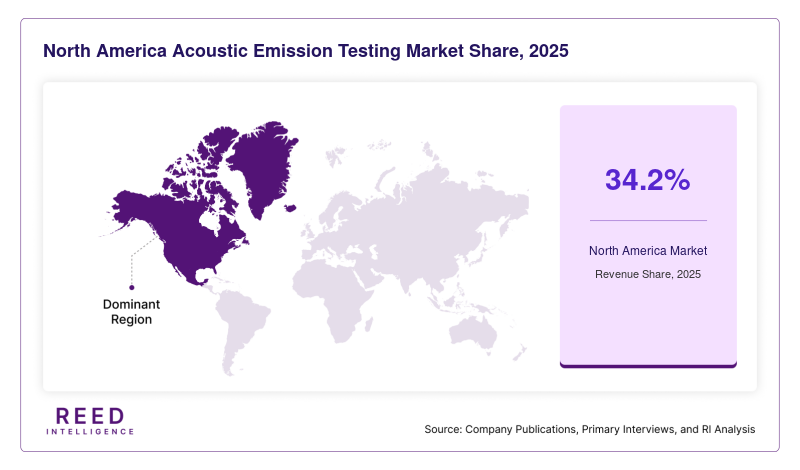
North America accounted for 34.2% of the Acoustic Emission Testing Market share in 2025 and is expected to grow at a CAGR of 8.9% during the forecast period. The region’s growth is attributed to the strong presence of advanced industries and the early adoption of innovative testing technologies.
The United States dominated the regional market due to its well-established industrial base and high investment in infrastructure maintenance. The increasing use of acoustic emission testing in aerospace and defense sectors has contributed to steady market expansion.
Europe
Europe held a 27.5% market share in 2025 and is projected to grow at a CAGR of 9.1% through 2034. The region has a strong focus on regulatory compliance and safety standards, which supports the adoption of acoustic emission testing solutions.
Germany emerged as the dominant country, driven by its advanced manufacturing sector and emphasis on quality control. The integration of testing solutions in automotive and industrial applications has supported market growth.
Asia Pacific
Asia Pacific represented 22.8% of the market share in 2025 and is expected to grow at the fastest CAGR of 11.2%. Rapid industrialization and infrastructure development are key factors driving market expansion in this region.
China led the regional market due to large-scale construction projects and increasing investments in energy infrastructure. The growing demand for efficient testing methods has accelerated the adoption of acoustic emission technologies.
Middle East & Africa
The Middle East & Africa region accounted for 8.1% of the market share in 2025 and is forecast to grow at a CAGR of 9.8%. The region’s growth is driven by investments in oil & gas and energy sectors.
Saudi Arabia dominated the market due to its extensive oil & gas operations. The need for pipeline monitoring and structural integrity assessment has increased the adoption of acoustic emission testing solutions.
Latin America
Latin America held a 7.4% share in 2025 and is expected to grow at a CAGR of 9.3% during the forecast period. The region is witnessing gradual adoption of advanced testing technologies.
Brazil emerged as the leading country due to its growing industrial sector and infrastructure projects. The demand for reliable inspection methods is supporting market growth in the region.
Competitive Landscape
The Acoustic Emission Testing Market is moderately competitive, with several global and regional players offering advanced solutions. Key companies focus on product innovation, strategic partnerships, and expansion into emerging markets.
MISTRAS Group is recognized as a leading player due to its comprehensive portfolio of acoustic emission testing solutions. The company recently introduced advanced sensor technologies to enhance detection accuracy and operational efficiency.
Other prominent players are actively investing in research and development to improve system capabilities and expand their market presence.
Key Players List
- MISTRAS Group, Inc.
- Physical Acoustics Corporation
- Vallen Systeme GmbH
- TUV Rheinland Group
- Parker Hannifin Corporation
- Score Atlanta Inc.
- Acoustic Emission Consulting Inc.
- KRN Services Inc.
- AET Technologies
- TWI Ltd.
- Eddyfi Technologies
- Ashtead Technology
- Intertek Group plc
- Bureau Veritas
- SGS SA
Recent Developments
- MISTRAS Group launched an advanced acoustic emission monitoring system for industrial applications in 2025.
- Eddyfi Technologies expanded its product portfolio with enhanced sensor solutions.
- TUV Rheinland increased its inspection service capabilities in Asia Pacific.
- SGS SA introduced new testing services for infrastructure monitoring.
- Bureau Veritas partnered with industrial firms to improve testing efficiency.
Acoustic Emission Testing Market Segments
Equipment Type
- Sensors
- Data Acquisition Systems
- Software
Application
- Structural Health Monitoring
- Leak Detection
- Corrosion Detection
- Crack Detection
End-Use Industry
- Oil & Gas
- Aerospace
- Manufacturing
- Power Generation
- Construction
Technique
- Continuous Monitoring
- Portable Testing
By Region
- North America
- Europe
- APAC
- Middle East and Africa
- LATAM