Acrylic Solid Surface Market Size, Share & Trends Analysis Report By Type (Standard Acrylic, Modified Acrylic, Recycled-Content Acrylic and Others), By Application (Countertops, Sinks & Vanities, Wall Cladding, Furniture & Interior Surfaces) and By End User (Residential, Commercial and Institutional) and By Region (North America, Europe, Asia Pacific, Latin America, Middle East & Africa) Forecasts, 2026–2034
USD 3950
Acrylic Solid Surface Market Size
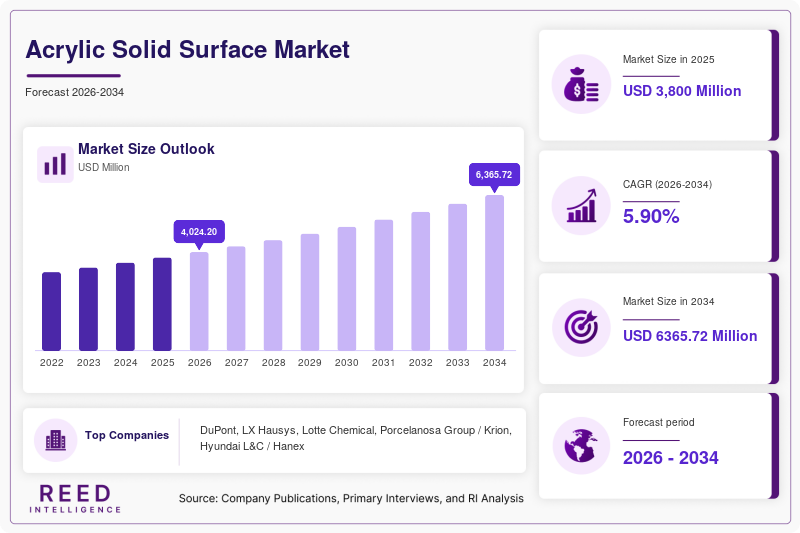
The global acrylic solid surface market size was valued at USD 3,800 million in 2025 and is projected to grow from USD 4,024 million in 2026 to USD 6,365.72 million by 2034, registering a CAGR of 5.90% during the forecast period from 2026 to 2034.
Acrylic solid surface is an engineered material generally produced from acrylic resin and mineral fillers, offering a combination of seamless fabrication, non-porosity, repairability and thermoformability. These characteristics allow fabricators to create continuous countertops, integrated basins, curved furniture elements, wall cladding and other customized components. Commercial applications increasingly include hospitality, healthcare, retail, restaurants, airports and corporate interiors where hygiene, appearance and maintenance requirements influence material selection.
Design flexibility remains a central market signal. Unlike conventional slab materials that depend heavily on straight-line installation, acrylic solid surfaces can be bonded with visually minimized joints and thermoformed into curved or complex geometries. This enables architects and interior designers to specify coordinated surfaces across countertops, walls, furniture and washroom components. Staron, Corian and HIMACS all emphasize seamless processing, thermoforming and broad application capabilities across residential and commercial projects.
Acrylic Solid Surface Market Drivers
Growth in Residential and Commercial Interior Renovation
Renovation activity across kitchens, bathrooms, hospitality spaces, retail outlets and corporate interiors supports demand for engineered surfaces that combine aesthetics with practical maintenance. Acrylic solid surface provides a continuous appearance across countertops, backsplashes, sinks and wall applications, reducing visible joints and allowing designers to coordinate multiple components using one material system.
The material's repairability also changes its lifecycle economics. Minor scratches and surface damage can generally be restored rather than requiring replacement of the complete surface, which is particularly relevant for high-use commercial environments. Healthcare, hospitality and public-space projects therefore represent important application areas where maintenance characteristics influence specification decisions.
Increasing Preference for Seamless and Hygienic Surfaces
Non-porous construction is an important purchasing criterion for kitchens, healthcare environments, laboratories, bathrooms and food-service facilities. Acrylic solid surfaces can be fabricated with seamless or near-seamless joints, while their non-porous characteristics simplify cleaning and reduce locations where moisture and contaminants can accumulate.
This functional profile is expanding the material's addressable applications beyond residential countertops. Commercial architects increasingly specify solid surfaces for reception counters, wall cladding, washbasins, laboratory surfaces and high-traffic interiors where cleaning requirements and surface continuity are important design considerations.
Greater Design Customization and Thermoforming
Thermoforming enables acrylic solid surface sheets to be shaped into curved fronts, integrated sinks, coves, furniture elements and three-dimensional architectural components. This provides designers with greater freedom to develop customized forms without switching between multiple material systems.
Manufacturers are reinforcing this capability through expanded colours, textures, stone-inspired patterns and larger sheet formats. The introduction of extra-wide HIMACS sheets, for example, allows larger surfaces to be fabricated with fewer joints, improving design continuity in commercial and architectural installations.
Acrylic Solid Surface Market Restraints
Higher Material and Fabrication Costs Compared with Conventional Surfaces
Acrylic solid surfaces generally require specialized fabrication, bonding, sanding and thermoforming capabilities. Material prices can also exceed those of entry-level laminates and some conventional countertop materials. This cost structure can restrict adoption in price-sensitive residential construction and standardized projects where upfront material cost has greater influence than lifecycle performance.
Fabricator availability is another constraint because installation quality depends on accurate cutting, bonding, finishing and thermoforming. Regions with a smaller professional fabrication network may experience higher installation costs and longer project lead times, limiting penetration outside established architectural and interior-design markets.
Competition from Quartz, Porcelain, Laminates and Natural Stone
Acrylic solid surface competes with quartz, porcelain, natural stone, compact surfaces, laminates and other engineered materials. Alternative surfaces can offer different combinations of hardness, scratch resistance, price, pattern realism or installation requirements, creating substitution pressure across countertops, wall surfaces and commercial interiors.
The competitive effect is strongest in applications where thermoforming and seamless fabrication are not essential. In these projects, buyers can prioritize material hardness, stone-like appearance or lower installed cost, requiring acrylic solid-surface manufacturers to differentiate through design flexibility, repairability, hygiene, sustainability and fabrication performance.
Acrylic Solid Surface Market Opportunities
Expansion into Healthcare, Hospitality and Public Infrastructure
Healthcare facilities, airports, hospitality properties, educational buildings and public spaces require surfaces that can withstand frequent cleaning and heavy usage while maintaining a consistent appearance. Corian and Staron applications demonstrate the use of solid surfaces across hospitals, airport terminals, public buildings, hospitality interiors and corporate environments.
The opportunity extends beyond conventional horizontal surfaces. Wall cladding, reception counters, elevator surrounds, washbasins, partitions and furniture components can use the same material platform, increasing material consumption per project. Large-scale commercial projects can therefore create higher-value demand than isolated residential countertop installations.
Development of Recycled-Content and Sustainable Surface Collections
Environmental requirements in building specifications are creating room for products that combine solid-surface functionality with verified recycled content and environmental certifications. HIMACS's 2026 collection includes multiple colours containing SCS-certified pre-consumer recycled content, while the company's sustainability platform highlights continued expansion of recycled-content products.
Acrylic Solid Surface Market Segmental Analysis
By Type
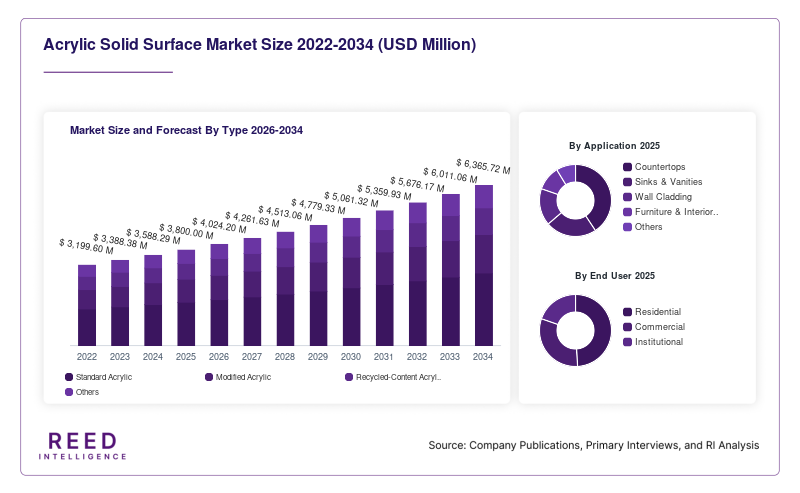
Standard Acrylic accounted for the dominant share of approximately 48% in 2026, supported by broad use in countertops, vanity surfaces, commercial interiors and fabricated architectural components. Standard formulations remain widely specified because they provide the core combination of seamless fabrication, non-porosity, repairability and thermoforming required across established applications. Recycled-Content Acrylic is projected to register the fastest CAGR of approximately 7.1% through 2034 as manufacturers expand products incorporating certified recycled materials.
Modified Acrylic represented approximately 27% of demand and is projected to expand at a 5.8% CAGR, supported by formulations optimized for specific aesthetic or performance requirements. Recycled-content products are increasingly moving from niche sustainability offerings toward mainstream architectural collections. HIMACS's 2026 portfolio demonstrates this transition, with multiple new colours incorporating SCS-certified pre-consumer recycled content.
By Application
Countertops represented the largest application at approximately 42% share in 2026 because of established adoption in kitchens, bathrooms, hospitality facilities and commercial workspaces. The ability to integrate sinks, backsplashes and countertop sections into a visually continuous surface supports specification where design continuity and maintenance are important. Wall Cladding is projected to be the fastest-growing application at approximately 6.8% CAGR.
Sinks & Vanities accounted for approximately 23% share and are expanding at a 5.9% CAGR, supported by integrated basin designs and bathroom renovation. Furniture & Interior Surfaces represented about 17% and is growing at 6.2% CAGR, while other applications accounted for approximately 18% with a 4.9% CAGR. Corian and Staron portfolios demonstrate the broad use of acrylic solid surfaces in reception counters, wall surfaces, furniture, public spaces, healthcare and hospitality.
By End User
Commercial applications held the largest share at approximately 46% in 2026, reflecting demand from hospitality, retail, restaurants, offices, healthcare-related facilities and public infrastructure. Commercial projects benefit from the material's repairability, non-porous surface and ability to create customized architectural forms. Institutional applications are projected to record the fastest CAGR of approximately 6.5% through 2034.
Residential applications accounted for approximately 39% share and are growing at 5.2% CAGR, driven by kitchen and bathroom renovation and demand for customized surfaces. Institutional users represented approximately 15% and include healthcare, education, transportation and public facilities, where hygiene, durability and maintenance requirements support solid-surface specifications.
Acrylic Solid Surface Market Regional Analysis
North America Acrylic Solid Surface Market
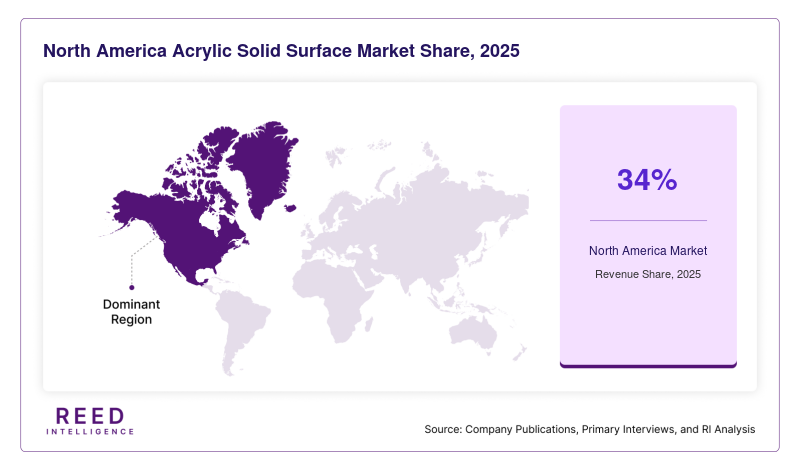
North America held the dominant regional share of approximately 34% in 2026, supported by established adoption of Corian and other solid-surface materials across residential remodeling, commercial interiors, healthcare, hospitality and public spaces. The region benefits from mature fabrication infrastructure, established architect-specifier networks and long-standing awareness of seamless engineered surfaces. Corian's portfolio specifically covers residential, healthcare, hospitality, food-service, education and public-space applications.
The United States remains the principal demand center, with renovation, commercial interiors and institutional construction supporting recurring surface requirements. Healthcare and hospitality projects provide applications where non-porous, easy-to-clean and repairable surfaces are valued, while architectural customization supports use in reception counters, wall cladding and integrated fixtures.
Europe Acrylic Solid Surface Market
Europe is projected to expand at approximately 5.5% CAGR during 2026–2034, supported by architectural renovation, hospitality projects and increasing emphasis on material sustainability. European designers increasingly use solid surfaces for furniture, kitchens, bathrooms, wall cladding and commercial interiors because of their combination of design flexibility and functional performance.
Germany, France, Italy and the United Kingdom represent important application markets, while manufacturers are increasingly differentiating products through recycled content, larger sheet formats and stone-inspired aesthetics. HIMACS's 2026 European portfolio expansion illustrates the regional emphasis on design variety and sustainability credentials.
Asia Pacific Acrylic Solid Surface Market
Asia Pacific is projected to be the fastest-growing region at approximately 7.0% CAGR through 2034. Urbanization, hospitality development, retail construction and expanding premium residential interiors are increasing the use of engineered surfaces. South Korean manufacturers and brands have a particularly strong position in acrylic solid surfaces, including HIMACS and Staron.
China, Japan, South Korea and India represent major demand centers, with commercial interiors, residential construction, healthcare infrastructure and premium hospitality projects creating application opportunities. In India, Staron is specified across airport, healthcare, administrative and commercial projects, demonstrating the expansion of acrylic solid surfaces into large infrastructure applications.
Latin America Acrylic Solid Surface Market
Latin America is expected to register approximately 5.8% CAGR during the forecast period as premium residential interiors, hospitality construction and commercial refurbishment increase demand for engineered architectural surfaces. Brazil and Mexico represent important markets where urban development and modern interior-design specifications create demand for customized countertops, wall surfaces and bathroom applications.
Demand remains sensitive to construction cycles, currency conditions and imported-material costs. As a result, suppliers with established distribution and fabrication networks can improve project accessibility by reducing lead times and supporting local installers, while differentiated colours, repairability and customized fabrication remain important purchasing factors.
Middle East & Africa Acrylic Solid Surface Market
The Middle East & Africa region is projected to record approximately 6.1% CAGR through 2034, supported by hospitality, airports, healthcare facilities, retail developments and high-end commercial construction. Large architectural projects favor materials capable of producing customized curves, seamless wall surfaces and integrated furniture elements, particularly where visual consistency is part of the interior specification.
Acrylic Solid Surface Market Competitive Landscape
The acrylic solid surface market is characterized by established international brands competing through material technology, design collections, fabrication support, certifications, sustainability attributes and distributor networks. DuPont's Corian maintains a broad architectural portfolio covering residential, healthcare, hospitality, food service, education and public-space applications. Its competitive positioning is supported by the established Corian brand and the ability to fabricate the material into seamless and thermoformed designs.
LX Hausys' HIMACS competes through design flexibility, thermoformability, large-format surfaces and product development focused on sustainability. Its 2026 launch of 15 new colours, including products with SCS-certified recycled content, demonstrates a strategy centered on aesthetic differentiation and environmental credentials. The introduction of a 1,520 mm-wide Aurora Alps sheet also expands fabrication possibilities for larger surfaces.
Key Market Players
- DuPont
- LX Hausys
- Lotte Chemical
- Porcelanosa Group / Krion
- Hyundai L&C / Hanex
- Aristech Surfaces
- Wilsonart
- Durasein
- Meganite
- Formica Group
- Staron
- Corian
- HIMACS
- Hanex
- Krion
Acrylic Solid Surface Market Recent Market Developments
-
2026 - LX Hausys: HIMACS introduced 15 new colours for 2026, including new marble, terrazzo, green and dark aesthetics. Several products contain SCS-certified pre-consumer recycled content, while Aurora Alps was expanded to an extra-wide 1,520 mm sheet.
-
2026 - DuPont / Corian Design: Corian's current 2026 portfolio highlights new nature-inspired aesthetics including Travertine Roma, Travertine Firenze, Artista Drift, Artista Mocha and City Roast, with selected designs incorporating recycled content.
Acrylic Solid Surface Market Segments
By Type
- Standard Acrylic
- Modified Acrylic
- Recycled-Content Acrylic
- Others
By Application
- Countertops
- Sinks & Vanities
- Wall Cladding
- Furniture & Interior Surfaces
- Others
By End User
- Residential
- Commercial
- Institutional
By Region
- North America
- Europe
- APAC
- Middle East and Africa
- LATAM