Acrylic Syntan Market Size, Share & Demand Report By Product Type (Amphoteric Acrylic Syntans, Anionic Acrylic Syntans), By Form (Liquid Acrylic Syntans), By Application (Footwear Leather, Automotive Leather, Furniture Upholstery Leather), By End-Use Industry (Leather Processing Industries, Automotive Industries, Footwear Manufacturing), By Distribution Channel (Direct Sales, Distributors & Wholesalers, Online Industrial Suppliers), By Region & Segment Forecasts, 2026–2034
USD 3950
Market Overview
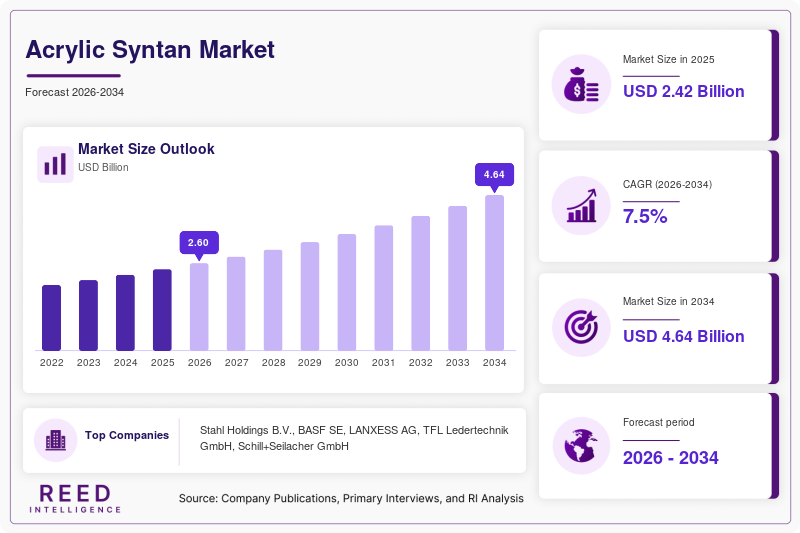
The Acrylic Syntan Market size was valued at USD 2.42 billion in 2026 and is projected to reach USD 4.31 billion by 2034, expanding at a CAGR of 7.5% during the forecast period (2026–2034). The market growth was supported by increasing demand for high-quality leather products across footwear, automotive upholstery, furniture, garments, and luxury accessories industries. Rising consumer preference for durable and lightweight leather materials accelerated the use of acrylic syntans in leather processing applications.
The expansion of leather manufacturing activities in emerging economies significantly contributed to the growth of the Acrylic Syntan Market. Acrylic syntans improved leather softness, fullness, dye penetration, and grain tightness, making them suitable for premium leather finishing applications. In addition, increasing investments in eco-friendly leather processing technologies encouraged the adoption of low-formaldehyde and biodegradable acrylic syntan formulations across global tanning industries.
Key Highlights
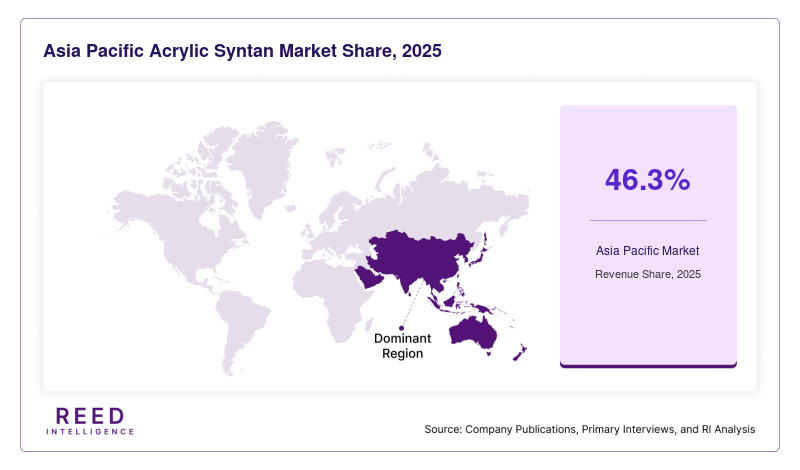
- Asia Pacific accounted for 46.3% of the global Acrylic Syntan Market share in 2025, while Latin America is projected to register the fastest CAGR of 8.4% during the forecast period.
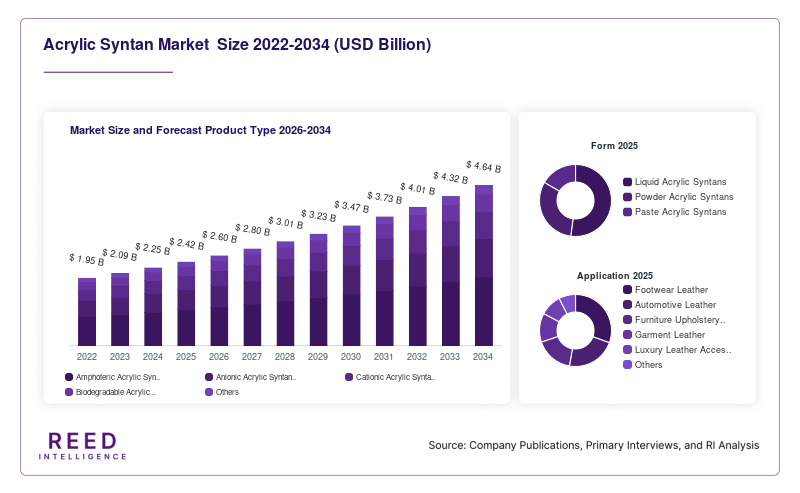
- By product type, amphoteric acrylic syntans held the leading share of 38.5% in 2025, whereas biodegradable acrylic syntans are expected to witness the fastest CAGR of 9.3% through 2034.
- By form, liquid acrylic syntans dominated with a 58.1% share in 2025, while powder acrylic syntans are forecast to grow at a CAGR of 8.1%.
- By application, footwear leather represented the largest share of 34.7% in 2025, whereas automotive leather applications are anticipated to record the fastest CAGR of 8.8%.
- By end-use industry, leather processing industries accounted for 41.9% of the market share in 2025, while luxury goods manufacturing is projected to expand at a CAGR of 8.9%.
- China dominated the Acrylic Syntan Market with a market value of USD 348 million in 2024 and USD 372 million in 2025.
Market Trends
Increasing Adoption of Eco-Friendly Leather Chemicals
The growing focus on environmentally compatible leather processing chemicals emerged as a major trend influencing the Acrylic Syntan Market. Leather manufacturers increasingly adopted acrylic syntans with low volatile organic compound emissions and reduced formaldehyde content to comply with environmental regulations.
Manufacturers also focused on biodegradable syntan formulations that minimized wastewater contamination during tanning operations. The trend gained significant momentum across footwear and automotive leather manufacturing sectors where sustainability standards became increasingly important.
Rising Demand for Premium Finished Leather
The increasing preference for premium leather products significantly influenced market trends. Consumers increasingly demanded leather products with improved softness, durability, color uniformity, and texture consistency.
Acrylic syntans gained wider acceptance due to their ability to enhance leather fullness and grain quality without affecting flexibility. Leather manufacturers increasingly incorporated advanced acrylic syntan formulations into high-end fashion accessories, upholstery, and luxury footwear applications.
Market Drivers
Expansion of Global Footwear Manufacturing
The rapid growth of global footwear manufacturing significantly supported the expansion of the Acrylic Syntan Market. Rising urbanization, changing fashion trends, and increasing disposable income accelerated demand for leather footwear products across emerging and developed economies.
Footwear manufacturers increasingly utilized acrylic syntans to improve leather softness, dye penetration, and tensile strength. The expansion of sports footwear and premium leather shoe production further contributed to market growth.
Growing Automotive Upholstery Industry
The expansion of automotive upholstery manufacturing accelerated demand for advanced leather processing chemicals. Automotive manufacturers increasingly required high-performance leather materials with enhanced durability, appearance, and resistance to environmental conditions.
Acrylic syntans gained broader acceptance in automotive leather processing because they improved grain tightness and softness while maintaining product durability. Increasing production of luxury vehicles and electric vehicles further strengthened market demand.
Market Restraint
Environmental Concerns Related to Leather Processing
Environmental concerns associated with wastewater generation and chemical disposal restrained the growth of the Acrylic Syntan Market to a certain extent. Leather processing industries face strict environmental regulations regarding water treatment and chemical emissions. Compliance with these regulations increased operational costs for leather manufacturers and chemical suppliers.
Market Opportunities
Growth of Sustainable Leather Manufacturing
The increasing adoption of sustainable leather manufacturing practices presents significant growth opportunities for the Acrylic Syntan Market. Leather producers increasingly require biodegradable and low-impact tanning chemicals to align with sustainability initiatives and export standards.
Acrylic syntan manufacturers are expected to benefit from rising investments in cleaner tanning technologies and eco-friendly leather production systems.
Expansion of Luxury Fashion Accessories
The growing demand for luxury handbags, wallets, belts, and fashion accessories is expected to create favorable opportunities for the market. Premium fashion brands increasingly require high-quality finished leather with improved softness and visual consistency.
Acrylic syntans are anticipated to witness rising demand due to their ability to enhance leather aesthetics and processing efficiency in luxury product manufacturing.
Segmental Analysis
By Product Type
Based on product type, the Acrylic Syntan Market is segmented into amphoteric acrylic syntans, anionic acrylic syntans, cationic acrylic syntans, biodegradable acrylic syntans, and others.
Amphoteric acrylic syntans accounted for the largest market share of 38.5% in 2025. Their dominance was attributed to excellent compatibility with different tanning agents and superior leather filling properties. These syntans were widely utilized across footwear, upholstery, and garment leather applications because they improved leather softness and grain uniformity.
Manufacturers increasingly preferred amphoteric acrylic syntans due to their ability to enhance dye penetration and maintain leather flexibility during processing. Their broad applicability across multiple leather types further contributed to segment dominance.
Biodegradable acrylic syntans are projected to register the fastest CAGR of 9.3% during the forecast period. Their growth will be supported by increasing environmental regulations and rising adoption of sustainable tanning chemicals. Leather manufacturers are expected to invest in biodegradable syntans to reduce wastewater pollution and improve compliance with export standards.
Anionic acrylic syntans are also anticipated to witness stable growth due to increasing use in lightweight leather applications requiring improved softness and fullness characteristics.
By Form
Based on form, the Acrylic Syntan Market is categorized into liquid acrylic syntans, powder acrylic syntans, and paste acrylic syntans.
Liquid acrylic syntans dominated the market with a 58.1% share in 2025. Their widespread adoption was supported by ease of application, improved solubility, and compatibility with automated tanning processes. Liquid formulations remained highly preferred in industrial leather processing because they enabled uniform penetration and simplified chemical handling.
Manufacturers increasingly utilized liquid syntans to improve operational efficiency and reduce processing time. The segment also maintained strong demand across automotive upholstery and footwear manufacturing industries.
Powder acrylic syntans are projected to grow at a CAGR of 8.1% during the forecast period. The growth will be driven by increasing demand for concentrated tanning chemicals with extended shelf life and reduced transportation costs. Powder formulations are expected to gain traction among small and medium-scale leather processing units.
Paste acrylic syntans are also anticipated to witness moderate growth due to their use in specialty leather finishing applications requiring controlled viscosity and precise formulation adjustments.
By Application
Based on application, the Acrylic Syntan Market is divided into footwear leather, automotive leather, furniture upholstery leather, garment leather, luxury leather accessories, and others.
Footwear leather accounted for the leading market share of 34.7% in 2025. The segment dominance was attributed to rising global footwear production and increasing consumer demand for comfortable leather shoes. Acrylic syntans improved leather softness, flexibility, and dye uniformity, making them suitable for premium footwear manufacturing.
Manufacturers increasingly incorporated acrylic syntans into sports shoes, formal footwear, and fashion footwear production to enhance product quality and durability. Growing footwear exports from Asia Pacific further supported segment demand.
Automotive leather applications are projected to register the fastest CAGR of 8.8% during the forecast period. The growth will be driven by increasing demand for premium vehicle interiors and durable upholstery materials. Automotive manufacturers are expected to adopt advanced acrylic syntans to improve leather resistance to heat, abrasion, and color fading.
Furniture upholstery leather is also anticipated to witness stable growth due to increasing demand for residential and commercial furniture products with premium leather finishes.
By End-Use Industry
Based on end-use industry, the Acrylic Syntan Market is segmented into leather processing industries, automotive industries, footwear manufacturing, luxury goods manufacturing, furniture industries, and others.
Leather processing industries held the largest market share of 41.9% in 2025. The segment growth was supported by increasing demand for advanced tanning chemicals and expanding leather exports globally. Leather processors increasingly utilized acrylic syntans to improve leather quality, fullness, and finishing performance.
The growing production of processed leather for footwear, upholstery, and fashion applications accelerated segment demand. Investments in modern tanning facilities and chemical-efficient processing systems further contributed to market growth.
Luxury goods manufacturing is projected to register the fastest CAGR of 8.9% during the forecast period. The growth will be supported by increasing consumer spending on premium handbags, wallets, belts, and fashion accessories. Luxury brands are expected to adopt advanced leather finishing technologies to improve product appearance and durability.
Automotive industries are also expected to witness strong growth due to rising demand for leather interiors in premium and electric vehicles.
By Distribution Channel
Based on distribution channel, the Acrylic Syntan Market is segmented into direct sales, distributors & wholesalers, online industrial suppliers, and specialty leather chemical suppliers.
Direct sales accounted for the dominant market share in 2025 due to strong procurement relationships between leather chemical manufacturers and tanning industries. Large leather processing companies preferred direct purchasing agreements for customized formulations and bulk procurement.
Online industrial suppliers are projected to witness the fastest CAGR during the forecast period due to increasing digitalization of industrial chemical procurement and expanding global trade networks.
Regional Analysis
Asia Pacific
Asia Pacific held 46.3% of the global Acrylic Syntan Market share in 2025 and is projected to expand at a CAGR of 7.9% during the forecast period. The region maintained a dominant position due to strong leather processing industries and rising footwear manufacturing activities.
China dominated the regional market owing to increasing leather exports and expanding automotive upholstery production. The country also benefited from large-scale leather chemical manufacturing infrastructure and growing domestic demand for leather goods.
North America
North America accounted for 19.6% of the Acrylic Syntan Market share in 2025 and is anticipated to grow at a CAGR of 6.8% through 2034. The region experienced stable demand due to increasing adoption of sustainable leather processing technologies and premium automotive interiors.
The United States led the regional market owing to rising demand for luxury leather products and customized automotive upholstery. Manufacturers increasingly invested in eco-friendly tanning processes to comply with environmental standards.
Europe
Europe represented 22.4% of the global Acrylic Syntan Market share in 2025 and is expected to register a CAGR of 6.9% during the forecast period. The region witnessed growth due to strong luxury fashion manufacturing and advanced leather processing industries.
Italy dominated the European market due to its established luxury leather goods industry and growing exports of premium footwear and fashion accessories. Increasing focus on sustainable leather manufacturing also contributed to regional growth.
Middle East & Africa
The Middle East & Africa accounted for 6.2% of the Acrylic Syntan Market share in 2025 and is forecast to grow at a CAGR of 7.3% during the forecast period. Increasing investments in leather processing and footwear manufacturing supported regional market expansion.
Turkey emerged as the dominant country due to expanding leather exports and rising demand for finished leather products across international markets. Industrial modernization programs also strengthened leather chemical consumption.
Latin America
Latin America held 5.5% of the global Acrylic Syntan Market share in 2025 and is projected to expand at the fastest CAGR of 8.4% during the forecast period. The regional market benefited from growing leather exports and expanding footwear production activities.
Brazil dominated the Latin American market due to strong cattle farming industries and increasing investments in leather processing facilities. Rising exports of leather footwear and automotive leather materials further supported market growth.
Competitive Landscape
The Acrylic Syntan Market remains moderately competitive with the presence of global leather chemical manufacturers and specialty tanning solution providers focusing on sustainable formulations, product innovation, and regional expansion strategies. Companies continue investing in environmentally compatible acrylic syntans to improve leather processing efficiency and reduce wastewater impact.
Stahl Holdings B.V. maintained a strong market position due to its diversified leather chemical portfolio and extensive global distribution network. The company recently introduced low-formaldehyde acrylic syntan formulations focused on sustainable leather processing applications.
Other major companies including BASF SE, LANXESS AG, TFL Ledertechnik GmbH, and Schill+Seilacher GmbH focused on expanding eco-friendly tanning chemical production and strengthening partnerships with leather manufacturers. Strategic investments in research and advanced leather finishing technologies also remained a key competitive strategy across the market.
Key Players List
- Stahl Holdings B.V.
- BASF SE
- LANXESS AG
- TFL Ledertechnik GmbH
- Schill+Seilacher GmbH
- Buckman Laboratories International, Inc.
- Zschimmer & Schwarz GmbH & Co KG
- Trumpler GmbH & Co. KG
- Smit & Zoon
- Pulcra Chemicals GmbH
- DyStar Group
- Fenice S.p.A.
- Indofil Industries Limited
- Pidilite Industries Limited
- Chemtan Company
Recent Developments
- In 2025, Stahl Holdings B.V. introduced low-formaldehyde acrylic syntan solutions for sustainable leather processing applications.
- BASF SE expanded specialty leather chemical production capacity to support increasing global leather manufacturing demand.
- LANXESS AG enhanced research programs focused on biodegradable tanning chemical technologies.
- TFL Ledertechnik GmbH launched advanced acrylic syntans designed for automotive upholstery leather applications.
- Schill+Seilacher GmbH invested in environmentally compatible leather finishing technologies to improve wastewater efficiency.
- Smit & Zoon strengthened partnerships with footwear manufacturers for customized leather chemical formulations.
- Pulcra Chemicals GmbH expanded distribution operations across Asia Pacific to support growing leather processing industries.
Acrylic Syntan Market Segments
Product Type
- Amphoteric Acrylic Syntans
- Anionic Acrylic Syntans
- Cationic Acrylic Syntans
- Biodegradable Acrylic Syntans
- Others
Form
- Liquid Acrylic Syntans
- Powder Acrylic Syntans
- Paste Acrylic Syntans
Application
- Footwear Leather
- Automotive Leather
- Furniture Upholstery Leather
- Garment Leather
- Luxury Leather Accessories
- Others
End-Use Industry
- Leather Processing Industries
- Automotive Industries
- Footwear Manufacturing
- Luxury Goods Manufacturing
- Furniture Industries
- Others
Distribution Channel
- Direct Sales
- Distributors & Wholesalers
- Online Industrial Suppliers
- Specialty Leather Chemical Suppliers
By Region
- North America
- Europe
- APAC
- Middle East and Africa
- LATAM