Activated Alumina Market Size, Share & Demand Report By Type (Adsorbent Activated Alumina, Catalyst Activated Alumina, Desiccant Activated Alumina), By Application (Water Treatment, Gas Drying, Catalyst Support, Air Purification, Chemical Processing), By End-Use Industry (Municipal Utilities, Petrochemical Industry, Oil & Gas, Chemical Manufacturing, Healthcare, Others), By Region & Segment Forecasts, 2026–2034
USD 3950
Market Overview
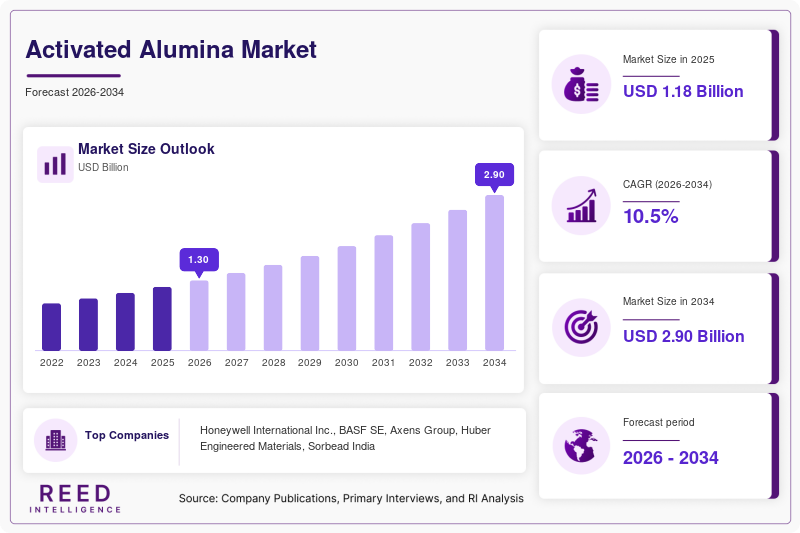
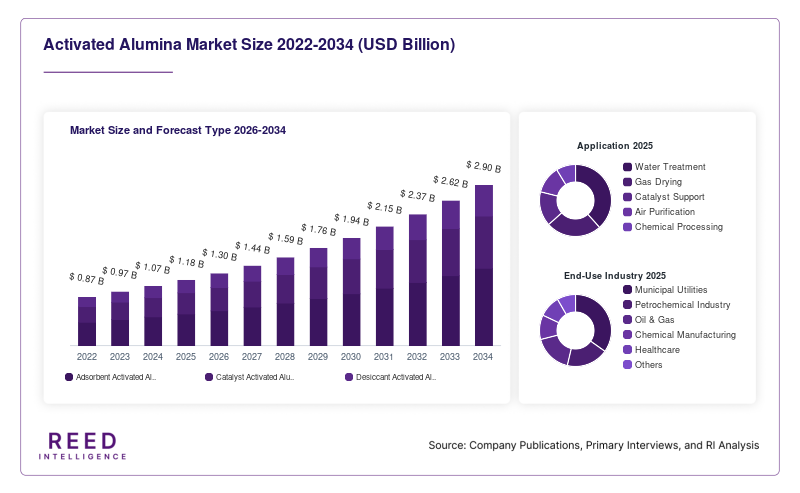
The global Activated Alumina Market size was valued at USD 1.18 billion in 2026 and is projected to reach USD 2.63 billion by 2034, expanding at a CAGR of 10.5% during 2026–2034. Activated alumina is a highly porous form of aluminum oxide widely used for adsorption, drying, fluoride removal, catalyst applications, and purification processes across water treatment, oil & gas, petrochemicals, healthcare, and industrial manufacturing sectors. The material’s high surface area, thermal stability, and regeneration capability continue to support its adoption in both mature and emerging industries.
A major global factor supporting market growth is the increasing investment in water treatment infrastructure. Governments and private utilities across developed and developing economies are expanding wastewater treatment, drinking water purification, and industrial water recycling facilities to address water scarcity and environmental concerns. Activated alumina remains one of the preferred adsorbents for fluoride, arsenic, and other contaminants, creating sustained demand across municipal and industrial applications.
Key Highlights
- North America dominated the market with a 35.4% share in 2025.
- while Asia Pacific is expected to grow at the fastest CAGR of 11.8% during 2026–2034.
- By type, Adsorbent Activated Alumina accounted for the largest share of 46.8%.
- while Catalyst Activated Alumina is projected to grow at a CAGR of 11.9%.
- By application, Water Treatment led with a 42.6% share.
- whereas Gas Drying is expected to expand at a CAGR of 11.6%.
- By end-use industry, Municipal Utilities held the largest share of 36.9%.
- while Petrochemical Industry is projected to grow at a CAGR of 12.1%.
- The United States remained the dominant country, with market values of USD 392 million in 2024 and USD 428 million in 2025.
Market Trends
Rising Adoption of Advanced Water Purification Technologies
The growing need for clean water resources is reshaping demand patterns within the Activated Alumina Market. Municipal authorities and industrial operators are increasingly investing in advanced filtration and adsorption technologies to comply with stricter water quality regulations. Activated alumina is gaining preference due to its effectiveness in removing fluoride, arsenic, selenium, and other dissolved contaminants from drinking water supplies. Several countries are upgrading aging water infrastructure while introducing new treatment facilities to support population growth and urban expansion. This trend is particularly visible in regions facing groundwater contamination and water scarcity challenges. As industries seek sustainable water management solutions, activated alumina continues to emerge as a practical and cost-efficient treatment medium, supporting consistent market growth across municipal and industrial applications.
Expanding Utilization in Petrochemical and Gas Processing Facilities
The expansion of petrochemical manufacturing and natural gas processing facilities is creating significant momentum for activated alumina consumption. The material plays a critical role in dehydration, purification, sulfur removal, and catalyst support applications. Increasing energy demand, coupled with investments in refining and chemical production capacity, is encouraging operators to adopt high-performance adsorption materials that improve process efficiency and product quality. Activated alumina offers excellent thermal stability and adsorption characteristics, making it suitable for demanding industrial environments. Market participants are introducing specialized grades tailored to hydrocarbon processing requirements, helping end users achieve operational reliability and lower maintenance costs. This trend is expected to remain influential as industrial production and energy infrastructure investments continue to expand globally.
Market Drivers
Increasing Investments in Municipal and Industrial Water Treatment
Growing concerns regarding water quality and environmental sustainability are driving substantial investments in water treatment infrastructure worldwide. Municipal agencies are implementing stricter purification standards to ensure safe drinking water, while industries are adopting advanced wastewater treatment systems to meet regulatory requirements. Activated alumina is widely recognized for its ability to remove fluoride, arsenic, and other contaminants effectively. Rising urbanization and industrialization are placing additional pressure on water resources, encouraging governments and private organizations to expand treatment capacities. The increasing adoption of water recycling and reuse programs further strengthens product demand. As water scarcity challenges intensify across multiple regions, activated alumina remains a critical component in modern treatment processes, supporting long-term market expansion.
Growing Demand from Oil, Gas, and Petrochemical Industries
The continued growth of oil, gas, and petrochemical operations represents another significant driver for the Activated Alumina Market. Processing facilities rely on activated alumina for dehydration, purification, catalyst support, and contaminant removal applications. Rising energy consumption and increasing investments in refining capacity are boosting demand for advanced adsorbent materials capable of maintaining process efficiency. The material’s durability, high adsorption capacity, and regenerative properties make it suitable for large-scale industrial environments. Emerging economies are expanding refining and chemical manufacturing capabilities to support domestic consumption and export activities. As a result, activated alumina suppliers are benefiting from growing procurement requirements across upstream, midstream, and downstream industrial operations, creating sustained revenue opportunities throughout the forecast period.
Market Restraint
Volatility in Raw Material and Energy Costs
Fluctuations in raw material prices and energy costs remain a significant challenge for the Activated Alumina Market. The production process requires substantial energy input for calcination and activation, making manufacturers sensitive to changes in electricity and fuel prices. Variations in aluminum-related feedstock costs can also influence overall production expenses and profit margins. In highly competitive markets, producers may face difficulties transferring increased costs to customers, resulting in pricing pressure and reduced profitability.
The impact is particularly noticeable among small and medium-sized manufacturers that operate with limited economies of scale. Unexpected increases in operational costs can affect production planning, investment decisions, and supply chain stability. For example, periods of elevated energy prices may lead to higher manufacturing expenses, reducing competitiveness in price-sensitive markets. Additionally, fluctuations in transportation and logistics costs can further affect product pricing. Although technological improvements and process optimization initiatives are helping manufacturers improve efficiency, cost volatility continues to represent a restraint that may influence market growth dynamics during the forecast period.
Market Opportunities
Expansion of Fluoride Removal Projects in Emerging Economies
Emerging economies present substantial opportunities for activated alumina suppliers due to increasing investments in fluoride removal and drinking water purification projects. Many regions continue to face challenges associated with naturally occurring fluoride contamination in groundwater resources. Governments and development agencies are implementing large-scale treatment programs to improve public health outcomes and expand access to safe drinking water. Activated alumina is widely utilized because of its proven effectiveness and operational reliability in fluoride removal systems. Growing awareness of waterborne health risks is encouraging greater adoption of advanced treatment technologies. As infrastructure development accelerates across developing nations, manufacturers can benefit from long-term supply contracts and increasing demand from municipal water authorities.
Development of High-Performance Catalyst Carrier Solutions
The growing focus on process efficiency and emissions reduction is creating opportunities for advanced catalyst carrier applications. Activated alumina serves as an important support material in refining, petrochemical processing, and specialty chemical manufacturing. Industrial operators are seeking materials that offer improved surface area, enhanced stability, and better catalytic performance under demanding operating conditions. Manufacturers are investing in research and development to introduce customized products designed for specific industrial applications. The emergence of cleaner fuel production technologies and stricter environmental regulations is expected to further increase demand for high-performance catalyst systems. These developments provide opportunities for suppliers to diversify product portfolios and strengthen their presence in high-value industrial markets.
Segmental Analysis
By Type
Adsorbent Activated Alumina represented the dominant subsegment, accounting for 46.8% of market share in 2024. Its leadership position is primarily attributed to widespread utilization in water treatment, air purification, gas drying, and industrial adsorption applications. The material’s high surface area and strong affinity for contaminants make it suitable for removing fluoride, arsenic, sulfur compounds, and moisture from various process streams. Municipal utilities and industrial facilities continue to prefer adsorbent grades because of their reliability and regeneration capability. Increasing investments in wastewater treatment and environmental compliance programs are supporting demand across developed and developing regions. Furthermore, advancements in manufacturing processes have improved adsorption efficiency, extending product lifespan and enhancing operational performance for end users.
Catalyst Activated Alumina is projected to be the fastest-growing subsegment, registering a CAGR of 11.9% during 2026–2034. Growth is being driven by expanding petrochemical, refining, and specialty chemical industries that require advanced catalyst support materials. Activated alumina provides excellent mechanical strength, thermal stability, and surface characteristics necessary for catalytic reactions under demanding operating conditions. Rising investments in cleaner fuel production and emissions reduction technologies are encouraging the adoption of high-performance catalyst systems. Manufacturers are developing customized formulations that deliver improved catalytic efficiency and process optimization. The increasing focus on sustainable industrial production and operational reliability is expected to further accelerate demand for catalyst-grade activated alumina throughout the forecast period.
By Application
Water Treatment emerged as the largest application segment, holding 42.6% of market share in 2024. The segment benefits from growing concerns regarding water quality, contamination, and resource sustainability. Activated alumina is extensively used for fluoride removal, arsenic reduction, and purification of drinking water supplies. Municipal authorities and industrial operators are investing heavily in advanced treatment systems to meet stricter environmental standards and improve public health outcomes. The material’s effectiveness, cost efficiency, and ability to be regenerated make it a preferred choice in numerous treatment processes. Rising urbanization and increasing demand for safe water resources continue to create favorable conditions for the expansion of this application segment across global markets.
Gas Drying is expected to record the fastest growth, expanding at a CAGR of 11.6% during the forecast period. The growth trajectory is closely linked to increasing natural gas production, processing activities, and energy infrastructure development. Activated alumina is widely used for moisture removal from gas streams, helping operators prevent corrosion, improve process efficiency, and maintain product quality. Growing investments in liquefied natural gas facilities, petrochemical complexes, and pipeline infrastructure are supporting rising demand for gas drying solutions. Technological advancements in adsorption systems are improving operational performance and reducing maintenance requirements. These factors collectively position gas drying as a rapidly expanding application area within the Activated Alumina Market.
By End-Use Industry
Municipal Utilities accounted for the largest share of the market, representing 36.9% of total revenue in 2024. The segment’s dominance reflects the increasing focus on providing safe drinking water and improving wastewater treatment capabilities. Municipal agencies are upgrading existing facilities and constructing new treatment plants to address population growth, urbanization, and environmental concerns. Activated alumina plays an important role in contaminant removal processes, particularly for fluoride and arsenic reduction. Government funding programs and regulatory mandates continue to support infrastructure investments worldwide. The ability of activated alumina to deliver effective purification performance while maintaining operational efficiency contributes significantly to its widespread adoption within municipal utility operations.
The Petrochemical Industry is anticipated to be the fastest-growing end-use segment, registering a CAGR of 12.1% between 2026 and 2034. Expansion of refining capacity, chemical manufacturing activities, and energy infrastructure projects is creating strong demand for activated alumina products. The material is extensively used in dehydration, purification, catalyst support, and contaminant removal applications across petrochemical operations. Increasing global energy consumption and investments in downstream processing facilities are further strengthening market prospects. Manufacturers are developing specialized grades tailored to specific industrial requirements, enabling higher performance and improved process efficiency. As petrochemical production continues to expand globally, this segment is expected to generate substantial growth opportunities for market participants.
Regional Analysis
North America
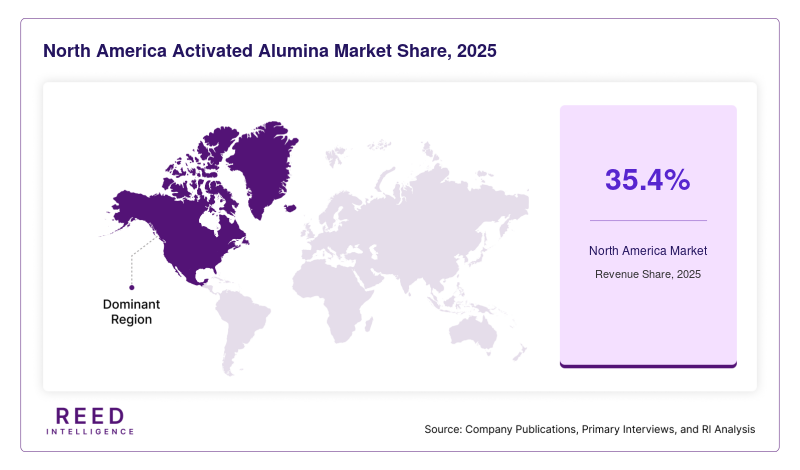
North America accounted for 35.4% of the global Activated Alumina Market in 2025, maintaining its position as the leading regional market. The region is expected to register a CAGR of 9.4% through 2034, supported by strong industrial infrastructure and continuous investments in environmental compliance initiatives. Demand remains high across water treatment, natural gas processing, and petrochemical sectors. Regulatory standards governing drinking water quality and industrial emissions continue to encourage the adoption of advanced adsorption materials. The presence of established manufacturers and technology providers further supports regional market development.
The United States represents the dominant country within the region. A key growth factor is the continuous modernization of municipal water treatment infrastructure. Federal and state authorities are allocating funding for the replacement and expansion of treatment facilities to improve water quality standards. Industrial facilities are also increasing investments in purification technologies to meet evolving environmental regulations, supporting stable demand for activated alumina products.
Europe
Europe held approximately 25.1% market share in 2025 and is projected to expand at a CAGR of 9.1% during the forecast period. The regional market benefits from stringent environmental regulations, advanced industrial operations, and strong adoption of sustainable manufacturing practices. Demand is particularly strong in wastewater treatment, chemical processing, and environmental remediation applications. European industries continue to invest in technologies that reduce emissions and improve resource efficiency, contributing to consistent consumption of activated alumina products.
Germany remains the leading country in the European market. A distinctive growth factor is the region’s emphasis on circular economy initiatives and industrial sustainability programs. Manufacturers are adopting advanced filtration and purification systems to optimize resource utilization and reduce environmental impact. The growing integration of water recycling systems in industrial facilities is also creating favorable conditions for activated alumina suppliers across the country.
Asia Pacific
Asia Pacific represented 22.8% of global market revenue in 2025 and is expected to record the fastest CAGR of 11.8% through 2034. Rapid urbanization, industrial expansion, and infrastructure development are contributing to rising demand across multiple end-use sectors. Countries throughout the region are increasing investments in municipal water treatment facilities, petrochemical complexes, and industrial processing plants. Growing environmental awareness and tightening regulatory frameworks are further supporting market growth.
China dominates the regional market due to its extensive industrial base and large-scale infrastructure investments. One major growth factor is the expansion of water treatment capacity to address increasing urban populations and environmental concerns. Government-led initiatives focused on wastewater management and industrial pollution control are encouraging widespread adoption of advanced adsorption technologies, including activated alumina systems.
Middle East & Africa
The Middle East & Africa accounted for 9.4% of the global market in 2025 and is anticipated to achieve a CAGR of 10.2% during the forecast period. Demand is primarily supported by water desalination projects, oil and gas operations, and industrial development activities. Many countries in the region face water scarcity challenges, encouraging investments in purification and treatment technologies. Activated alumina is increasingly utilized in both municipal and industrial applications due to its effectiveness and operational reliability.
Saudi Arabia remains the leading national market within the region. A significant growth factor is the ongoing expansion of desalination and water treatment infrastructure. Government programs focused on securing long-term water resources are increasing demand for advanced treatment materials. Additionally, investments in petrochemical and refining facilities continue to support industrial consumption of activated alumina products.
Latin America
Latin America captured 7.3% market share in 2025 and is forecast to grow at a CAGR of 9.8% through 2034. The market is benefiting from rising investments in industrial development, environmental management, and water infrastructure projects. Several countries are strengthening regulations related to wastewater discharge and industrial emissions, encouraging greater adoption of purification technologies. Demand is also increasing across mining, chemical processing, and municipal treatment sectors.
Brazil is the dominant country in the region. A unique growth factor is the modernization of industrial water management systems across manufacturing and mining operations. Companies are increasingly implementing treatment and recycling solutions to improve resource efficiency and comply with environmental regulations. These initiatives are expected to create sustained opportunities for activated alumina suppliers throughout the forecast period.
Competitive Landscape
The Activated Alumina Market is moderately consolidated, with leading companies focusing on capacity expansion, product innovation, strategic partnerships, and regional market penetration. Competition is largely based on product quality, adsorption efficiency, customization capabilities, and distribution networks. Companies are investing in research and development activities to improve performance characteristics and address evolving customer requirements across water treatment, petrochemical, and industrial processing applications.
Honeywell International Inc. remains a leading participant due to its diversified product portfolio and strong industrial customer base. The company recently expanded its specialty adsorbent offerings to support advanced gas processing applications. Other prominent players continue to strengthen their market positions through technological advancements and operational investments.
BASF SE focuses on catalyst support materials and industrial adsorption solutions. Axens Group maintains a strong presence in refining and petrochemical applications through specialized activated alumina products. Huber Engineered Materials emphasizes high-performance purification materials for environmental and industrial applications. Sorbead India continues to expand manufacturing capabilities and export operations to address growing demand across emerging markets. Market participants are expected to prioritize sustainable production methods and customized solutions to strengthen competitive positioning during the forecast period.
Key Players List
- Honeywell International Inc.
- BASF SE
- Axens Group
- Huber Engineered Materials
- Sorbead India
- Dynamic Adsorbents Inc.
- Shandong Zhongxin New Material Technology Co., Ltd.
- Jiangsu Jingjing New Material Co., Ltd.
- Porocel Industries LLC
- Sumitomo Chemical Co., Ltd.
- CHALCO Advanced Material Co., Ltd.
- Activated Alumina International LLC
- Bee Chems
- Global Adsorbents Pvt. Ltd.
Recent Developments
- Honeywell International Inc. introduced an enhanced activated alumina adsorption solution designed for high-efficiency gas dehydration applications.
- BASF SE expanded production capabilities for specialty alumina materials to address increasing demand from catalyst and environmental applications.
- Axens Group launched a new activated alumina product line focused on improving refinery process efficiency and contaminant removal performance.
- Sorbead India announced capacity expansion initiatives aimed at supporting growing export demand across Asia Pacific and the Middle East.
- Huber Engineered Materials invested in product development programs targeting advanced water treatment and industrial purification applications.
Activated Alumina Market Segments
Type
- Adsorbent Activated Alumina
- Catalyst Activated Alumina
- Desiccant Activated Alumina
Application
- Water Treatment
- Gas Drying
- Catalyst Support
- Air Purification
- Chemical Processing
End-Use Industry
- Municipal Utilities
- Petrochemical Industry
- Oil & Gas
- Chemical Manufacturing
- Healthcare
- Others
By Region
- North America
- Europe
- APAC
- Middle East and Africa
- LATAM