Activated Roller Belt Sorter Market Size, Share & Demand Report By Type (Linear Activated Roller Belt Sorter, Loop Activated Roller Belt Sorter), By Component (Hardware, Software), By Application (E-commerce, Retail, Food & Beverage, Pharmaceuticals, Others), By End-Use Industry (Logistics & Transportation, Manufacturing, Healthcare, Retail & Consumer Goods) By Region & Segment Forecasts, 2026–2034
USD 3950
Market Overview
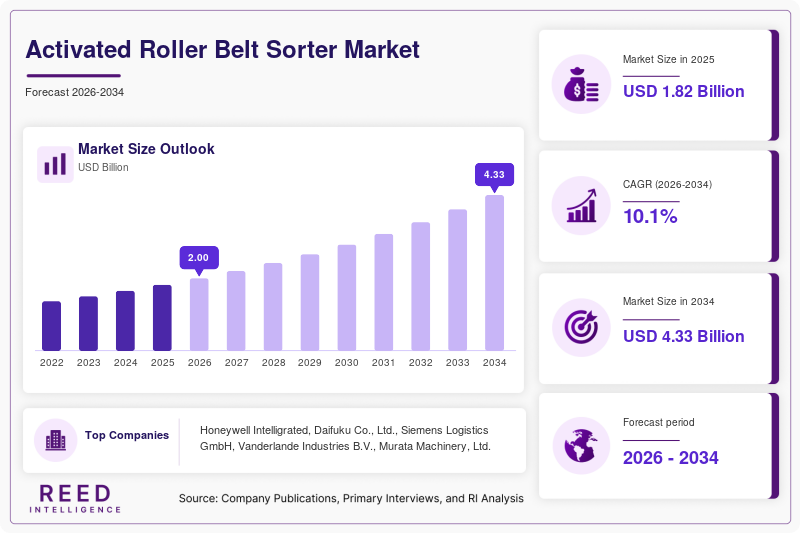
The Activated Roller Belt Sorter Market was valued at USD 1.82 billion in 2026 and is projected to reach USD 3.94 billion by 2034, expanding at a CAGR of 10.1% from 2026 to 2034. The market growth is being supported by the global expansion of automated material handling systems, particularly in logistics, e-commerce, and warehouse operations where speed, accuracy, and scalability are critical.
A key global factor driving the market is the rapid adoption of warehouse automation technologies to address labor shortages and rising order volumes. Activated roller belt sorters offer high-speed sorting, precise item handling, and flexibility for handling diverse package sizes, making them an essential component of modern fulfillment centers.
Key Highlights
- Dominant region: North America accounted for 36.4% market share in 2025, while Asia Pacific is expected to register the fastest CAGR of 12.8% during the forecast period.
- Leading subsegments: Linear sorters dominated the type segment with 52.7% share, while loop sorters are projected to grow at a CAGR of 11.6%. In application, e-commerce led with 44.2% share, whereas food & beverage is expected to grow at 11.2% CAGR.
- Dominant country: The United States market was valued at USD 620 million in 2024 and reached USD 675 million in 2025, driven by advanced logistics infrastructure and automation investments.
Market Trends
Integration of Smart Sensors and AI-Based Sorting Optimization
The integration of smart sensors, machine vision systems, and artificial intelligence is reshaping the Activated Roller Belt Sorter Market. These technologies enable real-time parcel identification, predictive routing, and adaptive sorting speeds. Companies are increasingly implementing AI-driven systems to minimize sorting errors and optimize throughput, especially in high-volume fulfillment centers. This trend is expected to enhance operational efficiency and reduce downtime.
Shift Toward Modular and Scalable Sorting Systems
Another significant trend is the growing preference for modular sorter designs that can be easily expanded or reconfigured. Businesses are investing in flexible activated roller belt sorter systems that can adapt to fluctuating demand patterns. Modular systems reduce installation time and allow operators to scale operations without major infrastructure changes, making them highly attractive for small and mid-sized warehouses.
Market Drivers
Rising Demand for High-Speed Parcel Sorting in E-commerce
The surge in global e-commerce activity has created a need for efficient and high-speed sorting systems. Activated roller belt sorters are capable of handling thousands of items per hour with high accuracy, making them suitable for large-scale distribution centers. The increasing volume of small parcel shipments has accelerated the adoption of these systems across logistics networks.
Growing Investments in Warehouse Automation
Organizations across industries are investing in automated material handling to improve productivity and reduce operational costs. Activated roller belt sorters play a key role in automated workflows by enabling seamless integration with conveyor systems, robotic picking solutions, and warehouse management software. This growing focus on automation is driving market expansion.
Market Restraints
High Initial Installation and Maintenance Costs
The adoption of activated roller belt sorter systems involves significant capital investment, including equipment costs, installation, and integration with existing systems. Additionally, maintenance and technical expertise requirements can pose challenges for small and medium-sized enterprises, limiting market penetration in cost-sensitive regions.
Market Opportunities
Expansion of Automation in Emerging Economies
Emerging economies in Asia Pacific and Latin America are witnessing rapid industrialization and infrastructure development. As companies in these regions adopt modern logistics practices, there is a growing opportunity for activated roller belt sorter manufacturers to expand their presence and offer cost-effective solutions tailored to local needs.
Adoption in Non-Traditional Sectors
While logistics and e-commerce dominate the market, industries such as pharmaceuticals, retail stores, and food processing are increasingly adopting automated sorting systems. The ability of activated roller belt sorters to handle delicate or irregular items opens new application areas, creating additional growth opportunities.
Segmental Analysis
By Type
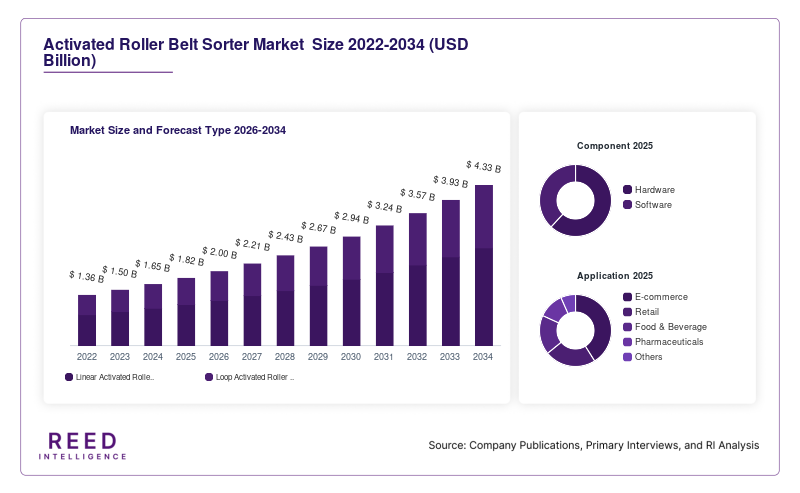
The linear activated roller belt sorter segment dominated the market with a 52.7% share in 2025, owing to its simplicity, cost-effectiveness, and suitability for straight-line sorting operations. Linear systems are widely used in warehouses with space constraints and standardized workflows.
The loop sorter segment is projected to grow at a CAGR of 11.6% during the forecast period. This growth will be driven by its ability to handle higher throughput and continuous sorting operations. Loop systems offer greater flexibility for complex distribution networks, making them ideal for large-scale logistics hubs.
By Component
The hardware segment accounted for 61.3% of the market share in 2025, driven by the demand for conveyor belts, rollers, motors, and control systems. Hardware components form the core of activated roller belt sorter systems, ensuring efficient item movement and sorting.
The software segment is expected to grow at a CAGR of 12.2% over the forecast period. This growth will be fueled by the increasing integration of advanced analytics, real-time monitoring, and AI-based optimization tools that enhance sorting accuracy and system performance.
By Application
The e-commerce segment led the market with a 44.2% share in 2025, supported by the high volume of parcel shipments and the need for rapid order fulfillment. Activated roller belt sorters are widely used in e-commerce warehouses to streamline operations and improve delivery timelines.
The food & beverage segment is anticipated to grow at a CAGR of 11.2% during the forecast period. This growth will be driven by the need for hygienic and efficient sorting systems capable of handling perishable goods with minimal damage.
By End-Use Industry
The logistics and transportation sector dominated the market with a 48.9% share in 2025, owing to the widespread adoption of automated sorting solutions in distribution centers and parcel hubs.
The pharmaceutical sector is expected to grow at a CAGR of 10.9%, driven by the increasing demand for precise and reliable sorting systems for medical supplies and sensitive products. The need for traceability and compliance will further support segment growth.
Regional Analysis
North America
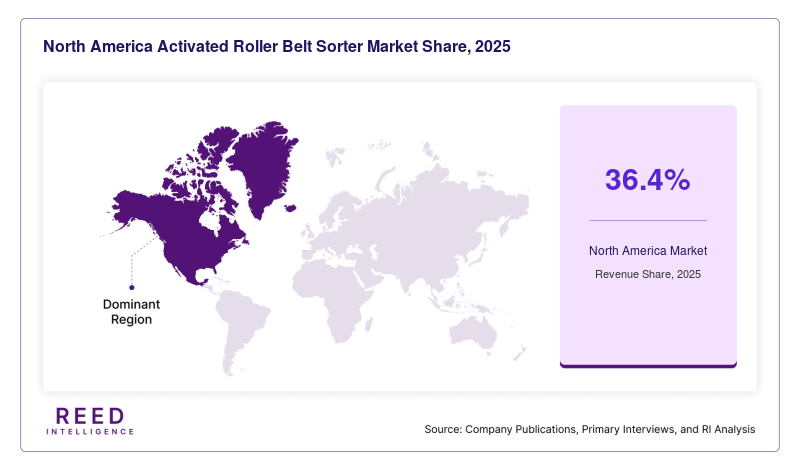
North America held 36.4% of the Activated Roller Belt Sorter Market share in 2025 and is expected to grow at a CAGR of 9.4% during 2026–2034. The United States dominated the region due to strong investments in warehouse automation and advanced logistics networks. The presence of large-scale fulfillment centers and continuous technological upgrades contributed to sustained demand for high-performance sorting systems.
Europe
Europe accounted for 27.1% market share in 2025 and is projected to expand at a CAGR of 9.1% over the forecast period. Germany emerged as the dominant country, driven by its robust manufacturing base and emphasis on Industry 4.0 technologies. The region’s focus on energy-efficient and sustainable automation solutions further supported market growth.
Asia Pacific
Asia Pacific represented 22.6% of the market in 2025 and is expected to register the fastest CAGR of 12.8% from 2026 to 2034. China led the regional market, supported by rapid expansion in e-commerce and logistics infrastructure. The growing number of distribution centers and increasing adoption of automation technologies are expected to drive future growth.
Middle East & Africa
The Middle East & Africa held 7.3% market share in 2025 and is anticipated to grow at a CAGR of 8.7% during the forecast period. The United Arab Emirates dominated the region due to its strategic focus on becoming a global logistics hub. Investments in smart warehouses and port infrastructure contributed to market development.
Latin America
Latin America captured 6.6% of the market share in 2025 and is expected to grow at a CAGR of 8.9% through 2034. Brazil led the regional market, supported by expanding retail and logistics sectors. The adoption of automated sorting solutions in urban distribution centers is expected to drive steady growth.
Competitive Landscape
The Activated Roller Belt Sorter Market is characterized by the presence of established automation solution providers and specialized material handling companies. Leading players focus on technological innovation, strategic partnerships, and geographic expansion to strengthen their market position.
A market leader, Honeywell Intelligrated, has maintained a strong presence through continuous advancements in automated sorting technologies. The company recently introduced enhanced AI-enabled sorter systems designed to improve throughput and operational efficiency in large-scale distribution centers.
Other key players emphasize modular system design, energy efficiency, and integration capabilities to meet evolving customer requirements. Competitive strategies include mergers, acquisitions, and collaborations aimed at expanding product portfolios and enhancing service offerings. The market remains moderately consolidated, with a mix of global and regional players competing on innovation, pricing, and customization capabilities.
Key Players List
- Honeywell Intelligrated
- Daifuku Co., Ltd.
- Siemens Logistics GmbH
- Vanderlande Industries B.V.
- Murata Machinery, Ltd.
- BEUMER Group GmbH & Co. KG
- Fives Group
- Interroll Holding AG
- TGW Logistics Group
- Dematic (KION Group AG)
- SSI Schaefer Group
- Bastian Solutions, Inc.
- Okura Yusoki Co., Ltd.
- Pteris Global Limited
- Material Handling Systems, Inc.
Recent Developments
- In 2025, Honeywell Intelligrated launched an advanced activated roller belt sorter with AI-based routing capabilities to enhance sorting efficiency.
- Vanderlande Industries introduced a modular sorter system designed for rapid deployment in mid-sized warehouses.
- Daifuku Co., Ltd. expanded its manufacturing facility in Asia to meet rising demand for automated sorting systems.
- BEUMER Group developed energy-efficient sorter solutions aimed at reducing operational costs.
- Siemens Logistics enhanced its software integration capabilities to enable real-time monitoring and predictive maintenance.
Activated Roller Belt Sorter Market Segments
Type
- Linear Activated Roller Belt Sorter
- Loop Activated Roller Belt Sorter
Component
- Hardware
- Software
Application
- E-commerce
- Retail
- Food & Beverage
- Pharmaceuticals
- Others
End-Use Industry
- Logistics & Transportation
- Manufacturing
- Healthcare
- Retail & Consumer Goods
By Region
- North America
- Europe
- APAC
- Middle East and Africa
- LATAM