Active Noise Cancellation Headphones Market Size, Share & Demand Report By Product Type (Over-Ear Headphones, On-Ear Headphones, In-Ear Headphones), By Connectivity (Wired, Wireless, Hybrid), By Price Range (Budget, Mid-Range, Premium), By Application (Personal Use, Professional Use), By Distribution Channel (Online Retail, Electronics & Specialty Stores, Department Stores, Multi-Brand Retail Outlets), By Region & Segment Forecasts, 2026–2034
USD 3950
Market Overview
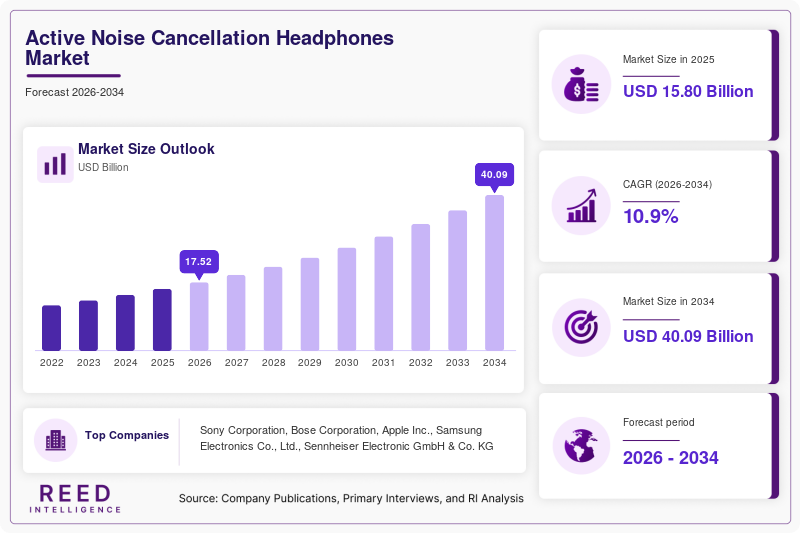
The Active Noise Cancellation Headphones Market size was valued at approximately USD 15.8 billion in 2026 and is projected to reach USD 36.4 billion by 2034, expanding at a CAGR of 10.9% during the forecast period (2026–2034). The market growth has been primarily supported by the global rise in hybrid work environments, which has increased the demand for immersive audio solutions that minimize background disturbances. As remote work and digital collaboration continue to evolve, consumers and professionals are increasingly adopting advanced audio technologies to improve focus and productivity.
The market is characterized by continuous technological advancements, including adaptive noise cancellation, AI-driven sound optimization, and improved battery efficiency. The integration of these features into consumer electronics has strengthened the appeal of active noise cancellation headphones across various demographics. Moreover, increasing consumer awareness regarding hearing health and sound quality has further supported adoption across both premium and mid-range product categories.
Key Highlights:
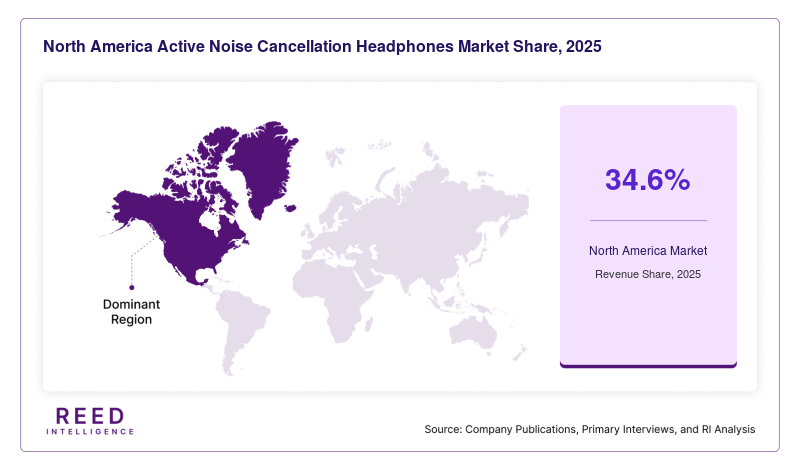
- North America dominated the market with a share of 34.6% in 2025, while Asia Pacific is expected to be the fastest-growing region at a CAGR of 12.8%.
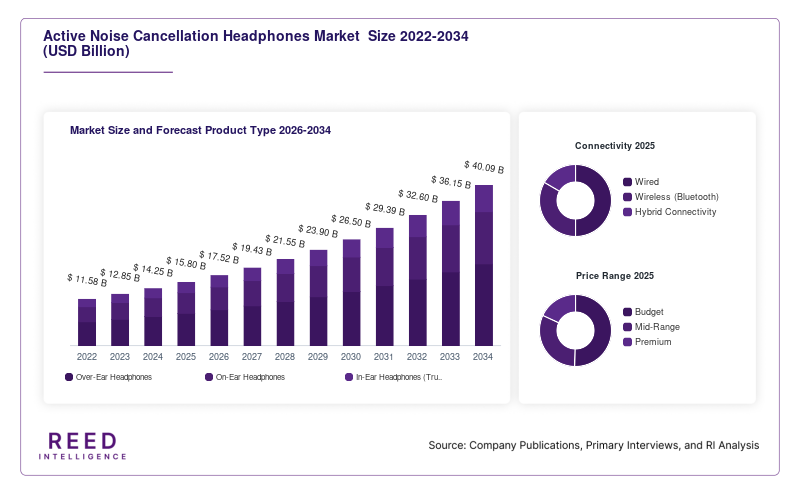
- Over-ear headphones emerged as the leading subsegment under type with a 48.2% share in 2025, while true wireless earbuds are projected to grow at a CAGR of 13.6%.
- Bluetooth-enabled devices dominated the connectivity segment with a 71.4% share in 2025, while hybrid connectivity is expected to witness a CAGR of 11.9%.
- The U.S. accounted for USD 4.2 billion in 2024 and USD 4.6 billion in 2025, maintaining its position as the dominant country in the market.
Market Trends
Integration of AI-Based Adaptive Noise Cancellation
Manufacturers are increasingly integrating artificial intelligence into noise cancellation systems to dynamically adjust sound filtering based on the surrounding environment. This trend is enhancing user experience by providing personalized soundscapes, thereby improving product differentiation in a competitive market.
Growth of True Wireless ANC Earbuds
The rising popularity of compact, wireless audio devices has accelerated the demand for true wireless earbuds with active noise cancellation. These products combine portability with advanced features, making them suitable for urban consumers and frequent travelers.
Market Drivers
Increasing Demand for Immersive Audio Experiences
The growing consumer preference for high-quality audio across entertainment, gaming, and professional applications is driving the adoption of active noise cancellation headphones. Enhanced listening experiences, coupled with the ability to eliminate ambient noise, have made these devices essential for modern lifestyles.
Expansion of Remote Work and Digital Learning
The shift toward remote work and online education has significantly boosted demand for noise-canceling audio devices. Professionals and students require clear communication and minimal distractions, which has increased the adoption of these headphones in both residential and commercial settings.
Market Restraint
High Cost of Advanced ANC Technology
The premium pricing associated with advanced noise cancellation features remains a key restraint. High manufacturing costs and the inclusion of sophisticated components limit affordability for price-sensitive consumers, thereby restricting market penetration in certain regions.
Market Opportunities
Expansion in Emerging Markets
Rapid urbanization and increasing disposable income in developing economies present significant growth opportunities. Consumers in these regions are becoming more inclined toward premium audio products, creating a favorable environment for market expansion.
Integration with Smart Devices and Ecosystems
The growing adoption of smart devices and interconnected ecosystems offers new opportunities for market players. Seamless integration with smartphones, wearables, and voice assistants is expected to enhance product functionality and user engagement.
Segmental Analysis
By Type
Over-ear headphones dominated the market with a 48.2% share in 2025 due to their superior noise isolation and sound quality. These devices are widely preferred by professionals and audiophiles for extended usage.
True wireless earbuds are expected to be the fastest-growing subsegment, expanding at a CAGR of 13.6% during the forecast period. Their compact design, portability, and increasing battery efficiency will support growth.
By Connectivity
Bluetooth-enabled devices held a dominant share of 71.4% in 2025, driven by the growing preference for wireless solutions and compatibility with multiple devices.
Hybrid connectivity (Bluetooth + wired) is projected to grow at a CAGR of 11.9%, supported by its flexibility and reliability in diverse usage scenarios.
By Price Range
The premium segment accounted for the largest share of 44.7% in 2025, reflecting strong demand for high-end features and brand value.
The mid-range segment is expected to grow at a CAGR of 12.2%, driven by increasing affordability and feature-rich offerings.
By Application
Personal use dominated the market with a 63.5% share in 2025, supported by rising demand for entertainment and daily communication.
Professional use is projected to grow at a CAGR of 11.4%, driven by increasing adoption in offices and remote work environments.
By Distribution Channel
Online retail held a dominant share of 58.9% in 2025, driven by the convenience of e-commerce platforms and wide product availability.
Offline retail is expected to grow at a CAGR of 9.2%, supported by consumer preference for in-store product testing and personalized assistance.
Regional Analysis
North America
North America accounted for 34.6% of the market share in 2025 and is expected to grow at a CAGR of 9.8% during the forecast period. The United States remained the dominant country, driven by strong consumer spending on premium electronics and widespread adoption of advanced audio technologies.
Europe
Europe held a 26.3% share in 2025 and will expand at a CAGR of 9.5% through 2034. Germany led the region, supported by a strong presence of audio equipment manufacturers and increasing demand for high-quality sound devices.
Asia Pacific
Asia Pacific captured 22.8% of the market in 2025 and is projected to grow at a CAGR of 12.8%. China dominated the region due to its large consumer base and rapid adoption of wireless audio technologies.
Middle East & Africa
The Middle East & Africa region accounted for 8.1% of the market share in 2025 and is expected to grow at a CAGR of 8.7%. The UAE emerged as a key market, driven by increasing demand for premium consumer electronics.
Latin America
Latin America held 8.2% of the market in 2025 and is anticipated to grow at a CAGR of 8.9%. Brazil led the region, supported by rising consumer awareness and growing adoption of advanced audio devices.
Competitive Landscape
The Active Noise Cancellation Headphones Market is moderately consolidated, with several global and regional players competing on product innovation, pricing, and brand positioning. Leading companies are focusing on integrating advanced technologies such as AI-driven noise cancellation and extended battery life to enhance user experience.
Sony Corporation remains a key market leader, driven by its strong portfolio of premium headphones and continuous innovation. The company recently introduced next-generation ANC models featuring adaptive sound control and improved comfort. Bose Corporation is another prominent player, known for its expertise in noise cancellation technology and consistent product performance. Apple Inc. has strengthened its presence through ecosystem integration and premium branding. Samsung Electronics Co., Ltd. and Sennheiser Electronic GmbH & Co. KG are also actively expanding their product offerings to capture a broader consumer base.
Key Players List
- Sony Corporation
- Bose Corporation
- Apple Inc.
- Samsung Electronics Co., Ltd.
- Sennheiser Electronic GmbH & Co. KG
- JBL (Harman International Industries, Inc.)
- Panasonic Corporation
- Skullcandy, Inc.
- Plantronics, Inc. (Poly)
- Shure Incorporated
- Beats Electronics LLC
- Bang & Olufsen
- Anker Innovations Limited
- Xiaomi Corporation
- Philips (Koninklijke Philips N.V.)
Recent Developments
- In 2025, Sony Corporation launched an upgraded ANC headphone model with enhanced AI-based noise cancellation and extended battery life.
- In 2025, Bose Corporation introduced new compact ANC earbuds targeting urban commuters and travelers.
- In 2024, Apple Inc. expanded its product lineup with improved spatial audio features in its ANC headphones.
- In 2025, Samsung Electronics Co., Ltd. released advanced wireless earbuds with adaptive noise control and seamless device connectivity.
- In 2024, Sennheiser introduced premium over-ear headphones focusing on high-fidelity sound and improved comfort.
Active Noise Cancellation Headphones Market Segments
Product Type
- Over-Ear Headphones
- On-Ear Headphones
- In-Ear Headphones (True Wireless Earbuds)
Connectivity
- Wired
- Wireless (Bluetooth)
- Hybrid Connectivity
Price Range
- Budget
- Mid-Range
- Premium
Application
- Personal Use
- Professional Use
Distribution Channel
- Online Retail
- Electronics & Specialty Stores
- Department Stores
- Multi-Brand Retail Outlets
By Region
- North America
- Europe
- APAC
- Middle East and Africa
- LATAM