Active Speaker Market Size, Share Demand Report By Product Type (Portable Speakers, Smart Speakers, Soundbars, Studio Monitors), By Application (Residential, Commercial, Professional/Studio, Automotive), By Connectivity (Bluetooth, Wi-Fi, Wired) & Segment Forecasts, 2026–2034
USD 3950
Active Speaker Market Size
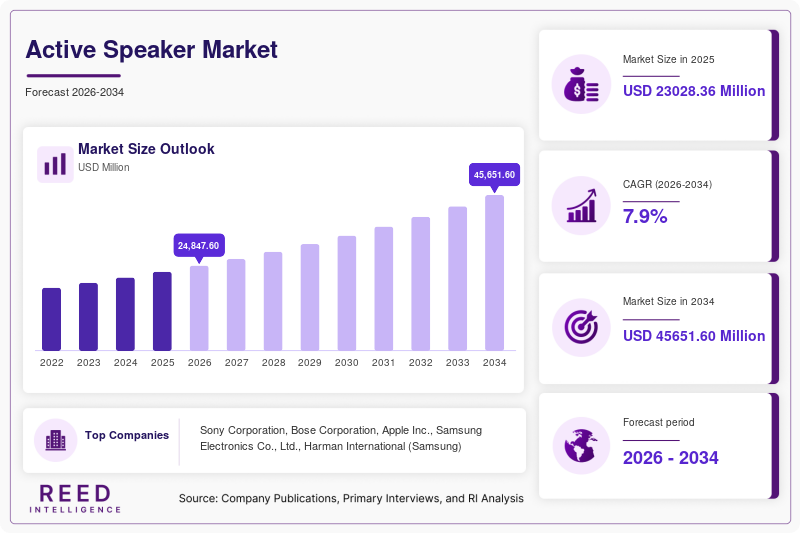
Active Speaker market size is projected at USD 24,847.6 million in 2026 and is expected to hit USD 45,847.5 million by 2034 with a CAGR of 7.9% during the forecast period. The increasing demand for high-quality audio experiences in residential, commercial, and professional settings, coupled with the growing adoption of wireless and smart audio technologies, underpins market expansion. This report delivers a comprehensive analysis of the Active Speaker market, including segmentation by type and application, competitive dynamics, and regional growth patterns, equipping stakeholders with critical intelligence. The Active Speaker market continues to demonstrate strong growth potential, fueled by the rising popularity of streaming services, the integration of voice assistants, and continuous innovation in audio technology.
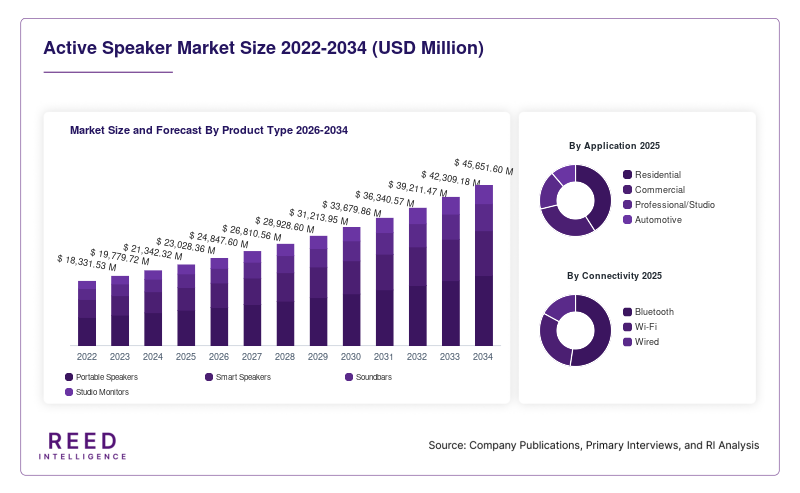
Active speakers, also known as powered speakers, are loudspeakers that have built-in amplifiers, eliminating the need for an external power source. They are used in a wide range of applications, from portable Bluetooth speakers and smart home devices to professional studio monitors and commercial sound systems. The global production volume of active speakers exceeded 250 million units in 2025, reflecting a 8% increase from 2023, driven by the growing consumer demand for convenient and high-fidelity audio solutions. Adoption patterns reveal that the Portable Speakers type dominates the market, accounting for 35% of total demand, followed by Smart Speakers at 28%, Soundbars at 22%, and Studio Monitors at 15%. The Active Speaker market's trajectory is closely linked to the growth of the global consumer electronics market, which is projected to reach USD 1.5 trillion by 2028, and the increasing integration of audio devices into daily life.
Active Speaker Market Trends
Integration of AI and Voice Assistants
The Active Speaker market is witnessing a significant trend toward the integration of AI and voice assistants, driven by the demand for smart, connected home audio ecosystems. The revenue from smart speakers with AI capabilities grew to USD 8.5 billion in 2025, a year-on-year increase of 15%, as 50% of new product launches in 2025 specified integrated voice assistants and smart home connectivity. Adoption rates of smart speakers in residential settings reached 40%, with this figure projected to exceed 65% by 2030. The Active Speaker market's trend toward AI integration is reinforced by the need for hands-free control, the increasing adoption of smart home ecosystems, and the continuous innovation in natural language processing and voice recognition technologies.
Growing Demand for High-Resolution and Spatial Audio
The increasing focus on high-resolution and spatial audio is a major trend shaping the Active Speaker market, with the development of speakers supporting immersive audio formats like Dolby Atmos and high-fidelity streaming. The market has seen a 20% increase in the demand for high-resolution active speakers since 2022, with 30% of new products in 2025 featuring immersive audio support and advanced sound processing. The use of active speakers for multi-room audio and home theater setups has also gained significant traction. The Active Speaker market's trend toward high-quality audio is reinforced by the growing popularity of music streaming services, the increasing consumer awareness of audio fidelity, and the continuous innovation in sound engineering and digital signal processing.
Active Speaker Market Drivers
The Active Speaker market's expansion is primarily driven by the increasing demand for convenient and high-quality audio experiences, with the global audio equipment market valued at USD 40 billion in 2025 and growing at a steady pace. The need for wireless, portable, and easy-to-use audio solutions has been a major driver, with active speakers offering integrated amplification and connectivity. The rising adoption of music streaming services, with over 500 million subscribers globally in 2025, has also fueled market growth. Additionally, the integration of active speakers into smart home ecosystems has spurred demand. The Active Speaker market's growth is further reinforced by the continuous improvement in audio technology, leading to better sound quality and features.
Active Speaker Market Restraints
Despite favorable growth prospects, the Active Speaker market faces significant constraints, primarily related to the higher cost of premium, high-fidelity active speakers compared to passive systems, which can be 20-50% more expensive. The complexity of integrating wireless and smart features, which can lead to compatibility issues, can also be a limitation. The Active Speaker market's growth is also tempered by the challenge of maintaining audio quality while miniaturizing components, and the battery life limitations in portable models.
Active Speaker Market Opportunities
The Active Speaker market presents significant opportunities in the rapidly expanding market for outdoor and portable audio, where rugged, battery-powered speakers are in high demand. The development of sustainable and eco-friendly active speakers using recycled materials is expected to grow at a CAGR of 10% through 2034. Emerging opportunities also exist in the integration of active speakers with other smart home devices and the development of new form factors for specific use cases. The Active Speaker market's opportunity profile is further enhanced by the growing trend of audio streaming and the increasing importance of sound quality in home entertainment.
Challenges in Active Speaker Market
The Active Speaker market faces persistent challenges related to the need for continuous innovation to differentiate products in a highly competitive market. The complexity of managing the balance between sound quality, size, and cost can also be a challenge. The market is also contending with the challenge of ensuring seamless connectivity and user experience across various devices and platforms. Additionally, the Active Speaker market is challenged by the need to keep pace with rapidly evolving audio standards and consumer preferences.
Active Speaker Market Segmentation
The Active Speaker market is segmented by Type and Application to provide a comprehensive market perspective. By Type, Portable Speakers dominate with a 35% market share, driven by their convenience and outdoor use. The Application segment is led by Residential, which accounts for 50% of the market, followed by Commercial at 25%, Professional/Studio at 15%, and Automotive at 10%.
By Type
Portable Speakers represent the largest segment in the Active Speaker market, commanding a 35% share, with production reaching 87.5 million units in 2025. These are characterized by their battery-powered, compact design for on-the-go use. Technical specifications include battery life, Bluetooth connectivity, and water resistance. The Active Speaker market's Portable segment is driven by its use in outdoor activities, travel, and casual listening.
Smart Speakers capture a 28% share of the Active Speaker market, with production of 70 million units in 2025. These are characterized by their integration of voice assistants and smart home features. Technical specifications include Wi-Fi connectivity, microphone arrays, and compatibility with smart home ecosystems. The Active Speaker market's Smart segment is driven by its use in smart homes and connected living.
Soundbars represent 22% of the Active Speaker market, with production of 55 million units in 2025. These are characterized by their elongated, multi-driver design, used to improve TV audio. Technical specifications include Dolby Atmos support, wireless subwoofer connectivity, and HDMI inputs. The Active Speaker market's Soundbar segment is driven by its use in home theater setups.
Studio Monitors comprise the remainder of the Active Speaker market, accounting for 15% of total production, with 37.5 million units in 2025. These are characterized by their flat frequency response for accurate audio reproduction. Technical specifications include balanced inputs, low distortion, and high power handling. The Active Speaker market's Studio Monitors segment is driven by its use in professional audio production and critical listening.
By Application
Residential dominates the Active Speaker market, accounting for 50% of sales, representing 125 million units in 2025. This segment includes use in homes for music, TV, and smart home applications. Usage penetration exceeds 30% in households. The Active Speaker market's Residential segment is characterized by its focus on aesthetics, ease of use, and integration with home systems.
Commercial accounts for 25% of the Active Speaker market, with sales of 62.5 million units in 2025. This segment encompasses use in retail, hospitality, and corporate environments. The segment is growing at a steady CAGR, driven by the need for background music and public address systems. The Active Speaker market's Commercial segment is characterized by its focus on durability, coverage, and reliability.
Professional/Studio represents 15% of the Active Speaker market, with sales of 37.5 million units in 2025. This segment includes use in recording studios, broadcast, and live sound. The segment is growing at a robust CAGR, driven by the expansion of content creation. The Active Speaker market's Professional segment is characterized by its focus on accuracy, power, and reliability.
Automotive comprises the remainder of the Active Speaker market, accounting for 10% of total sales, with 25 million units in 2025. This segment includes use in car audio systems. The segment is projected to grow at a moderate CAGR through 2034, driven by the demand for premium in-car audio. The Active Speaker market's Automotive segment is characterized by its focus on space optimization and integration with vehicle systems.
Active Speaker Market Regional Outlook
Asia-Pacific Active Speaker Market
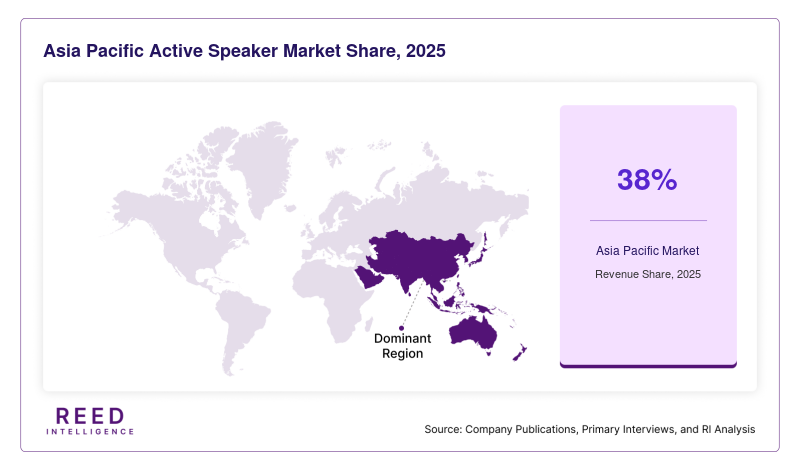
Leads the Active Speaker market, commanding a 38% share, with a revenue of USD 9,442.1 million in 2025. China is the primary driver, accounting for 60% of regional demand, driven by the large consumer electronics manufacturing base, growing middle class, and high adoption of smart devices. The Asia-Pacific Active Speaker market is characterized by its focus on high-volume production and cost-effective solutions.
North America Active Speaker Market
Represents the second-largest market, capturing a 28% share with a revenue of USD 6,957.3 million in 2025. The United States is the primary driver, accounting for 85% of regional demand, driven by the high consumer spending, strong smart home adoption, and a mature audio market. The North American Active Speaker market is characterized by its focus on innovation and premium products.
Europe Active Speaker Market
Accounts for 22% of the global Active Speaker market, with a revenue of USD 5,466.5 million in 2025. The UK, Germany, and France are the primary drivers, collectively accounting for 60% of regional demand, driven by a strong consumer electronics market and high audio fidelity awareness. The European Active Speaker market is projected to grow at a CAGR of 6% through 2034.
Middle East & Africa and Latin America Active Speaker Market
Together account for the remaining 12% of the Active Speaker market, with the UAE leading the Middle East market and Brazil leading the Latin American market. Both regions are projected to grow at CAGRs exceeding 8%, driven by increasing disposable incomes and consumer electronics adoption.
Top players in Active Speaker Market
- Sony Corporation
- Bose Corporation
- Apple Inc.
- Samsung Electronics Co., Ltd.
- Harman International (Samsung)
- Sonos, Inc.
- JBL
- Amazon.com, Inc.
- Google LLC
- Microsoft Corporation
- Logitech International S.A.
- Panasonic Corporation
- Philips
- Pioneer Corporation
- Yamaha Corporation
Sony Corporation
Sony Corporation holds a dominant position in the Active Speaker market, with an estimated 15% global market share, particularly strong in the portable and high-fidelity audio segments. The company's portfolio of active speakers is widely recognized for its audio quality, innovation, and design. Sony's market leadership is reinforced by its significant R&D investment in audio technology, its strong brand reputation, and its extensive product line. Sony commands over 18% of the Asian market and 12% of the North American market, positioning it as a key player in the Active Speaker market.
Bose Corporation
Bose Corporation is a leading player in the Active Speaker market, commanding approximately 12% of the global market share through its comprehensive portfolio of premium audio solutions. The company's expertise in sound engineering and its focus on the consumer and commercial segments have solidified its position. Bose's active speakers are known for their superior sound quality, durability, and user experience. The company's commitment to innovation and its strong presence in the North American and European markets have enhanced its competitive advantage.
Apple Inc. holds a significant 10% market share, with particular strength in the smart speaker segment through its HomePod product. Samsung Electronics Co., Ltd. is a major player in the portable and soundbar market, holding an 8% share.
Recent Developments in Active Speaker Market
- 2025: Sony launched a new series of portable active speakers with advanced noise-cancelling and immersive audio features for outdoor use.
- 2025: Bose introduced a new smart soundbar with integrated voice assistants and advanced room calibration technology.
Active Speaker Market Segments
By Product Type
- Portable Speakers
- Smart Speakers
- Soundbars
- Studio Monitors
By Application
- Residential
- Commercial
- Professional/Studio
- Automotive
By Connectivity
- Bluetooth
- Wi-Fi
- Wired
By Region
- North America
- Europe
- APAC
- Middle East and Africa
- LATAM