Activewear And Sportswear Market Size, Share & Trends Analysis Report By Product Type (Apparel, Footwear, Accessories), By Activity (Running & Training, Yoga & Studio, Team Sports, Outdoor & Adventure, Other Activities), By End User (Men, Women, Kids), By Distribution Channel (Online, Specialty Stores & Brand Stores, Supermarkets & Hypermarkets, Department Stores, Other Channels) and By Region (North America, Europe, APAC, Middle East and Africa, LATAM) Forecasts, 2026–2034
USD 3950
Activewear And Sportswear Market Size
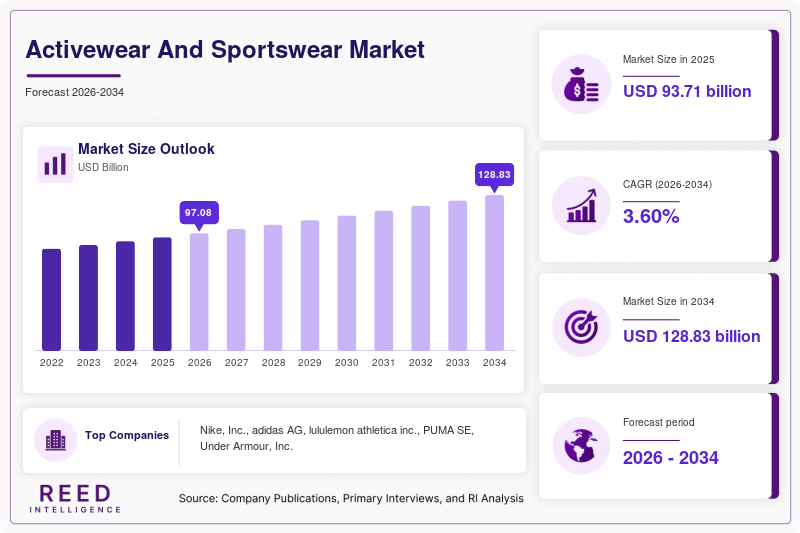
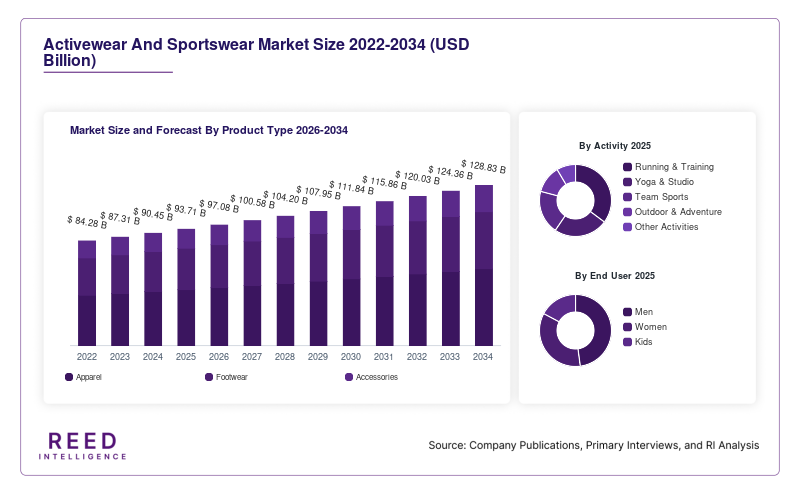
The global Activewear And Sportswear Market size was valued at USD 93.71 billion in 2025 and is projected to grow from USD 97.08 billion in 2026 to USD 128.83 billion by 2034, registering a CAGR of 3.60% during the forecast period from 2026 to 2034.
The activewear and sportswear market is becoming less dependent on traditional sports participation and more connected to the broader convergence of performance clothing, wellness, casual fashion, and everyday comfort. Consumers increasingly use athletic products outside formal exercise, while brands are expanding product ranges across running, training, yoga, outdoor activities, and sport-inspired lifestyle apparel. adidas specifically identifies the continuing popularity of athletic and sport-inspired products for everyday use and growing demand for comfort as structural factors supporting the sporting-goods industry.
The competitive structure is also changing. McKinsey and the World Federation of the Sporting Goods Industry reported that challenger brands and specialized players have gained share from major incumbents as consumers increasingly choose brands associated with particular activities and identities, such as running, yoga, cycling, and gym training.
Product innovation remains a major commercial mechanism. adidas reported 15% currency-neutral growth in apparel during 2025, with double-digit increases in Running, Training, Football, and Originals apparel, while its Running business accelerated to more than 30% growth during the year. Nike generated USD 46.4 billion in FY2026 revenue and continues to emphasize innovation, athletic performance, digital consumer experiences, and direct distribution.
At the consumer level, the long-term opportunity is substantial but not equivalent to universal participation growth. WHO reported that 31% of adults worldwide were insufficiently physically active in 2022, equivalent to approximately 1.8 billion people. Consequently, the market is being supported simultaneously by active consumers purchasing more specialized products and by lifestyle consumers purchasing athletic products for comfort, fashion, and daily use.
Activewear And Sportswear Market Drivers
Convergence of athletic performance and everyday apparel:
Activewear is increasingly purchased for activities beyond structured exercise. adidas reported double-digit growth in both its Performance and Lifestyle businesses in 2025, while Sportswear and Originals benefited from sport-inspired products adapted to local consumer preferences. Nike similarly states that a large percentage of its athletic footwear and apparel is worn for casual or leisure purposes rather than exclusively for athletic use. This convergence expands the number of occasions on which consumers can purchase activewear, creating demand from work-from-home clothing, travel, casual outings, commuting, and social activities in addition to running, gym, or team sports. It also changes product development: brands increasingly need fabrics and silhouettes that combine technical performance with aesthetics, comfort, durability, and everyday styling.
Product innovation in running, training, and technical apparel:
Technical innovation is supporting premium product positioning and encouraging replacement purchases. adidas reported that its Performance business increased 15% in 2025, with Running growth exceeding 30% during the year, supported by Adizero products and matching performance apparel. Training also recorded double-digit growth, supported by head-to-toe product offerings. PUMA's 2025 results similarly identified Running and Training as important areas, with NITRO products and its HYROX partnership supporting Training demand. The mechanism extends beyond footwear: improvements in moisture management, stretch, thermal regulation, lightweight construction, compression, durability, and recycled or lower-impact materials allow brands to introduce new apparel collections and maintain differentiation in a crowded market.
Increasing focus on health, fitness, and active lifestyles:
Health and fitness awareness is supporting participation among consumers who already exercise and increasing interest in products associated with wellness. adidas identifies increasing sports participation and health and fitness awareness as structural factors supporting sporting-goods demand. McKinsey's research also found that exercise has increasingly become part of personal identity among active consumers, while specialized brands are using running, yoga, cycling, and gym communities to develop stronger consumer relationships. WHO data provides an important counterbalance: 31% of adults globally did not meet recommended physical-activity levels in 2022. Therefore, market expansion depends not only on increasing participation but also on converting wellness interest and lifestyle consumption into apparel purchases.
Activewear And Sportswear Market Restraints
High competition and changing consumer preferences:
The market has become increasingly fragmented as specialist brands enter categories previously dominated by global sportswear companies. McKinsey estimates that large incumbent brands Nike and adidas lost approximately three percentage points of market share between 2019 and 2024 as challenger brands expanded. This creates a difficult commercial environment because brands must maintain product innovation, marketing visibility, athlete partnerships, community engagement, and distribution while controlling inventory. PUMA's 2025 results illustrate the consequences of weak category and distribution performance: overall sales declined 8.1% on a currency-adjusted basis, while the company undertook a strategic reset involving inventory and distribution cleanup. For activewear manufacturers, excessive product proliferation can also increase markdowns and reduce full-price selling.
Macroeconomic pressure and discretionary spending:
Activewear includes both essential performance products and discretionary lifestyle purchases, making demand sensitive to household purchasing power. adidas notes that real disposable incomes remain under pressure and consumer sentiment is subdued in several major markets, while geopolitical tensions, tariffs, commodity prices, and supply-chain disruption remain risks for sporting-goods companies. PUMA's 2025 results also show the impact of promotional activity and inventory normalization on profitability. The commercial effect is particularly important in mid-priced and premium apparel, where consumers can delay purchases or substitute products from lower-priced competitors. Brands therefore need to balance premium technical products with accessible price points.
Activewear And Sportswear Market Opportunities
Women's activewear and specialized activity categories:
Women's participation provides room for product-specific expansion because fit, sizing, support, modesty, and activity requirements can differ substantially from men's products. adidas expanded women-focused visibility through UEFA Women's EURO 2025 and its broader performance and lifestyle product strategy. The opportunity extends beyond generic women's apparel into running, training, yoga, cycling, outdoor activities, tennis, and team sports. Specialized products can support higher consumer relevance because they solve specific functional requirements rather than simply reproducing men's products in different sizes. Brands can also use community programs, athlete partnerships, and sport-specific retail experiences to increase customer acquisition and repeat purchases.
Direct-to-consumer and digitally connected retail:
Digital channels allow brands to combine product sales with fitness content, communities, personalization, product education, and loyalty programs. Nike operates through owned retail and digital platforms alongside wholesale accounts across nearly all global markets. PUMA increased its DTC share to 32.4% in 2025, with both e-commerce and owned stores contributing to DTC growth. adidas, meanwhile, continues to use wholesale as its largest channel while investing in local product assortments and direct consumer experiences. This creates opportunities to use DTC channels for product launches and consumer data while maintaining wholesale reach for volume distribution.
Segmental Analysis
By Product Type
Apparel represents approximately 39% of the global activewear and sportswear market in 2025, supported by demand across running, training, football, yoga, outdoor activities, and everyday athleisure. adidas reported 15% currency-neutral apparel growth in 2025, with differentiated apparel collections generating double-digit increases in Football, Running, Training, and Originals. Apparel also benefits from more frequent purchasing cycles than durable sporting equipment because consumers can buy multiple garments for different activities and seasons.
Footwear is the fastest-growing product category, with an estimated 4.4% CAGR through 2034. Running is an important catalyst: adidas reported more than 30% Running growth in 2025, driven by the Adizero family, while PUMA reported strong performance in Running and Training during its 2026 transition period. Technical running shoes, lightweight construction, cushioning systems, carbon-plate designs, and activity-specific footwear encourage consumers to maintain different shoes for different sports and training purposes.
By Activity
Running & Training represents approximately 38% of the market in 2025, reflecting the large installed base of recreational runners, gym users, fitness consumers, and hybrid training participants. adidas recorded strong growth in both Running and Training during 2025, while PUMA identified Running and Training as core priorities for its 2026 product strategy.
Outdoor & Adventure is the fastest-growing activity category, with an estimated 5.1% CAGR. Consumers are increasingly purchasing technical clothing for hiking, trail running, travel, trekking, and outdoor recreation, creating demand for waterproofing, insulation, lightweight construction, packability, and abrasion resistance. The category also benefits from the expansion of specialized brands that target specific outdoor and performance identities, a trend identified by McKinsey in its assessment of challenger brands.
By End User
Women represent approximately 45% of the market in 2025, reflecting the expansion of women's participation across running, training, yoga, football, tennis, and outdoor activities. adidas highlighted women's sport through its UEFA Women's EURO 2025 activation and continued investment in locally relevant sports products and marketing.
Women are also the fastest-growing end-user category, at approximately 4.2% CAGR, as brands broaden sizing, fit, support, and activity-specific collections. The opportunity is particularly relevant in sports bras, leggings, training apparel, running apparel, and sport-inspired lifestyle products.
By Distribution Channel
Specialty Stores & Brand Stores account for approximately 34% of the market, supported by consumers seeking product expertise, fitting, technical guidance, and brand-specific assortments. adidas reported that wholesale remained its largest distribution channel at 60% of total net sales in 2025, demonstrating the continued importance of physical and wholesale retail even as digital commerce expands.
Online is the fastest-growing distribution channel, with an estimated 5.3% CAGR. Digital channels enable product discovery, personalized recommendations, limited releases, loyalty programs, and direct communication between brands and customers. PUMA's 2025 DTC growth was supported by both e-commerce and owned retail, while Nike operates dedicated digital platforms as part of its NIKE Direct model.
Regional Analysis
North America Activewear And Sportswear Market
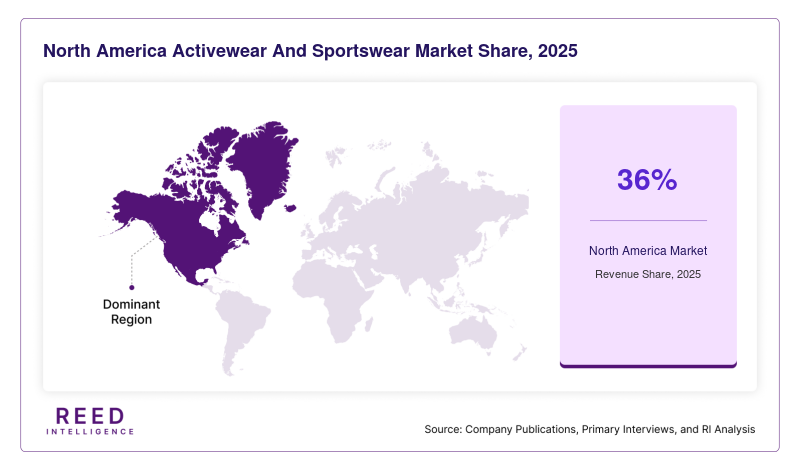
North America represents approximately 36% of the global activewear and sportswear market in 2025 and is growing at around 3.2% CAGR. The region has a mature sportswear ecosystem, high brand penetration, extensive specialty retail, strong e-commerce adoption, and a well-developed fitness culture. Nike's FY2026 revenue reached USD 46.4 billion, with North America representing 45% of Nike Brand revenue.
The market is increasingly divided between established global brands and specialized challengers. McKinsey found that challenger brands focused on activities such as running, yoga, cycling, and gym apparel have gained share from large incumbents. This creates competition around technical performance, brand identity, community, athlete partnerships, and product innovation.
The region's large installed consumer base also supports replacement demand. Running, training, basketball, football, outdoor activities, and athleisure generate recurring purchases across apparel and footwear. However, mature penetration and consumer sensitivity to promotional pricing limit the pace of unit expansion. Nike's FY2026 NIKE Direct revenue declined to USD 17.7 billion, while wholesale revenue increased to USD 27.5 billion, highlighting the continuing importance of channel balance.
Europe Activewear And Sportswear Market
Europe accounts for approximately 28% of the global market and is expanding at around 3.5% CAGR. The region has strong participation across football, running, cycling, outdoor activities, fitness, and recreational sports. adidas reported 10% currency-neutral brand revenue growth in Europe during 2025, led by Running, Training, Specialist Sports, Performance Basketball, Sportswear, and Originals.
Running has become an important product and brand-development category. adidas reported more than 30% Running growth globally in 2025, while its Road to Records program combined elite competition with community participation and more than 350,000 virtual race participants. This illustrates how brands increasingly use sport communities as both marketing and customer-engagement mechanisms.
Europe also has strong sustainability expectations and regulatory attention surrounding textiles, product durability, and environmental claims. Brands therefore face increasing pressure to improve material traceability, recycled content, product longevity, and manufacturing practices while maintaining technical performance.
APAC Activewear And Sportswear Market
APAC represents approximately 23% of the global market and is the fastest-growing region, with an estimated CAGR of 5.2%. The region combines large populations, expanding urban fitness cultures, rising sports participation, growing e-commerce, and increasing interest in international sportswear brands.
China remains a major market, although consumer conditions are uneven. adidas reported 13% currency-neutral growth in Greater China in 2025, while its Japan/South Korea business increased 14%. Emerging Markets increased 17% and Latin America increased 22%, illustrating the importance of localized product strategies across APAC and other growth markets.
Japan and South Korea offer mature premium markets where technical products, running, lifestyle sportswear, and brand collaborations can command consumer attention. Southeast Asia provides a different mechanism, with expanding e-commerce, younger consumers, warmer climates, and growing participation in running, gym training, football, badminton, and other sports.
PUMA's Q1 2026 results also showed Greater China growth of 9% and rest-of-Asia/Pacific growth of 7.4%, supported by DTC and e-commerce in Southeast Asia. The combination of population scale and increasing digital access makes APAC the fastest-growing major region.
Middle East and Africa Activewear And Sportswear Market
Middle East and Africa represents approximately 6% of the global market and is growing at around 4.5% CAGR. Demand is supported by urbanization, gym and fitness development, running communities, football culture, outdoor activities, and increasing penetration of international sportswear brands.
The Gulf markets provide a strong premium retail environment, while larger African markets offer longer-term volume potential through population growth, smartphone adoption, e-commerce, and increasing participation in sports. The region's young demographic profile also creates opportunities for sports-inspired lifestyle apparel.
However, purchasing power differences, climate conditions, import costs, and limited local manufacturing capacity influence product mix and pricing. Lightweight fabrics, moisture management, modest sportswear, and climate-appropriate training apparel are particularly relevant in hotter markets.
LATAM Activewear And Sportswear Market
LATAM accounts for approximately 7% of the global market and is growing at around 4.8% CAGR. Football remains a major demand driver, while running, gym training, cycling, and recreational fitness are expanding the addressable consumer base.
adidas reported 22% currency-neutral brand growth in Latin America in 2025, the strongest increase among its reported major geographic markets. The company attributed its broader performance to locally relevant product ranges, activations, and expansion across both wholesale and DTC channels.
The region therefore offers opportunities for sportswear brands that combine global brand recognition with local sports preferences. Brazil and Mexico are particularly important because of population size, sports culture, organized retail, and e-commerce. Currency volatility and lower average purchasing power remain constraints, increasing the importance of mid-priced product ranges and locally adapted assortments.
Competitive Landscape
The activewear and sportswear market contains a mixture of global incumbents, specialist performance brands, fashion-led sportswear companies, and digitally native challengers. Nike, adidas, lululemon, PUMA, Under Armour, ASICS, On, Hoka, New Balance, VF Corporation, and Anta Sports compete across different combinations of performance, lifestyle, footwear, apparel, and geographic markets.
Nike remains one of the industry's largest integrated players. Its FY2026 revenue was USD 46.4 billion, with NIKE Brand wholesale accounting for USD 27.5 billion and NIKE Direct for USD 17.7 billion. Its product portfolio covers athletic footwear, apparel, equipment, accessories, and digital fitness experiences.
adidas recorded EUR 24.811 billion of 2025 revenue, with currency-neutral brand revenue increasing 13%. Apparel increased 15%, while Running and Training were among the categories supporting performance growth. Its 2026 strategy emphasizes local consumer relevance, product pipelines, retailer relationships, and sports activations.
Key Market Players
- Nike, Inc.
- adidas AG
- lululemon athletica inc.
- PUMA SE
- Under Armour, Inc.
- ASICS Corporation
- On Holding AG
- New Balance Athletics, Inc.
- Hoka / Deckers Brands
- Anta Sports Products Limited
- VF Corporation
- Columbia Sportswear Company
- Li Ning Company Limited
- Skechers U.S.A., Inc.
- Gymshark
- Alo Yoga
- Decathlon
- Fila Holdings Corp.
Recent Market Developments
- September 2026 – On: On signed footballer Kylian Mbappé and announced its entry into football, with its first football boots planned for 2027. The move extends a brand historically concentrated in running and expanding into tennis toward a new major sports category.
- September 2026 – PUMA: The company continued its brand reset, highlighting NITRO performance products in Running and Hybrid Training and expanding its connection with HYROX.
Activewear And Sportswear Market Segments
By Product Type
- Apparel
- Footwear
- Accessories
By Activity
- Running & Training
- Yoga & Studio
- Team Sports
- Outdoor & Adventure
- Other Activities
By End User
- Men
- Women
- Kids
By Distribution Channel
- Online
- Specialty Stores & Brand Stores
- Supermarkets & Hypermarkets
- Department Stores
- Other Channels
By Region
- North America
- Europe
- APAC
- Middle East and Africa
- LATAM