Acupuncture Market Size, Share & Trends Analysis Report By Type (Manual Acupuncture, Electroacupuncture, Auricular Acupuncture and Other Acupuncture Techniques), By Application (Pain Management, Musculoskeletal Disorders, Neurological Disorders, Women’s Health, Stress & Mental Wellness and Others), By End User (Hospitals & Clinics, Specialty Acupuncture Centers, Wellness Centers and Home Care) and By Region (North America, Europe, Asia-Pacific, Latin America, Middle East & Africa) Forecasts, 202
USD 3950
Acupuncture Market Size
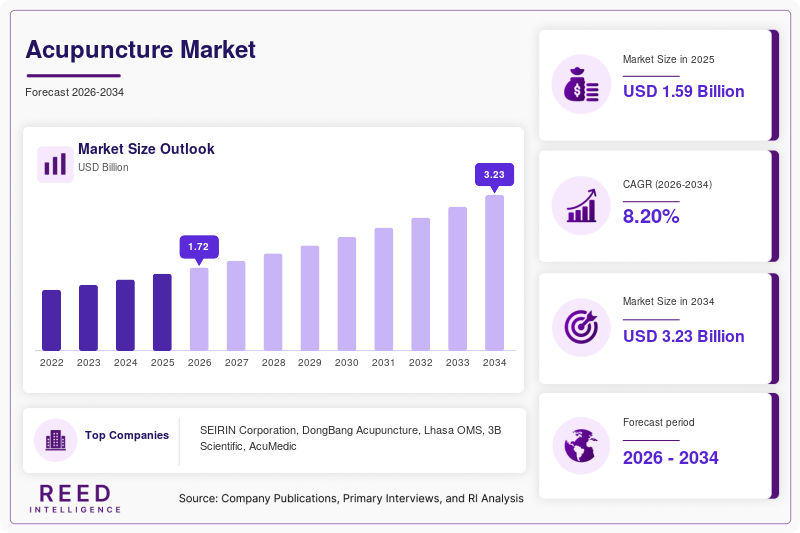
The global Acupuncture Market was valued at USD 1.59 billion in 2025 and is projected to grow from USD 1.72 billion in 2026 to USD 3.23 billion by 2034, registering a CAGR of 8.20% during the forecast period from 2026 to 2034.
Acupuncture is moving from a predominantly traditional-medicine practice toward a more integrated service within pain-management and complementary-care settings. The strongest commercial demand is associated with recurring treatment for chronic pain, particularly musculoskeletal conditions, while demand also extends to headaches, migraine and selected wellness applications. The U.S. National Center for Complementary and Integrative Health notes that acupuncture use among U.S. adults increased from 1.0% in 2002 to 2.2% in 2022, while pain was the most common reason for use.
The market's expansion is also being influenced by institutional recognition. In 2025, the World Health Organization adopted its Global Traditional Medicine Strategy 2025–2034, emphasizing evidence generation, safety and regulation, integration into health systems and qualified practitioners.
Acupuncture Market Drivers
Growing Use of Acupuncture for Chronic Pain Expands Recurring Treatment Demand
Chronic pain is the clearest demand mechanism for acupuncture services. NCCIH identifies back and neck pain, knee osteoarthritis, migraine and several other painful conditions among areas where research has found potential benefits. It also notes that acupuncture is included among non-drug treatment options in clinical guidance for chronic low-back pain.
The commercial mechanism is based on repeat treatment rather than one-time consumption: patients who use acupuncture for chronic conditions may require multiple sessions, increasing utilization of practitioner services and disposable needles. Pain-management clinics and integrated-care providers therefore represent important demand centers. The limitation is that clinical effectiveness varies by condition, and the difference between acupuncture and sham treatment can be relatively small in some studies.
Health-System Integration Creates New Referral and Reimbursement Channels
WHO's 2025–2034 traditional medicine strategy explicitly calls for evidence-based integration of traditional, complementary and integrative medicine into health systems, alongside stronger regulation, safety systems and research.
This creates a potential market mechanism through which acupuncture can move from standalone complementary-care practices into broader healthcare pathways. Integration can increase referrals, professional training and institutional procurement of acupuncture supplies. The impact will vary substantially by country because reimbursement, licensing and clinical-practice rules remain nationally determined.
Wider Acceptance of Non-Drug Pain Management Supports Acupuncture Utilization
Healthcare systems are increasingly evaluating non-pharmacological approaches alongside medication-based pain management. NCCIH reports evidence that acupuncture can provide benefits for several chronic pain conditions and notes its inclusion among non-drug treatment approaches for low-back pain.
For providers, acupuncture can therefore function as an adjunct to conventional care rather than necessarily replacing medication or other therapies. This broadens the potential customer base to multidisciplinary clinics, rehabilitation providers and pain-management centers. However, the economic effect depends on whether insurers reimburse treatment and whether providers can demonstrate sufficient clinical value for specific patient groups.
Acupuncture Market Restraints
Uneven Reimbursement Limits Patient Access and Provider Expansion
Insurance coverage remains inconsistent. In the United States, Medicare covers acupuncture specifically for chronic low-back pain under defined conditions, including up to 12 visits within 90 days and up to eight additional sessions when improvement is demonstrated. Other indications remain nationally non-covered under the Medicare policy.
The market mechanism is direct: where reimbursement is available, the patient's out-of-pocket burden can decline and providers have a more predictable revenue pathway; where reimbursement is absent, treatment is more dependent on discretionary spending. This makes coverage policy an important constraint on geographic adoption.
Variation in Clinical Evidence and Practitioner Standards Can Restrict Institutional Adoption
NCCIH states that acupuncture may be beneficial for several pain conditions but also emphasizes that evidence quality and treatment effects vary across indications. It further notes that serious complications are uncommon when acupuncture is performed appropriately but can include infections and punctured organs when treatment is improperly delivered.
This creates demand for qualified practitioners, sterile single-use needles and standardized treatment protocols. Regulatory differences between jurisdictions can also increase training and compliance requirements, potentially limiting expansion into markets where professional standards and reimbursement frameworks are less developed.
Acupuncture Market Opportunities
Evidence-Based Integration Into Hospitals Creates a New Service-Delivery Channel
WHO's new traditional medicine strategy places evidence, safety, regulation and health-system integration at the center of its 2025–2034 framework.
This creates an opportunity for acupuncture providers to develop services around conditions where evidence is comparatively stronger, particularly selected pain-management applications. Hospital-based programs can also facilitate referrals from physicians and rehabilitation specialists. Commercial adoption will depend on local licensing, reimbursement and institutional evidence requirements, making standardized clinical protocols and practitioner credentials important differentiators.
Electroacupuncture and Technology-Enabled Treatment Expand the Product Opportunity
Acupuncture is not limited to manually manipulated needles. NCCIH describes electroacupuncture as a technique in which needles are stimulated using small electrical currents and notes ongoing research into acupuncture combined with other technologies.
This creates an opportunity for suppliers of electrotherapy units, specialized needles and clinic equipment to capture value beyond conventional disposable needles. The constraint is that technological additions must demonstrate practical clinical value and remain compatible with practitioner training and regulatory requirements.
Standardized Disposable Needles Support Recurring Consumable Demand
Acupuncture treatment requires needles and related clinical supplies on a recurring basis. SEIRIN, for example, produces single-use sterile acupuncture needles in multiple configurations, while Lhasa OMS distributes SEIRIN, DBC, Hwato and other acupuncture-supply brands to practitioners.
This creates a recurring consumables opportunity even when service-provider growth is moderate. Product differentiation is increasingly based on sterility, insertion characteristics, gauge, packaging and practitioner convenience.
Type Segment Analysis
Manual Acupuncture Holds the Largest Share Because It Remains the Core Treatment Format
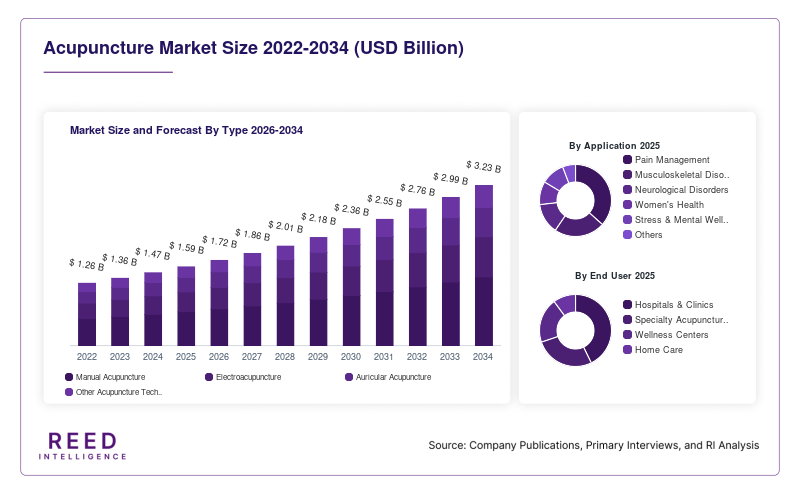
Manual acupuncture accounted for approximately 52% of the global market in 2025, making it the largest type segment. Its position reflects the broad use of conventional needle insertion and manual stimulation across pain-management, musculoskeletal and complementary-care settings. NCCIH identifies conventional needle acupuncture as the foundational technique, while electroacupuncture represents an electrically stimulated variation.
The segment benefits from comparatively straightforward equipment requirements and broad practitioner familiarity. Recurring treatment sessions also create continuing demand for sterile disposable needles. However, practitioner availability and differences in training standards can limit service capacity.
Electroacupuncture represented approximately 24% of the market and is projected to grow at approximately 9.1% CAGR. Its faster expansion is linked to interest in technology-assisted stimulation and research into combined treatment approaches. Other techniques accounted for the remainder of the market.
Electroacupuncture Is the Fastest-Growing Type as Technology Enters Acupuncture Delivery
Electroacupuncture is projected to expand at approximately 9.1% CAGR through 2034, compared with the overall market CAGR of 8.20%. The technique adds controlled electrical stimulation to conventional needle placement, creating demand for specialized equipment alongside needles. NCCIH recognizes electroacupuncture as an established variation and notes ongoing research involving technology-enhanced acupuncture approaches.
Growth is likely to be concentrated in professional clinics and hospital-based programs where equipment costs and practitioner training can be absorbed more readily. Limited evidence for some indications and additional equipment requirements can slow adoption.
Application Segment Analysis
Pain Management Represents the Largest Application Through Recurring Treatment Needs
Pain Management accounted for approximately 43% of the global market in 2025, making it the largest application. NCCIH identifies back and neck pain, knee osteoarthritis and migraine among conditions for which acupuncture may provide benefits.
The segment's commercial importance comes from treatment frequency: chronic conditions can require multiple sessions, generating recurring service revenue and consumable demand. Pain clinics, rehabilitation centers and multidisciplinary healthcare practices therefore provide an important customer base.
Musculoskeletal Disorders represented approximately 22% of the market and are projected to grow at approximately 8.8% CAGR, supported by applications involving back pain, osteoarthritis and related conditions. Neurological disorders accounted for approximately 12%, women's health 9%, stress and mental wellness 8%, and other applications 6%.
Musculoskeletal Disorders Are the Fastest-Growing Major Application
Musculoskeletal Disorders are projected to grow at approximately 8.8% CAGR through 2034. The segment benefits from the concentration of acupuncture research and clinical use around back, neck and joint pain. NCCIH reports evidence supporting acupuncture for several of these conditions, although the strength of evidence differs by indication.
The opportunity is strongest where acupuncture is incorporated alongside physical therapy, medication or other pain-management interventions. Reimbursement restrictions and differing clinical guidelines remain important adoption constraints.
End-User Segment Analysis
Hospitals & Clinics Account for the Largest Share Through Integration With Conventional Care
Hospitals & Clinics accounted for approximately 41% of the market in 2025. Their position reflects the potential for acupuncture to be delivered as part of multidisciplinary pain-management and rehabilitation services.
Institutional settings can also support standardized infection-control practices and practitioner credentialing. WHO's emphasis on safe and evidence-based integration of traditional medicine could support the development of such models where national health systems choose to adopt them.
Specialty Acupuncture Centers represented approximately 34% and are projected to grow at approximately 8.7% CAGR. These providers benefit from specialized practitioner expertise and a treatment model centered specifically on acupuncture.
Wellness Centers accounted for approximately 17%, while Home Care represented approximately 8%.
Acupuncture Market Regional Analysis
Asia-Pacific Holds the Largest Share Through Established Traditional-Medicine Use and Practitioner Infrastructure
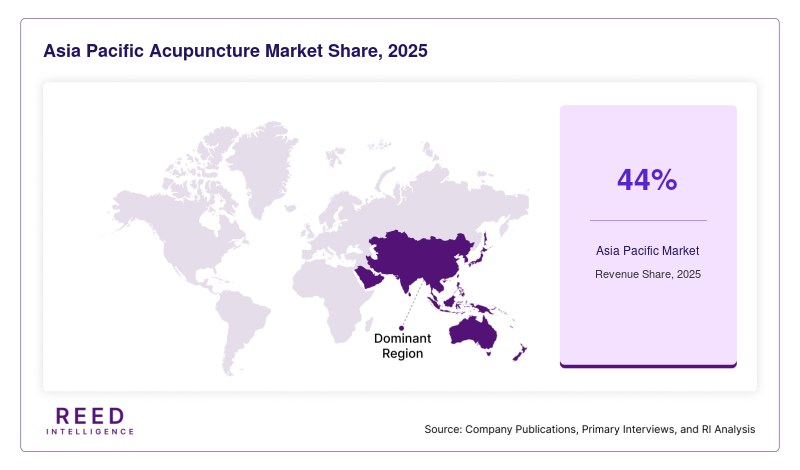
Asia-Pacific accounted for approximately 44% of the global acupuncture market in 2025, making it the largest regional market. Acupuncture has deep historical roots in East Asia, and established practitioner networks and complementary-medicine infrastructure provide a large service base.
The region's future development is increasingly influenced by formalization of training, regulation, clinical research and integration into health systems. WHO's traditional-medicine strategy specifically emphasizes evidence, safety, regulation and integration across health systems.
Asia-Pacific is also the fastest-growing region, with approximately 9.0% CAGR through 2034. Expansion is supported by established utilization, increasing institutional integration and growing professionalization. Differences in reimbursement and regulatory systems across individual countries can produce uneven adoption.
North America Maintains Strong Demand Through Pain-Management Applications
North America represented approximately 25% of the market in 2025 and is projected to grow at approximately 7.7% CAGR.
The United States is the principal market, supported by increasing reported acupuncture use and its incorporation into selected healthcare pathways. NCCIH reports that U.S. adult acupuncture use more than doubled between 2002 and 2022, reaching 2.2% in 2022.
Medicare's coverage of acupuncture for qualifying chronic low-back pain provides a defined reimbursement pathway, although coverage remains limited to specified indications.
Europe Represents an Established Complementary-Care Market With Greater Emphasis on Evidence
Europe accounted for approximately 18% of the market in 2025 and is projected to grow at approximately 7.5% CAGR.
Demand is supported by complementary healthcare use, pain-management services and interest in non-pharmacological interventions. The commercial mechanism is increasingly linked to clinical evidence and integration with mainstream healthcare rather than traditional use alone.
Regulatory requirements and reimbursement arrangements differ substantially between European countries, creating variation in practitioner access and treatment affordability.
Latin America Develops Through Complementary Healthcare and Private Practice
Latin America represented approximately 8% of the market in 2025 and is projected to grow at approximately 7.0% CAGR.
The market is centered primarily on private practices, complementary-health providers and selected clinical applications. Growth depends on practitioner availability, consumer willingness to pay and the development of professional standards.
Limited reimbursement and uneven integration with public healthcare systems can constrain broader institutional adoption.
Middle East & Africa Remains an Emerging Market With Selective Clinical Adoption
Middle East & Africa accounted for approximately 5% of the market in 2025 and is projected to grow at approximately 6.6% CAGR.
Demand is concentrated in major urban healthcare centers, private clinics and wellness facilities. Adoption can increase where acupuncture is incorporated into pain-management and rehabilitation services.
The primary constraints are practitioner availability, regulatory variation and limited insurance coverage in several markets.
Acupuncture Market Competitive Landscape
Competition spans acupuncture needle manufacturers, equipment suppliers, professional distributors and treatment-service providers. Unlike pharmaceutical markets, competition is not primarily based on proprietary therapeutic compounds. Product quality, sterility, needle consistency, practitioner familiarity, distribution and equipment reliability are more important competitive factors.
SEIRIN differentiates through automated needle manufacturing, sterile single-use products and multiple needle configurations. Its portfolio includes J-Type, J-15, L-Type, G-Type, intradermal and other needle formats.
Lhasa OMS occupies a distribution role, supplying professional acupuncture products and carrying brands including SEIRIN, DBC, Hwato and Tai-Chi. Its extensive catalog creates a route to market for multiple manufacturers and gives it access to recurring practitioner purchases.
Key Market Players
- SEIRIN Corporation
- DongBang Acupuncture
- Lhasa OMS
- 3B Scientific
- AcuMedic
- Schwa-medico
- Wuxi Jiajian Medical Devices
- Suzhou Medical Appliance Factory
- Sedatelec
- Asia-Med
Acupuncture Market Recent Developments
- In May 2025, Member States at the 78th World Health Assembly agreed on the WHO Global Traditional Medicine Strategy 2025–2034. The strategy emphasizes stronger evidence, safety and regulation, integration into health systems and qualified practitioners. For acupuncture, the development is commercially relevant because greater emphasis on evidence and professional standards can support integration into formal healthcare pathways while also raising requirements for clinical validation and practitioner qualification.
- WHO published its Global Report on Traditional, Complementary and Integrative Medicine 2024 in December 2025. The report draws on responses from 106 Member States and examines governance, financing, health workforce, research, service models and access to care. The development provides a broader evidence and policy baseline for countries considering how traditional and complementary practices should be incorporated into healthcare systems.
Acupuncture Market Segments
By Type
- Manual Acupuncture
- Electroacupuncture
- Auricular Acupuncture
- Other Acupuncture Techniques
By Application
- Pain Management
- Musculoskeletal Disorders
- Neurological Disorders
- Women's Health
- Stress & Mental Wellness
- Others
By End User
- Hospitals & Clinics
- Specialty Acupuncture Centers
- Wellness Centers
- Home Care
By Region
- North America
- Europe
- APAC
- Middle East and Africa
- LATAM