Adaptive Ski Equipment Market Size, Share & Trends Analysis Report By Product Type (Adaptive Skis, Adaptive Sit-Skis, Adaptive Snowboards, Skiing Wheelchairs and Accessories), By User Type (Beginners, Intermediate Users and Advanced Users), By End User (Individuals, Adaptive Sports Programs, Ski Schools & Resorts and Non-Profit Organizations) Forecasts, 2026–2034
USD 3950
Adaptive Ski Equipment Market Size
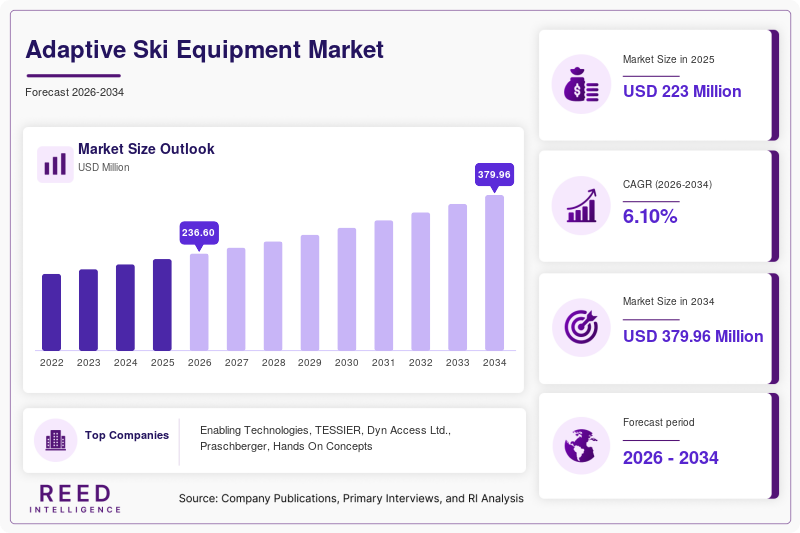
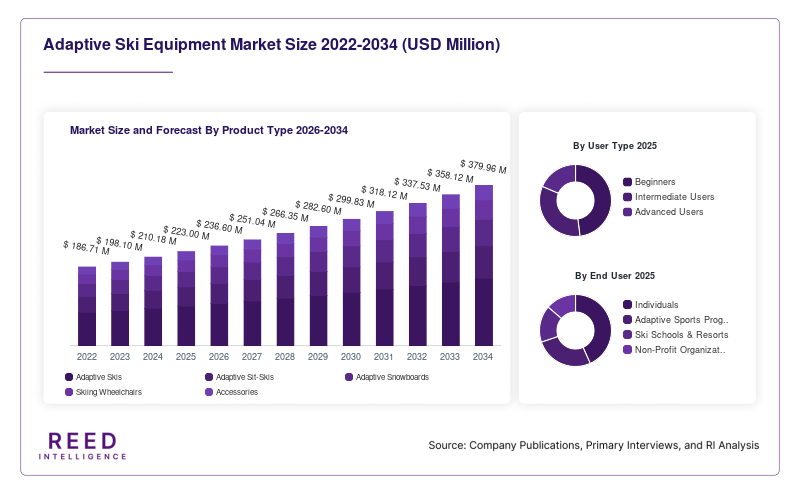
The global adaptive ski equipment market size was valued at USD 223 million in 2025 and is projected to grow from USD 236 million in 2026 to USD 379.96 million by 2034, registering a CAGR of 6.10% during the forecast period from 2026 to 2034.
Adaptive ski equipment enables people with physical impairments and other mobility requirements to participate in alpine and cross-country skiing. Depending on an athlete's classification and ability, equipment can include mono-skis, bi-skis, outriggers, prosthetic or orthotic aids and modified conventional skis. In Para alpine skiing, sit-ski athletes use a specially fitted seat mounted over a ski and commonly use outriggers for balance and steering.
The equipment ecosystem extends beyond competitive athletes. Ski schools, adaptive sports organizations, rehabilitation programs, resorts and nonprofit organizations use equipment for instruction and recreational participation. Vail Resorts reported adaptive programs at 30 resorts through 54 nonprofit partners and stated that it had invested USD 6.4 million in adaptive-access programs, illustrating the role of organized programs in expanding access to adaptive snow sports.
Adaptive Ski Equipment Market Drivers
Expansion of Adaptive Snow-Sport Participation
The expansion of adaptive skiing programs at resorts and specialized sports organizations increases the addressable user base for adaptive equipment. Programs provide instruction and access for people with physical, visual and other disabilities, creating recurring requirements for mono-skis, bi-skis, outriggers, seating systems and related equipment. Vail Resorts' adaptive-access programs operate through partnerships with nonprofit organizations across multiple resorts.
The program model also creates a pathway from introductory equipment to advanced equipment. Beginners may initially use bi-skis or tethered systems before progressing toward independent mono-skiing. Vail's adaptive skiing program identifies mono-skis and bi-skis as its two primary equipment configurations, demonstrating how equipment requirements can change with user experience.
Technological Improvements in Sit-Ski Design
Equipment engineering is shifting toward improved suspension, lower weight, modular seating and greater adjustability. Competitive sit-skis use suspension systems to reduce the effect of uneven terrain and maintain ski-snow contact, while modern products incorporate adjustable seating and frame configurations to accommodate different body sizes and skiing abilities.
The development of lightweight carbon structures is particularly relevant to competitive skiing. Athletes participating in the Milano Cortina 2026 Paralympic Games described the progression toward lightweight carbon sit-skis, while manufacturers are simultaneously improving beginner-oriented stability and chairlift loading.
Greater Institutional Support for Accessible Winter Sports
Adaptive skiing increasingly operates through coordinated relationships among resorts, nonprofit organizations, instructors, equipment manufacturers and athletes. These relationships reduce some of the practical barriers associated with accessing specialized equipment and training. Vail Resorts' adaptive-access model combines resort infrastructure, partner organizations, equipment contributions and discounted access programs.
International sporting organizations are also formalizing equipment requirements. FIS published updated Para Snowsports Adaptive Equipment Regulations in July 2026 and an Adaptive Equipment Registration Manual in September 2026, reinforcing the importance of standardized equipment compliance for competitive use.
Adaptive Ski Equipment Market Restraints
High Cost of Specialized Equipment
Adaptive ski equipment is typically more specialized and individually configured than conventional recreational ski equipment. Current product listings illustrate the price differential: Enabling Technologies lists the Pique-R mono-ski at USD 6,950 and the Pique-C at USD 7,700, before certain additional ski and binding components.
The high upfront cost can limit individual ownership, particularly for beginners or occasional participants. Adaptive programs, rental services, nonprofit organizations and ski schools can therefore remain important purchasing channels because shared equipment spreads acquisition costs across multiple users.
Limited Availability of Specialized Fabrication and Training
Adaptive equipment requires appropriate fitting, instruction and maintenance. A sit-ski's seat configuration, suspension, footrest and outriggers must correspond with the skier's physical characteristics and ability. This creates additional requirements beyond purchasing a conventional pair of skis.
Geographic availability can also constrain adoption. Specialized equipment manufacturers and experienced adaptive instructors are concentrated in established adaptive-sports regions, meaning users in developing ski markets may face longer procurement cycles, fewer fitting services and limited opportunities to test equipment before purchase.
Adaptive Ski Equipment Market Opportunities
Expansion of Adaptive Programs at Ski Resorts
Ski resorts represent an important channel for expanding equipment utilization because organized programs can provide access without requiring every participant to purchase specialized equipment. Resort-based programs also create demand for multiple equipment configurations suitable for beginners, intermediate users and independent skiers.
Vail Resorts reported 30 resorts, 54 nonprofit partners and USD 6.4 million invested in adaptive-access programs in its reported program data. Such institutional infrastructure can support equipment utilization while increasing exposure to adaptive skiing among new participants.
Development of Modular and Adjustable Equipment
Modular designs provide an opportunity to reduce fitting complexity and extend equipment utilization across multiple users. Interchangeable seating systems, adjustable footrests, standardized hardware and adaptable suspension settings allow one platform to accommodate different body sizes and ability levels.
Enabling Technologies' current platforms demonstrate this direction. Its fiberglass seating system can be exchanged between the Dynamique, Monique and Pique platforms, while the Pique provides multiple setup positions covering center-of-mass, seat-angle and footrest adjustments.
Adaptive Ski Equipment Market Segmental Analysis
By Product Type
Adaptive Sit-Skis represented the dominant product category with approximately 42% share in 2026. Their importance is linked to use among skiers with lower-body impairments in both recreational and competitive settings. Para alpine sit-skis use a molded seat, suspension and ski configuration, while outriggers provide additional balance and steering control.
Accessories are projected to record the fastest growth at approximately 7.2% CAGR through 2034 as equipment programs require replacement outriggers, seating components, bindings, footrests and other adaptive accessories. Adaptive skis accounted for approximately 24% share and are projected to expand at 5.9% CAGR, while adaptive snowboards represented 15% with a 6.7% CAGR. Skiing wheelchairs and other equipment accounted for the remaining share and are projected to grow at approximately 5.4% CAGR.
By User Type
Beginners accounted for approximately 45% share in 2026 as adaptive skiing programs introduce participants to the sport through stable, easier-to-control equipment. Beginner-oriented equipment increasingly emphasizes lower ride heights, forgiving suspension and simplified chairlift loading. Enabling Technologies positions its Monique specifically around stability and accessibility for beginner mono-skiers.
Advanced Users are projected to be the fastest-growing user category at approximately 7.0% CAGR, supported by demand for lighter, more precise and highly adjustable equipment. Intermediate users represented approximately 34% share and are growing at 6.2% CAGR, while advanced users accounted for approximately 21% and are increasingly adopting performance-oriented mono-skis such as the Pique platform.
By End User
Adaptive Sports Programs held the largest share at approximately 39% in 2026 because shared equipment models allow programs to serve multiple participants without requiring individual ownership. These programs also create recurring demand for multiple sizes, seating configurations, outriggers, maintenance components and replacement equipment.
Individuals are projected to be the fastest-growing end-user category at approximately 7.0% CAGR as experienced skiers increasingly transition toward independent skiing and performance-oriented equipment. Ski schools and resorts represented approximately 27% share with a 6.4% CAGR, while nonprofit organizations accounted for 18% and expanded at approximately 6.0% CAGR. The remaining end users represented approximately 16% share with a 5.3% CAGR.
Adaptive Ski Equipment Market Regional Analysis
North America Adaptive Ski Equipment Market
North America held the dominant regional share of approximately 41% in 2026, supported by an established network of adaptive ski programs, specialized manufacturers, nonprofit organizations and ski resorts. The region has a mature adaptive-equipment ecosystem, with Move United identifying suppliers such as Enabling Technologies, Dyn Access, Hands On Concepts, Praschberger and TESSIER across mono-skis, bi-skis and outriggers.
The United States represents the principal regional demand center, with Colorado, Utah, California and other established ski destinations supporting adaptive programs. Vail Resorts reported adaptive programming across 30 resorts through 54 nonprofit partners, while specialist manufacturers provide equipment directly to individuals and programs.
Europe Adaptive Ski Equipment Market
Europe is projected to register approximately 5.8% CAGR from 2026 to 2034, supported by established Para sport infrastructure, alpine ski destinations and specialist equipment manufacturers. Austria, France, Germany, Switzerland and Italy have strong connections with competitive and recreational adaptive skiing.
The region benefits from the formalization of adaptive equipment standards through FIS. Updated Para Snowsports equipment specifications and adaptive-equipment regulations were published in July 2026, while the FIS Adaptive Equipment Registration Manual was updated in September 2026.
Asia Pacific Adaptive Ski Equipment Market
Asia Pacific is projected to be the fastest-growing region at approximately 7.1% CAGR through 2034. Growth is supported by increasing awareness of adaptive sports, Paralympic participation, ski-resort development and broader interest in inclusive recreational activities.
Japan, South Korea, Australia and China represent important regional markets. Japan has a long-established Para alpine skiing presence, while Australia maintains structured Para alpine and Para cross-country programs. The Milano Cortina 2026 Paralympic Games also increased international visibility of adaptive equipment, including mono-skis and outriggers.
Latin America Adaptive Ski Equipment Market
Latin America is projected to grow at approximately 5.9% CAGR during 2026–2034. Demand remains concentrated in countries with developed ski infrastructure and established adaptive-sport initiatives, particularly Argentina and Chile, where mountain tourism and winter-sports participation provide a foundation for specialized equipment adoption.
The regional opportunity is closely tied to institutional programs because adaptive equipment can be expensive for individual participants. Ski schools, resorts, nonprofit organizations and rehabilitation-oriented programs can increase utilization through shared equipment, instruction and equipment-access initiatives.
Middle East & Africa Adaptive Ski Equipment Market
Middle East & Africa is projected to register approximately 6.0% CAGR through 2034. Although natural alpine skiing infrastructure is limited across much of the region, indoor ski facilities and inclusive sports initiatives provide potential channels for adaptive skiing equipment.
Adaptive Ski Equipment Market Regional Analysis
North America Adaptive Ski Equipment Market
North America held the dominant regional share of approximately 41% in 2026, supported by an established network of adaptive ski programs, specialized manufacturers, nonprofit organizations and ski resorts. The region has a mature adaptive-equipment ecosystem, with Move United identifying suppliers such as Enabling Technologies, Dyn Access, Hands On Concepts, Praschberger and TESSIER across mono-skis, bi-skis and outriggers.
The United States represents the principal regional demand center, with Colorado, Utah, California and other established ski destinations supporting adaptive programs. Vail Resorts reported adaptive programming across 30 resorts through 54 nonprofit partners, while specialist manufacturers provide equipment directly to individuals and programs.
Europe Adaptive Ski Equipment Market
Europe is projected to register approximately 5.8% CAGR from 2026 to 2034, supported by established Para sport infrastructure, alpine ski destinations and specialist equipment manufacturers. Austria, France, Germany, Switzerland and Italy have strong connections with competitive and recreational adaptive skiing.
The region benefits from the formalization of adaptive equipment standards through FIS. Updated Para Snowsports equipment specifications and adaptive-equipment regulations were published in July 2026, while the FIS Adaptive Equipment Registration Manual was updated in September 2026.
Asia Pacific Adaptive Ski Equipment Market
Asia Pacific is projected to be the fastest-growing region at approximately 7.1% CAGR through 2034. Growth is supported by increasing awareness of adaptive sports, Paralympic participation, ski-resort development and broader interest in inclusive recreational activities.
Japan, South Korea, Australia and China represent important regional markets. Japan has a long-established Para alpine skiing presence, while Australia maintains structured Para alpine and Para cross-country programs. The Milano Cortina 2026 Paralympic Games also increased international visibility of adaptive equipment, including mono-skis and outriggers.
Latin America Adaptive Ski Equipment Market
Latin America is projected to grow at approximately 5.9% CAGR during 2026–2034. Demand remains concentrated in countries with developed ski infrastructure and established adaptive-sport initiatives, particularly Argentina and Chile, where mountain tourism and winter-sports participation provide a foundation for specialized equipment adoption.
The regional opportunity is closely tied to institutional programs because adaptive equipment can be expensive for individual participants. Ski schools, resorts, nonprofit organizations and rehabilitation-oriented programs can increase utilization through shared equipment, instruction and equipment-access initiatives.
Middle East & Africa Adaptive Ski Equipment Market
Middle East & Africa is projected to register approximately 6.0% CAGR through 2034. Although natural alpine skiing infrastructure is limited across much of the region, indoor ski facilities and inclusive sports initiatives provide potential channels for adaptive skiing equipment.
Key Market Players
- Enabling Technologies
- TESSIER
- Dyn Access Ltd.
- Praschberger
- Hands On Concepts
- HowiRoll Sports
- New Halls
- iSkibike
- Innovative Adaptive Technologies
- Adaptive Sports & Adventures Program
- Vail Resorts
- Move United
- Turtle Ridge Foundation
- Seated Sports
Adaptive Ski Equipment Market Recent Market Developments
-
September 2026 – FIS: The International Ski and Snowboard Federation published its FIS Adaptive Equipment Registration Manual on September 15, 2026, strengthening the formal registration framework for adaptive equipment used in Para snow sports.
-
2026 – Enabling Technologies: The company introduced its next-generation 7th-generation Monique Mono Ski, incorporating revised suspension, lower ride height, improved chairlift-loading mechanics, standardized interchangeable seating and additional adjustment features. Production shipments are scheduled to begin in December 2026.
Adaptive Ski Equipment Market Segments
By Product Type
- Adaptive Skis
- Adaptive Sit-Skis
- Adaptive Snowboards
- Skiing Wheelchairs
- Accessories
By User Type
- Beginners
- Intermediate Users
- Advanced Users
By End User
- Individuals
- Adaptive Sports Programs
- Ski Schools & Resorts
- Non-Profit Organizations
By Region
- North America
- Europe
- APAC
- Middle East and Africa
- LATAM