Adrenocorticotropic Hormone Market Size, Share & Demand Report By Type (Natural ACTH, Synthetic ACTH), By Application (Therapeutic, Diagnostic), By End-Use (Hospitals, Specialty Clinics, Research Institutes), By Distribution Channel (Hospital Pharmacies, Retail Pharmacies, Online Pharmacies), By Region & Segment Forecasts, 2025–2034
USD 3950
Market Overview
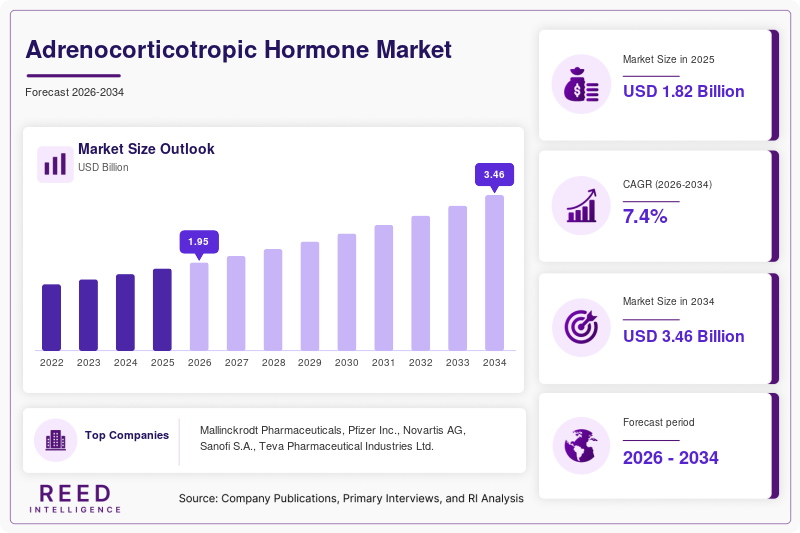
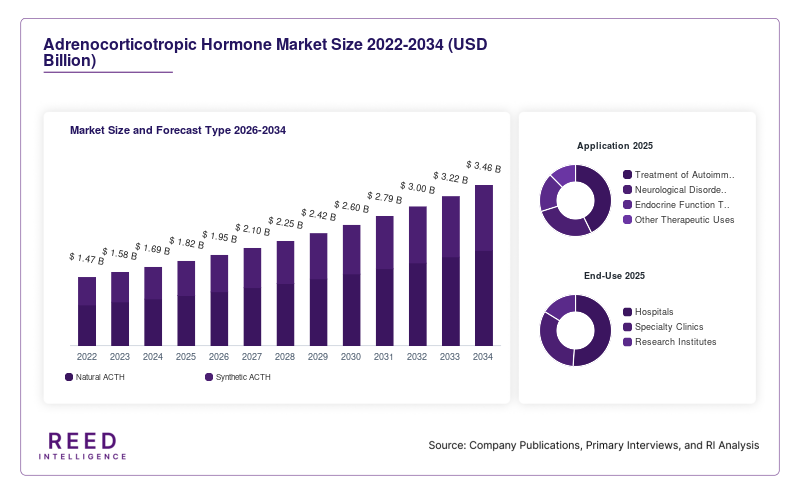
The global Adrenocorticotropic Hormone Market size was valued at approximately USD 1.82 billion in 2025 and is projected to reach USD 3.46 billion by 2034, expanding at a CAGR of 7.4% during the forecast period (2025–2034). The market growth is primarily supported by the increasing prevalence of endocrine disorders and autoimmune diseases, where adrenocorticotropic hormone (ACTH) therapies are widely utilized for diagnosis and treatment. Rising awareness about early disease detection and advancements in peptide-based therapeutics have also contributed to the expansion of the Adrenocorticotropic Hormone Market.
Globally, the growing burden of chronic conditions such as multiple sclerosis, nephrotic syndrome, and adrenal insufficiency has significantly increased demand for ACTH-based medications and diagnostic tests. Additionally, the expansion of healthcare infrastructure and improved reimbursement policies in developed economies have further strengthened market growth. Pharmaceutical companies are increasingly focusing on developing synthetic ACTH analogs with improved efficacy and safety profiles, which is expected to drive long-term adoption.
Key Highlights:
- North America dominated the market with a 42.6% share in 2025, while Asia Pacific is expected to register the fastest CAGR of 9.1% during the forecast period.
- By type, natural ACTH led with a 58.3% share in 2024, whereas synthetic ACTH is projected to grow at the fastest CAGR of 8.6%.
- By application, therapeutic use dominated with a 64.7% share, while diagnostic applications are expected to grow at a CAGR of 8.9%.
- The U.S. market was valued at USD 0.68 billion in 2024 and increased to USD 0.72 billion in 2025.
Market Trends
Rising Adoption of Synthetic ACTH Analogs
The Adrenocorticotropic Hormone Market is witnessing a notable shift toward synthetic ACTH analogs due to their consistent quality, enhanced stability, and reduced immunogenic reactions compared to natural formulations. Pharmaceutical manufacturers are investing in peptide engineering technologies to improve pharmacokinetics and therapeutic outcomes. This transition is particularly evident in developed markets where regulatory standards favor controlled and reproducible formulations. As a result, synthetic ACTH products are gaining acceptance among healthcare providers and are expected to play a central role in future market expansion.
Expansion of ACTH Use in Rare Disease Treatment
Another significant trend shaping the Adrenocorticotropic Hormone Market is the increasing use of ACTH therapies in treating rare and orphan diseases. Conditions such as infantile spasms and refractory autoimmune disorders are driving demand for specialized ACTH-based treatments. Governments and regulatory agencies are supporting orphan drug development through incentives, encouraging pharmaceutical companies to invest in niche therapeutic areas. This trend is expected to create new revenue streams and diversify the application scope of ACTH therapies globally.
Market Drivers
Increasing Prevalence of Endocrine and Autoimmune Disorders
The rising incidence of endocrine disorders such as adrenal insufficiency and autoimmune diseases is a key driver of the Adrenocorticotropic Hormone Market. These conditions require precise hormonal regulation, where ACTH plays a critical role in diagnosis and treatment. Aging populations and lifestyle-related health issues have further increased disease prevalence, leading to higher demand for hormone-based therapies. The growing patient pool continues to support sustained market growth.
Advancements in Peptide Therapeutics and Drug Delivery
Technological advancements in peptide synthesis and drug delivery systems are significantly enhancing the effectiveness of ACTH therapies. Innovations such as sustained-release formulations and targeted delivery mechanisms have improved patient compliance and therapeutic outcomes. These developments are encouraging pharmaceutical companies to expand their ACTH product portfolios, thereby contributing to the overall growth of the Adrenocorticotropic Hormone Market.
Market Restraint
High Cost of ACTH Therapies and Limited Accessibility
One of the major challenges in the Adrenocorticotropic Hormone Market is the high cost associated with ACTH therapies, particularly in developing regions. The complex manufacturing process and regulatory requirements contribute to elevated product prices, limiting accessibility for a large patient population. In addition, limited insurance coverage in certain countries further restricts adoption.
Healthcare providers in low- and middle-income regions often rely on alternative treatments due to cost constraints, which negatively impacts market penetration. Furthermore, pricing pressures from regulatory authorities and reimbursement bodies in developed economies may affect profit margins for manufacturers. These factors collectively pose a significant restraint to the widespread adoption of ACTH therapies across global markets.
Market Opportunities
Growth in Emerging Markets
Emerging economies present significant growth opportunities for the Adrenocorticotropic Hormone Market due to improving healthcare infrastructure and increasing healthcare expenditure. Countries in Asia Pacific and Latin America are witnessing rising awareness about endocrine disorders and better access to diagnostic facilities. Pharmaceutical companies are expanding their presence in these regions through strategic partnerships and distribution networks, which is expected to drive market growth.
Development of Biosimilar and Cost-Effective ACTH Products
The development of biosimilar and cost-effective ACTH products offers a promising opportunity for market expansion. As patents for existing ACTH formulations expire, new entrants can introduce affordable alternatives, increasing competition and accessibility. This trend is likely to benefit patients in cost-sensitive markets and support overall growth in the Adrenocorticotropic Hormone Market.
Segmental Analysis
By Type
Natural ACTH dominated the market with a 58.3% share in 2024 due to its established clinical use and proven efficacy.
Synthetic ACTH is expected to grow at a CAGR of 8.6% due to improved formulation stability and increasing preference for standardized therapies.
By Application
Therapeutic applications held the largest share of 64.7% in 2024, driven by widespread use in treating autoimmune and neurological disorders.
Diagnostic applications are projected to grow at a CAGR of 8.9%, supported by increasing use in endocrine function testing.
By End-Use
Hospitals accounted for the largest share of 52.1% in 2024 due to high patient inflow and availability of advanced treatment facilities.
Specialty clinics are expected to grow at a CAGR of 8.3%, driven by increasing focus on specialized care and outpatient treatment.
By Distribution Channel
Hospital pharmacies dominated with a 49.8% share in 2024 due to direct procurement and administration of ACTH therapies.
Online pharmacies are projected to grow at a CAGR of 9.4%, supported by digitalization and increasing patient preference for convenience.
Regional Analysis
North America
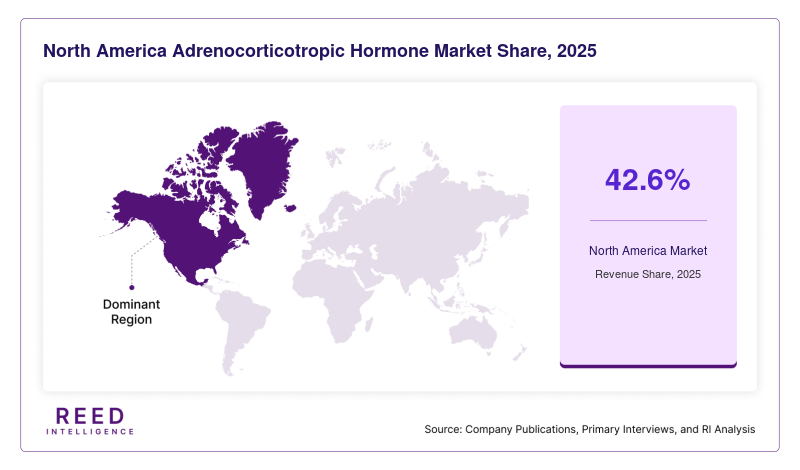
North America accounted for 42.6% of the Adrenocorticotropic Hormone Market share in 2025 and is expected to grow at a CAGR of 6.8% during the forecast period.
The United States dominated the regional market due to advanced healthcare infrastructure and high adoption of hormone therapies. Strong research funding and favorable reimbursement policies have supported widespread use of ACTH-based treatments.
Europe
Europe held a 27.3% share of the Adrenocorticotropic Hormone Market in 2025 and will grow at a CAGR of 6.9% through 2034.
Germany emerged as the leading country, driven by a well-established pharmaceutical industry and increasing focus on rare disease treatment. Government support for orphan drug development has further boosted market growth.
Asia Pacific
Asia Pacific captured 18.5% of the market in 2025 and is projected to grow at the fastest CAGR of 9.1%.
China led the region due to expanding healthcare access and a growing patient population. Increasing investments in biotechnology and rising awareness of endocrine disorders are key growth factors.
Middle East & Africa
The Middle East & Africa held a 6.1% share in 2025 and is anticipated to grow at a CAGR of 7.2%.
Saudi Arabia dominated the region, supported by healthcare modernization initiatives and increasing government spending on advanced treatments.
Latin America
Latin America accounted for 5.5% of the Adrenocorticotropic Hormone Market in 2025 and is expected to grow at a CAGR of 7.5%.
Brazil led the regional market due to improving healthcare infrastructure and rising awareness of hormonal disorders.
Competitive Landscape
The Adrenocorticotropic Hormone Market is moderately consolidated, with key players focusing on product innovation and strategic collaborations. Leading companies are investing in research and development to enhance the efficacy and safety of ACTH formulations.
Mallinckrodt Pharmaceuticals is a prominent market leader, driven by its strong portfolio of ACTH-based therapies. The company recently expanded its manufacturing capabilities to meet growing demand. Other players are focusing on geographic expansion and partnerships to strengthen their market presence.
Key Players List
- Mallinckrodt Pharmaceuticals
- Pfizer Inc.
- Novartis AG
- Sanofi S.A.
- Teva Pharmaceutical Industries Ltd.
- Hikma Pharmaceuticals PLC
- Cipla Limited
- Sun Pharmaceutical Industries Ltd.
- Amgen Inc.
- Bristol-Myers Squibb Company
- Ferring Pharmaceuticals
- Dr. Reddy’s Laboratories Ltd.
- Lupin Limited
- Zydus Lifesciences Ltd.
- Glenmark Pharmaceuticals Ltd.
Recent Developments
- Mallinckrodt Pharmaceuticals expanded production capacity for ACTH therapies in 2025.
- Pfizer Inc. initiated research on next-generation synthetic ACTH analogs.
- Novartis AG invested in peptide-based drug development technologies.
- Cipla Limited entered emerging markets with cost-effective hormone therapies.
- Teva Pharmaceutical Industries Ltd. strengthened its biosimilar pipeline for ACTH products.
Adrenocorticotropic Hormone Market Segments
Type
- Natural ACTH
- Synthetic ACTH
Application
- Treatment of Autoimmune Disorders
- Neurological Disorders (Infantile Spasms, Multiple Sclerosis)
- Endocrine Function Testing
- Other Therapeutic Uses
End-Use
- Hospitals
- Specialty Clinics
- Research Institutes
Distribution Channel
- Hospital Pharmacies
- Retail Pharmacies
- Online Pharmacies
By Region
- North America
- Europe
- APAC
- Middle East and Africa
- LATAM