Adult Disposable Diaper Market Size, Share & Trends Analysis Report By Product Type (Adult Briefs, Adult Pull-Up Diapers, Adult Underwear and Adult Pads), By Absorbency (Light, Moderate and Heavy), By End User (Individuals, Hospitals & Clinics, Nursing Homes & Long-Term Care Facilities and Home Healthcare) and By Region (North America, Europe, Asia Pacific, Latin America, Middle East & Africa) Forecasts, 2026–2034
USD 3950
Adult Disposable Diaper Market Size
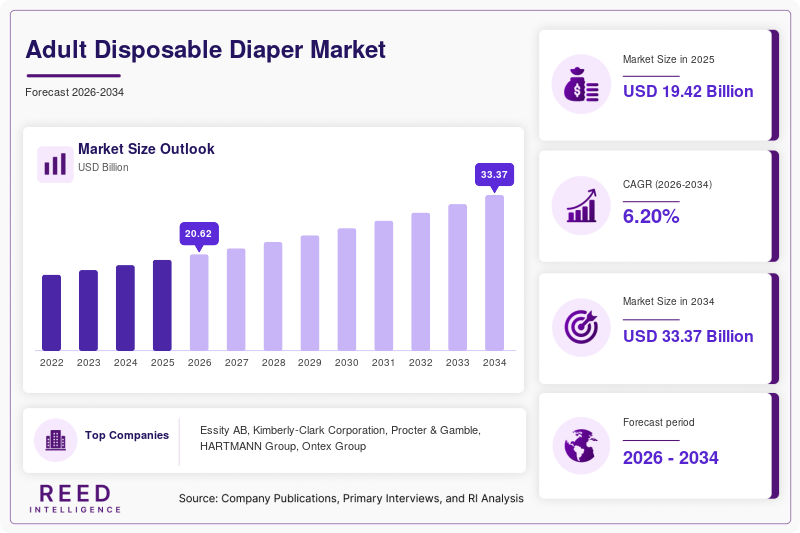
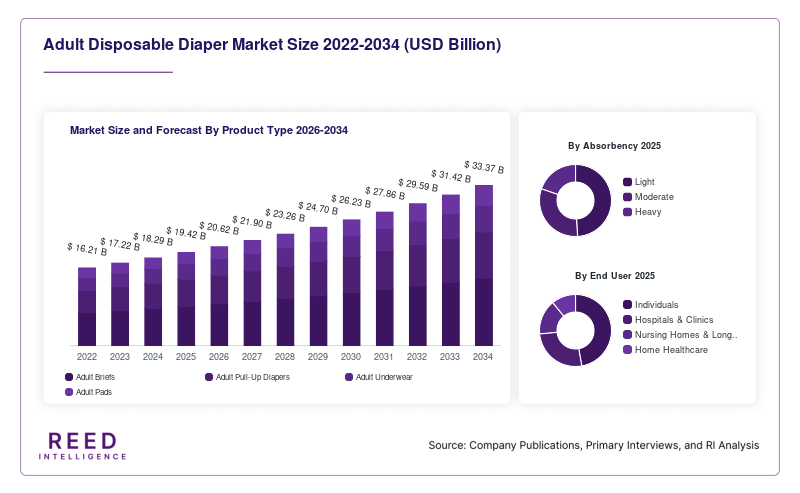
The global adult disposable diaper market size was valued at USD 19.42 billion in 2025 and is projected to grow from USD 20.62 billion in 2026 to USD 33.37 billion by 2034, registering a CAGR of 6.20% during the forecast period from 2026 to 2034.
Adult disposable diapers are absorbent hygiene products designed for people experiencing moderate to heavy urinary or fecal incontinence. The category includes taped briefs, pull-up styles, protective underwear and other disposable absorbent formats. Product selection depends on leakage severity, mobility, body shape, changing frequency, caregiver requirements and the user's preference for discretion.
The adult disposable diaper market Growth is being shaped by demographic changes as well as improvements in continence-care products. WHO estimates that the global population aged 60 years and older will reach 1.4 billion by 2030 and 2.1 billion by 2050. Older populations are more likely to experience geriatric syndromes including urinary incontinence, creating a structural requirement for continence-management products.
Adult Disposable Diaper Market Drivers
Global Population Ageing
Population ageing is expanding the underlying population requiring continence-management products. WHO states that by 2030 one in six people globally will be aged 60 years or older, increasing the number of people exposed to age-associated conditions including urinary incontinence. The ageing trend is occurring across both developed and developing economies, broadening the geographic demand base.
The effect on disposable diaper consumption is reinforced by longer life expectancy and greater demand for independent living. Older adults living at home may require recurring supplies, while nursing facilities and assisted-living environments purchase products in larger volumes. This creates both retail and institutional demand channels.
Rising Demand for Skin-Friendly and High-Absorbency Products
Product performance is increasingly measured by more than absorbency. Consumers and caregivers seek products that maintain dryness, reduce leakage, provide secure fit and limit prolonged skin exposure to moisture. TENA ProSkin combines absorbent products with cleansing and barrier-care products designed specifically around the needs of aging skin.
Manufacturers are therefore incorporating breathable materials, improved absorbent cores, adjustable fastening systems and body-contoured designs. TENA ProSkin Super Briefs, for example, combine 100% breathable construction, adjustable tabs and super absorbency for day-and-night protection.
Increasing Home-Based and Caregiver-Led Continence Care
Healthcare delivery is increasingly distributed between hospitals, residential care and home-based environments. This changes the purchasing requirements for adult disposable diapers because caregivers need products that are easy to select, apply, monitor and replace.
Digital continence-care technologies are reinforcing this shift. TENA SmartCare Change Indicator can notify caregivers regarding product wetness and when a change may need to be considered, while SmartCare Identifi supports continence assessment. These technologies connect disposable absorbent products with broader care-management workflows.
Adult Disposable Diaper Market Restraints
Product Cost and Recurring Consumption
Adult disposable diapers represent a recurring expense because users with moderate or severe incontinence may require multiple products each day. For individuals paying out of pocket, continued consumption can make affordability an important purchasing constraint, particularly in markets where reimbursement or insurance coverage is limited.
Institutional buyers face a similar cost challenge at a larger scale. Nursing facilities and hospitals must balance absorbency, fit and skin-health performance against per-unit purchasing costs. Lower-priced products can therefore retain demand even when premium products provide additional comfort or leakage protection.
Environmental and Waste-Management Concerns
Disposable adult diapers contain multiple material layers, including absorbent polymers, cellulose fibers, nonwoven materials and plastic components. High-frequency use creates a substantial recurring waste stream, making disposal and environmental performance increasingly relevant to manufacturers, institutional purchasers and sustainability-conscious consumers.
The industry is responding through material reduction, packaging changes and sustainability initiatives, but maintaining high absorbency while reducing material consumption remains a technical challenge. Product redesign must therefore balance leakage protection, comfort, skin health, manufacturing efficiency and environmental impact.
Adult Disposable Diaper Market Opportunities
Development of Smart Continence-Care Products
Digital monitoring creates an opportunity to move adult disposable diapers from standalone hygiene products toward connected continence-care systems. Smart sensors and change indicators can provide caregivers with information about wetness, changing requirements and continence patterns, potentially reducing unnecessary changes while improving care coordination.
TENA's SmartCare Change Indicator and Identifi demonstrate how digital technologies can be integrated with absorbent products and professional continence assessment. This creates an opportunity for manufacturers to combine disposable products with subscription services, monitoring platforms and professional-care solutions.
Premium Products for Active and Independent Users
A growing segment of users wants continence products that resemble conventional underwear and can be worn discreetly during daily activities. Pull-up underwear and thinner absorbent products can address consumers who prioritize mobility, discretion and independence rather than traditional diaper-style designs.
TENA offers multiple underwear shapes and sizes alongside briefs and pads, indicating the industry's movement toward differentiated products based on lifestyle and user requirements. Manufacturers can further differentiate through thinner cores, odor control, body-close fit, breathable materials and gender-specific designs.
Adult Disposable Diaper Market Segmental Analysis
By Product Type
Adult Briefs held the dominant share of approximately 39% in 2026, supported by their use among people with moderate-to-heavy incontinence and by institutional caregivers requiring high-absorbency products. Adjustable fastening systems allow caregivers to modify fit according to body shape and mobility. TENA's ProSkin Super Briefs, for example, use adjustable tabs and a high-absorbency construction for day-and-night protection.
Adult Pull-Up Diapers are projected to be the fastest-growing product type at approximately 7.3% CAGR through 2034. Their underwear-like format supports greater discretion and independence for mobile users. Adult underwear represented approximately 25% share and is projected to grow at 6.8% CAGR, while adult pads accounted for 19% and expanded at 5.5% CAGR. Other product formats represented the remaining 17%, with approximately 4.9% CAGR.
By Absorbency
Heavy Absorbency accounted for approximately 44% of the market in 2026 because users with moderate-to-severe incontinence and institutional care requirements need extended protection and reduced leakage risk. High-absorbency briefs are particularly relevant for overnight use, immobile users and situations where frequent product changes are difficult.
Moderate Absorbency is projected to be the fastest-growing absorbency category at approximately 6.8% CAGR, supported by users who require regular protection but retain greater mobility and independence. Light absorbency represented approximately 18% share and is growing at 5.4% CAGR, while moderate absorbency accounted for approximately 38% and continues to expand through retail and home-care channels.
By End User
Individuals represented the largest end-user category at approximately 41% share in 2026. Retail and direct-to-consumer purchasing gives mobile users greater control over product selection, while discreet underwear and pull-up formats reduce the visibility of continence management during everyday activities.
Home Healthcare is projected to be the fastest-growing end-user category at approximately 7.1% CAGR. The expansion of home-based care increases demand for products that caregivers can apply and replace efficiently. Hospitals and clinics accounted for approximately 23% share and are growing at 5.5% CAGR, while nursing homes and long-term care facilities represented 25% and expanded at 6.3% CAGR. Other institutional users accounted for approximately 11%, with a 5.1% CAGR.
Adult Disposable Diaper Market Regional Analysis
North America Adult Disposable Diaper Market
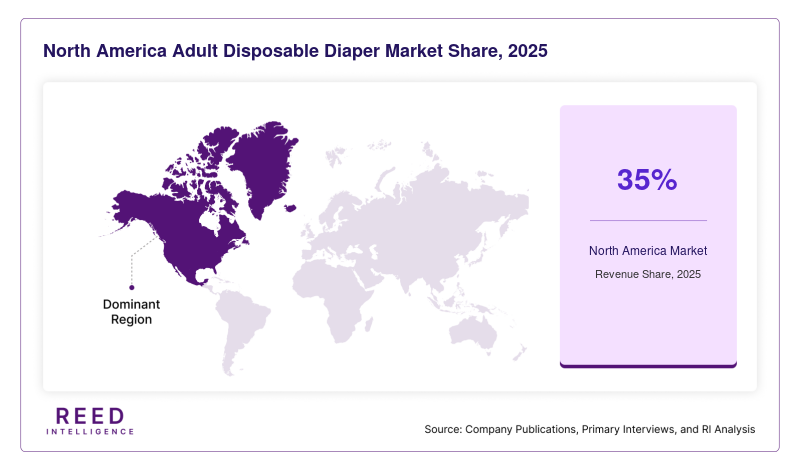
North America held the dominant regional share of approximately 35% in 2026, supported by an established continence-care industry, high awareness of incontinence products, developed healthcare infrastructure and strong availability of premium absorbent products. TENA operates across consumer and professional channels in the United States, offering briefs, underwear, pads, skin-care products and digital care solutions.
The United States represents the principal regional demand center, with nursing facilities, home healthcare, hospitals and retail consumers forming multiple purchasing channels. Product differentiation around skin health, breathability, fit and discreet designs is particularly relevant in a mature market where consumers can choose among multiple absorbency and format categories.
Europe Adult Disposable Diaper Market
Europe is projected to register approximately 5.8% CAGR from 2026 to 2034. The region benefits from an ageing population, established continence-care systems and strong presence of manufacturers such as Essity. Essity reported high organic growth in its Incontinence Products business during the first quarter of 2026, primarily driven by increased volumes.
Germany, the United Kingdom, France, Italy and the Nordic countries represent important demand centers. Product development increasingly emphasizes dignity, skin health and discreet continence management. TENA Men was recognized as a Top Brand 2026 in Germany, reflecting continued commercial focus on male urinary-incontinence products and greater visibility of the category.
Asia Pacific Adult Disposable Diaper Market
Asia Pacific is projected to be the fastest-growing region at approximately 7.5% CAGR through 2034. Population ageing in Japan, China, South Korea and other Asian economies is increasing the number of potential continence-care users, while rising healthcare expenditure and expanding home-care infrastructure are improving product accessibility.
Japan represents a particularly mature ageing market, while China and India provide a larger population base with expanding healthcare and retail distribution. Greater awareness of adult incontinence and the development of modern retail and e-commerce channels are reducing some of the historical barriers associated with purchasing these products.
Latin America Adult Disposable Diaper Market
Latin America is projected to grow at approximately 6.1% CAGR during 2026–2034. Brazil and Mexico represent key markets because of their population size, developing healthcare infrastructure and expanding retail availability of personal-care products.
Demand remains influenced by affordability and product accessibility. Premium products can encounter price sensitivity, while manufacturers that offer different absorbency levels, pack sizes and formats can address differences in household purchasing capacity. Essity's 2026 expansion of personal-care innovation across Latin America also demonstrates continued investment in differentiated hygiene products within the region.
Middle East & Africa Adult Disposable Diaper Market
Middle East & Africa is projected to register approximately 6.4% CAGR through 2034. Demand is supported by expanding healthcare infrastructure, increasing awareness of continence care and population growth in countries with developing modern retail and healthcare channels.
The United Arab Emirates, Saudi Arabia and South Africa represent important demand centers, while healthcare providers and home-care services remain important distribution channels. Improvements in healthcare access and caregiver education can increase product adoption where adult incontinence has historically been underdiagnosed or managed through informal methods.
Adult Disposable Diaper Market Competitive Landscape
The adult disposable diaper market is characterized by large hygiene and healthcare companies competing through absorbent-core technology, fit, skin health, product discretion, brand recognition and distribution. Essity, through its TENA brand, maintains a broad continence-care portfolio covering briefs, underwear, pads, skincare and digital health solutions. TENA states that its products are distributed in more than 90 countries and that the brand serves consumers, caregivers and healthcare professionals.
Kimberly-Clark, through brands such as Depend, competes across adult protective underwear and other incontinence formats, with product differentiation centered on discreet fit, absorbency and consumer comfort. Procter & Gamble, through its Always Discreet portfolio, similarly targets consumers seeking thinner, underwear-like protection and products differentiated by leakage management and discretion.
Key Market Players
- Essity AB
- Kimberly-Clark Corporation
- Procter & Gamble
- HARTMANN Group
- Ontex Group
- First Quality Enterprises, Inc.
- Attends Healthcare Products
- Medline Industries, LP
- Cardinal Health
- Abena A/S
- Lille Healthcare
- Daio Paper Corporation
- Kao Corporation
- Nobel Hygiene
- Domtar Corporation
Adult Disposable Diaper Market Recent Developments
-
July 2026 -Essity: Essity reported strong growth in its Incontinence Products business during its first-quarter 2026 results, primarily driven by higher volumes. The company also reported increased market shares across more than 60% of its branded sales.
-
July 2026 -TENA: TENA continues expanding its connected continence-care proposition through SmartCare Change Indicator and SmartCare Identifi, combining absorbent products with digital information for caregivers and continence assessment.
Adult Disposable Diaper Market Segments
By Product Type
- Adult Briefs
- Adult Pull-Up Diapers
- Adult Underwear
- Adult Pads
By Absorbency
- Light
- Moderate
- Heavy
By End User
- Individuals
- Hospitals & Clinics
- Nursing Homes & Long-Term Care Facilities
- Home Healthcare
By Region
- North America
- Europe
- APAC
- Middle East and Africa
- LATAM