Adult Incontinence Products Market Size, Share & Trends Analysis Report By Product Type (Adult Diapers & Briefs, Pull-Up Pants, Pads & Liners, Underpads), By Incontinence Type (Urinary Incontinence, Fecal Incontinence), By End User (Home Care, Hospitals & Clinics, Long-Term Care & Nursing Facilities), By Distribution Channel (Retail & Supermarkets, Pharmacies & Drugstores, Institutional/B2B, Online Channels) and By Region (North America, Europe, APAC, Middle East and Africa, LATAM) Forecasts, 20
USD 3950
Adult Incontinence Products Market Size
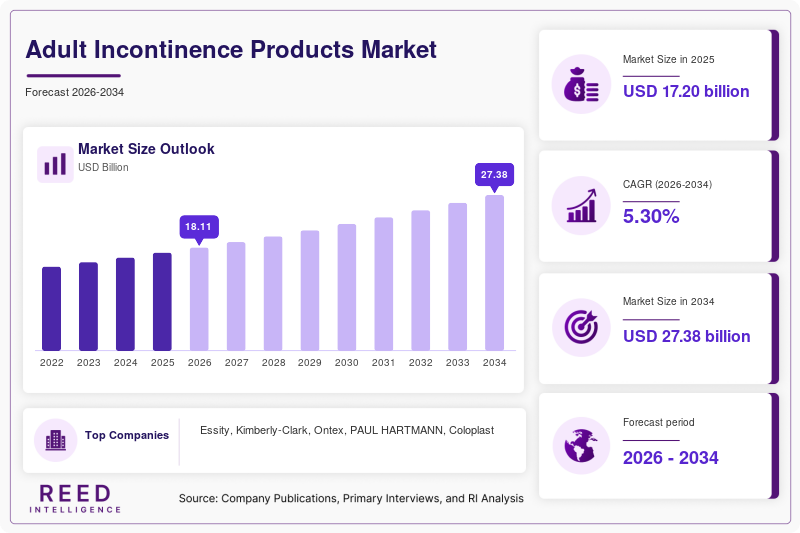
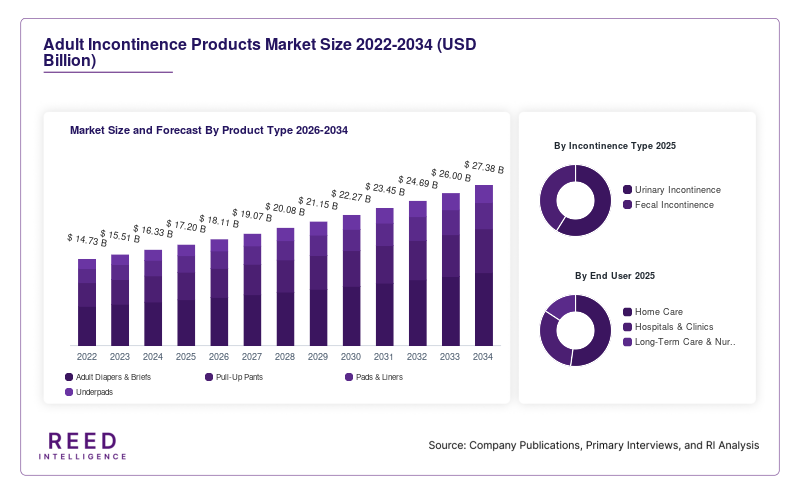
The global Adult Incontinence Products Market size was valued at USD 17.20 billion in 2025 and is projected to grow from USD 18.11 billion in 2026 to USD 27.38 billion by 2034, registering a CAGR of 5.30% during the forecast period from 2026 to 2034.
The market's expansion is tied to recurring daily-use demand rather than one-time medical purchases. Ageing populations, increasing awareness of bladder-control conditions, greater willingness to seek continence products, and the shift toward products that resemble normal underwear are changing the category. WHO identifies urinary incontinence as one of the geriatric syndromes associated with older age, while U.S. government health guidance notes that urinary incontinence becomes more common with age.
Adult incontinence products cover disposable and reusable absorbent solutions designed to manage urinary or fecal leakage among adults in home, community and institutional settings. The category includes briefs, pull-up pants, pads, liners, underpads and related continence-management products. FDA records classify protective garments for incontinence, including adult diapers and pull-ups, under product code EYQ as Class I medical devices in the U.S.
Demand is increasingly influenced by the ageing population. WHO projects that the global population aged 60 years and older will rise from 1 billion in 2019 to 1.4 billion by 2030 and 2.1 billion by 2050. WHO also identifies urinary incontinence among common geriatric syndromes.
Product development is moving toward better anatomical fit, skin protection, odour control, thinner absorbent cores and underwear-like designs. In February 2026, Ontex introduced its Sensitive adult-care range with a focus on skin health, while Essity upgraded parts of its North American TENA portfolio during the first quarter.
Adult Incontinence Products Market Drivers
Population Ageing Is Expanding the Addressable User Base
Population ageing creates a structural increase in the number of adults who may require continence-management products. WHO estimates that people aged 60 and above will reach 1.4 billion by 2030 and 2.1 billion by 2050, compared with 1 billion in 2019. Urinary incontinence is recognized by WHO as one of the health conditions and geriatric syndromes associated with ageing.
The commercial mechanism is straightforward: a larger older population increases the number of people managing bladder-control problems, while longer life expectancy extends the potential duration of product use. U.S. National Institute on Aging guidance similarly identifies urinary incontinence as more common among older adults, particularly older women.
The effect is particularly relevant to long-term-care operators, pharmacies, home-health providers and consumer hygiene companies. Manufacturers that can offer different absorbency levels, sizes and formats can address users across mild, moderate and heavy leakage requirements. The counterbalance is that incontinence should not be treated as an inevitable part of ageing, and treatment options other than absorbent products remain available.
Product Design Is Moving Toward Discretion, Comfort and Skin Health
Consumers increasingly expect adult incontinence products to provide protection without resembling conventional medical supplies. Pull-up pants, absorbent underwear, anatomically shaped briefs and thinner absorbent cores allow manufacturers to compete on comfort, discretion and mobility rather than absorbency alone.
HARTMANN's MoliCare portfolio illustrates this shift through underwear-style products designed for moderate leakage, with breathable materials, improved anatomical fit and anti-leakage barriers. The company has also developed MoliCare absorbent underwear with replaceable X-Change Pads for light leakage.
Skin health is another commercial mechanism. Ontex launched its Sensitive range in February 2026 after research involving more than 2,500 people living with incontinence; the company reported that almost half of respondents had experienced intimate-area dermatitis or skin irritation.
This pushes manufacturers toward softer materials, faster liquid acquisition, breathable back sheets, skin-friendly formulations and better moisture management. These upgrades can support premium pricing but also increase material and manufacturing requirements.
Healthcare and Home-Care Purchasing Is Becoming More Data-Driven
Adult incontinence is increasingly managed as a continuous care process rather than simply a consumable purchase. Healthcare professionals influence product selection for patients leaving hospitals, rehabilitation centers and nursing facilities, while consumers and caregivers increasingly select products directly in community settings.
Coloplast states that its chronic-care products are generally used daily and often for long periods, with the clinical setting serving as an important introduction point before users transition into community care.
Technology is beginning to extend this model. In March 2026, Ontex and Henkel announced a European rollout of Orizon, a smart incontinence solution designed to provide real-time information to care facilities and reduce routine workload for professional caregivers.
The commercial effect is broader than product sales: connected continence management can influence product selection, changing frequency, staffing requirements and purchasing decisions within long-term-care facilities.
Adult Incontinence Products Market Restraints
Raw-Material Costs and Price Competition Pressure Margins
Adult incontinence products depend on absorbent cores, superabsorbent polymers, cellulose, nonwoven materials, elastics, adhesives and packaging. Changes in pulp, polymer, energy, transportation and manufacturing costs can therefore affect producer margins.
Essity reported that higher costs of goods sold in 2025 were driven partly by raw-material costs and trade tariffs, while its Incontinence Products Health Care business experienced higher volumes but lower sales prices.
Ontex similarly described 2025 as a challenging operating environment and entered 2026 with a cost-transformation program and an emphasis on efficiency.
Large retailers and institutional buyers can negotiate aggressively because absorbent products are high-frequency purchases. Manufacturers therefore need to balance affordability with investment in absorbency, fit, skin protection and sustainability.
Product Waste and Sustainability Requirements Create Design Constraints
Most high-absorbency adult incontinence products are designed for single use, creating challenges around material consumption, disposal and end-of-life treatment. Sustainability expectations increasingly affect product design, packaging, manufacturing waste and procurement criteria.
Ontex reports that its Dourges, France facility, which produces adult incontinence products, reduced production waste by 21% in 2023 and implemented initiatives covering scrap reduction, waste sorting and reuse.
The constraint is not limited to environmental reporting. Manufacturers must maintain liquid retention, leakage protection and hygiene while reducing material intensity. Changes to absorbent-core construction therefore require performance testing and manufacturing adjustments before they can become commercially viable.
Adult Incontinence Products Market Opportunities
Premium Pull-Up Pants and Absorbent Underwear
The transition from traditional briefs toward underwear-like products creates an opportunity for manufacturers to capture users who prioritize discretion, mobility and lifestyle compatibility. HARTMANN describes absorbent underwear as a new category targeting light bladder weakness, while its MoliCare Mobile products combine pull-up construction with breathable materials and improved fit.
This category can also broaden the addressable population because products that resemble ordinary underwear can reduce the psychological barrier associated with traditional adult diapers. Essity's TENA portfolio similarly includes discreet products ranging from liners and pads to men's products.
Smart Continence Management in Long-Term Care
Connected products can shift the market from reactive changing schedules toward more targeted care. Ontex and Henkel's Orizon solution provides an example of how printed electronics and absorbent-product manufacturing can be combined with digital information for care facilities.
The commercial opportunity extends to nursing homes, hospitals and other institutional environments where staff time is a significant operating cost. Products that help caregivers identify when intervention is required could influence product selection, staffing efficiency and procurement decisions.
Emerging-Market Distribution and Consumer Education
Continence-product adoption can increase when consumers gain access to discreet retail formats, pharmacies, online purchasing and educational resources. Essity operates TENA across healthcare and consumer channels, while Kimberly-Clark's adult-care portfolio includes Depend, Poise and Plenitud across multiple international markets.
Emerging markets provide room for category development because demographic ageing is spreading beyond North America and Western Europe. WHO notes that by 2050, 80% of older people will live in low- and middle-income countries.
Segmental Analysis
By Product Type
Adult Diapers & Briefs represent approximately 41% of the global market in 2025, supported by their suitability for moderate-to-heavy incontinence and institutional care. These products provide high absorbency, secure fastening, and flexibility in sizing, making them common in hospitals and long-term-care environments. Major manufacturers continue to refine absorbent cores and leakage barriers rather than relying solely on additional material volume.
Pull-Up Pants are the fastest-growing product segment, with a CAGR of approximately 6.8% during 2026–2034. Their underwear-like appearance addresses discretion and independence, particularly among users with light-to-moderate leakage. HARTMANN's absorbent-underwear development and Essity's TENA portfolio demonstrate the industry's movement toward consumer-oriented designs.
Pads & Liners remain important for light bladder leakage because they are relatively discreet and compatible with conventional underwear. Underpads serve both home and institutional settings, particularly where protection of beds, chairs and other surfaces is required.
By Incontinence Type
Urinary Incontinence accounts for approximately 79% of the market in 2025. Bladder leakage affects both men and women and becomes more prevalent with age. U.S. government health information states that more than four in ten women aged 65 and older experience urinary incontinence, while NIDDK notes that bladder-control problems are common among women and that as many as one in three men over 65 may experience accidental urine loss.
Fecal Incontinence represents approximately 21% and is the faster-growing incontinence category at around 6.1% CAGR. Demand is supported by ageing populations and requirements in long-term-care settings, although its smaller user population and greater clinical complexity limit its overall market contribution.
By End User
Home Care represents approximately 55% of market demand. Community-based continence management benefits from retail availability, pharmacy access and online purchasing. The movement toward discreet products also supports direct consumer purchasing.
Hospitals & Clinics account for approximately 20%, with products used for patients requiring temporary or ongoing continence management.
Long-Term Care & Nursing Facilities account for approximately 25% and represent an important institutional demand base because residents may require products on a continuous basis. Digital continence-management solutions such as Ontex and Henkel's Orizon are particularly relevant to this segment.
By Distribution Channel
Retail & Supermarkets represent approximately 46% of the market in 2025, benefiting from consumer familiarity and broad product availability.
Pharmacies & Drugstores account for approximately 24%, particularly for products positioned around light-to-moderate bladder weakness and pharmacist-supported selection.
Institutional/B2B channels account for approximately 20%, supported by hospitals, nursing facilities and professional care providers.
Online Channels represent approximately 10% but are the fastest-growing distribution segment, with a CAGR of approximately 10.2%. Online purchasing offers discretion, recurring-order functionality and a broad range of sizes and absorbency levels.
Regional Analysis
North America Adult Incontinence Products Market
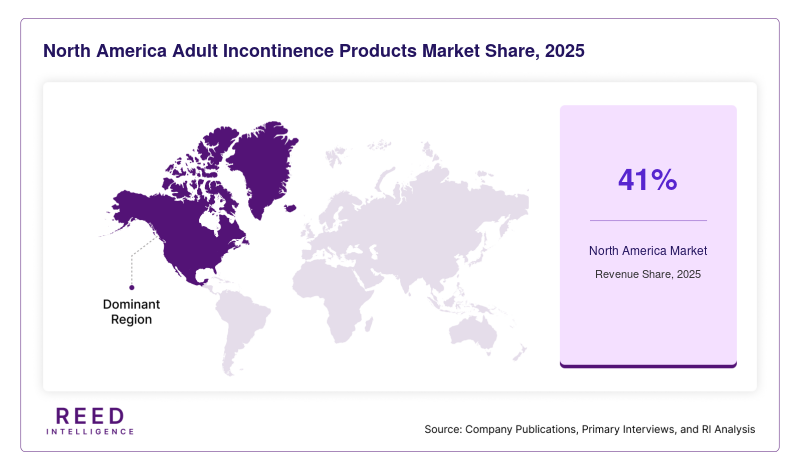
North America represents approximately 31% of the global Adult Incontinence Products Market in 2025, supported by established retail and pharmacy distribution, high product awareness, developed healthcare systems and strong participation from global hygiene companies. Kimberly-Clark markets Depend and Poise across its adult-care portfolio, while Essity operates TENA products across healthcare and consumer channels.
The region's purchasing behavior is split between consumers, caregivers, pharmacies, retailers and institutional healthcare providers. Online ordering adds convenience for recurring purchases, while product differentiation increasingly focuses on fit, absorbency, odour control and discretion.
The regulatory environment also supports a structured product market. FDA records classify protective incontinence garments such as adult diapers and pull-ups under Class I medical-device regulations.
North America is projected to expand at approximately 4.8% CAGR through 2034. Product upgrades remain an important mechanism. Essity upgraded parts of its North American TENA assortment in 2026, including TENA ProSkin Super Briefs and Ultra Briefs. Kimberly-Clark's international personal-care business also reported share gains for adult care in Australia during the second quarter of 2026, demonstrating the importance of portfolio and channel execution beyond the U.S.
Europe Adult Incontinence Products Market
Europe accounts for approximately 29% of the global market in 2025. The region benefits from an ageing population, established continence-care systems and a strong base of specialist manufacturers. Essity identifies Incontinence Products Health Care as a major category within Health & Medical and operates TENA across European markets.
Institutional demand is particularly important because hospitals and long-term-care providers influence product selection. Ontex remains focused on Europe and North America following the divestment of its remaining emerging-market businesses, while continuing to develop adult-care products for healthcare institutions.
Europe is expected to record approximately 5.0% CAGR during 2026–2034. Product development is increasingly centered on skin protection and material efficiency. Ontex launched its Sensitive range in February 2026 for European healthcare institutions, while Essity reported additional TENA product development during 2026.
APAC Adult Incontinence Products Market
APAC represents approximately 25% of the global market in 2025 and is the fastest-growing region, with a CAGR of approximately 7.2%. The region combines rapidly ageing populations with expanding healthcare infrastructure, increasing consumer awareness and a broad manufacturing base for hygiene products.
The demographic mechanism is particularly relevant in East Asia. WHO reports that population ageing is accelerating globally and that a substantial majority of older people will live in low- and middle-income countries by 2050.
Purchasing behavior varies considerably across countries. Japan and South Korea have mature continence-care markets, while China, India and Southeast Asia provide longer-term expansion potential as retail, pharmacy and online channels develop.
Kimberly-Clark's 2026 international personal-care results show adult-care share momentum in Australia, while the company maintains a portfolio including Depend, Poise, Plenitud and other adult-care brands across international markets.
The region also benefits from manufacturing and supply-chain capabilities for absorbent hygiene products, supporting competitive pricing and local production.
Middle East and Africa Adult Incontinence Products Market
Middle East and Africa represents approximately 7% of the global market in 2025 and is projected to expand at approximately 6.4% CAGR. Demand is supported by urbanization, healthcare infrastructure development, expanding pharmacy networks and gradual increases in awareness of continence management.
The region has a more fragmented purchasing structure than North America and Europe, with institutional procurement and pharmacy-based purchasing remaining important. Affordability is a central constraint because premium absorbent products can have a high recurring cost for households.
The commercial pathway therefore favors products that combine adequate absorbency with lower material usage, while local distribution partnerships can reduce logistics costs. International manufacturers with broad portfolios can also adapt product formats to different income groups rather than relying on a single premium product architecture.
LATAM Adult Incontinence Products Market
LATAM accounts for approximately 8% of the global market in 2025 and is expected to grow at approximately 6.0% CAGR. Brazil and Mexico are important demand centers because of their population size, retail infrastructure and growing healthcare markets.
Kimberly-Clark operates adult-care brands including Plenitud and other personal-care products across international markets, while Essity identifies Latin America as an important geographic market for its hygiene portfolio and maintains a leading incontinence position in Brazil through TENA.
Growth is linked to increasing consumer awareness, pharmacy access, ageing demographics and the expansion of modern retail and online purchasing. Price sensitivity remains a counterbalance, increasing the importance of private-label products, smaller pack sizes and differentiated products for light, moderate and heavy leakage.
Competitive Landscape
The Adult Incontinence Products Market has a combination of large global hygiene companies, specialist continence-care manufacturers and regional/private-label producers. Competition is based on absorbency performance, leakage protection, anatomical fit, skin health, product discretion, manufacturing efficiency, distribution coverage and brand recognition.
Essity has a broad continence-care presence through TENA. Its 2025 reporting showed Incontinence Products Health Care representing 12% of group category sales and Incontinence Products Retail representing another 8% on its pro forma category structure. Essity also reported that its healthcare incontinence business experienced higher volumes in 2025, although pricing was lower.
Kimberly-Clark competes through Depend, Poise and Plenitud. Its adult-care portfolio covers absorbent products for different leakage levels and genders, while its international personal-care business reported adult-care share gains in Australia in 2026.
Key Market Players
- Essity
- Kimberly-Clark
- Ontex
- PAUL HARTMANN
- Coloplast
- Attends Healthcare Products
- TZMO
- Abena
- First Quality Enterprises
- Medline Industries
Recent Market Developments
- February 2026 – Ontex launched its Sensitive adult-care range. The Sensitive Pants, Sensitive Slip and Sensitive Form products were developed around protection and skin health and were scheduled for gradual introduction to healthcare institutions across Europe. This strengthens competition around skin-friendly continence products rather than absorbency alone.
- Q1 2026 – Essity upgraded its North American TENA assortment. The company introduced upgraded products including TENA ProSkin Super Briefs and Ultra Briefs, reflecting continued investment in fit, absorbency and skin protection in the healthcare channel.
Adult Incontinence Products Market Segments
By Product Type
- Adult Diapers & Briefs
- Pull-Up Pants
- Pads & Liners
- Underpads
By Incontinence Type
- Urinary Incontinence
- Fecal Incontinence
By End User
- Home Care
- Hospitals & Clinics
- Long-Term Care & Nursing Facilities
By Distribution Channel
- Retail & Supermarkets
- Pharmacies & Drugstores
- Institutional/B2B
- Online Channels
By Region
- North America
- Europe
- APAC
- Middle East and Africa
- LATAM