Advanced Ceramics and Nanoceramic Powders Market Size, Share & Trends Analysis Report By Material Type (Alumina, Zirconia, Silicon Carbide, Silicon Nitride, Aluminum Nitride and Others), By Application (Electronics & Semiconductors, Automotive & Transportation, Medical & Healthcare, Aerospace & Defense, Energy & Power and Industrial), By Form (Powders, Components and Coatings) Forecasts 2026–2034
USD 3950
Advanced Ceramics and Nanoceramic Powders Market Size
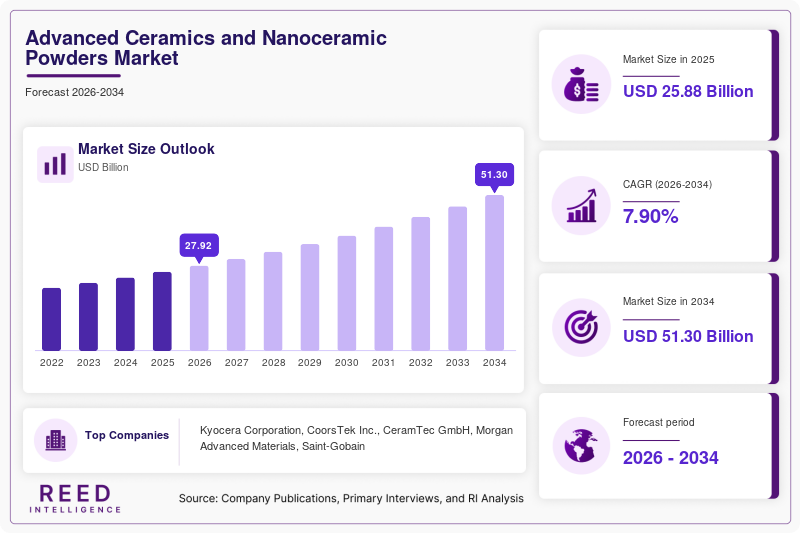
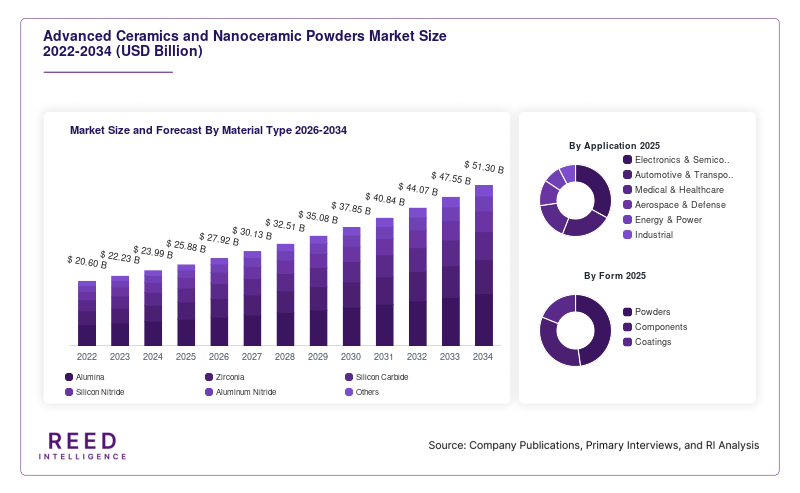
The global advanced ceramics and nanoceramic powders market size was valued at USD 25.88 billion in 2025 and is projected to grow from USD 27.93 billion in 2026 to USD 51.30 billion by 2034, registering a CAGR of 7.90% during the forecast period from 2026 to 2034.
Advanced ceramics are engineered inorganic materials produced from refined ceramic powders and processed through forming, sintering, machining, coating, or other specialized manufacturing techniques. Major material families include alumina, zirconia, silicon carbide, silicon nitride, aluminum nitride, titanates, and other oxide and non-oxide ceramics. Their commercial value comes from combinations of hardness, thermal stability, corrosion resistance, electrical insulation, dielectric performance, and resistance to demanding environments.
Electronics and semiconductor manufacturing represent an important demand center because ceramic materials can provide electrical isolation, thermal management, dimensional stability, and resistance to aggressive processing environments. Advanced ceramics are also increasingly connected with AI infrastructure, electric vehicles, high-power electronics, and communications equipment, where heat dissipation and reliability are critical design requirements.
Advanced Ceramics and Nanoceramic Powders Market Drivers
Semiconductor and AI Infrastructure Demand
The expansion of semiconductor manufacturing is increasing the requirement for fine ceramic components capable of maintaining mechanical and thermal stability under high-temperature, corrosive, and high-precision processing conditions. Ceramic packages, substrates, rings, tubes, insulators, and equipment components are increasingly integrated into semiconductor manufacturing ecosystems. Kyocera's 2026 capital expenditure program specifically identifies fine ceramic components for semiconductor production equipment and AI-related applications as focus areas.
AI infrastructure adds another layer of demand through high-density computing, advanced packaging, optical communication, and power-management systems. Ceramic materials provide thermal, dielectric, and dimensional characteristics that support these architectures. This creates a direct mechanism between data-center investment and higher-value ceramic component requirements rather than simply increasing conventional electronics consumption.
Growth of High-Temperature and High-Power Applications
Advanced ceramics are increasingly selected where conventional materials face thermal, electrical, corrosion, or wear limitations. Silicon carbide can operate under high-temperature and high-radiation conditions, while alumina, aluminum nitride, zirconia, and silicon nitride address different combinations of insulation, thermal conductivity, toughness, and wear resistance.
The same material characteristics support automotive power electronics, aerospace systems, industrial equipment, energy infrastructure, and defense applications. The commercial effect is a gradual movement toward engineered ceramic solutions in components where performance failure has high operational costs.
Expansion of Medical, Automotive and Aerospace Applications
Advanced ceramics are used in medical and dental components because selected materials combine strength, wear resistance, chemical stability, and biocompatibility. Zirconia is particularly relevant to medical and dental applications, while ceramic components also serve automotive sensors, electrical systems, bearings, seals, and wear-resistant components.
Aerospace applications extend from thermal protection and engine-related components to sensors, electronic thermal-management structures, optical components, and ceramic matrix composites. The American Ceramic Society identifies alumina, carbides, borides, nitrides, glass-ceramics, and silicon-carbide ceramic matrix composites across aerospace applications.
Advanced Ceramics and Nanoceramic Powders Market Restraints
High Processing and Manufacturing Costs
Advanced ceramic manufacturing generally requires specialized powder preparation, forming, debinding, sintering, grinding, polishing, inspection, and precision machining. These processes increase capital requirements and manufacturing complexity compared with many conventional material systems. Tight tolerances can require additional finishing operations, increasing production time and reducing cost competitiveness in applications where conventional materials provide sufficient performance.
Nanoceramic powders introduce additional control requirements involving particle size distribution, agglomeration, purity, dispersion, and sintering behavior. Maintaining consistent powder characteristics across batches is important because small variations can affect final density, mechanical performance, electrical properties, and dimensional stability.
Brittleness and Processing Limitations
Ceramics provide high hardness and temperature resistance but can exhibit brittle fracture and sensitivity to defects. Ceramic additive manufacturing research continues to identify brittleness, defect sensitivity, and extensive post-processing as barriers to broader industrial adoption.
Complex geometries therefore require carefully controlled processing and inspection. This limits substitution in applications requiring high impact resistance or substantial deformation before failure. Manufacturers must balance hardness, thermal stability, toughness, manufacturability, and lifecycle economics when selecting ceramic materials.
Advanced Ceramics and Nanoceramic Powders Market Opportunities
Nanoceramics for Semiconductor and Electronic Components
Nanoceramic powders provide opportunities in substrates, dielectric materials, coatings, thermal-management structures, electronic packaging, and high-frequency components. Increasing device density places greater emphasis on thermal dissipation, electrical isolation, dimensional precision, and miniaturization.
The commercial opportunity extends into AI hardware and advanced semiconductor packaging, where ceramic components can support high-temperature and high-frequency operating environments. Kyocera's 2026 development of a multilayer ceramic core substrate for advanced AI semiconductors illustrates the movement toward specialized ceramic architectures rather than commodity ceramic components.
Ceramic Additive Manufacturing and Complex Components
Additive manufacturing is creating a route toward complex ceramic geometries that can be difficult or expensive to manufacture using conventional forming methods. Aerospace and defense applications are particularly relevant because ceramic components may require internal channels, lightweight structures, customized thermal-management features, or geometries optimized for extreme environments.
Further development of ceramic feedstocks, printing accuracy, sintering control, and automated inspection can reduce some manufacturing barriers. This can expand the role of advanced ceramics in low-volume, high-value applications where component performance has a greater economic impact than material cost.
Advanced Ceramics and Nanoceramic Powders Market Segmental Analysis
By Material Type
Alumina accounted for the largest share of the material segment at approximately 36% in 2025, supported by its established use in electrical insulation, semiconductor equipment, structural ceramics, medical components, and wear-resistant applications. Alumina combines relatively low cost with high hardness, chemical stability, electrical insulation, and temperature resistance, making it suitable across a broad industrial base. Silicon Carbide is projected to record the fastest growth at approximately 9.4% CAGR, supported by high-temperature electronics, power semiconductors, aerospace systems, automotive power electronics, and energy applications.
Zirconia represented approximately 21% of demand with a CAGR of 7.5%, reflecting its strength, toughness, and biocompatibility. Silicon Nitride represented approximately 14% and is expected to expand at 7.8% CAGR, particularly in bearings, automotive systems, industrial machinery, and high-temperature applications. Aluminum Nitride accounted for approximately 10% and is projected to grow at 8.5% CAGR, supported by thermal-management requirements. Other materials accounted for approximately 19%, with a CAGR of 6.3%.
By Application
Electronics & Semiconductors represented the largest application segment with approximately 37% share in 2025. The segment benefits from the use of ceramics in semiconductor manufacturing equipment, electronic packages, substrates, insulators, and thermal-management systems. Semiconductor-related demand is increasingly linked to AI infrastructure and advanced computing. Energy & Power is projected to be the fastest-growing application at approximately 9.2% CAGR, supported by power electronics, high-temperature systems, energy infrastructure, and the use of silicon-carbide technologies.
Automotive & Transportation represented approximately 18% and is projected to expand at 8.1% CAGR, driven by sensors, electrical systems, power electronics, wear-resistant components, and EV architectures. Medical & Healthcare accounted for 13%, growing at 7.4% CAGR, while Aerospace & Defense represented 12% with a 8.7% CAGR due to thermal protection, sensors, armor, seals, and high-temperature components. Industrial applications represented approximately 20%, with a CAGR of 6.5%.
By Form
Components represented the largest form category at approximately 48% share, reflecting the established use of processed ceramics in semiconductor equipment, electronics, automotive components, medical devices, and industrial machinery. Powders accounted for approximately 32% and are projected to record the fastest growth at 9.0% CAGR, supported by increasing use of engineered and nanoceramic feedstocks.
Coatings represented approximately 20% of the segment and are projected to expand at 7.3% CAGR. Ceramic coatings provide wear, corrosion, thermal, and electrical protection and are increasingly relevant to aerospace, industrial machinery, energy equipment, and semiconductor manufacturing. The development of specialized powder chemistries is therefore closely connected with higher-value component and coating applications.
Advanced Ceramics and Nanoceramic Powders Market Regional Analysis
North America Advanced Ceramics and Nanoceramic Powders Market
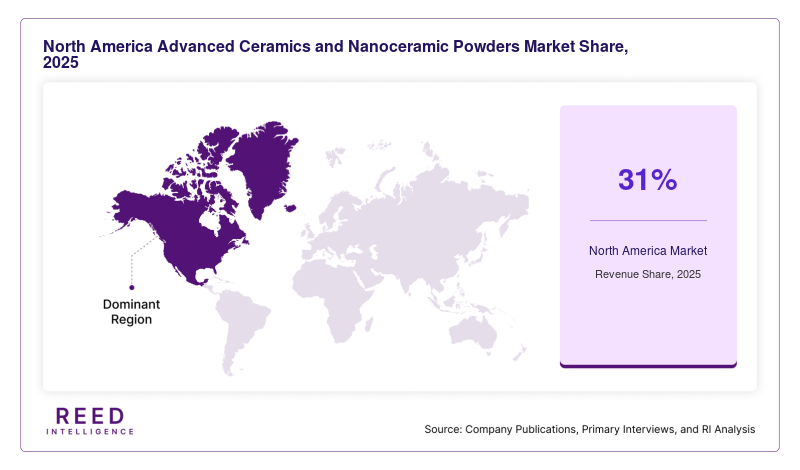
North America remained the dominant regional market with approximately 31% share in 2025, supported by semiconductor manufacturing, aerospace and defense, medical technologies, advanced automotive systems, and industrial automation. The U.S. has substantial demand for high-temperature and high-performance ceramics, including silicon-carbide technologies for aerospace, power, automotive, communications, and energy applications.
The regional market is projected to expand at approximately 7.2% CAGR through 2034. Semiconductor manufacturing investment, AI infrastructure, defense programs, and aerospace component development are creating demand for specialized ceramics where thermal stability, electrical insulation, wear resistance, and dimensional reliability are required.
Europe Advanced Ceramics and Nanoceramic Powders Market
Europe is projected to register approximately 6.9% CAGR through 2034. Demand is supported by automotive electrification, industrial machinery, medical technologies, semiconductor equipment, aerospace, and energy systems. Germany, France, Italy, and the U.K. maintain established ceramic-processing and engineering capabilities, while industrial decarbonization increases interest in high-temperature and energy-efficient materials.
The region also has an established ecosystem of advanced ceramic manufacturers and research institutions. Aerospace applications include thermal protection, sensors, turbine-related components, seals, and electronic structures, creating demand for alumina, zirconia, silicon carbide, aluminum nitride, and ceramic matrix composites.
Asia Pacific Advanced Ceramics and Nanoceramic Powders Market
Asia Pacific is projected to be the fastest-growing region at approximately 9.1% CAGR through 2034. Semiconductor manufacturing, electronics production, EV manufacturing, telecommunications, industrial automation, and energy infrastructure create a large addressable base for advanced ceramics. Japan, China, South Korea, Taiwan, and India are important demand and manufacturing centers.
Japan is particularly important for high-value ceramic components and semiconductor packages. Kyocera completed its Nagasaki Isahaya plant in September 2026, with production focused on fine ceramic components for semiconductor manufacturing equipment and semiconductor packages; full-scale operations are scheduled for spring 2027, with approximately JPY 68 billion of investment planned through March 2029.
Latin America Advanced Ceramics and Nanoceramic Powders Market
Latin America is projected to record approximately 7.0% CAGR during the forecast period. Brazil and Mexico represent major industrial markets, with demand connected to automotive production, electronics, industrial equipment, energy infrastructure, medical products, and mining-related machinery.
The regional opportunity is increasingly tied to industrial modernization and localized manufacturing. Advanced ceramics can replace or complement conventional materials in wear, corrosion, thermal, and electrical applications, although specialized processing capabilities and supply-chain availability remain important constraints for broader adoption.
Middle East & Africa Advanced Ceramics and Nanoceramic Powders Market
Middle East & Africa is projected to grow at approximately 7.5% CAGR through 2034. Demand is linked to industrial diversification, aerospace and defense, energy infrastructure, electronics, medical equipment, and advanced manufacturing programs. Investments in high-temperature and wear-resistant materials are particularly relevant to harsh operating environments.
The region's demand profile also reflects oil and gas, power generation, industrial processing, and emerging manufacturing ecosystems. Ceramic components and coatings can extend equipment operating life under high temperatures, corrosion, abrasion, and chemically aggressive conditions, creating specialized applications even where local ceramic manufacturing capacity remains comparatively limited.
Advanced Ceramics and Nanoceramic Powders Market Competitive Landscape
The advanced ceramics and nanoceramic powders market is characterized by competition across material purity, powder morphology, formulation control, component engineering, processing technology, customization, and application-specific qualification. Companies with integrated powder-to-component capabilities can capture higher-value applications because customers increasingly require material formulation, component design, processing, and quality control within a coordinated supply chain.
Kyocera Corporation maintains a broad advanced-ceramics position spanning semiconductor components, fine ceramic components, automotive applications, ceramic packages, and other high-performance products. Its 2026 investment in the Nagasaki Isahaya facility demonstrates an expansion of production infrastructure directed toward semiconductor-related ceramic components and packages.
Key Market Players
- Kyocera Corporation
- CoorsTek Inc.
- CeramTec GmbH
- Morgan Advanced Materials
- Saint-Gobain
- 3M
- Tosoh Corporation
- NGK Insulators, Ltd.
- Murata Manufacturing Co., Ltd.
- Ferro Corporation
- Momentive Technologies
- Ceradyne
- Rauschert
- Superior Technical Ceramics
- LAM Research-related ceramic component suppliers
Advanced Ceramics and Nanoceramic Powders Market Recent Developments
-
September 2026 – Kyocera completed its Nagasaki Isahaya Plant, a new manufacturing facility focused on fine ceramic components for semiconductor manufacturing equipment and semiconductor packages. Kyocera plans approximately JPY 68 billion of investment through March 2029, with production capacity targeted at approximately JPY 25 billion annually from fiscal 2030.
-
April 2026 – Kyocera developed a multilayer ceramic core substrate for advanced AI semiconductors, expanding its ceramic-package technology toward high-performance AI semiconductor architectures. The development reflects the increasing overlap between advanced ceramics, high-density computing, and semiconductor packaging.
Advanced Ceramics and Nanoceramic Powders Market Segments
By Material Type
- Alumina
- Zirconia
- Silicon Carbide
- Silicon Nitride
- Aluminum Nitride
- Others
By Application
- Electronics & Semiconductors
- Automotive & Transportation
- Medical & Healthcare
- Aerospace & Defense
- Energy & Power
- Industrial
By Form
- Powders
- Components
- Coatings
By Region
- North America
- Europe
- APAC
- Middle East and Africa
- LATAM